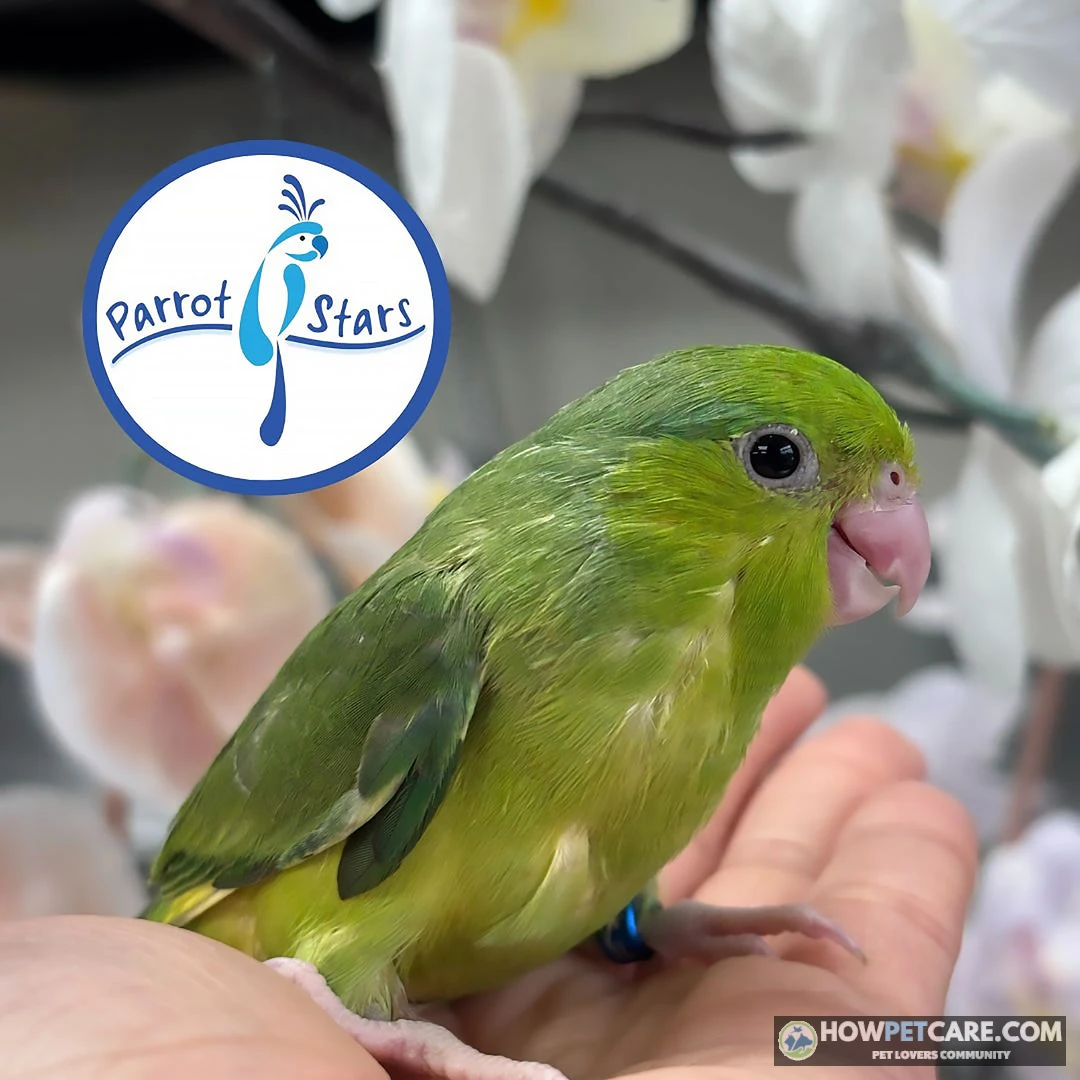

A green parrotlet is usually one of three birds: a wild-type green Pacific parrotlet (Forpus coelestis), the most common pet species; a green-rumped parrotlet (Forpus passerinus), a separate wild species; or a captive-bred green-based color mutation. Ask the seller for the species name, not just the color.
A green parrotlet may be a naturally green Pacific parrotlet kept as a pet, a green-rumped parrotlet from a different species, or a bird with a selectively bred green-based color mutation. The Pacific parrotlet is the most popular pet species, and its normal green coloring is not itself a special mutation.
For a prospective owner, the distinction matters: ask for the bird’s species, not just its color. The care advice below focuses on a captive-bred green Pacific parrotlet; the species comparison also helps birders identify a green-rumped parrotlet.
Which Green Parrotlet Do You Mean? Green-Rumped, Wild-Type Pacific, or Green Mutation
| Type | Species | Where found | Appearance | Pet availability | Best for |
|---|---|---|---|---|---|
| Green-rumped parrotlet | Forpus passerinus | Northern South America and nearby islands | Green, with blue wing feathers in males | Less common as a pet than the Pacific | Birders and people identifying the species |
| Wild-type green Pacific | Forpus coelestis | Native to western South America; also bred in captivity | Green; males typically have blue behind the eyes and on the wings | The more familiar pet parrotlet | Most prospective pet owners |
| Green-based mutation | Depends on the bird; often a Pacific parrotlet in pet listings | Captive-bred birds | Green coloration altered by inherited traits | Depends on the mutation and seller | Buyers interested in a specific inherited color |
The Pacific parrotlet is the most popular pet species; the green-rumped parrotlet is a separate species, not another name for it. Color alone can’t confirm a bird’s species or its genetics.
Green-rumped parrotlet: the wild species
The green-rumped parrotlet is a small South American parrot in the same genus as the Pacific. According to a general pet-parrotlet overview, it tends to be smaller and shyer than the Pacific. If you’re identifying a wild bird, compare its range and wing markings rather than assuming every green parrotlet is a Pacific.
Green Pacific parrotlet: the wild-type pet
A seller describing a green parrotlet bird may mean a Pacific with its natural, or wild-type, coloration. Ask the seller to confirm Forpus coelestis and whether the bird was bred in captivity. A green Pacific needs the same careful housing, diet, social interaction, and veterinary care as other Pacific color varieties.
Green mutation: where the term gets murky
A green-looking bird can also carry color traits that change its shade or pattern. A listing’s description isn’t a genetic certificate. Ask what the mutation name means and what is known about the parents. If the seller can’t explain the label, don’t pay a premium on the assumption that the color is rare.
Green Pacific Parrotlet vs Green-Rumped Parrotlet: Side-by-Side Differences
Both birds belong to the parrot family, Psittacidae, but they are different species. Green-rumped parrotlets occur across parts of northern South America, including Colombia, Venezuela, Brazil, and the Guianas; Pacific parrotlets are native to western Ecuador and Peru. A bird found outside those ranges may be in captivity or part of an introduced population rather than in its native range.
For identification, look at the whole bird. Male Pacific parrotlets typically show blue behind the eye and on the wings; male green-rumped parrotlets also show blue wing feathers, so blue on a wing alone isn’t enough to identify the species. A green-rumped male’s rump remains greenish, unlike the blue rump commonly seen on a wild-type Pacific male.

The green-rumped is less familiar in the pet market, but a seller offering one isn’t automatically dishonest. Ask for the scientific name, captive-bred origin, and documentation. Avoid a wild-caught bird: capture and trade raise welfare and legal concerns, and a wild bird isn’t a shortcut to a manageable pet.
Green Parrotlet Size, Appearance, and Lifespan: The Baseline Facts
Quick facts at a glance
The figures below are approximate planning ranges for a pet Pacific parrotlet, not guarantees for every individual or every Forpus species. Confirm an individual bird’s weight and care needs with an avian veterinarian.
| Attribute | Typical value or planning guide | Notes |
|---|---|---|
| Species | Pacific parrotlet, Forpus coelestis | The green-rumped parrotlet is F. passerinus |
| Length | Roughly 4.5–5.5 inches | Measured from head to tail; individuals vary |
| Weight | Roughly 1–1.2 ounces | A vet can help establish an individual healthy baseline |
| Captive lifespan | Often estimated at 10–20 years | A planning range, not a promise |
| Temperament | Bold and potentially territorial | Small size does not mean a hands-off pet |
| Noise | Chirps and occasional sharp calls | Individual birds and households differ |
| Talking | Some learn words or sounds | Many do not talk |
| Cage planning target | At least 24 × 18 × 18 inches for one bird | Larger is better; check bar spacing and allow supervised exercise |
Pet parrotlets are under six inches long and have a reputation for a large-parrot personality. A wild-type Pacific has a compact green body, a short tail, a curved beak, and grasping feet. Blue markings depend on sex and can be altered by mutations.

What affects parrotlet lifespan
Plan for a long commitment rather than counting on a particular birthday. Diet, safe housing, genetics, veterinary access, and accidents can all affect an individual bird’s life. Wild birds face different pressures from captive birds, so a pet lifespan estimate isn’t a reliable estimate for a wild bird.
Male vs Female Green Parrotlets: How to Sex Them by Sight
In a wild-type green Pacific parrotlet, males typically have blue markings behind the eyes and on the wings; females generally lack those markings or have paler blue. Males also commonly show a blue rump. These are identification clues, not proof of an individual bird’s sex.
Visual markings checklist
When you can see a wild-type Pacific clearly, compare these areas:
- Behind the eye: Look for a blue streak or wash, typically more pronounced in males.
- Wings: Look for blue in the wing feathers and coverts; the amount visible can depend on how the bird holds its wings.
- Rump: A blue patch supports a male identification; a mostly green rump is more consistent with a female.
- Overall pattern: Compare several markings together, not one feather or the apparent warmth of the green.

Green-rumped parrotlets differ: males show blue wing feathers, while females may have a yellow patch above the beak. Don’t rule out a male green-rumped bird simply because its rump is green.
When to use DNA sexing
Age, lighting, individual variation, and color mutations can make visual sexing uncertain. Some young birds show useful markings, so it’s inaccurate to assume all juveniles look female. If sex matters to your decision, ask an avian veterinarian or a reputable testing laboratory about DNA testing and proper sample collection. Request the result rather than relying solely on a seller’s visual estimate.
Where “Green” Fits Among Parrotlet Color Mutations
Wild-type green is the natural color baseline, not a mutation name. Captive parrotlets also occur in blue, yellow, white, and darker green varieties. Other descriptions you may encounter include dilute, pied, fallow, lutino, or albino. These labels refer to different inherited changes or combinations, not simply to how bright a bird looks in a photograph.
Advertisements don’t always use names consistently. A yellow bird, for example, shouldn’t automatically be assumed to have a particular genotype. Ask a breeder to provide the species, stated mutation, and known parentage in writing. Mutations may affect the sex-linked visual cues described above, but color alone doesn’t establish a different temperament or remove the need for ordinary care.

Green Parrotlet Temperament: Biting, Taming, Noise, and Talking
Parrotlets are small birds with notably strong personalities. A well-socialized bird may enjoy training and close interaction, but it can also be cautious, independent, or territorial. Behavior depends on the individual and its experiences, not simply on whether its feathers are green.
Why parrotlets bite and how to stop it
A bird may bite in response to fear, discomfort, unwanted handling, or a hand entering a defended space. Hormonal changes or illness can also affect behavior. Watch for a bird moving away, stiffening, or lunging, and give it room before it feels compelled to bite.
Don’t hit, flick the beak, yell, or force the bird to stay on your hand. Step back, identify what triggered the bite, and make the next interaction easier. If a normally comfortable bird suddenly bites or behaves differently, contact an avian veterinarian to rule out a health problem.
Step-by-step taming routine
-
Let the bird settle
Place the cage in a calm household area and speak softly without reaching in unnecessarily.
-
Offer a reward
Offer a small favorite food through or near the cage opening, allowing the bird to approach voluntarily.
-
Introduce a target
Reward the bird for approaching and then touching a safe target, such as the end of a small training stick.
-
Practice stepping up
Use the target to invite the bird onto a stable perch or hand; reward the choice and let it step away.
Keep sessions short and stop while the bird is still comfortable. A hand-fed parrotlet may be accustomed to people, but hand-feeding alone doesn’t guarantee a tame adult. Parent-raised birds can also learn to trust people through patient, positive handling. Buy only a fully weaned bird that eats independently.
Chirping and sharp calls are part of living with a parrotlet. Provide sleep, enrichment, and attention rather than rewarding repeated screaming with an immediate reaction. A bird that’s quieter than a conure isn’t necessarily a quiet apartment pet.

Can a green parrotlet talk?
Some parrotlets learn a few words, whistles, or household sounds; many never speak. Choose one because you want to care for a bird, not because you expect it to talk.
What Green Parrotlets Eat: Wild Diet vs Pet Diet
Wild parrotlets forage for plant foods, including seeds and other available vegetation. A seed-heavy wild diet doesn’t mean an all-seed bowl is a complete diet for a pet: captive activity, food availability, and nutritional needs differ.
Sample daily feeding breakdown
For a pet Pacific, offer a formulated small-parrot pellet as the mainstay, alongside a variety of bird-safe vegetables and a smaller amount of fruit and seeds. As a practical starting point, ask your avian veterinarian whether a diet around 60–70% formulated pellets, 20–30% vegetables, and a small remainder of fruit and seeds suits your bird. These proportions are a general planning guide, not a prescription or a substitute for a veterinary assessment.
Offer fresh water daily, wash dishes, and remove fresh food before it spoils. Introduce unfamiliar foods gradually. If a bird currently eats mostly seed, don’t abruptly remove its familiar food: a small bird that refuses the replacement can become ill quickly. Ask your vet how to monitor intake and weight during a transition.
A cuttlebone may give your bird an opportunity to chew, but it’s not a substitute for a balanced diet. Don’t routinely add vitamins or other supplements without veterinary advice; excesses can also be harmful.

Foods that are unsafe
Keep avocado, chocolate, caffeine, and alcohol away from birds. Avoid salty foods and offer plain produce rather than seasoned human meals. If you’re unsure whether a food or plant is safe, check with your avian veterinarian before offering it.
Do not wait for a scheduled appointment if your parrotlet is not eating, is unusually quiet or fluffed up, or is having difficulty breathing. Contact an avian veterinarian promptly.
Green Parrotlet Care Setup: Cage Size, Toys, Daily Routine, and Health
Cage and toy checklist
A useful starting cage size for one Pacific parrotlet is at least 24 inches wide by 18 inches deep by 18 inches high; choose a larger enclosure whenever possible. Width matters because it gives the bird more room to move between perches. This is a practical planning target, not a reason to skip time outside the cage.
- Bar spacing: Around 1/2 inch or narrower is a common starting point; check that the bird cannot squeeze its head through or get trapped.
- Perches: Use bird-safe natural perches of varied diameters. Arrange them so food and water are not directly underneath a favorite perch.
- Toys: Provide appropriately sized, bird-safe chewing and foraging toys, and inspect them for loose threads, broken parts, or entrapment hazards.
- Dishes and liner: Make bowls easy to clean and use a plain, replaceable cage liner so droppings are easy to monitor.
- Carrier: Have a secure, appropriately ventilated carrier ready before the first veterinary visit.

Overheated nonstick cookware and other fumes can be dangerous to birds. Keep the bird away from cooking areas, smoke, aerosols, and scented products; use a separate secure room when necessary.
Daily and weekly routine
Each morning, replace water, provide the day’s food, and check the bird’s appetite, posture, and droppings. Offer daily interaction and aim for 1–2 hours or more of supervised out-of-cage activity when possible. Close windows and doors, cover hazards, and keep other pets out of the room. Before bed, allow a consistent, quiet dark period for sleep.
Replace soiled liners and wash dishes daily. Clean perches, cage surfaces, and toys regularly, with a more thorough cleaning at least weekly or sooner when needed. Rotate safe toys as they become worn or uninteresting.
Supervised flight can provide exercise and choice, but the room must be bird-proofed. Wing clipping may reduce lift; it doesn’t make a bird escape-proof or prevent every injury. Discuss the benefits and risks for your individual bird with an avian veterinarian rather than treating clipping as an automatic part of ownership.
Don’t assume a parrotlet needs a cage mate. Territorial birds can injure one another, including larger birds. If adding another bird, plan for separate cages, veterinary guidance, a quarantine period, and slow, supervised introductions; some birds may never safely share a cage.
Health issues and vet planning
Find an avian veterinarian before bringing a bird home and arrange an initial wellness examination. Discuss ongoing examinations, weight monitoring, and emergency availability. Nutritional problems, respiratory illness, injuries, and abnormal droppings are among the concerns a vet may investigate; those signs don’t establish a diagnosis at home.
Birds can conceal illness. A change in appetite, weight, activity, breathing, or droppings deserves a call to your vet. Breathing difficulty or a bird sitting weakly at the cage bottom warrants urgent attention.

Green Parrotlet Price in the US and Real Monthly Costs
The available evidence doesn’t establish verified 2026 US market prices. The figures below are illustrative budgeting assumptions, not surveyed quotes or guarantees of what a breeder, rescue, or veterinarian will charge. Request local prices before committing, especially for veterinary care.
| Cost item | One-time or monthly | Illustrative planning range | Notes |
|---|---|---|---|
| Wild-type green Pacific | One-time | $150–$400 | Seller and region can change the price; rescue fees may differ |
| Cage | One-time | $80–$200 | Larger or more durable cages may cost more |
| Perches, dishes, toys, carrier | One-time | $50–$100 | Starter supplies; replacements continue |
| Initial avian vet visit | One-time | $60–$150 | Testing or treatment may add substantially more |
| Food and produce | Monthly | $15–$30 | Depends on diet and local prices |
| Toy replacement and liner | Monthly | $10–$20 | Wear and buying choices vary |
| Routine vet savings | Monthly | $10–$25 | A reserve, not a quoted examination price |
Purchase price vs lifetime cost
Using those assumptions, the bird and initial setup total approximately $340–$850. Ongoing expenses add approximately $35–$75 a month. A simple first-year example comes to $760–$1,750: the initial total plus twelve months of ongoing costs. The initial exam is separate from the monthly savings reserved for later routine care.
After the first year, the same monthly assumptions equal about $420–$900 a year. Over a hypothetical 15-year ownership, adding fourteen further years to the first-year estimate gives approximately $6,640–$14,350 before inflation, major equipment replacement, boarding, and emergency treatment. Actual costs can fall outside these ranges; a medical emergency in particular can exceed a modest savings fund.
How to vet a parrotlet breeder
If you’re searching for a green parrotlet for sale near you, start with a bird rescue, an established captive-breeding program, or a referral from an avian veterinarian. Screening is important, but it isn’t a guarantee that any particular seller has a healthy bird.
Ask for the scientific name, captive-bred origin, age, current diet, weaning status, and available health records. A responsible seller should welcome questions and explain how the bird has been socialized. Confirm any stated mutation and DNA sexing in writing if those details affect your decision.
Be cautious about pressure to pay immediately, refusal to discuss husbandry, an unweaned bird offered for you to hand-feed, or a seller who can’t explain the bird’s origin. Arrange your own veterinary examination after acquisition, even if the seller reports that the bird appears healthy.

Is a Green Parrotlet Right for You? Comparison and Pre-Purchase Checklist
A green Pacific parrotlet can be a good pet for a prepared beginner who accepts biting risks, daily work, noise, and a long commitment. It isn’t an ideal choice for someone who wants a silent bird, a guaranteed cuddler, or a pet that can remain in a small cage without regular interaction.
Parrotlet vs budgie vs lovebird vs green-cheek conure
These are broad tendencies, not promises about individual birds. Ask an avian veterinarian and experienced keepers about the needs of the particular species before choosing.
| Factor | Green Pacific parrotlet | Budgie | Lovebird | Green-cheek conure |
|---|---|---|---|---|
| Size | Very small, short-tailed | Small, with a longer tail | Small and stocky | Larger, with a longer tail |
| Noise | Chirps and sharp calls | Frequent chatter and chirps | Can make persistent, sharp calls | Often louder, with sharp calls |
| Talking | Some learn a few sounds or words | Some can become capable talkers | Talking is generally limited | Some learn words; not guaranteed |
| Lifespan | Plan for a long commitment; often estimated at 10–20 years | Long-term commitment | Long-term commitment | Long-term commitment |
| Purchase cost | Illustrative green Pacific budget: $150–$400 | Obtain a local quote | Obtain a local quote | Obtain a local quote |

A budgie may appeal to someone interested in a more vocal small bird; a green-cheek conure requires planning for a larger bird and potentially louder calls. Lovebirds and parrotlets can both be assertive. Housing, enrichment, and avian veterinary care remain essential for all four.
Pre-purchase checklist
- ☐ I have confirmed the species and want a captive-bred bird, not just a particular green color.
- ☐ I can provide daily attention, supervised exercise, and care during travel.
- ☐ I am prepared for a commitment that may last well beyond a decade.
- ☐ I have priced a suitable cage and supplies locally and can cover food, replacements, and veterinary care.
- ☐ I have a separate emergency-care plan rather than relying only on routine vet savings.
- ☐ I have identified an avian veterinarian and checked how to obtain urgent care.
- ☐ My household can manage chirping, safe out-of-cage time, fumes, and separation from cats and dogs.
- ☐ I have screened a rescue or breeder, confirmed that the bird is fully weaned, and asked about its records.
- ☐ The cage, perches, food, and carrier will be ready before the bird comes home.
Once those boxes are checked, contact your chosen rescue or breeder, arrange an initial avian veterinary appointment, and prepare the bird-safe room before bringing your parrotlet home.
1Which scientific name correctly identifies the wild-type Pacific parrotlet most commonly kept as a pet?
This scientific name identifies the Pacific parrotlet, which is the most widely kept pet species in the genus.
2How can a male wild-type green Pacific parrotlet usually be distinguished visually from a female?
Male wild-type Pacific parrotlets exhibit distinct blue markings behind the eyes, on the wings, and across the rump that females lack or show only faintly.
3What is the recommended baseline diet composition for a pet Pacific parrotlet according to general veterinary planning guides?
This dietary breakdown provides balanced nutrition centered on pellets while incorporating essential fresh veggies and controlled seeds.
4What geographic regions constitute the native wild range of the green-rumped parrotlet (Forpus passerinus)?
The green-rumped parrotlet naturally inhabits northern countries of South America along with nearby islands.
5What is the practical minimum cage dimension target recommended for housing a single Pacific parrotlet?
These dimensions provide adequate horizontal flying and hopping space between perches for one small parrotlet.
6Which of the following foods poses a severe health hazard and must be kept away from pet parrotlets?
Avocado contains compounds that are toxic to birds and can cause serious illness or death.
7What is the proper response when a parrotlet bites during handling?
Stepping back and modifying future approach prevents defensive biting without reinforcing fear or aggression.
8What is a major reason why visual sexing of parrotlets might be uncertain, requiring DNA testing?
Inherited mutations and juvenile feather development can alter or hide the typical sex-linked blue feather patterns.
9When budgeting for a pet green Pacific parrotlet, what is the estimated initial one-time total cost range covering the bird and essential starter setup?
This range combines basic setup expenses including the bird, cage, starter supplies, and initial avian vet exam.
10What does the term 'green' represent in reference to a captive Pacific parrotlet?
Green is the natural ancestral wild-type color of Pacific parrotlets, serving as the standard baseline in captivity.
| Bird Species | Scientific Name | Size | Noise Level | Talking Ability | Estimated Lifespan | Estimated Purchase Cost |
|---|---|---|---|---|---|---|
| Green Pacific parrotlet | Forpus coelestis | Very small, short-tailed (roughly 4.5–5.5 inches) | Chirps and sharp calls | Some learn a few sounds or words | Plan for a long commitment; often estimated at 10–20 years | 150–400 |
| Budgie | Not in source | Small, longer tail | Frequent chatter and chirps | Some can become capable talkers | Long-term commitment | Obtain a local quote |
| Lovebird | Not in source | Small, stocky | Persistent, sharp calls | Generally limited | Long-term commitment | Obtain a local quote |
| Green-cheek conure | Not in source | Larger, longer tail | Often louder, sharp calls | Some learn words; not guaranteed | Long-term commitment | Obtain a local quote |
| Green-rumped parrotlet | Forpus passerinus | Small, tends to be smaller than the Pacific parrotlet | Not in source | Not in source | Not in source | Not in source |
FAQ
Is a green parrotlet the same as a green-rumped parrotlet?
Not exactly. The green-rumped parrotlet is a distinct wild species, Forpus passerinus, while the green parrotlet kept as a pet is usually a wild-type Pacific parrotlet, Forpus coelestis. Both are small, mostly green parrots, so the names are often mixed up.
Are green parrotlets noisy?
They are quieter than most parrots, but they still chirp and screech, especially at dawn, at dusk, and when excited or bored. They are generally acceptable for apartments, though not silent.
Can a green parrotlet live with other birds?
It is risky. Parrotlets are territorial and can injure larger birds, so they are usually best housed alone or as a carefully introduced bonded pair, with supervision.
Is a green parrotlet cheaper than a mutation parrotlet?
Typically yes, since green is the wild-type color and the most common in captivity. Rarer mutations usually cost more, although prices vary by breeder and region.
Do green parrotlets need a companion?
A single parrotlet can thrive with daily interaction from its owner, while a pair will bond with each other and may be less interested in people. Time and attention matter more than the number of birds.