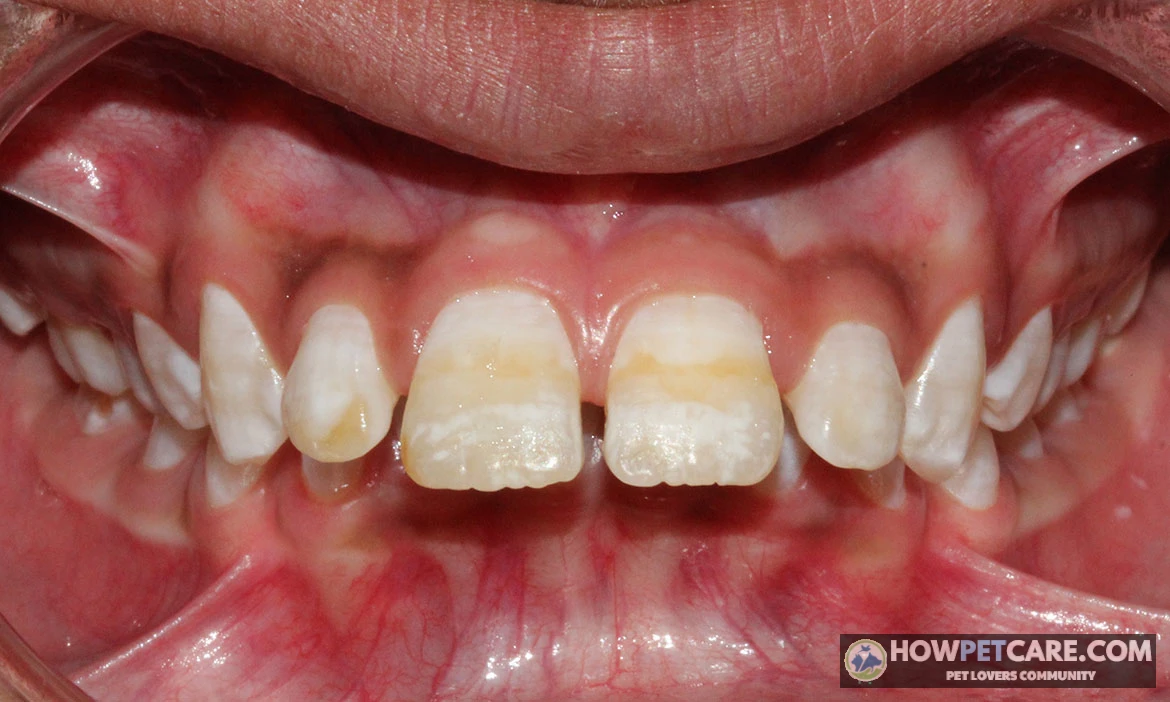

Bunny teeth is an informal term for protruding upper front teeth, clinically called excessive overjet. Human incisors stop growing after eruption, unlike rabbit teeth. Mild cases need monitoring; larger overjets raise trauma and speech risks, and braces, aligners, veneers, or bonding can help depending on bite and age.
“Bunny teeth” is an informal nickname for upper front teeth that visibly stick out or look unusually prominent. It is not a dental diagnosis. Clinicians usually describe the same look with terms such as overjet, protruding incisors, or malocclusion. In humans, adult incisors do not grow continuously; rabbit incisors do.
Bunny teeth (human, informal): upper front teeth (incisors) that visibly stick out or look large and prominent — a casual description, not a diagnosis. Overjet (clinical term): the horizontal distance between the front of the upper incisors and the front of the lower incisors. Normal is roughly 1–3 mm; dentists start calling it excessive above about 3–5 mm, and severe overjet is often 7 mm or more. Buck teeth (informal): usually the same thing as bunny teeth — protruding upper incisors — sometimes used loosely for any visible overjet. Rabbit teeth (actual animal anatomy): rabbits’ incisors grow continuously throughout life and are kept worn down by chewing. Human incisors do not grow continuously — once an adult incisor is fully erupted, it is its final size. Quick disambiguation: “My child’s front teeth stick out” → likely excessive overjet (bunny/buck teeth); “My front teeth look big but my bite is fine” → normal tooth size or proportions, not a bite problem; “My teeth keep growing” → impossible in humans; only rabbits and rodents have continuously growing incisors.
What “Bunny Teeth” Means in Humans (and What It Isn’t)
The phrase “bunny teeth” describes protruding upper front teeth in humans, also called buck teeth. It is descriptive, not clinical. If the bite itself is the problem, orthodontics addresses the cause; veneers and bonding change how protruding teeth look, not where they sit.

Human incisors vs. rabbit teeth

Rabbits have 28 teeth, including 6 incisors and 2 peg teeth, and lack canine teeth. Their incisors and molars grow continuously and are worn down by chewing. Human teeth do not work this way: once an adult incisor is fully erupted, it does not keep growing. Pet dental concerns should go to a veterinarian.
Overjet vs. buck teeth vs. bunny teeth

Overjet is the measurable horizontal gap between upper and lower front teeth. Bunny teeth and buck teeth are informal names for a visible version of that same protrusion. “Bunny teeth” often implies large-looking front teeth, while “buck teeth” usually implies clear protrusion; clinically, both may be described as excessive overjet.
What Causes Protruding Front Teeth
Causes include genetics, prolonged thumb-sucking, jaw misalignment, and teeth crowding. Jaw development, bite alignment, habits, and injury can all play a role.
Genetics and jaw development

Genetics and jaw development shape the dental arch and can leave the upper incisors positioned farther forward than the lower teeth. A narrow upper arch or a jaw growth pattern that favors forward upper incisor position can make front teeth look prominent even when tooth size is normal.
Habits and environmental factors

Prolonged thumb sucking, pacifier use, and tongue thrust can push upper incisors forward or affect how the lips and tongue support the teeth. Injury, early tooth loss, spacing problems, or crowding can also change incisor position. A general dentist or orthodontist can determine whether the cause is tooth position, jaw growth, or both.
 You might be wonderingDutch bunny rabbitsDutch Rabbit: Size, Markings, Care Costs & Feeding PlanRead the answer
Are Bunny Teeth a Health Problem? Severity Thresholds
Protruding teeth can increase dental trauma risk, affect biting and chewing, and cause speech problems. They are not always a health problem; the key is whether function, safety, or daily life is affected.
Run through this list. Any single checked item is a reason to book an evaluation rather than just monitor. Trauma risk: the upper front teeth stick out far enough that the lips do not comfortably cover them at rest; the child has already chipped, fractured, or knocked loose a front tooth; the child plays contact sports without a mouthguard and has visible protrusion. Function: certain sounds (s, f, v, th) are noticeably hard to produce; biting into foods like sandwiches or apples is difficult because the front teeth do not meet; the lower teeth bite into the roof of the mouth or behind the upper teeth when closing. Comfort and tissue health: the gums behind the upper front teeth are regularly irritated or the teeth are hard to keep clean; dry, cracked, or chapped lips from chronic mouth opening. Quality of life: the child hides their smile, avoids photos, or reports teasing; an adult reports the protrusion affects job interviews, confidence, or social life. Interpretation: 0 checked → monitoring is reasonable; 1–2 checked → schedule a dental or orthodontic evaluation within a few months; 3+ checked, or any trauma history → seek an evaluation promptly.
Trauma, speech, and chewing thresholds

A useful threshold is whether the upper front teeth can be comfortably covered by the lips at rest. If they cannot, trauma risk rises, especially in active children. Speech concerns are more significant when specific sounds are consistently hard and a speech evaluation has been suggested. Chewing concerns matter when front teeth do not meet well enough to bite into foods such as apples or sandwiches.
When aesthetics alone justify treatment
Cosmetic treatment is legitimate when the bite is healthy and the person is genuinely bothered in daily life, not just in one photo. Start with the least irreversible option and get a bite assessment first, so a real overjet is not masked by appearance-only treatment.
Age-by-Age Dental Development and When to See an Orthodontist
Normal development varies, and mild protrusion can improve as the jaw grows. Significant overjet often persists or worsens without evaluation. An orthodontic check around age 7 is commonly recommended.
| Age | What’s Normal for Front Teeth | Watch For | Orthodontic Action |
|---|---|---|---|
| 6–12 months | No teeth or first lower incisors erupting | Nothing yet | Routine well-child dental guidance |
| 1–3 years | All 20 baby teeth typically in by around age 3; small gaps are normal | Prolonged pacifier or thumb sucking past age 3 | Discourage habits; first dental visit by age 1 |
| 4–6 years | Baby teeth may look more prominent as the face grows; spacing normal | Deep overbite, front teeth that do not meet, speech concerns | Mention protrusion at checkups; no formal ortho referral usually needed yet |
| 6–8 years | First adult incisors can look very large and slightly flared — usually the “ugly duckling” stage | Overjet clearly exceeding the width of one lower incisor; a front tooth knocked out of position | First orthodontic evaluation by age 7 is the standard recommendation |
| 8–12 years | Baby and adult teeth coexist; some crowding and flare is normal | Worsening overjet, habits persisting, jaw shift when biting | Orthodontist decides: monitor, habit appliance, or early treatment |
| 12–16 years | Most adult teeth in; most common window for full braces | Any untreated overjet | Comprehensive orthodontic treatment if indicated |
| 16+ / adults | Bite is settled; changes are slow | Trauma, tooth loss, or new protrusion | Orthodontics still works in adults; cosmetic options become relevant for mild cases |

Normal development timeline
The 6–8 year window can look alarming because first adult incisors are large and may flare before the rest of the mouth catches up. That alone is not a diagnosis. Watch for overjet that clearly exceeds the width of one lower incisor, or a front tooth displaced by injury.
Orthodontic evaluation windows
Age 7 is a benchmark, not a braces prescription. An orthodontist can spot developing overjet problems while growth still makes guidance easier. You can go directly to an orthodontist; no referral is required.
How to Fix Bunny Teeth: Braces, Aligners, Veneers, and Bonding
An orthodontist can treat bunny teeth using braces, clear aligners, palatal expanders, or headgear. The right option depends on severity, age, bite, and goals.
| Option | Best For | Typical Duration | Reversibility | Key Trade-offs |
|---|---|---|---|---|
| Braces | Moderate-to-severe overjet, jaw alignment issues in children and teens; also adults | 12–36 months | Not applicable — moves teeth into a new position | Most versatile; visible; requires careful hygiene; can address skeletal issues with growth guidance or, in adults, sometimes with jaw surgery |
| Clear aligners (e.g., Invisalign) | Mild-to-moderate overjet in teens and adults with good compliance | 6–24 months | Not applicable — moves teeth | Nearly invisible; removable, so results depend on wearing 20–22 hrs/day; less suited to complex bite corrections |
| Veneers | Adults with mild protrusion and healthy bite who want a cosmetic change only | 2–3 visits over a few weeks | Irreversible — enamel is permanently removed | Fast cosmetic result; does not fix the bite; teeth may need replacement in 10–15 years; not for children |
| Bonding | Very mild protrusion or shape/size concerns; budget option | 1 visit, often under an hour per tooth | Partially reversible — minimal or no enamel removal | Cheapest and fastest; stains and chips more easily; lasts roughly 3–10 years; cosmetic only |
Orthodontic correction
Braces are the most versatile option for moderate-to-severe overjet and bite issues. Clear aligners can correct mild to moderate protrusion in many adults and teens, but severe skeletal or bite issues may require braces or combined treatment. An orthodontist must assess candidacy.
Cosmetic correction
Veneers and bonding are cosmetic options for adults with a healthy bite. Veneers are irreversible; bonding is more reversible but less durable. Neither fixes the underlying bite.
Cost, Insurance, and Treatment Timelines
Costs vary by provider, location, age, severity, and insurance. The ranges below are broad US estimates and should be confirmed locally.
| Treatment | Approximate Cost Range | Insurance Notes | Typical Timeline |
|---|---|---|---|
| Braces | Often several thousand dollars | Orthodontic benefits may cover part, especially for children with medical need; adult coverage varies | 12–36 months |
| Clear aligners | Often comparable to or slightly above braces | Coverage varies by plan and whether treatment is deemed medically necessary | 6–24 months |
| Veneers | Often several hundred to over a thousand dollars per tooth | Usually cosmetic, so often not covered | 2–3 visits over a few weeks |
| Bonding | Often lower per tooth than veneers | Usually cosmetic; sometimes partially covered if repair-related | 1 visit, often under an hour per tooth |
Cost ranges and insurance notes
Insurance is more likely to contribute when protrusion creates a functional or health-related problem, such as trauma risk or bite dysfunction, rather than a purely cosmetic concern. Payment plans, HSAs, and FSAs may help, but availability varies.
Timelines by option
Orthodontic treatment takes longer because it changes tooth position and sometimes guides growth. Cosmetic options are faster but do not correct the bite. Retainers are commonly needed after orthodontic treatment to help maintain results.
Leave Them Alone or Treat? A Balanced Decision Guide
Not every case of bunny teeth needs treatment. Monitoring is reasonable when there are no functional, trauma, or quality-of-life concerns.
Step 1 — Answer these five questions: Is the overjet large enough that the lips cannot protect the front teeth at rest? Is there any history of chipped, broken, or displaced front teeth? Does the protrusion interfere with chewing, speech, or keeping the teeth clean? Does the child or adult actively dislike their smile in daily life — not just in one photo? Is the person still growing (roughly under 14 for girls, under 16–18 for boys)? Step 2 — Read your result: All no → Monitor. Photograph the smile every 6–12 months, keep dental checkups, and re-ask yearly. Any yes on questions 1–3 → Treat path; these are functional/trauma criteria, not cosmetic ones. Only question 4 yes → Your call; cosmetic treatment is legitimate, but start with the least irreversible option and get a bite assessment first. Only question 5 yes → Growth is an asset; early evaluation costs little and keeps options open. Step 3 — Referral flow: 1. Start with a general dentist if you are unsure, if there was recent trauma, or if it has been over a year since a checkup. They measure overjet and screen for problems. 2. General dentist → orthodontist if overjet is excessive, the bite does not meet, or habits are still active. You can also go directly to an orthodontist — no referral is required. 3. Orthodontist first, cosmetic dentist second for anyone still growing or with overjet above about 4–5 mm. 4. Cosmetic dentist (veneers/bonding) only when the bite is healthy, growth is finished, and the goal is purely appearance. Questions to bring to the consultation: How many millimeters of overjet do I or my child have? Is this a tooth-position problem, a jaw-growth problem, or both? What happens if we wait 12 months? Which options fix the cause versus just the look? What is the least irreversible option that solves the actual problem?
Treat-now criteria
Treat when there is trauma history, difficulty chewing or speaking, gum irritation, or strong daily-life distress. Functional and trauma criteria should outweigh purely cosmetic preferences.
Monitor-and-wait criteria
Monitoring is reasonable when overjet is mild, lips cover the teeth at rest, there is no speech or chewing problem, and the person is not distressed. Recheck regularly, especially during growth.
Next Steps: Referral Path and a Simple Decision Checklist
Start with a general dentist if you are unsure, if there was recent trauma, or if it has been over a year since a checkup. See an orthodontist for excessive overjet, bite problems, or active habits. Consider a cosmetic dentist only when the bite is healthy, growth is finished, and the goal is purely appearance.
This article is general information, not a diagnosis. Treatment decisions should be made with a licensed dental professional who can measure overjet, assess bite, and account for age, growth, and overall oral health.
FAQ
Is ‘bunny teeth’ a real dental term?
No, it is an informal, descriptive phrase rather than a clinical diagnosis. Dentists and orthodontists typically describe the same look using terms like overjet or protruding incisors.
Do rabbit teeth keep growing, and how are they worn down?
Yes, rabbit incisors grow continuously throughout life and are worn down by chewing fibrous foods and gnawing. This is fundamentally different from human teeth, which do not grow after eruption.
Can clear aligners fix bunny teeth?
Clear aligners can correct mild to moderate protrusion in many adults and teens, but severe skeletal or bite issues may require braces or combined treatment. An orthodontist must assess candidacy.
Will a child’s protruding front teeth fix themselves as they grow?
Sometimes mild protrusion improves as the jaw develops, but significant overjet often persists or worsens without evaluation. An orthodontic check around age 7 helps determine whether early treatment is needed.