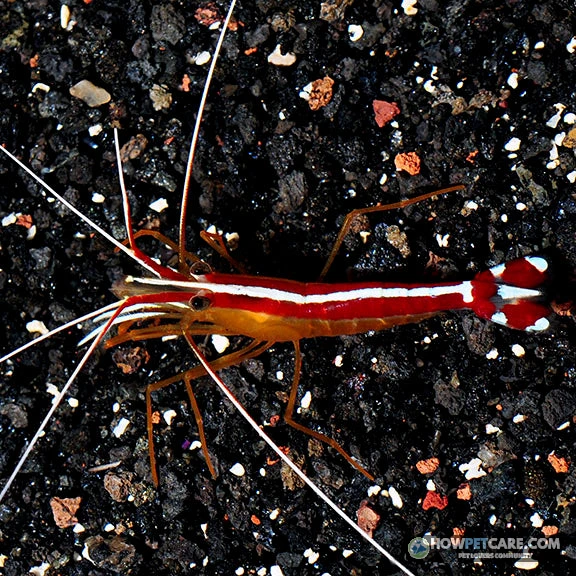

A cleaner shrimp is a small marine crustacean — usually a Lysmata species — that scavenges and picks debris and parasites from fish. The scarlet skunk cleaner (Lysmata amboinensis) suits most beginners: keep it in an established reef tank around 20+ gallons at 1.024–1.026 specific gravity and 74–80°F, away from shrimp-eating fish and copper.
A Cleaner Shrimp can thrive in an established saltwater aquarium when the water stays stable, tankmates won’t eat it, and it gets food beyond what it picks from fish. If you want to watch a shrimp clean fish, consider the scarlet skunk cleaner shrimp, Lysmata amboinensis. Choose a fire shrimp for its color and tendency to shelter, or a correctly identified peppermint shrimp if possible Aiptasia control is your main goal.
Before buying, check the species name, salinity, temperature, tankmates, and any medications in use. Cleaner shrimp scavenge and can be fascinating to watch, but they won’t cure marine ich.
Choose a cleaner shrimp that fits your reef tank
How to tell four commonly sold Lysmata apart
Common names aren’t always consistent at aquarium stores. Check the scientific name as well as the markings, and ask the seller to confirm the identification before you buy.
| Species and common name | Store identification cues | Typical behavior or role | Best fit | Cautions |
|---|---|---|---|---|
| Lysmata amboinensis — scarlet skunk cleaner shrimp | Red and yellow body, a prominent white stripe along the back, and long white antennae | Visible cleaner that may set up a station for fish | A beginner seeking fish-cleaning behavior in an established reef | Fish may ignore it; it still needs feeding and protection from predators |
| Lysmata debelius — blood red fire shrimp | Deep red body with conspicuous white spots and white antennae | Ornamental cleaner, often more inclined to shelter in rockwork | A keeper who values its appearance and can provide hiding places | Can be territorial toward other shrimp; don’t assume it will remain in view |
| Lysmata wurdemanni — peppermint shrimp | Translucent body with fine reddish stripes; no bold white skunk stripe | Primarily bought for scavenging and possible Aiptasia control | A buyer targeting nuisance anemones who can verify the species | Similar-looking shrimp are sold under the same common name; Aiptasia consumption isn’t guaranteed |
| Lysmata grabhami — Atlantic cleaner shrimp | Similar to the skunk cleaner, with a white dorsal stripe and white markings on the tail | Fish-cleaning species associated with Atlantic reefs | A buyer seeking an Atlantic species or a less commonly offered cleaner | Easily confused with L. amboinensis; ask for species and origin confirmation |

Peppermint shrimp may eat Aiptasia, but buying one doesn’t guarantee pest control. Camel shrimp, sometimes mistaken for peppermints, aren’t Lysmata wurdemanni. Check the identification rather than relying on a common name.
Which cleaner shrimp is right for your tank?
For a first saltwater cleaner shrimp, L. amboinensis is a practical option if you want to watch it interact with fish. An adult can reach roughly 2–2.4 inches in body length, excluding its long antennae. Choose L. debelius if you can provide sheltered rockwork and don’t expect the shrimp to stay in view all day. Consider L. wurdemanni for Aiptasia only after confirming what the seller is offering.
At the store, look for an alert shrimp that walks normally and responds to food. Ask how long the store has had it, what it eats, and whether it was captive-bred or collected from the wild. A missing limb alone doesn’t tell you whether a shrimp is healthy, but unexplained lethargy or visible damage is reason to ask more questions or wait.

What cleaner shrimp do—and why they do not cure marine ich
A cleaner shrimp may pick material from another animal’s surface, including accessible parasites and dead tissue. In this cleaning symbiosis, the shrimp gets food, and the fish may benefit from having material removed. Skunk cleaner shrimp can advertise a cleaning station by rocking from side to side and waving their long antennae.

What fish cleaning can and cannot accomplish
Fish must approach and tolerate the shrimp; not every fish will become a customer. Cleaning is opportunistic. A shrimp may remove some material from a willing fish, but it can’t reliably eliminate fish parasites from the aquarium.
Cleaner shrimp do not cure marine ich. Cryptocaryon irritans, the parasite responsible for marine ich, has stages on fish and in the environment. Even if a shrimp removes some accessible parasites, that won’t control an outbreak. Identify the disease and seek an appropriate quarantine and treatment plan instead of relying on a cleaning station. Fish may need treatment in a separate hospital tank; don’t expose the shrimp to copper medication.
Peppermint shrimp serve a different purpose. They’re generally bought for scavenging or possible Aiptasia control, not as a substitute for fish-disease treatment.
Cleaner shrimp tank size, water parameters, and reef compatibility
For a first skunk cleaner shrimp, an established tank of around 20 gallons is a practical starting point, not a biological rule. Smaller nano reef systems can house shrimp, but conditions may change quickly, and a fish’s space needs may far exceed the shrimp’s. Choose the tank for all its inhabitants, not just the shrimp.
Provide stable rockwork, a sheltered retreat, and an accessible ledge or overhang. A cleaning station is useful only when the shrimp feels secure enough to use it and can reach food safely.

Water parameters to verify before purchase
The figures below are practical general reef-keeping targets rather than verified species-specific minimums. Use reliable marine equipment to test the water, compare your readings with the seller’s, and favor stability over abrupt corrections. Calcium, magnesium, and iodine values are reference points for managing a reef system; they don’t show that a shrimp needs supplementation.
| Check | Target or compatibility rating | Practical notes |
|---|---|---|
| Specific gravity | Approximately 1.024–1.026 | Measure with a calibrated, temperature-compensated instrument; avoid sudden changes. |
| Temperature | Approximately 74–80°F | Keep temperature stable and match arrival water carefully. |
| pH | Approximately 8.1–8.4 | Investigate persistent out-of-range readings rather than making rapid corrections. |
| Ammonia and nitrite | Undetectable | Don’t add a shrimp to an uncycled or unstable aquarium. |
| Nitrate | Preferably below 20 ppm | Manage as part of overall reef water quality; avoid sudden corrective changes. |
| Calcium | Approximately 380–450 ppm | A normal reef range is sufficient as a management target; don’t raise it solely for the shrimp. |
| Magnesium | Approximately 1,250–1,350 ppm | Monitor as part of reef chemistry, particularly if the tank contains calcifying corals. |
| Iodine | Natural seawater is roughly 0.06 ppm total iodine; no cleaner-shrimp-specific target is established | Don’t dose blindly. Salt mix and food can supply iodine; test and seek informed advice before supplementing. |
Iodine isn’t a proven fix for a difficult molt. Test results can also depend on which forms of iodine a kit measures, so don’t assume every kit can verify total iodine against the reference value in the table.

Tankmates to welcome, monitor, or avoid
A skunk cleaner is generally considered reef compatible, but compatibility depends on the animals, available space, and feeding. Even a shrimp that doesn’t normally eat coral may steal food from one or disturb it while scavenging.
| Tankmate | Assessment | Practical consideration |
|---|---|---|
| Peaceful gobies, clownfish, and other small community fish | Usually suitable | Observe each fish; being peaceful doesn’t guarantee it will accept cleaning. |
| Triggers, puffers, lionfish, groupers, and shrimp-eating wrasses or hawkfish | Avoid | A fish capable of swallowing or dismantling the shrimp may treat it as food. |
| Banded coral shrimp (Stenopus hispidus) | Avoid | Territorial encounters can injure or kill a smaller shrimp, especially in confined space. |
| Other Lysmata shrimp | Monitor carefully | Allow room and separate shelters; don’t assume different species will tolerate one another. |
| Corals and anemones | Generally compatible with skunk cleaners | Watch for food theft or persistent picking; peppermint shrimp and lookalikes warrant closer observation. |
| Crabs and other predatory invertebrates | Species-dependent; avoid known predators | A newly molted shrimp is particularly vulnerable while its shell is soft. |
For a beginner, one skunk cleaner is the simplest starting point. A compatible pair may work in a suitable tank, but additional shrimp need more space, shelter, food, and monitoring. Don’t add a group just to increase the chance of seeing fish cleaned.
Acclimate a cleaner shrimp safely and protect it from medication
Salinity differences and deteriorating transport water both matter when a shrimp arrives. Ask the seller for shipment-specific instructions before opening the bag, especially after a long delivery. A drawn-out drip isn’t automatically safer if the shipping water has become poor.
Arrival-day drip-acclimation checklist
Prepare airline tubing, a valve or loose knot to control flow, a clean container reserved for aquarium use, and a calibrated salinity instrument. About an hour of drip acclimation is a commonly cited approach, but the starting water, shipment condition, and seller’s instructions should guide the procedure.
- Prepare the tank. Confirm temperature and salinity, dim the lights, and make sure a sheltered release spot is ready.
- Inspect the sealed bag. Check the shrimp and contact the seller promptly if it appears dead or severely distressed. Follow the seller’s arrival-guarantee instructions.
- Equalize temperature. Float the sealed bag for about 15–20 minutes, keeping it secure and out of strong flow.
- Move to a clean container. Open the bag and gently transfer the shrimp and enough shipping water to keep it submerged. Keep that water out of the display.
- Check the starting salinity. Compare it with the display and follow the seller’s guidance if there’s a large difference or the water looks fouled. Don’t leave the shrimp in a small volume of deteriorating water while improvising.
- Start a controlled siphon. Run airline tubing from the display to the container and adjust the flow to a gentle drip. Keep the container warm and the shrimp submerged.
- Monitor the water. As the volume rises, remove and discard some mixed water if needed, then continue the drip. Check temperature and salinity instead of relying on drip rate alone.
- Transfer when conditions are close. Once the container water is close to the display in salinity and temperature, gently move the shrimp with a small container, leaving the mixed shipping water behind. Release it near shelter under dim light.
- Observe without disturbing it. A newly introduced shrimp may hide. Offer a small amount of suitable food after it has settled, and remove uneaten food.

If the shrimp is in obvious distress, or the seller recommends a different procedure because of shipping conditions, contact the seller or an aquatic professional rather than extending the process to meet a preset clock.

Copper and other medication warnings
Copper-based medications are lethal to cleaner shrimp. Treat fish in a separate, appropriately managed hospital tank; do not dose copper into a display containing shrimp.
Keep fish-treatment levels of hyposalinity, formalin baths, and medications not established as safe for ornamental shrimp away from the shrimp. A freshwater dip is for an individual fish in a separate container, not for a shrimp or an entire reef tank.
A product labeled for reef use isn’t automatically proven safe for every crustacean, dose, or treatment combination. Read the full label and consult the manufacturer or an aquatic veterinarian if shrimp safety is unclear. Previously copper-treated tanks and equipment also warrant caution because residues can persist. Don’t assume a quick rinse makes them safe for invertebrates.
Feed, monitor, and support cleaner shrimp through molts
Cleaning fish doesn’t provide a dependable, complete diet. Offer appropriately sized pieces of meaty marine food or a suitable prepared marine food. Start with a small portion, then adjust to the shrimp’s response and your aquarium’s water quality.
If fish intercept every morsel, use feeding tongs or a pipette to place food beside the shrimp’s shelter or cleaning station. Feeding the fish elsewhere first can give the shrimp time to take its portion. Remove leftovers rather than repeatedly adding food the shrimp never reaches.
Molting, limb loss, and refusal to eat
Cleaner shrimp periodically shed their exoskeleton. The empty, pale shell can look remarkably like a dead shrimp, and the animal may hide while its new covering hardens. Adult molts have been reported roughly every 3–8 weeks, though an individual’s schedule varies. A shrimp is vulnerable to attack immediately after molting.
| What you notice | What to check | What to do |
|---|---|---|
| An intact-looking shell and a missing shrimp | Look quietly around its usual shelter; the shell may be a molt. | Avoid dismantling the rockwork. Leave the shrimp protected while you observe. |
| A limb or antenna missing after a molt | Check for harassment, injury, and access to shelter. | Keep conditions stable and minimize handling. A limb may regrow over subsequent molts. |
| Old shell appears stuck | Check salinity, temperature, water quality, and signs of distress. | Don’t pull at the shell or add iodine without evidence; ask an aquatic veterinarian or experienced marine specialist for help. |
| Food is refused | Consider a recent molt, arrival stress, water quality, bullying, and whether food reaches the shrimp. | Test the water, observe from a distance, and offer a small suitable portion near shelter. Seek help if weakness or refusal persists. |
| A swelling near the gills or unusual breathing | A lump can have more than one cause; a parasitic isopod is one possibility. | Photograph the shrimp and consult an aquatic veterinarian or knowledgeable marine specialist. Don’t attempt an improvised dip, copper treatment, or removal. |

Give a recently molted shrimp access to a quiet hiding place. Watch for tankmates waiting outside its shelter, but avoid repeatedly moving the shrimp or rearranging its surroundings.
How long cleaner shrimp live and whether pairs can breed
The Aquarium of the Pacific reports a 3–5-year average lifespan for cleaner shrimp. Aquarium life varies with species, health, and care, so treat that figure as a general expectation, not a guarantee.
Skunk cleaners are protandric simultaneous hermaphrodites: they begin life as males and later develop both male and female reproductive function. A compatible pair may produce eggs, but raising the larvae is a separate, demanding project. Reported larval development can take 5–6 months, so don’t expect eggs to become juvenile shrimp in an ordinary display.
Buy a healthy cleaner shrimp and make a tank-readiness check
Price, shipping, and captive-bred versus wild-caught
For a November 2026 purchase, ask for the animal price and shipping charge separately. US prices and overnight-shipping charges vary widely between sellers, species, and seasons. Online orders may include a minimum purchase, packaging charge, or arrival-guarantee conditions; get the full delivered total before paying.
You can buy cleaner shrimp online from marine aquarium retailers or specialist breeders, or through a local saltwater store. Ask the seller to confirm the scientific name, feeding response, source, shipping method, and what happens if the animal arrives in poor condition. If you order online, arrange to receive the delivery promptly rather than leaving the package outdoors.
Captive-bred stock may appeal to buyers who want to avoid direct collection from a reef, but availability varies. Cleaner-shrimp larvae are difficult to rear, and wild collection has historically supplied much of the trade. Captive-bred doesn’t mean guaranteed healthy or automatically suited to your tank. Ask about rearing, feeding, and water conditions either way. For wild-caught shrimp, ask about collection origin and handling rather than assuming every source has the same environmental impact.

Before-you-buy checklist
| Stage | Action | What to verify |
|---|---|---|
| Species | Confirm the scientific name and markings. | You are buying the cleaner or peppermint species you actually want. |
| Aquarium | Test the established system. | Salinity, temperature, pH, and water quality are stable; ammonia and nitrite are undetectable. |
| Tankmates | Review fish and invertebrates individually. | No likely shrimp predators or aggressive banded coral shrimp share the space. |
| Treatment | Check recent and planned medications. | The shrimp won’t enter copper-treated water or be exposed to an unverified treatment. |
| Feeding | Prepare suitable food and a way to place it near shelter. | The shrimp can eat even if fish compete for food. |
| Arrival | Gather a container, tubing, and salinity tester. | Seller-specific acclimation and delivery instructions are available. |
| Purchase | Confirm source, health, and total cost. | The animal, shipping terms, and arrival policy are acceptable before checkout. |
If any check fails, wait and address it before bringing the shrimp home. Once all checks pass, choose a healthy animal and prepare its sheltered release spot before the bag arrives.
| Scientific Name | Common Name | Identification Cues | Typical Role / Behavior | Best Fit | Cautions |
|---|---|---|---|---|---|
| Lysmata amboinensis | scarlet skunk cleaner shrimp | Red and yellow body, a prominent white stripe along the back, and long white antennae | Visible cleaner that may set up a station for fish | A beginner seeking fish-cleaning behavior in an established reef | Fish may ignore it; it still needs feeding and protection from predators |
| Lysmata debelius | blood red fire shrimp | Deep red body with conspicuous white spots and white antennae | Ornamental cleaner, often more inclined to shelter in rockwork | A keeper who values its appearance and can provide hiding places | Can be territorial toward other shrimp; don't assume it will remain in view |
| Lysmata wurdemanni | peppermint shrimp | Translucent body with fine reddish stripes; no bold white skunk stripe | Primarily bought for scavenging and possible Aiptasia control | A buyer targeting nuisance anemones who can verify the species | Similar-looking shrimp are sold under the same common name; Aiptasia consumption isn't guaranteed |
| Lysmata grabhami | Atlantic cleaner shrimp | Similar to the skunk cleaner, with a white dorsal stripe and white markings on the tail | Fish-cleaning species associated with Atlantic reefs | A buyer seeking an Atlantic species or a less commonly offered cleaner | Easily confused with L. amboinensis; ask for species and origin confirmation |
FAQ
How long do cleaner shrimp live in captivity?
Lifespan varies with species, health, and aquarium conditions; a retailer or species-specific care source can provide a more reliable expectation than a single guaranteed number. Stable water, appropriate food, and protection from predators and unsafe medications support longevity.
Do cleaner shrimp need iodine supplements to molt?
Not necessarily: iodine is present in saltwater and may be replenished through regular water changes and a suitable marine diet. Avoid dosing iodine blindly, since excess can harm invertebrates; test and follow a product’s instructions if supplementation is indicated.
Can cleaner shrimp live with a banded coral shrimp?
It is risky because banded coral shrimp can be territorial and may injure or eat other shrimp, especially in confined spaces. Compatibility is not guaranteed, so the safer choice is to avoid housing them together.
What should I do if I find a parasitic isopod on my cleaner shrimp’s gills?
Do not dose copper or improvise a freshwater dip in the display. Photograph the problem and seek advice from an aquatic veterinarian or experienced marine specialist before attempting removal or treatment, because shrimp are sensitive to many medications and procedures.