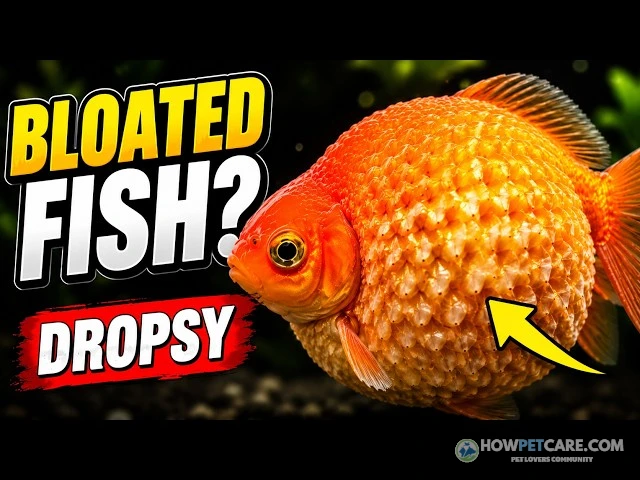

Dropsy in fish is a sign of internal fluid buildup, not a single disease. The classic warning is a swollen body with scales newly lifted into a pinecone shape. Move the fish to clean, conditioned water, test the tank, and contact an aquatic veterinarian if it struggles to breathe or stay upright.
Dropsy in fish signals fluid buildup; it isn’t a disease with one cause. If a fish is swollen and its scales have newly lifted into a pinecone-like shape, act promptly: move it to suitable clean water, test the original tank, and contact an aquatic veterinarian if it struggles to breathe or stay upright. Swelling can stem from a bacterial infection, organ damage, or another underlying problem. Salt and antibiotics aren’t guaranteed cures.
This guide offers general fish-care information, not a substitute for a veterinarian’s diagnosis. If the fish is severely distressed, seek veterinary help while you correct its water conditions. Don’t wait to finish a home treatment plan.
Dropsy in fish: What to do in the first hour
First-hour decision tree
View the fish from directly above. A swollen body with scales that now stick out across much of it suggests dropsy. This look is often called “pineconing” or, informally, pinecone disease. It’s a warning sign, not an explanation for the fluid buildup.
If the belly is rounded but the scales remain flat and the fish otherwise behaves normally, compare it with the lookalikes in the next section before assuming medication is needed. Flat scales don’t rule out illness, especially if the fish is breathing rapidly or can’t swim normally.

-
Check for an emergency
Watch for labored breathing, loss of balance, profound weakness, or severe swelling. Contact an aquatic veterinarian urgently if you see any of these signs.
-
Prepare clean water
Set up a covered, appropriately sized hospital container with conditioned water close to the display tank’s temperature and pH. Add gentle aeration and a suitable filter if available.
-
Move the fish gently
Use a clean container or soft net. Minimize handling, keep the light subdued, and avoid chasing or squeezing the fish.
-
Test both tanks
Check the hospital water and original aquarium for ammonia, nitrite, temperature, and pH; check nitrate too. If ammonia or nitrite is detectable, make a partial water change with conditioned, temperature-matched water.
-
Choose treatment deliberately
Measure the hospital tank’s actual water volume. Check the species, exact medication label, and veterinary advice before adding medication or salt.
If setting up a hospital tank will take time and the display water tests unsafe, correct the display water promptly. Don’t leave the fish in a known water-quality emergency. A clean, adequately sized temporary container with conditioned, temperature-matched water and aeration is better than a rushed transfer into an unsuitable one.
What to do for the other fish
Dropsy itself isn’t contagious; it describes fluid retention. An underlying infection may spread, and a shared water-quality problem can affect several fish. Test the display tank and watch tankmates for changes in appetite, breathing, behavior, or body shape. Keep hospital equipment separate, or clean it between uses.
Don’t automatically medicate the entire aquarium. Antibacterial treatment may not help when a bacterial cause hasn’t been established, and it can add stress.

Is it dropsy? Compare pinecone scales with common lookalikes
A swollen belly with scales sticking out warrants attention, but appearance alone can’t show what’s happening inside the fish. Compare the whole body from above and both sides. An older photo can help you spot what has changed.
| Condition | Scale appearance | Swelling pattern | Other clues | Recommended next step |
|---|---|---|---|---|
| Suspected dropsy or edema | Newly raised scales can protrude across much of the body | Often generalized, rather than a single lump | Lethargy, reduced appetite, clamped fins, or sometimes bulging eyes | Quarantine in suitable water, test both tanks, and contact a vet if signs are severe |
| Gravid female | Usually flat | Fullness mainly in the belly, often fairly symmetrical | Species-specific breeding signs; behavior may remain normal | Check the species and breeding history; do not medicate a healthy fish solely for a rounded belly |
| Tumor or other internal mass | May stretch or lift over one area | Often focal or uneven, though internal masses can be harder to distinguish | A persistent localized lump; other signs vary | Ask an aquatic vet about examination or imaging |
| Constipation or other bloat | Usually flat | Mainly abdominal fullness | Feeding changes or reduced feces may provide clues, but are not proof | Check water and diet; seek help if swelling persists or the fish deteriorates |
| Swim bladder disorder | Usually flat unless another problem is present | Swelling may be absent; buoyancy is the main issue | Floating, sinking, tilting, or difficulty holding position | Check water and seek the underlying cause; buoyancy problems can coexist with dropsy |
| Pearlscale or another naturally raised-scale breed | Scales have their usual lifelong domed appearance | Body shape is normal for that individual or breed | No new scale lift or behavioral change | Compare with earlier photos; investigate any new swelling or illness |
The clearest visual warning is a change: scales that once lay flat now stand away from a swollen body. Bulging eyes can occur, but their absence doesn’t rule out a serious problem. A raised patch over one lump, on the other hand, doesn’t establish generalized dropsy.
An aquatic veterinarian may examine a live fish and use imaging or fluid sampling when appropriate. Testing may not reveal the precise cause; sometimes a definitive answer requires examination after death.

Set up a hospital tank and correct water quality
Hospital-tank setup sequence
Choose a clean, fish-safe container that lets the fish turn comfortably and gives you enough water to maintain good quality. A small cup may work for a brief transfer, but not as a hospital tank. Cover the container for jumping species, while leaving room for air exchange.
Fill it with dechlorinated water. At transfer, match the fish’s current temperature and pH as closely as practical, then maintain conditions suited to its species. Provide gentle aeration. A mature sponge filter offers filtration and water movement without a strong current. Without an established filter, treat the tank as uncycled and test more often.
Measure the water you add; don’t rely on the tank’s advertised capacity. Equipment and an unfilled upper margin reduce the actual volume, which matters when calculating medication. Keep a separate bucket and siphon for hospital use if possible.

An uncycled hospital tank can develop unsafe water quickly. Test frequently and change water as needed; medication does not replace filtration or water changes.
Testing and water-change targets
| Parameter | Target or species-specific guidance | Testing frequency | Action if outside target |
|---|---|---|---|
| Actual water volume | Measure the water present, not the nominal tank size | At setup and whenever the working volume changes | Recalculate any treatment from the actual volume |
| Ammonia | 0 parts per million (ppm) | At setup and at least daily; check at least twice daily initially in an uncycled tank | Make a partial change with conditioned, temperature-matched water; check waste and filtration |
| Nitrite | 0 ppm | At setup and at least daily; check more often in an uncycled tank | Make a partial water change and continue testing |
| Nitrate | Below 20 ppm where practical for the species | At setup and during acute care | Change water as needed and check source water and accumulated waste |
| Temperature | Stable within the species’ appropriate range; match at transfer | At least twice daily | Check the heater or room conditions; avoid abrupt changes |
| pH | Stable and appropriate for the species | At setup, after water changes, and if the fish worsens | Check source water and avoid sudden chemical adjustments |
| General hardness (GH) and carbonate hardness (KH) | Appropriate and stable for the species; there is no universal dropsy target | At setup and when source water or conditions change | Test replacement water and correct mismatches gradually with species-specific advice |

Use a reliable aquarium test kit and write down the results. If ammonia or nitrite is detectable, respond to the reading rather than waiting for the next scheduled water change. Siphon waste carefully, avoid overfeeding, and match replacement water as closely as practical.
Offer a small amount of the fish’s usual appropriate food if it’s interested; remove uneaten food promptly. Don’t force-feed. If the fish stops eating or continues to decline, ask a vet for guidance.
Dropsy treatment: Salt, antibiotics, and dose calculations
There’s no single best medication for fish dropsy because swelling alone doesn’t reveal its cause. Start supportive care with clean, appropriate water and low stress. A veterinarian can help assess whether a bacterial infection is plausible and medication is appropriate. Antibacterial treatment without that indication may not help.
Aquarium salt vs. Epsom salt
Aquarium salt is primarily sodium chloride; Epsom salt is magnesium sulfate. They’re different chemicals, so you can’t substitute one for the other by dose. Neither is a proven cure for organ failure, and neither should be added automatically to a swollen fish’s water.
An Epsom salt bath is a short-duration treatment in a separate container, not the same as continuously adding a substance to a hospital tank. A bath needs a verified concentration, duration, frequency, and species-specific safety guidance. A continuous aquarium-salt plan also needs a verified concentration, duration, and instructions for replacing salt after water changes. The available evidence doesn’t establish a safe universal per-gallon or per-liter dose for either regimen. Ask an aquatic veterinarian to set a plan for the fish in your care.

Many soft-water tropicals and some scaleless fish may be sensitive to salt. Don’t assume a betta, goldfish, or any other species will tolerate a particular bath or tank concentration just because another keeper used it. Stop and seek advice if the fish shows distress during a prescribed treatment.
Do not combine salt regimens or convert a bath concentration into a continuous tank dose. Verify the salt type, concentration, duration, and species compatibility before use.
Kanamycin: Verify the product and calculate the dose
Kanamycin is an antibiotic found in some fish medications; Seachem KanaPlex is one named formulation. It can help only when the underlying problem involves bacteria susceptible to it. Kanamycin won’t address every cause of edema, and pinecone-like scales don’t show that it’s the right choice.
Before using any product, consult an aquatic veterinarian where possible. Read the label on the exact package for its water-treatment dose, interval, maximum course, species restrictions, and applicable local rules. Don’t apply a KanaPlex dose to a different kanamycin formulation or another antibiotic. The available evidence here doesn’t verify the product’s current label, so the chart below is a calculation worksheet, not a prescription.
| Actual water volume in US gallons | Approximate liters | Verified product or salt regimen | Calculated amount | Interval and duration | Species and safety cautions |
|---|---|---|---|---|---|
| 5 | 18.9 | Enter the exact verified label rate: per gallons or liters | 5 divided by the label’s gallon volume, multiplied by its stated amount | Enter label interval and maximum course | Verify the exact fish and product; do not assume salt tolerance |
| 10 | 37.9 | Use the same verified rate only if appropriate for this fish | 10 divided by the label’s gallon volume, multiplied by its stated amount | Follow the verified label or veterinary plan | Measure actual water, not tank capacity |
| 20 | 75.7 | Use the same verified rate only if appropriate for this fish | 20 divided by the label’s gallon volume, multiplied by its stated amount | Follow the verified label or veterinary plan | Check filtration and species compatibility |
Use this formula: amount = actual water volume ÷ label water volume × label amount. Keep units consistent; 1 US gallon is approximately 3.785 liters.
For example, if the exact product label you’ve verified says one supplied measure per 5 US gallons, a tank holding 10 actual gallons would need two measures for that label-directed dose; 20 actual gallons would need four. This example doesn’t establish the label rate, repeat interval, or course for any product. Record the product name, amount, and time each time you dose.

Dosing after water changes
Water changes remove some medication or salt, but products differ in how much to replace. Check the exact label or ask the prescribing vet before adding more. Don’t automatically add another full-tank dose after a partial change, and don’t skip an urgently needed water change because treatment is underway.
For example, a 50% change in a 10-gallon tank removes 5 gallons. If a verified plan specifically says to replace only the amount associated with the water removed, calculate the replacement for 5 gallons—not 10. A scheduled full dose is a separate matter, governed by the product instructions or vet’s plan.
Adjust care for bettas, goldfish, and sensitive species
Betta fish: Use a covered hospital tank with warm, stable water suited to the fish and gentle flow. Make it easy for a weak betta to reach the surface without fighting a filter current. Small volumes can change quickly, so measure water and any treatment carefully and check water quality often. A salt bath isn’t an automatic part of dropsy treatment for betta fish; get species-specific advice first.

Goldfish: Provide adequate water volume and aeration. Match the temperature to the fish’s established, species-appropriate conditions rather than defaulting to a tropical-fish temperature. Pearlscale goldfish have naturally domed scales; compare their current appearance with their usual look before calling it pineconing. New scale lift, swelling, or a change in behavior still warrants investigation.
Koi and valuable fish: Contact an aquatic vet early, especially if moving the fish safely or maintaining enough hospital water is difficult. A large fish may need a different setup from a small indoor aquarium fish.
Scaleless fish and soft-water tropicals: Ask about the exact species before using salt or medication. A regimen tolerated by one community fish may not suit every tankmate. Treating the sick fish separately also helps avoid exposing unaffected, potentially sensitive fish.
Can a fish survive dropsy? Prognosis and humane endpoints
Some fish improve, but the outlook depends on the underlying cause, its severity, and whether it’s treatable. Generalized fluid buildup can accompany serious organ dysfunction; recovery may be difficult once obvious signs appear. Reliable, comparable survival percentages for early versus advanced cases aren’t established in the evidence available here, so numerical odds would be misleading.
Early signs vs. advanced pineconing
- Mild swelling or slight new scale lift: The cause remains uncertain. Correct water conditions, compare lookalikes, and seek veterinary advice. A fish that’s alert, breathing comfortably, and maintaining its position may be a candidate for a carefully monitored treatment attempt.
- Obvious swelling with widespread raised scales: Treat this as serious. Set up suitable hospital care and contact a vet, especially if the fish’s appetite or activity is falling. Some fish may improve, but a visual examination can’t promise recovery.
- Severe swelling with major distress: Inability to stay upright, persistent gasping, profound weakness, or rapid decline calls for urgent veterinary help. Bulging eyes along with severe swelling heighten the concern. Discuss whether treatment is realistic and whether euthanasia could prevent further suffering.

These stages help organize your response; they aren’t a diagnosis or a survival-rate calculator. Breathing or posture problems can make any case urgent.
When to stop treatment or call an aquatic vet
Record breathing, posture, appetite, activity, swelling, and water-test results each day. Reassess sooner if the fish worsens. Don’t wait for a medication course to finish if it’s gasping or losing balance. If there’s no improvement during a correctly followed treatment course, contact a vet rather than extending it or combining medications on your own.
Use this decision check:
- Continue a monitored plan when the fish can breathe and hold position, the water is safe, and signs are stable or improving under a verified treatment plan.
- Escalate promptly for rapid decline, worsening swelling, loss of balance, multiple sick tankmates, persistent water-test problems, or no response to the prescribed course.
- Discuss a humane endpoint when severe suffering persists, the fish can’t breathe or remain upright, or a veterinarian judges recovery unlikely.
Depending on the case, an aquatic vet may examine the fish, use imaging, take a sample or culture, prescribe injectable antibiotics when indicated, or consider draining fluid in selected fish. Drainage isn’t a home procedure and doesn’t cure the underlying problem on its own.
Never flush a fish, freeze it alive, or leave it out of water to suffocate. Contact a veterinarian for humane euthanasia when suffering is severe or recovery is unlikely.
If a veterinarian isn’t available, seek a current, authoritative, species-appropriate fish euthanasia protocol or direct professional guidance. Clove oil appears in some fish-euthanasia protocols, but preparations and species responses vary. Don’t improvise a concentration or assume a fish is dead just because it stops swimming. A suitable protocol must explain preparation, gradual administration, sufficient exposure, and confirmation of death. When possible, have a veterinarian perform the procedure.
After the emergency: Monitor recovery and prevent recurrence
Keep the recovering fish in quarantine while you monitor appetite, breathing, swimming, and scale position. Log water readings, changes, treatments, and responses. Ask a veterinarian when it’s appropriate to return the fish to the display tank, particularly if an infectious cause is suspected or signs return.
Look into the conditions that came before the swelling. Poor water quality can contribute to stress and illness, but it doesn’t explain every case. Edema means fluid accumulation; ascites refers specifically to fluid in the abdominal cavity. Kidney or other organ dysfunction and bacterial infection are among the possible underlying problems. Bacteria such as Aeromonas may play a role in some infections, but appearance alone can’t identify an organism or show that antibiotics will work. White fuzzy growths on the skin or fins point instead toward a fish fungal infection, a separate issue with its own treatment.
For the display aquarium, test water regularly, maintain the filter, remove excess waste, and review stocking and feeding. Quarantine new arrivals in a suitable setup. Watch the other fish each day instead of routinely medicating the entire tank. If another fish develops swelling, breathing changes, or raised scales, record the signs and contact an aquatic veterinarian with your water readings and treatment history.

1What physical feature is considered the primary classic warning sign of dropsy in fish when viewed from above?
Raised scales protruding across much of the body create the classic 'pineconing' visual warning sign of fluid retention.
2How do aquatic care guidelines define the condition known as dropsy?
Dropsy is a sign of internal fluid buildup stemming from various underlying organ or bacterial issues.
3What is the recommended initial action if a fish has a rounded belly but its scales remain flat and it behaves normally?
Evaluating lookalikes such as constipation or breeding fullness prevents unnecessary medication stress when scales remain flat.
4When setting up a hospital tank, how should the water volume be determined for calculating medication doses?
Equipment and unfilled margins reduce working volume below advertised capacity, requiring precise measurement for accurate dosing.
5What is the target parameter for both ammonia and nitrite in aquarium testing during dropsy care?
Both ammonia and nitrite are toxic compounds that must be maintained at zero to prevent severe water-quality stress.
6What is the primary chemical difference between Aquarium Salt and Epsom Salt?
Because they consist of entirely different chemical compounds, these salts cannot be substituted for one another by dose.
7Which formula correctly calculates the dose of medication needed based on actual water volume?
Dividing actual volume by the label's base volume scales the manufacturer's dosage rate accurately to the specific container.
8After a 50% water change on a 10-gallon hospital tank under a plan specifying replacement of lost treatment, how much treatment should be replaced?
When a plan specifies replacing lost treatment, dosing should correspond strictly to the volume of water removed during the change.
9What environment adjustment is specifically advised for a weakened betta fish showing signs of dropsy?
Weakened bettas struggle against strong currents and need low-flow conditions to reach surface air comfortably.
10Which of the following practices is explicitly highlighted in the text as an unsafe and inhumane method of fish euthanasia?
These actions cause severe suffering and are explicitly highlighted as cruel and unacceptable methods.
| Condition | Scale Appearance | Swelling Pattern | Other Clues | Recommended Next Step |
|---|---|---|---|---|
| Gravid female | Usually flat | Fullness mainly in the belly, often fairly symmetrical | Species-specific breeding signs; behavior may remain normal | Check the species and breeding history; do not medicate a healthy fish solely for a rounded belly |
| Suspected dropsy or edema | Newly raised scales can protrude across much of the body | Often generalized, rather than a single lump | Lethargy, reduced appetite, clamped fins, or sometimes bulging eyes | Quarantine in suitable water, test both tanks, and contact a vet if signs are severe |
| Constipation or other bloat | Usually flat | Mainly abdominal fullness | Feeding changes or reduced feces may provide clues, but are not proof | Check water and diet; seek help if swelling persists or the fish deteriorates |
| Tumor or other internal mass | May stretch or lift over one area | Often focal or uneven, though internal masses can be harder to distinguish | A persistent localized lump; other signs vary | Ask an aquatic vet about examination or imaging |
| Swim bladder disorder | Usually flat unless another problem is present | Swelling may be absent; buoyancy is the main issue | Floating, sinking, tilting, or difficulty holding position | Check water and seek the underlying cause; buoyancy problems can coexist with dropsy |
| Pearlscale or another naturally raised-scale breed | Scales have their usual lifelong domed appearance | Body shape is normal for that individual or breed | No new scale lift or behavioral change | Compare with earlier photos; investigate any new swelling or illness |
FAQ
Does a swollen fish always have dropsy?
No. Swelling can have several causes, including eggs, constipation, or a localized growth. Newly raised scales with generalized swelling are especially concerning, but they do not identify the underlying cause.
Is dropsy also called pinecone disease in fish?
Hobbyists sometimes use that name because fluid buildup can make scales stick out like a pinecone. Dropsy describes a sign of illness, not one specific infectious disease.
Should I feed a fish with suspected dropsy?
Do not force-feed a sick fish. Offer a small amount of its usual appropriate food if it is interested, remove uneaten food promptly, and ask an aquatic veterinarian for advice if it stops eating.
Can poor water quality cause dropsy in fish?
Poor water quality can stress fish and contribute to conditions in which illness develops, but it does not explain every case. Test ammonia, nitrite, and nitrate promptly while investigating other possible causes.