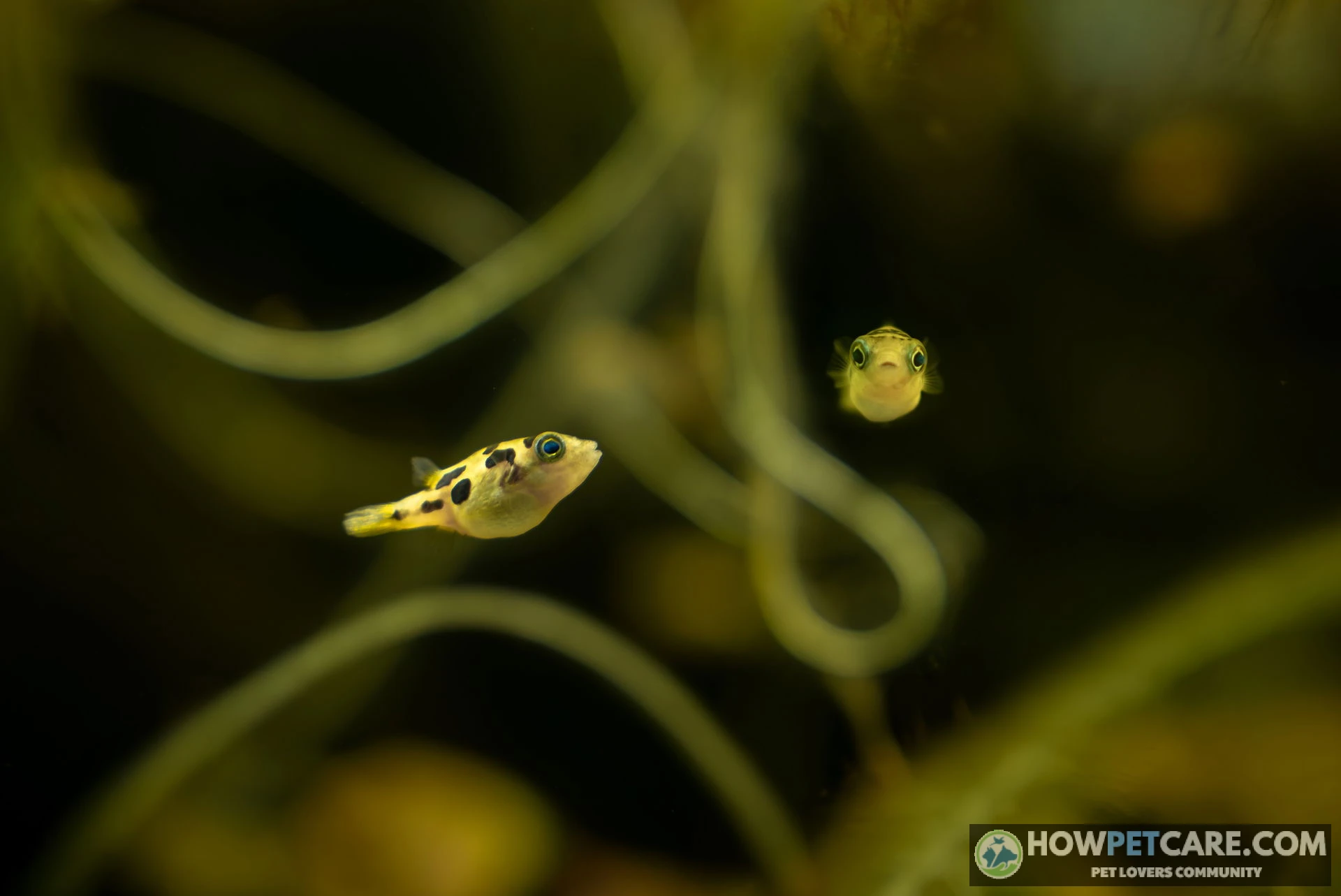

Malabar pufferfish need a mature, heavily planted freshwater aquarium with stable warm water, gentle filtration, broken sightlines, and a separation plan. Feed varied frozen or live invertebrates, quarantine new fish for at least four weeks, and avoid routine salt, casual copper, and community tank mates.
Malabar Pufferfish Care at a Glance
A suitable Malabar pufferfish aquarium is a mature, densely planted freshwater tank with stable tropical water, gentle filtration, distinct territories, and a dependable supply of meaty frozen or live foods. Although these fish are small, they are not low-maintenance nano-tank residents. Their territorial behavior, specialized diet, parasite risk, and sensitivity to medication make them a better fit for attentive intermediate aquarists than impulse buyers.
| Parameter | Target Range or Minimum | Why It Matters | Warning Signs |
|---|---|---|---|
| Adult size | Commonly about 1 inch; published maxima vary from under 1 inch in the wild to 1.4 inches | Small size affects prey selection but does not eliminate territorial needs | Stunting, wasting, or unusually swollen abdomen |
| Practical aquarium size | About 10 US gallons for a carefully managed small group; 50 liters, or about 13 gallons, is a more conservative published minimum | Footprint and zoning matter more than nominal volume alone | Chasing across the entire tank, blocked feeding access |
| Temperature | 75–82°F (24–28°C); published habitat guidance extends to 72°F (22°C) | Stable warmth supports appetite and normal activity | Gasping, lethargy, abrupt appetite loss |
| pH | Aim for a stable value accepted by the fish; published aquarium guidance is 7.2–8.0 | Stability is safer than repeatedly adjusting pH | Rapid breathing or distress after chemistry changes |
| Hardness | Low to moderate, kept stable | Avoids unnecessary osmotic stress | Distress following large or poorly matched water changes |
| Ammonia and nitrite | 0 ppm | Both are toxic and indicate an immature or overloaded biofilter | Surface breathing, clamped fins, inactivity |
| Nitrate | Consistently low | Reduces chronic stress and supports long-term health | Persistent poor appetite or declining condition |
| Salinity | Freshwater; no routine salt | This is a true freshwater species, not a brackish or marine fish | Irritation or stress after salt treatment |
| Social setup | Structured group with broken sightlines and a separation plan | Limits tank-wide dominance | Relentless pursuit, hiding, bites, weight loss |
| Diet | Varied small invertebrate prey | The species is carnivorous and naturally takes small prey and mollusks | Hollow belly, refusal of food, obesity |
What Is a Malabar Pufferfish?
The Malabar pufferfish, Carinotetraodon travancoricus, is a miniature member of the pufferfish family Tetraodontidae. Sellers may also label it the Malabar puffer fish, pea puffer, Indian dwarf puffer, or dwarf puffer. The species is native to freshwater habitats in Kerala and southern Karnataka in southwestern India.
This puffer is a true freshwater fish. Claims that it needs routine brackish or saltwater conditions generally stem from confusion with other species. It does not belong in a marine aquarium or reef aquarium.
Most adults reach around 0.8–1 inch long. Sources disagree about the maximum Malabar pufferfish size, with cited figures ranging from under 2.5 cm in the wild to 3–3.5 cm, or as much as 1.4 inches. Even at the upper end, that small size does not justify keeping one in an exposed bowl or unplanted five-gallon cube.

Is This Freshwater Puffer Right for You?
Choose this species only if you can provide all of the following:
- A fully cycled, heavily planted aquarium with several defensible areas.
- Daily access to appropriate frozen or live invertebrate foods.
- Time to watch every fish eat and spot social stress early.
- A separate quarantine tank and a backup isolation container.
- Careful medication practices suited to a scale-reduced fish.
- A commitment measured in years rather than months. Captive lifespan is often described as roughly three to five years under good care, although outcomes vary with origin, parasites, nutrition, and chronic stress.
The main ownership challenges include fin-nipping, competition within a group, frequent rejection of dry food, internal parasites in imported fish, and uncertain retail provenance. A puffer that costs only a few dollars may still require a planted display, quarantine equipment, food cultures, frozen-food storage, and professional veterinary care. One documented retail listing showed a sale price of $6.99 and a regular price of $9.95, but that example should not be treated as a universal 2026 Malabar pufferfish price.
A Malabar pufferfish is not a disposable answer to a snail population. Snails can be part of its diet, but adding a territorial carnivore to a community aquarium creates welfare and compatibility problems that remain long after the snails are gone.
Malabar Pufferfish Aquarium Size, Water Parameters, and Zoning
Minimum Tank Size and Group Footprint
A 10-gallon aquarium is a practical lower boundary for a carefully monitored small group, not an automatic stocking allowance. A more conservative published minimum is 50 liters, approximately 13 US gallons. Larger footprints are strongly preferable if you plan to keep additional fish or more than one mature male.
Tank length and usable horizontal space matter more than height. A tall aquarium with one open territory may be less functional than a longer tank divided by plants and wood. Avoid fish-per-gallon formulas. Stocking capacity depends on sex, individual temperament, plant density, access to food, and whether a subordinate fish can move out of another fish’s view.
Water Temperature, pH, Hardness, and Filtration
Keep the water stable at approximately 75–82°F (24–28°C). Evidence-based profiles report a broader 72–82°F (22–28°C) habitat range. Published aquarium recommendations put pH at 7.2–8.0, while reported natural conditions may reach 7.5–8.3. Don’t force a precise value through repeated chemical adjustments. Stable, suitable source water is usually safer than fluctuating water.
Use low-to-moderate hardness unless the breeder or supplier has documented different acclimation conditions. Keep ammonia and nitrite at zero and nitrate consistently low. A sponge filter or a baffled hang-on-back or canister return can provide biological filtration without creating an exhausting current. Cover filter intakes with fine foam, particularly when juveniles or fry are present.
Measurable Sightline Breaks and Territory Design
Arrange the aquarium so that no fish can supervise the entire footprint. Provide more retreats than fish, spread out the feeding points, and break end-to-end visibility at the front, middle, and rear of the tank.
-
Install two vertical anchors
Position dense branching wood or stable porous rock around the 25% and 75% points of the tank’s length. Each barrier should extend from the substrate to within about 2 inches of the surface and block visibility through the middle of the water column.
-
Stagger plant depth
Place broad-leaved stems or crypts along the rear and perimeter. Add dense midground groups of Vallisneria, Java fern, or comparable aquarium-safe plants so no straight swimming lane extends beyond about 6 inches.
-
Create a neutral center
Arrange lower plants and grouped leaf litter in the central foraging area. Leave several entrances open, but make sure one fish cannot watch both ends from a single position.
-
Separate resources
Set up at least three feeding stations and spread resting cover across all visual zones. A dominant fish should not be able to defend every meal and shelter.
-
Run the sightline test
Look through the filled aquarium at eye level. If you have an uninterrupted view from one side panel to the other at mid-water depth, add plants or reposition wood until the footprint appears divided into at least three visual compartments.
Treat this three-zone layout as a starting blueprint, not a guarantee. Pay attention to where the fish actually feed, sleep, and chase. Adjust the hardscape if one individual repeatedly controls the center or pins another against the glass.

Cycling and Weekly Maintenance
Fully cycle the aquarium before buying fish. Verify that the biofilter processes waste without detectable ammonia or nitrite, and introduce the puffers only after temperature and chemistry remain stable.
Every week, test the water, inspect the intake prefilter, siphon out decomposing food, and perform a moderate partial water change with dechlorinated water closely matched for temperature and chemistry. When flow declines, clean filter media in removed aquarium water. Don’t replace all biological media at once.
Routine aquarium salt is unnecessary and can complicate treatment decisions. Avoid exposed nano cubes, unstable new tanks, sharp decor, and sparse layouts that force the fish into constant visual contact.
Social Dynamics, Sex Ratios, and Tank-Mate Risks
Are Malabar Puffers Solitary or Social?
Malabar puffers show complex social behavior, but they are not peaceful community shoalers. A group may forage together and interact frequently, yet those same fish can establish strong hierarchies and inflict repeated bites. Successful group care requires enough footprint and cover, dispersed food, compatible individuals, and daily observation.
Keeping a single fish can prevent direct aggression between members of the species, but it does not make an unstructured tiny aquarium suitable. By the same token, adding more fish won’t automatically spread out aggression. A female-biased group is usually easier to manage once the adults can be sexed, though every aquarium still needs a separation plan.
How to Sex Mature Males and Females
Juveniles under approximately 1.5 cm are difficult to sex reliably. Wait until maturity and assess several traits instead of relying on body color alone.
| Diagnostic Feature | Mature Male (Carinotetraodon travancoricus) | Mature Female (Carinotetraodon travancoricus) | Juvenile or Subadult |
|---|---|---|---|
| Ventral medial line | Dark brown-to-black line along the underside, often stronger during display | Usually pale or creamy underside without a dark central line | Usually absent regardless of eventual sex |
| Eye contour | Fine wrinkles or radiating lines behind and around the eye | Smoother pattern around the eye | Adult lines not yet developed |
| Color | Often deeper olive or bronze with stronger iridescence | Often paler with contrasting blotches | Variable green-yellow mottling |
| Body profile | Generally leaner and more streamlined | Generally rounder and broader, especially when mature | Slender with little dependable differentiation |
Once sex is confirmed, start with one mature male for at least two females. This ratio may reduce direct rivalry between males, but it cannot stop harassment from an unusually persistent male. Give females several escape routes, and remove any fish that cannot feed or rest normally.
Accurate identification matters because C. travancoricus can be mistaken for similar dwarf puffers, including Carinotetraodon imitator. Ask for the scientific name and provenance instead of relying on a generic “pea puffer” label.

Why Community Tank Mates Usually Fail
A species-only aquarium is the most predictable option. Slow and long-finned fish are vulnerable to nipping. Shrimp and small snails become prey, while larger snails may face repeated attacks. Fast fish may avoid bites but consume the frozen food before a more deliberate puffer gets enough to eat.
Occasional reports of peaceful mixed tanks do not remove the underlying risk. Compatibility may change at sexual maturity, during spawning, after a rescape, or when food becomes concentrated in one area. An absence of immediate aggression is not proof of long-term safety.
Warning Signs That a Fish Must Be Separated
Separate a fish promptly if you notice:
- Repeated pursuit that continues across several zones.
- A fish staying at the surface, behind equipment, or in one corner.
- Fresh bite marks, torn fins, cloudy wounds, or missing skin.
- Loss of abdominal fullness even though food is being offered.
- One fish blocking another from every feeding station.
- Persistent courtship that leaves a female exhausted or unable to rest.
Use an established isolation tank or a secure divider that blocks the fish’s view. Simply adding more food rarely solves territorial aggression and can degrade water quality.

Malabar Pufferfish Diet and Feeding Schedule
Daily Portions for Juveniles and Adults
The Malabar pufferfish diet should focus on varied invertebrate foods. Good options include daphnia, bloodworms, mosquito larvae, blackworms, brine shrimp, copepods, and appropriately sized snails. This species is a carnivorous predator that naturally eats small animals and mollusks.
Feed adults one or two small, targeted meals each day. Give each fish only what it can finish in about two to three minutes, then remove any leftovers. Growing juveniles need smaller meals two or three times daily. Adjust portions according to body condition rather than trying to keep the abdomen permanently distended.
These fish often refuse flakes and pellets. If an individual accepts a nutritionally appropriate prepared food, use it to add variety rather than as the sole diet. Make sure you have a reliable supply of frozen or live food before buying the fish.
Seven-Day Frozen and Live Food Rotation
| Day | Primary Food | Alternative Food | Adult Portion and Frequency | Juvenile Portion and Frequency |
|---|---|---|---|---|
| Monday | Live or thawed daphnia or moina | Copepods | About 4–6 suitable prey items once; adjust to size | Two light feedings |
| Tuesday | Thawed bloodworms | Chopped mosquito larvae | About 2–3 appropriately sized worms once | Chopped food in two small meals |
| Wednesday | Tiny bladder or ramshorn snails | Small crustaceans | About 1–2 eye-sized snails | Newly hatched or crushed micro-snails |
| Thursday | Thoroughly rinsed blackworms | Grindal worms | About 1–2 worms once | Chopped portions twice |
| Friday | Enriched adult brine shrimp | Tiny snail plus daphnia | Small serving finished within three minutes | Nauplii or small prey twice |
| Saturday | White mosquito larvae | Daphnia or grindal worms | One small targeted meal | Two micro-meals |
| Sunday | Observation or lighter-feeding day | Daphnia if body condition requires food | Healthy adults may receive a reduced meal; do not fast thin fish | One or two small meals; growing fish should not undergo prolonged fasting |
Thaw frozen food in a clean cup, discard the packing liquid, and use a pipette, tongs, or feeding dish to deliver it. Set up several stations so subordinate fish receive measurable portions. Quarantine or culture live feeder organisms from reliable sources. Never introduce animals collected from pesticide-exposed or fish-bearing outdoor water.
Set feeding dishes in separate visual zones and record which fish takes each portion. Target feeding makes appetite loss and social exclusion visible before a fish suffers substantial weight loss.

Maintaining the Dental Beak Without Live Snails
Unlike many larger pufferfish, Malabar puffers don’t usually develop dramatic tooth overgrowth when they receive a varied, appropriate diet. Tiny snails offer some shell resistance, but they are not the only choice. Whole daphnia, brine shrimp, copepods, and other small crustaceans provide exoskeleton and encourage natural picking behavior.
Don’t use oversized, thick-shelled snails to force tooth wear. A shell roughly matched to the puffer’s eye is a safer starting point. If snails are unavailable, rotate whole crustacean prey and check the mouth regularly. Seek help from an aquatic veterinarian if the fish cannot close its mouth, repeatedly misses food, or develops visibly elongated dental plates.
Body-Condition and Feeding-Competition Checks
Once a week, view each fish from the side and above before feeding. A healthy fish should not have a sharply pinched abdomen or a pronounced hollow line behind its head. A constantly swollen belly may indicate overfeeding. In contrast, a hollow abdomen despite a strong appetite raises concerns about parasites or competition for food.
Keep records of appetite, body outline, feces, and access to food. Photos taken from the same angle can expose a gradual decline. White feces alone do not prove that parasites are present, but persistent pale or stringy feces combined with wasting calls for quarantine and diagnostic guidance.
Quarantine, Deworming, and Medication-Sensitive Health Care
Four-Week Quarantine Protocol
Quarantine every new Malabar puffer for at least four weeks in a cycled tank where it can be observed easily. Because scaleless puffers absorb dissolved medications rapidly, treating internal parasites in wild-caught specimens requires a measured diagnostic approach rather than harsh blanket treatments. A simple bare-bottom setup with a mature sponge filter, smooth ceramic shelters, gentle aeration, and dedicated tools makes it easier to monitor feces, appetite, and lesions.
-
Days 1–3: Establish a baseline
Acclimate the fish, keep the water stable, and document respiration, body profile, feces, and feeding response. Make sure it eats an appropriate food before considering oral medication.
-
Days 4–7: Diagnose before treating
Review the supplier’s history and the fish’s clinical signs. Arrange an aquatic-veterinary fecal examination where possible. Don’t automatically combine praziquantel and levamisole simply because the fish may be wild-caught.
-
First treatment cycle
If flatworms are suspected or confirmed, use a puffer-appropriate praziquantel product exactly according to its active concentration and professional or label directions. If testing identifies nematodes, use an appropriate levamisole product instead. Increase aeration and watch continuously for respiratory distress.
-
Remove expelled material
At the instructed end of treatment, siphon the bare bottom and perform the specified water change. Use activated carbon only when the product directions call for drug removal, and take it out before administering any later medication.
-
Allow recovery and reassess
Restore nutrition, monitor feces and body condition, and test the water. Repeat treatment only at the interval specified for that exact product or by the veterinarian; formulations and parasite life cycles differ.
-
Days 28–30: Clearance review
Transfer the fish only when it eats consistently, maintains or gains condition, passes normal feces, breathes normally, and has no progressive skin or fin lesions. Extend quarantine if any criterion remains unresolved.
Some aquarium protocols cite active praziquantel concentrations around 2.0–2.5 mg/L or levamisole hydrochloride around 2.0 mg/L, but these figures are not universal dosing instructions. Product purity, salt form, excipients, route, diagnosis, water volume, and label concentration can all change the correct calculation. Never convert a target concentration into a product dose without checking the exact formulation.
Choosing Praziquantel, Levamisole, or Diagnostic Testing
Praziquantel treats many cestodes and trematodes, while levamisole targets certain nematodes. Neither drug treats every possible cause of weight loss. Poor water quality, social exclusion, bacterial disease, unsuitable food, and other parasites can produce similar signs.
Choose diagnostic testing when a fish is deteriorating, has already been medicated, or fails to improve after a correctly selected course. If the fish continues to eat and the drug is suitable for oral delivery, medicated food may target an intestinal problem more effectively than exposing the entire fish through the water. Product-specific or veterinary instructions are still necessary for preparation and dosing.
Why Exact Dosage Depends on Product Concentration
Base treatment calculations on the actual water volume after displacement by equipment and decor, not the tank’s advertised capacity. Next, identify the concentration of the product’s active ingredient. A liquid, powder, veterinary prescription, and combination product cannot be substituted volume for volume.
Don’t stack drugs “for coverage.” Treating flatworms and nematodes at the same time can increase stress, hide adverse reactions, and make treatment failure harder to interpret. Unless emergency veterinary advice says otherwise, correct water quality, stabilize temperature, and increase oxygen before giving medication.
Never assume that a standard community-fish dose is safe for a Malabar puffer. Before dosing, verify the active ingredient, formulation, actual water volume, aeration requirement, treatment interval, and compatibility with the species.

Copper, Salt, and Combination-Treatment Risks
Puffers have reduced scales and may be unusually sensitive to medication. Copper-based remedies can be dangerous if used casually or at an unverified concentration. Avoid copper unless an aquatic veterinarian has diagnosed a copper-responsive disease and supplied monitoring instructions. Copper also interacts with water chemistry and decor, which makes exposure difficult to control.
Never combine copper, formalin, aquarium salt, or multiple antiparasitics without expert supervision. Excess salt does not provide routine support for this freshwater species and may cause additional osmotic stress. Move a sick fish to a controlled hospital aquarium rather than blindly medicating a planted display.
Common Signs of Ich, Velvet, and Bacterial Disease
Ich may appear as distinct white spots accompanied by rubbing, clamped fins, or faster breathing. Velvet can cause fine, dusty coloration, avoidance of light, and severe respiratory distress. Signs of bacterial disease include progressive fin erosion, ulcers, redness, cloudy tissue, or a wound that continues to expand after aggression.
Start by checking ammonia, nitrite, temperature, oxygenation, and recent chemical changes. Isolate the fish and seek professional help if it struggles to breathe, stops eating for more than a brief adjustment period, develops an enlarging lesion, loses weight despite eating, or deteriorates during treatment. Repeated blind dosing cannot replace a diagnosis.

Toxicity and Safe Handling of Malabar Pufferfish
Are Malabar Pufferfish Toxic to Humans?
Pufferfish are associated with tetrodotoxin, or TTX, a potent neurotoxin. Evidence concerning Malabar puffers describes toxin concentrations in tissues that include the liver, internal organs, skin, and ovaries. Presence and concentration may vary with origin, diet, microbiome, tissue, and the individual fish. For that reason, even an apparently harmless aquarium specimen must never be considered edible.
Ingestion is the primary human hazard, not simply looking at the fish or placing a protected hand in aquarium water. Tetrodotoxin poisoning can cause respiratory paralysis and may be fatal. Never eat a Malabar pufferfish, prepare one near food, or let children or pets reach a dead specimen.
Routine contact with intact skin is not the same as consuming toxic tissue, but handling the fish with bare hands is still inappropriate. Doing so can damage its protective skin and expose cuts, eyes, or mucous membranes to aquarium water.
Treat every Malabar pufferfish as unfit for human or animal consumption. If ingestion is suspected, contact emergency medical services or animal poison-control professionals immediately instead of waiting for symptoms.
How to Net, Move, and Handle Them Safely
Move the fish only when necessary. A wet, fish-safe cup or submerged container is preferable. If a container is impractical, use a soft net carefully and avoid abrasive mesh or prolonged restraint.
Keep the fish submerged throughout the transfer whenever possible. Puffing is an emergency defense response, not a form of enrichment, so never provoke it. Inflation with air can cause severe stress and may make it difficult for the fish to return to normal.
Cover cuts with waterproof gloves, and wash your hands and forearms after maintenance. Disinfect dedicated tools and keep aquarium equipment out of kitchens. Seek local professional advice after ingestion, exposure to the eyes or mucous membranes, or contact involving a significant open wound.

Captive Breeding: Sexing, Spawning Triggers, and Fry Rearing
Breeding Group and Male-to-Female Ratio
Start with healthy, mature fish whose sex has been assessed using several features. A breeding group commonly begins with one male and at least two females, but the fish’s behavior determines whether that arrangement is workable. Remove any male that pursues the females relentlessly despite adequate cover.
Condition the breeders with varied live and frozen foods while keeping the water clean and stable. Captive breeding is preferable to relying on vulnerable wild populations, but it requires records detailed enough to establish genuine provenance.
Plant Density and Environmental Spawning Triggers
Supply dense Java moss or another fine-leaved spawning medium, gentle flow, and several visual barriers. Malabar puffers are egg-layers that spawn among aquatic vegetation. During courtship, a male may follow or steer a female toward thick plant growth.
A modest cool water change followed by stable warm conditions may act as a spawning cue. Avoid abrupt temperature changes and aggressive manipulation. Good nutrition, mature fish, privacy, clean water, and suitable vegetation matter more than repeatedly pursuing a single numerical trigger.
Egg Incubation and Adult Separation
Adults may eat their eggs or fry. Once spawning occurs, move the plant material to a separate rearing container or remove the adults. Match the rearing water closely to the breeding aquarium, and provide gentle aeration without directing strong bubbles toward the eggs.
Check the eggs daily and remove any that are clearly opaque and fungused with clean tools. Hatching time depends on temperature and development, so use direct observation rather than relying on one universal incubation figure. Newly hatched larvae may remain attached or inactive as they consume their yolk reserves.

Fry Feeding From Infusoria to Brine Shrimp
Wait until the fry are free-swimming and have absorbed the yolk sac before feeding. Then increase food size according to mouth size and feeding response:
- Offer infusoria or similarly tiny live foods in several small feedings.
- Introduce microworms once the fry can eat larger moving prey.
- Add newly hatched brine shrimp nauplii as their mouths and swimming ability develop.
- Move on to small daphnia and finely chopped worms.
- Offer juvenile-sized frozen foods only after the young fish recognize nonliving prey.
Feed small quantities often and remove waste with airline tubing. Make gentle, temperature-matched water changes to maintain water quality without sweeping up fry. A mature sponge filter supplies biological filtration and has a safer intake than a conventional power filter.
Juvenile Grading and Grow-Out
Young puffers grow at different rates. Separate individuals that become markedly larger before they monopolize food or attack smaller siblings. Keep plant cover in every grow-out container and check each cohort for full bellies after feeding.
Document parent identities, spawning date, hatch observations, first foods, treatment history, losses, and transfer dates. Photos of each batch at several growth stages create a provenance trail that retailers can share with future buyers. Such records separate a documented captive-bred line from an unsupported marketing claim.
Ethical Sourcing and the Pre-Purchase Readiness Checklist
Where Malabar Pufferfish Are Found in the Wild
Carinotetraodon travancoricus is endemic to freshwater habitats in India’s Western Ghats, including Kerala and southern Karnataka. In nature, it does not require a reef aquarium, marine salt mix, or routine brackish conditions.
Aquarium collection and habitat degradation have placed pressure on the species, which has been listed as Vulnerable on the IUCN Red List since 2013. Traceable captive breeding therefore matters. Avoid retailers that dismiss origin as irrelevant or promote newly imported, underweight fish as cheap snail control.
How to Verify Captive-Bred Provenance
You cannot prove origin from appearance alone. Look for documentation and a clear chain of custody.
| Retail Signal | Captive-Bred Evidence | Wild-Caught Risk Indicator | Question to Ask the Seller |
|---|---|---|---|
| Origin | Named breeder, facility, and country | Origin listed only as “imported” or unknown | Who bred these fish, and where? |
| Batch records | Spawning or hatch dates and juvenile photos | No records before wholesale arrival | Can I see batch or breeder records? |
| Size pattern | Documented cohort with explainable consistency | Mixed sizes and conditions after import | Did these fish arrive as one batch? |
| Feeding | Consistent response to frozen food | Accepts only live prey or does not feed | What exact foods have they eaten here? |
| Health history | Quarantine dates and disclosed treatments | Recent arrival, wasting, or unclear medication | How long were they quarantined, and with what treatments? |
| Chain of custody | Breeder-to-wholesaler-to-retailer documentation | Unsupported “farm raised” or “local bred” label | Can you identify every supplier in the chain? |
| Availability | Planned breeder batches | Sudden seasonal influx with no breeder named | Is this a recurring captive-bred line or an import shipment? |
Consider “captive-bred,” “farm raised,” and “local bred” unverified claims until the seller provides evidence. Strong proof includes the breeder’s name, batch dates, spawning records, juvenile photographs, treatment history, and consistent chain-of-custody information.

Questions to Ask Before Paying
Ask the retailer:
- What is the scientific identification, and how was confusion with Carinotetraodon imitator excluded?
- Is the fish captive-bred or wild-caught, and what documents support that claim?
- What country and supplier did the batch come from?
- When did it arrive, and how long has it been quarantined?
- What medications, salt, or copper products have been used?
- Which frozen or live foods does it currently eat?
- Have any fish in the batch shown wasting, white feces, respiratory distress, or unexplained deaths?
Postpone the purchase if the answers are vague, the fish arrived recently, several individuals have hollow abdomens, or the seller cannot show that they are feeding. Paying more for documented captive-bred stock may be a more ethical and lower-risk choice than buying a cheap import with no traceable history.
Final Setup and Supply Checklist
Proceed only after every essential item is ready:
- ☐ The display aquarium is fully cycled, planted, and stable.
- ☐ The footprint contains at least three broken-sightline zones.
- ☐ Ammonia and nitrite are zero, nitrate is controlled, and temperature and pH are stable.
- ☐ Filtration is gentle, the intake is protected, and water-change equipment is dedicated.
- ☐ The proposed group has enough retreats, dispersed feeding stations, and a realistic sex plan.
- ☐ A cycled quarantine or hospital tank is operating before purchase.
- ☐ Frozen foods are in storage, and reliable live foods or cultures are available.
- ☐ You can observe and target-feed every fish daily.
- ☐ A divider or separate tank is available for aggression or illness.
- ☐ Copper, salt, and combination medications will not be used casually.
- ☐ An aquatic veterinarian or qualified fish-health service is accessible.
- ☐ The seller can document origin, quarantine history, feeding response, and treatments.
- ☐ The long-term budget covers food, testing, replacement equipment, and veterinary care rather than only the Malabar pufferfish price.
If any essential box remains unchecked, delay the purchase. Set up the quarantine system, secure the food supply, finish the three-zone aquascape, and ask for provenance records first. Responsible ownership is not about finding the smallest tank in which a Malabar puffer can survive. It means showing that your aquarium can provide feeding access, social escape, stable health, and traceable care throughout the fish’s life.
| Parameter | Target Range or Minimum | Why It Matters | Warning Signs |
|---|---|---|---|
| Adult size | Commonly about 1 inch; published maxima vary from under 1 inch in the wild to 1.4 inches | Small size affects prey selection but does not eliminate territorial needs | Stunting, wasting, or unusually swollen abdomen |
| Practical aquarium size | About 10 US gallons for a carefully managed small group; 50 liters, or about 13 gallons, is a more conservative published minimum | Footprint and zoning matter more than nominal volume alone | Chasing across the entire tank, blocked feeding access |
| Temperature | 75–82°F (24–28°C); published habitat guidance extends to 72°F (22°C) | Stable warmth supports appetite and normal activity | Gasping, lethargy, abrupt appetite loss |
| pH | Aim for a stable value accepted by the fish; published aquarium guidance is 7.2–8.0 | Stability is safer than repeatedly adjusting pH | Rapid breathing or distress after chemistry changes |
| Hardness | Low to moderate, kept stable | Avoids unnecessary osmotic stress | Distress following large or poorly matched water changes |
| Ammonia and nitrite | 0 ppm | Both are toxic and indicate an immature or overloaded biofilter | Surface breathing, clamped fins, inactivity |
| Nitrate | Consistently low | Reduces chronic stress and supports long-term health | Persistent poor appetite or declining condition |
| Salinity | Freshwater; no routine salt | This is a true freshwater species, not a brackish or marine fish | Irritation or stress after salt treatment |
| Social setup | Structured group with broken sightlines and a separation plan | Limits tank-wide dominance | Relentless pursuit, hiding, bites, weight loss |
| Diet | Varied small invertebrate prey | The species is carnivorous and naturally takes small prey and mollusks | Hollow belly, refusal of food, obesity |
FAQ
How long do Malabar pufferfish live in captivity?
With stable water, suitable nutrition, low social stress, and prompt parasite management, a Malabar pufferfish may live around three to five years, with some individuals potentially living longer. Wild-caught fish in poor condition often have shorter outcomes.
How much does a Malabar pufferfish cost?
Malabar pufferfish price varies by country, season, and provenance, and the purchase price is usually minor compared with the cost of a planted tank, quarantine setup, live or frozen foods, and health care. Documented captive-bred fish may cost more but generally represent the more ethical purchase.
Can Malabar pufferfish eat pellets or flakes?
Most Malabar puffers strongly prefer moving or meaty invertebrate foods and may refuse flakes and pellets entirely. A prepared food can supplement the diet if an individual accepts it, but it should not replace a varied supply of frozen or live prey.
Can Malabar pufferfish puff up?
Yes, they can inflate as an emergency defense, but puffing is a stress response rather than normal behavior. Never provoke it, and keep the fish underwater during transfers to reduce the risk of air ingestion.