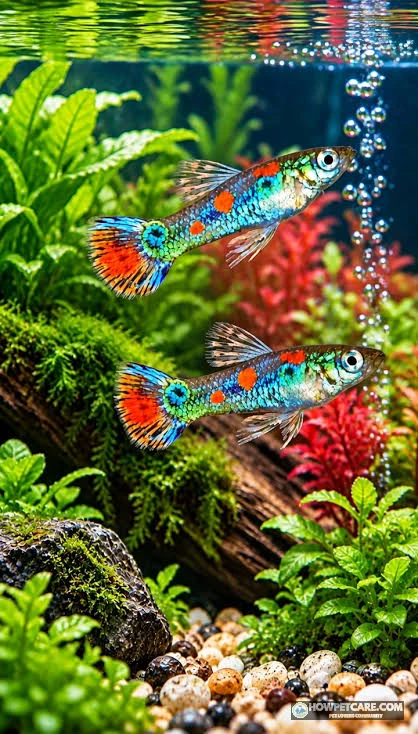

Guppies need a cycled 10-gallon or larger aquarium, 72-82°F water, a pH of 7.0-8.2, and moderate-to-hard water. Use gentle, fry-safe filtration, keep ammonia and nitrite at 0 ppm, feed small portions, and choose an all-male, all-female, or responsibly managed mixed colony.
Healthy guppies need a minimum 10-gallon aquarium, a stable temperature between 72°F-82°F (22°C-28°C), a pH of 7.0-8.2, and moderate to hard water (8-12 dGH). Choose gentle sponge-type or pre-filtered HOB filtration, and match the sex ratio to the space you can devote to fry care. Getting these basics right helps prevent the most common losses, keeps the colony calm, and prepares you for responsible breeding.
Guppy Care Fundamentals: Ideal Tank Size, Equipment, and Water Parameters
Start with the tank and water conditions. The checklist below turns the species’ needs into a practical home-aquarium setup, with equipment you can check and maintain yourself.
Core Water Parameter Targets
- Temperature: 72-82°F (22-28°C). A steady 78°F (25.5°C) provides a comfortable middle ground that supports coloration without dramatically shortening lifespan.
- pH: 7.0-8.2; staying above 7.0 protects the delicate gills of livebearers.
- General Hardness (GH): 8-12 dGH (140-215 ppm). Guppies thrive in moderately hard water; softer water can cause osmotic stress.
- Ammonia / Nitrite: 0 ppm (any detectable amount is a warning sign).
- Nitrate: < 20 ppm for routine health; spikes above 40 ppm call for urgent water changes.
Fry-Safe Filtration and Equipment Setup
| Item | Why It Matters | Recommended Spec |
|---|---|---|
| Heater | Maintains the tropical temperature range and prevents stressful temperature swings. | Adjustable 50-W submersible heater for 10-20 gal tanks. |
| Thermometer | Checks heater accuracy so temperature drift doesn’t go unnoticed. | Digital stick-on probe placed opposite the heater. |
| Test Kit | Helps you detect toxic spikes quickly. | API liquid test kit (ammonia, nitrite, nitrate, pH, GH). |
| Filter | Provides biological filtration while protecting delicate fins and newborn fry. | Sponge filter (medium) or HOB with pre-filter sponge. |
| Lighting | Simulates daylight, supports plant growth, and shows guppy coloration. | Low-intensity LED (8-10 W) on a 10-gal tank. |
| Substrate | Provides surface area for beneficial bacteria without sharp edges that can tear fins. | Fine sand or fine-grained gravel, rinsed thoroughly. |

This equipment covers the essentials for a basic tank. A beginner can assemble the hardware over a weekend.
Cycling, Testing, and Water Maintenance Troubleshooting
Guppies need a fully cycled aquarium with stable water chemistry. Use the targets and corrective actions below to check conditions and respond when test results move outside the safe range.
Diagnosing and Correcting Water Quality Spikes
| Parameter | Target Safe Range | Danger Threshold | Immediate Operational Action | Water Change Limits & Retest Interval |
|---|---|---|---|---|
| Ammonia (NH3/NH4+) | 0.0 ppm | > 0.25 ppm | Dose Seachem Prime (1 ml per 10 gal) and stop feeding for 48 h. Inspect the filter for decaying matter. | 30-40% water change with temperature-matched water; retest every 12 h until 0 ppm. |
| Nitrite (NO2-) | 0.0 ppm | > 0.25 ppm | Add aquarium salt 1 g per gal to block nitrite uptake; clear filter clogs. | 30% water change immediately; retest every 24 h. |
| Nitrate (NO3-) | 5-20 ppm | > 40 ppm | Vacuum the substrate, prune dead plant leaves, and cut dry-food portions by 50%. | 25% water change every 48 h until < 20 ppm; avoid > 50% change at once. |
| GH | 8-12 dGH | < 6 dGH (too soft) | Add crushed coral in a media bag (0.5 cup per 10 gal) or use a commercial remineralizer. | Raise no more than 1-2 dGH per 24 h; monitor daily. |
| pH | 7.0-8.2 | < 6.8 or > 8.5 | If falling, add sodium bicarbonate (½ tsp per 10 gal) or more crushed coral; if rising, use peat or a commercial pH-down buffer. | Adjust no more than 0.2-0.3 pH units per day; retest after 24 h. |
Use the retest intervals to track each correction rather than guessing whether conditions have improved.

Step-by-Step Acclimation Protocol for New Arrivals
-
Float the bag
Place the sealed bag in the tank water for 15 minutes to equalize the temperature.
-
Gradual water exchange
Open the bag and slowly add 100 ml of tank water every 5 minutes for 30-45 minutes. Use a clean cup rather than a net to avoid tearing fin tissue.
-
Final drip acclimation
Transfer the fish into a clean 5-gal quarantine bucket and attach a drip line delivering tank water at 2 drops per second for 45-60 minutes.
-
Observe before release
Watch the fish for 10 minutes. Check for normal swimming and unclamped fins before moving them to the main display.
During the drip stage, the guppy’s gills can adjust to subtle differences in pH or hardness that may have developed during transport.
Sex Ratios and Stocking Strategy: All-Male vs. All-Female vs. Mixed Colonies
Decide on the colony structure before buying fish. Your choice helps prevent repeated breeding, harassment of females, and sudden population growth.
Identifying Sex Differences in Guppies
- Male: Smaller and slender, with bright tail and body colors and a pointed gonopodium (modified anal fin). The dorsal fin is often slightly longer than a female’s.
- Female: Larger, with a rounded body, a gravid spot (dark oval) near the anal fin, and a fan-shaped anal fin. Females can store sperm for up to six months after a single mating.

Preventing Harassment and Population Explosions
| Colony Strategy | Recommended Ratio/Count | Key Advantages | Primary Management Challenges |
|---|---|---|---|
| All-Male Display | 5-6 males in 10 gal; 10-12 males in 20 gal | Bright color variety; no fry to manage. | Fin-nipping may occur if one male dominates; monitor for bullying. |
| All-Female Sorority | 12-15 females in 30 gal | Calm community; approachable for hesitant beginners. | Stored sperm can produce 4-6 broods without a male; plan for surplus fry. |
| Mixed-Sex Controlled | 1-2 males per 6-8 females (approximately 1:3 ratio) | Natural breeding with a manageable fry load. | Requires dense planting or a fry trap to protect newborns; watch for excessive male aggression. |
Use the Tank-Size & Colony Structure Planning Matrix below to match your available gallons to a stocking plan and see the management work each option requires.
| Tank Size | Stocking Setup | Exact Counts & Sex Ratios | Weekly Waste / Bio-Load Impact | Management Trade-Offs & Guardrails |
|---|---|---|---|---|
| 10 Gallon | All-Male Display | 5-6 Males | Low; little waste | No breeding. Add visual breaks (driftwood/tall plants) to deter one dominant male. |
| 10 Gallon | Breeding Trio | 1 Male, 2 Females | Rapid increase after week 4 | High risk of overcrowding. A guaranteed cull or rehoming outlet is essential. |
| 20 Gallon (Long) | Bachelor Colony | 10-12 Males | Low-to-Moderate | Best color display. School size reduces inter-male aggression. |
| 20 Gallon (Long) | Controlled Mixed Group | 2 Males, 6 Females | Moderate-to-High | 1:3 ratio keeps females unstressed. Dense floating cover is needed if saving fry. |
| 30 Gallon | Female Sorority | 15-18 Females | Moderate | Calm, low-stress aquarium. Store-bought females may produce several broods without males. |
| 30 Gallon | Sustainable Colony | 3 Males, 9 Females + 6 Corydoras | High; bi-weekly monitoring mandatory | Requires strong biological filtration (dual sponge or oversized HOB). Plan to remove 15-20 sub-adults monthly. |
Tip: If you don’t have space for a dedicated fry nursery, maintain an all-female tank and let natural survival limit numbers. Most females will produce only 20-30 fry per brood, and many fry won’t survive without cover.

What Do Guppies Eat? Nutrition, Portions, and Feeding Schedules
A balanced diet supports immune health, vivid coloration, and successful reproduction. Portion size matters, too: uneaten food adds to the tank’s waste load.
- Feeding frequency: Offer food once or twice daily. Give only what the fish consume within 60-90 seconds; excess food fuels nitrate spikes.
- Fasting day: Skip feeding one day per week to aid digestion and reduce waste buildup.
- Diet composition:
- High-quality micro-pellets or flakes (30% protein) as the staple.
- Crushed spirulina flakes for pigments.
- Freeze-dried or live baby brine shrimp (Artemia nauplii) 2-3 times per week for extra protein.
- Freeze-dried daphnia or microworms for gut-flora diversity.
- Blanched spinach or zucchini strips for fiber, once a week.
In a community aquarium, surface-dwelling guppies will out-compete bottom feeders for floating flakes. Give catfish or plecos a sinking pellet so they get food as well.

Community Compatibility: Safe Tank Mates and Betta Fish Assessment
Guppies are peaceful, but tank mates still need compatible temperaments and water requirements. Choose species that can share those conditions without threatening them.
Guppies and Bettas: Risk Factors and Assessment
- Fin length: Long-fin male guppies can trigger aggression in a male betta, who may mistake a flowing tail for a rival.
- Tank size: A minimum 20-gallon tank with heavy planting breaks up sightlines and provides escape routes.
- Temperament test: Introduce a betta in a separate quarantine tank first. Watch for flaring in response to guppy-colored objects before mixing the fish.
- Safety net: Use a floating plant canopy to keep guppies in the lower half of the tank, where the betta cannot easily nip at them.
- Bottom line: Co-habitation is possible if the betta is docile, the tank is well-planted, and you check behavior daily. Separate the fish immediately if you see any flaring or fin nipping.
Ideal Peaceful Tank Mates
| Compatible Species | Reason for Compatibility |
|---|---|
| Zebra Danio | Similar temperature range; fast swimmers that do not bully guppies. |
| Neon Tetra | Small schooling fish that occupy the mid-water column. |
| Corydoras (pictus) | Gentle bottom dwellers that help clean up leftover food. |
| Bristlenose Pleco | Eats algae and tolerates moderate flow. |
| Molly Fish (livebearer cousin) | Shares the same water hardness needs; its live-bearing nature reduces stress. |
Avoid fin-nippers such as tiger barbs, aggressive cichlids, and large predatory fish that can swallow guppies whole.

A Symptom-to-Action Health Guide: Ich, Fin Rot, Dropsy, and Quarantine
Spotting symptoms early can save fish. Before reaching for medication, use the diagnostic table to distinguish water-quality stress from signs of disease.
Symptom Diagnostic Table: Stress vs. Pathogen
| Observed Symptom | Probable Cause | Primary Trigger | Treatment & Management Steps |
|---|---|---|---|
| Clamped fins, pale coloration, gasping at surface | Water-quality stress (ammonia, nitrite, low O₂) | Elevated toxic nitrogen or poor aeration | 30-40% water change, increase surface agitation, test parameters, stop feeding for 48 h. |
| White "salt-like" spots on body, especially after temperature rise | Ich (Ichthyophthirius multifiliis) | Parasite outbreak favored by warm, stagnant water | Raise temperature to 82-84°F over 24 h, add aquarium salt 1 tbsp/3 gal, treat with copper-free medication. |
| Frayed, white-rimmed fin edges, occasional bleeding | Bacterial fin rot | Chronic nitrate > 30 ppm, tissue damage | Improve water quality (< 10 ppm nitrates), treat with Maracyn 2 or Nitrofurazone in a hospital tank. |
| Pine-coned scales, abdominal swelling, loss of buoyancy | Dropsy (possible bacterial or kidney failure) | Advanced organ failure, often secondary to poor water | Isolate immediately, 15-minute Epsom-salt bath (1 tbsp/gal), add kanamycin; consider humane euthanasia if no improvement after 4 days. |
Quarantine Tank Setup and Medication Rules
- Use a bare-bottom 5-gallon tank with a mature air-driven sponge filter (no fine media that can trap medication).
- Pre-heat to 78°F and match pH/hardness to the display tank using water transferred directly from the main tank.
- Provide a single PVC hide to reduce stress.
- Medicate only in quarantine; never add chemicals directly to a planted community tank.
- After treatment, observe the fish for a 7-day period without medication before returning them.

All new fish, purchased locally or shipped, should spend at least two weeks in a quarantine tank before joining the main display. This prevents hidden pathogens from entering the aquarium and gives you time to monitor behavior.
How to Breed Guppies at Home and Responsibly Manage Fry
Breeding guppies can be rewarding, but the population can quickly grow beyond your available space. Have a clear plan for the fry before you begin.
Gestation Signs and Birthing Care
- Pregnancy detection: Look for an expanding dark gravid spot and a boxy abdomen. Gestation lasts 21-30 days, depending on temperature (warmer water shortens the cycle).
- Birth environment: Rather than using a plastic breeder box, densely plant one corner with Guppy Grass, Hornwort, or Java Moss. These plants give newborns natural cover and reduce stress.
Fry Feeding and Growth Milestones
- Day 0-3: Fry rely on the yolk sac; no feeding is required.
- Day 3-14: Offer freshly hatched baby brine shrimp 3-4 times daily. Supplement with microworms or powdered fry starter.
- Day 14-28: Start introducing finely crushed high-protein flakes while continuing frequent micro-feedings.
- Week 4-5: Separate males (developed gonopodium) from females to prevent sibling inbreeding.
- Week 8+: Fry reach ~1 inch and can be marketed or rehomed.

The Ethical Rehoming Plan
- Pre-sale outreach: Contact local fish stores (LFS), aquarium clubs, or hobbyist groups at least two weeks before fry reach sellable size.
- Health prep: Fast fry for 12 hours before transport to reduce ammonia buildup in travel bags.
- Packaging: Use heavy-duty poly bags filled 1/3 water, 2/3 air. Insulate them in a styrofoam box with a cold pack if ambient temperature exceeds 78°F.
- Documentation: Give the new keeper a brief care sheet covering temperature, diet, and the expected growth timeline.
-
Gestation Monitoring
Check the gravid spot daily and note any sudden abdominal swelling that indicates imminent birth.
-
Live-birth Management
When fry appear, let the mother remain for 30 minutes, then gently scoop the fry into a nursery tank using a soft cup.
-
Nursery Maintenance
Perform 10% water changes daily, feed 3-4 micro-meals, and siphon out uneaten food each evening.
-
Sex Sorting
At 4-5 weeks, separate males from females under a magnifying lamp.
-
Rehoming Outreach
Two weeks before fry reach 1 inch, email LFS and hobbyist listservs with availability details.
Sourcing and Buying Guppies: Evaluating Health, Genetics, and Lifespan
Choose fish by health and breeding background, not appearance alone. The stock you buy affects both lifespan and the care your colony may need.
Commercial Stock vs. Pedigree Fancy Strains
- Feeder guppies (often $2-$4 per fish) are hardy, bred for rapid turnover, and typically live for 1-2 years.
- Fancy strains (glitter guppy, Black Moscow, Dumbo Mosaic) sell for $20-$60 per pair and may carry inbreeding issues that reduce vigor and fertility.
- Lifespan impact: Higher temperatures (> 80°F) accelerate metabolism and can shorten life to ~18 months, while maintaining 74-78°F extends average lifespan to 2-3 years.
Pre-Purchase Health Checklist
- Visual inspection: Look for clear eyes, intact fins without torn or ragged edges, and active swimming.
- Behavioral cue: Fish should school together and occasionally explore the surface rather than hide constantly.
- Tank conditions: Check for clean substrate, a working filter, and no dead fish in the seller’s tank.
- Seller credibility: Ask about water parameters, quarantine practices, and the source of breeding stock. Reputable sellers will provide a brief health guarantee and may share recent water test results.
- Shipping considerations: For online orders, verify that the carrier uses insulated packaging and that fish ship early in the week to avoid weekend delays.
A higher price doesn’t automatically mean healthier fish. Start with the health checklist; a $5 well-cared feeder may outlive a $30 inbred fancy.

Putting It All Together: Your First Guppy Colony Blueprint
Use this quick-reference matrix to match your available space and preferred colony type to the maintenance you’re prepared to do.
| Desired Goal | Tank Size | Stocking Ratio | Approx. Total Fish | Maintenance Frequency |
|---|---|---|---|---|
| Display of Color (no fry) | 10 gal | 5-6 Males | 5-6 | Weekly 20% water change, daily behavior check |
| Low-Stress Community | 20 gal (long) | 10-12 Males | 10-12 | Bi-weekly 25% water change, monthly filter media rinse |
| Controlled Breeding | 30 gal | 2 Males : 6 Females | 8 + 6-8 bottom dwellers | Weekly 25% water change, daily fry feeding routine |
| All-Female Sorority | 30 gal | 15-18 Females | 15-18 | Weekly 20% water change, monitor for hidden broods |
Actionable checklist (print and keep near your tank):
New Tank Cycling & Setup Phase
- ☐ Hardware Installation: Position the heater near the filter outflow and place the digital thermometer on the opposite side.
- ☐ Filter Intake Protection: Slip a coarse pre-filter sponge over any HOB intake.
- ☐ Fish-less Cycle: Dose liquid ammonia to 2.0 ppm; verify conversion to 0 ppm nitrite and detectable nitrate before adding fish.
- ☐ Mineral Buffer Baseline: Test tap water GH/KH; add crushed coral if GH < 8 dGH.
Daily Routine (Under 2 minutes)
- ☐ Behavioral Sweep: Look for active surface swimming and unclamped fins.
- ☐ Hardware Audit: Confirm temperature 74-78°F and check for steady filter flow.
- ☐ Precision Feeding: Offer only what the fish consume within 60 seconds; remove leftovers.
Weekly Maintenance (approximately 30 minutes)
- ☐ Pre-Water-Change Test: Check ammonia, nitrite, and nitrate; log the results.
- ☐ Substrate Vacuum: Remove waste from the top 30% of substrate; limit removal to ≤ 25% of total volume.
- ☐ Mechanical Media Cleanse: Rinse the pre-filter sponge in siphoned tank water only.
- ☐ Water Conditioning: Match the new water’s temperature within 1°F; add dechlorinator.
- ☐ Glass Service: Clean the front glass and top off evaporated water to prevent mineral creep.
Following this routine helps you avoid common problems such as parameter spikes, uncontrolled breeding, and disease outbreaks. With those basics covered, you can spend more time watching the colors and lively behavior that make guppies popular among U.S. hobbyists.
Next steps:
- Choose a tank size that fits your space and use the matrix above to decide on a colony strategy.
- Purchase the hardware on the equipment checklist and set up the fish-less cycle.
- Once the cycle is complete, use the pre-purchase health checklist to select healthy guppies.
- Acclimate them with the drip protocol, then begin a regular maintenance routine.
- If you plan to breed, follow the breeding timeline and prepare a fry-safe nursery.
Watch your fish closely and keep a record of water tests. Make adjustments slowly. Steady care gives your guppies the conditions they need to thrive for years and makes the aquarium a satisfying hobby to maintain.

| Observed Symptom | Probable Cause | Primary Trigger | Treatment & Management Steps |
|---|---|---|---|
| Clamped fins, pale coloration, gasping at surface | Water-quality stress (ammonia, nitrite, low O₂) | Elevated toxic nitrogen or poor aeration | 30-40% water change, increase surface agitation, test parameters, stop feeding for 48 h. |
| White "salt-like" spots on body, especially after temperature rise | Ich (Ichthyophthirius multifiliis) | Parasite outbreak favored by warm, stagnant water | Raise temperature to 82-84°F over 24 h, add aquarium salt 1 tbsp/3 gal, treat with copper-free medication. |
| Frayed, white-rimmed fin edges, occasional bleeding | Bacterial fin rot | Chronic nitrate > 30 ppm, tissue damage | Improve water quality (< 10 ppm nitrates), treat with Maracyn 2 or Nitrofurazone in a hospital tank. |
| Pine-coned scales, abdominal swelling, loss of buoyancy | Dropsy (possible bacterial or kidney failure) | Advanced organ failure, often secondary to poor water | Isolate immediately, 15-minute Epsom-salt bath (1 tbsp/gal), add kanamycin; consider humane euthanasia if no improvement after 4 days. |
FAQ
Can a guppy survive in a bowl without a filter or heater?
No. Guppies are tropical freshwater fish that require stable temperatures between 72°F and 82°F and active biological filtration to process toxic ammonia. Bowls lack the water volume, oxygenation, and thermal stability needed for a guppy to survive long term.
Can female guppies reproduce without a male present?
Female guppies cannot self-fertilize, but they can store viable sperm from previous matings for up to six months. A female kept with males at a pet store can produce multiple consecutive broods in an all-female aquarium.
Do adult guppies eat their own fry?
Yes, guppies may eat newborn fry. To improve fry survival, provide dense plant cover such as Java Moss or hornwort, or transfer fry to a separate nursery tank soon after birth.
Why are my guppies swimming near the surface and gasping?
Surface gasping usually indicates critically low dissolved oxygen or elevated ammonia and nitrite, which can damage gill tissue. Perform an immediate 30% to 50% water change, test the water, and increase surface agitation with an air stone or filter outflow.