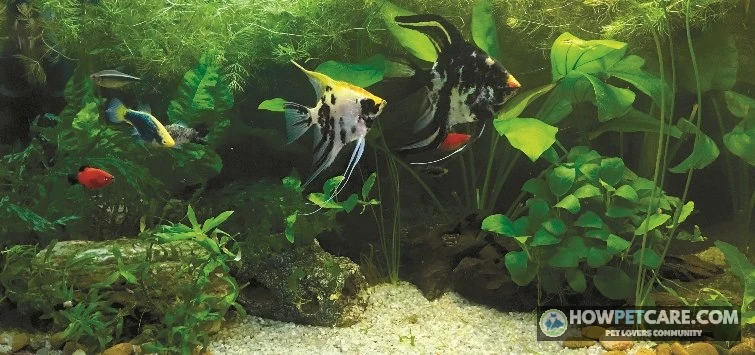

Freshwater angelfish are usually captive-bred Pterophyllum scalare cichlids. They can suit a prepared beginner who has a tall, cycled aquarium, stable warm water, compatible tank mates, a varied diet, and a separate quarantine plan—but they are not a small-tank or uncycled-tank fish.
Freshwater angelfish at a glance: care needs and saltwater look-alikes
Freshwater angelfish can suit a prepared beginner, but they need a tall, cycled aquarium, stable warm water, and carefully chosen tank mates. Most aquarium varieties are captive-bred Pterophyllum scalare, a South American cichlid. They are not the same fish as marine angelfish, which need a saltwater system.
Plan for the adult fish, not the small juvenile at the store. A 55-gallon or larger tall aquarium gives you more flexibility, particularly for a community or a group. Aqueon recommends at least a 55-gallon tall aquarium for angelfish. These fish can become territorial, especially when breeding or living in cramped conditions.
Freshwater angelfish vs. marine angelfish
| Feature | Freshwater angelfish | Marine angelfish |
|---|---|---|
| Identity | Usually Pterophyllum scalare, a cichlid | Saltwater fishes in the family Pomacanthidae |
| Water | Conditioned freshwater | Saltwater prepared for the species |
| Aquarium | Tall freshwater aquarium with gentle flow | Marine aquarium with equipment and water preparation suited to saltwater fish |
| Beginner decision | Possible for a prepared beginner | Research the particular species and marine setup before buying |
| Diet and companions | Freshwater fish foods and carefully selected tank mates | Species-specific marine diet and compatibility |

The rest of this guide covers freshwater angelfish. Don’t assume that care instructions for one group apply to the other.
Quick care requirements
| Care factor | Guidance | What to watch |
|---|---|---|
| Adult size | Often about 6 inches in body length and 8–10 inches tall including fins | Check tank height as well as gallons; long-finned fish need clearance. |
| Lifespan | Often around 8–12 years; 10–15 years is possible under ideal conditions | Health, genetics, diet, and long-term water quality all matter. |
| Tank | Consider 29 gallons a practical minimum for one adult; a 55-gallon tall tank offers more room, especially for a community | A pair or group needs more territory and a separation plan. |
| Water temperature | About 76–82°F is a practical general range; Aqueon lists 78–84°F. | Avoid rapid changes and match tank mates to the chosen range. |
| pH level | Roughly 6.5–7.8 for many captive-bred fish; Aqueon lists 6.8–7.8. | Stability and the conditions in which the fish was raised matter more than chasing a particular number. |
| Hardness | Soft to moderately hard water is a useful starting point; Aqueon lists 3–8 degrees of carbonate hardness. | Carbonate hardness, or KH, is not the same measurement as general hardness, or GH. |
| Diet | Quality flake food or appropriately sized pellets, supplemented with foods such as brine shrimp | Feed small portions and remove leftovers. |
| Temperament | Semi-aggressive; small fish may be eaten and breeding fish may defend territory. | Individual behavior and tank layout affect compatibility. |
Choose a variety and a realistic stocking plan
Most store varieties differ in color, pattern, or fin shape rather than basic care needs. Ask the seller which species and variety you’re buying: Pterophyllum altum is occasionally sold, while Pterophyllum leopoldi is rare. Don’t assume either has requirements identical to those of a common captive-bred P. scalare.
How common varieties look
| Variety | Appearance to look for | Buying consideration |
|---|---|---|
| Silver | Silvery body with dark vertical bars | A familiar, comparatively simple pattern to recognize. |
| Marble | Irregular dark and light patches rather than neat bars | The pattern varies from fish to fish. |
| Koi | White or pale body with orange and black markings | Color and pattern vary; attractive markings can affect the asking price. |
| Veiltail | Extended, trailing fins; can occur in several colors | Long fins need open clearance and are vulnerable to nipping. |
| Albino | Pale coloration and characteristic reddish eyes | Ask the seller about the fish’s history and observe how it feeds and swims. |

Use these descriptions as identification aids, not guarantees of lineage. The seller’s label and the fish’s appearance may not reveal its exact genetics.
Single fish, pair, or group?
One angelfish can be a manageable starting point if its tank is appropriately sized and its companions are compatible. A bonded pair may coexist well, but two randomly selected juveniles aren’t necessarily a pair and may become aggressive as they mature. Even a bonded pair can defend a spawning site against the rest of the tank.
A group needs substantially more room, visual barriers, and a plan for fish bullied when pairs form. A 55-gallon tall aquarium is a more realistic starting point than a small tank, but it doesn’t guarantee that every group will coexist. Stock according to adult size, footprint, filtration, and behavior; be prepared to separate or responsibly rehome fish.

Size and cycle the aquarium before bringing a fish home
Tank size, equipment, and layout
A tall aquarium matters because an adult angelfish’s fins extend well above and below its body. For one adult, treat 29 gallons as a practical minimum only if the tank has sufficient height, open swimming room, and light stocking. A 55-gallon tall tank provides more margin and is the minimum recommended by Aqueon. A community or group may need even more space.
Install a reliable heater and thermometer, a filter rated for the aquarium, and a secure lid. Set the filter return for gentle movement rather than a current that pushes fish around. Plants and upright driftwood can break sight lines, but leave an open swimming area and avoid sharp decorations that could tear fins. Aqueon also recommends gentle flow, broadleaf plants, and vertical driftwood.

Cycling and acclimating step by step
The nitrogen cycle is the process by which beneficial microbes convert toxic ammonia from waste into nitrite and then nitrate. A new filter needs time to establish those microbes. Clear water alone doesn’t mean the aquarium is safe.

-
Set up the aquarium
Install the heater, thermometer, filter, lid, substrate, and decorations. Fill with tap water treated with an appropriate water conditioner and run the equipment.
-
Cycle without fish
Use an aquarium-appropriate ammonia source and a liquid test kit to track ammonia, nitrite, and nitrate. Follow the ammonia product’s directions and allow the biofilter to develop before buying the fish.
-
Confirm the cycle
The tank should process its usual ammonia input to zero detectable ammonia and nitrite; nitrate should be controlled with conditioned partial water changes. Check readings over several days rather than relying on one test.
-
Stabilize and prepare quarantine
Confirm the temperature holds within your chosen range and pH is stable. Prepare a separate heated, cycled quarantine tank with its own equipment before purchase.
-
Match temperature
Dim the lights and float the closed transport bag in the quarantine tank for about 15–20 minutes, following any seller instructions that differ.
-
Adjust to the water
Open the bag and gradually add small amounts of quarantine water over about 30 minutes. For a long shipment, ask the seller for its acclimation instructions: leaving an opened bag for a prolonged period can expose fish to increasingly toxic ammonia.
-
Transfer and observe
Gently net or transfer the fish without adding transport water to the tank. Keep lighting subdued, watch breathing and behavior, and offer a small meal once the fish settles.
A divider in the display tank may help with aggression, but it isn’t quarantine: shared water can carry pathogens between fish. If a cycled quarantine tank is unavailable, postpone the purchase rather than relying on a divider for disease protection.

Maintain stable water, feed a varied diet, and choose tank mates carefully
Water parameters and weekly maintenance
Keep temperature, pH, and hardness within a range appropriate for the fish you buy, and ask the seller about its existing conditions. Captive-bred fish may tolerate some variation; abrupt swings can be more stressful than a stable reading that differs slightly from an idealized target.
Test ammonia and nitrite whenever a tank is new, a fish looks unwell, or the filter has been disrupted. Both should be undetectable in a functioning aquarium. Check nitrate regularly and control it with partial water changes. Aqueon suggests either weekly 10% or biweekly 25% changes as a starting schedule. A more heavily stocked aquarium may need a different routine based on test results.
During water changes, use conditioner and match the replacement water’s temperature as closely as practical. Gently rinse dirty filter media in removed aquarium water rather than replacing all the media at once; the established media houses much of the biological filtration.

Diet and feeding schedule
Angelfish eat a varied diet. Use a quality tropical or cichlid flake food or suitably sized pellet as the staple, with occasional frozen or properly sourced live foods such as brine shrimp. Thaw frozen food as directed, and use rich foods, including bloodworms, as supplements rather than the whole diet.
Offer adults a small amount once or twice a day—roughly what they readily eat in a couple of minutes. Remove uneaten food. Juveniles may need smaller, more frequent meals; increase maintenance accordingly. Watch bottom-dwelling tank mates at feeding time so the angelfish don’t take all the food.

Tank-mate compatibility matrix
No tank-mate list is a guarantee. Angelfish may eat smaller fish, and their territorial behavior can intensify during spawning. Choose companions for their adult size and shared water needs, observe them daily, and keep a separation plan.
| Candidate | Typical fit | Conditions and potential problems |
|---|---|---|
| Corydoras catfish | Often suitable | Keep a suitable group, use smooth substrate, and provide sinking food. Choose a species comfortable with the tank’s temperature. |
| Bristlenose pleco | Often suitable | Provide a cave, appropriate food, and room for its adult size; monitor interactions. |
| Larger peaceful tetras | Conditional | A school of appropriately sized fish may work, but small individuals can be eaten and breeding angelfish may chase companions. |
| Neon or cardinal tetras | High risk | Even established small fish may become prey as an angelfish grows; don’t count on cover to eliminate the risk. |
| Other angelfish | Conditional | A compatible pair or planned group needs space; a pair may bully others once it forms. |
| Discus | Advanced, conditional | Require careful matching of temperature, feeding, space, and health management; Aqueon notes discus compatibility at temperatures above 82°F. |
| Bettas | Generally avoid | Long fins and individual territorial behavior can lead to injury or sustained stress. |
| Tiger barbs and other fin-nippers | Avoid | Trailing fins are an easy target, particularly on veiltails. |
| Tiny fish, fry, and small shrimp | Avoid | Anything small enough to fit in an angelfish’s mouth may be eaten. |

Budget for the fish, the aquarium, and ongoing ownership
Where to buy and what to check
You can find freshwater angelfish at independent aquarium stores, chain retailers such as PetSmart, online sellers such as LiveAquaria, and specialist breeders. Each has trade-offs. A local shop lets you inspect fish in person, while a breeder may know more about a particular line. Online selection can be wider, but shipping adds cost and stress. Check the seller’s arrival, refund, and quarantine policies before ordering.
The following are illustrative U.S. planning allowances, not verified 2026 price quotes. Actual prices vary by region, seller, fish size, variety, availability, and shipping. Get current quotes before committing to a purchase.
| Purchase option or variety | Illustrative fish-only allowance | What can change the total |
|---|---|---|
| Common silver or other standard variety | About $5–$15 | Size, store, and local availability |
| Marble | About $12–$25 | Pattern, size, and seller |
| Specialty koi, veil, or albino | About $20–$40 or more | Lineage, appearance, size, and availability |
| Online seller or breeder | Ask for a fish price plus shipping | Insulated packaging, delivery, minimum orders, and live-arrival terms |
Before buying, watch the fish swim and eat if possible. Look for clear eyes, intact fins, steady breathing, and an upright posture. Avoid a tank with multiple visibly sick or dead fish, and ask how long the new arrivals have been at the store. A healthy-looking fish can still carry disease, so quarantine remains useful.
First-year and recurring costs
A fish’s purchase price is only a small part of the commitment. The following example uses the planning allowances listed for a single marble angelfish and a 29-gallon setup. These are estimates, not a survey of current retailer prices, and don’t include sales tax or delivery.
| Category | Illustrative allowance | Timing or caveat |
|---|---|---|
| Marble angelfish | $12–$25 | Fish only |
| Tank and stand | $180–$350 | Confirm the stand is rated for the filled aquarium. |
| Heater and thermometer | $30–$60 | Initial equipment |
| Filter or filter upgrade | $40–$90 | Check whether a tank kit already includes one. |
| Test kit and initial conditioner | $35–$60 | Initial supplies |
| Substrate, decor, and lid | $60–$150 | Initial setup; avoid counting kit components twice. |
| Food | $8–$15 per month | Varies with package size and waste. |
| Conditioner and test refills | $4–$10 per month | Averaged allowance; avoid double-counting initial supplies. |
| Electricity | $3–$10 per month | Depends on local rates, heater use, and room temperature. |
| Medication or replacement-parts reserve | $30–$80 | A reserve, not a substitute for veterinary care. |

The listed setup equipment totals about $345–$710 before the fish. Adding the fish, recurring allowances, and reserve gives roughly $590–$1,180 for the first year. That’s arithmetic on the illustrative ranges, not a promised retail total. A separate quarantine setup, veterinary fees, shipping, and additional tank mates can increase it; a complete kit may reduce some individual equipment costs. For subsequent years, the listed recurring items and reserve total roughly $210–$500, before replacement equipment or veterinary care.
Get local quotes for both the display and quarantine tanks before buying the fish. If a tank kit includes a lid, heater, or filter, check the quality and suitability of each item rather than paying for it twice.
Quarantine new arrivals and respond to illness or injury
A symptom can have several causes. White spots, damaged fins, or refusal to eat are reasons to check the environment and observe closely, not proof of a particular diagnosis. An aquatic veterinarian can help when signs are severe, progress, or don’t respond to basic care.
Quarantine protocol
- Prepare a separate tank. Use a heated, filtered aquarium with an established biological filter, thermometer, cover, and simple shelter. Size it for the fish; a small temporary container can foul quickly.
- Keep equipment separate. Use a dedicated net, siphon, and other tools. Don’t move quarantine water into the display tank.
- Acclimate and observe. Transfer the fish using the acclimation process above. Watch daily for appetite, breathing changes, spots, damaged fins, and abnormal swimming.
- Test and maintain water. Check ammonia and nitrite regularly, especially if the quarantine filter is lightly established. Change conditioned, temperature-matched water as needed.
- Allow an observation period. A practical starting period is about four weeks; ask an aquatic veterinarian for advice if the fish has symptoms or a known exposure. Quarantine reduces risk but can’t guarantee a fish is disease-free.
- Transfer only when appropriate. Move a healthy, eating fish into the display after the observation period. If illness appears, extend quarantine and resolve the problem before transfer.

Ich and fin-rot response
Suspected Ich: Tiny white, salt-like spots and rubbing against objects can be consistent with Ich, but other problems can look similar.
- Test ammonia and nitrite, check temperature, and correct water-quality problems with conditioned partial water changes. Increase aeration if breathing is fast.
- Consult an aquatic veterinarian or knowledgeable aquatic professional if identification is uncertain. Ich can affect an entire aquarium even when spots are visible on only one fish, so isolating the visibly affected fish alone may not address exposure in the original tank.
- Select a freshwater Ich treatment labeled for the fish and aquarium inhabitants. Check restrictions for invertebrates, plants, and sensitive species. Follow the label for dose, duration, filtration changes, and water changes; don’t mix treatments unless directed by a veterinarian.
- Continue the full labeled course and monitor water quality and breathing. Don’t rely on raising temperature alone, and don’t rapidly increase it: warmer water can hold less oxygen.
- Seek prompt veterinary help for labored breathing, worsening signs, or uncertainty about treating a mixed-species tank.
Suspected fin rot or fin damage: Ragged fins can result from nipping, sharp decor, or infection. The response depends on the cause.
- Test the water and correct detectable ammonia or nitrite. Maintain clean water with appropriately sized, conditioned partial changes.
- Watch the tank at feeding and quiet times. Remove a persistent fin-nipper or sharp object; separate the injured fish if it can’t recover safely.
- Observe the fin edges and the fish’s behavior. Clean tears may recover with good conditions, while spreading erosion, redness, or fuzzy growth warrants closer assessment.
- Contact an aquatic veterinarian if damage progresses, the fish stops eating, or you see extensive inflammation. Use medication only when appropriate for the suspected problem and according to its label or veterinary directions; unnecessary medication can harm fish or the biofilter.
If a fish is gasping or several fish are breathing rapidly, increase surface agitation, test the water, and make a conditioned, temperature-matched partial water change if water quality is poor. Seek veterinary help promptly if distress continues or worsens.
What to do when an angelfish stops eating
| What you see | First checks | Immediate response and escalation |
|---|---|---|
| Refuses food | Test ammonia and nitrite; check temperature and bullying. | Offer a small amount of a familiar or tempting food, such as thawed brine shrimp, and remove leftovers. Contact a vet if refusal persists for several days, weight drops, or other symptoms develop. |
| Clamped fins or hiding | Check water, recent changes, and aggressive tank mates. | Reduce disturbance and separate a bully. Escalate if the fish remains distressed or develops visible symptoms. |
| Nipped fins | Watch for fin-nippers and inspect decor. | Remove the cause and maintain clean water. Seek help if damage spreads or becomes inflamed. |
| Rapid breathing | Check filter operation, surface movement, temperature, ammonia, and nitrite. | Increase aeration and correct water problems; seek prompt help if distress persists. |
| White or fuzzy eggs | Inspect the spawn without repeatedly disturbing the pair. | White eggs may be infertile or affected by fungus; see the breeding guidance below. |
Understand lifespan, sexing limits, and breeding outcomes
Freshwater angelfish can be a long commitment: many live around 8–12 years, and some reach 10–15 years under ideal conditions. Stable water, suitable food, a safe social environment, and early attention to illness support a longer life, although genetics and prior care matter too.
Male or female? What visual signs can tell you
Juvenile angelfish can’t be reliably sexed by appearance. Body shape, forehead shape, and fin length are at best uncertain clues, not a dependable way to select a male and female at the store.
Near spawning, an adult’s breeding tube may be visible: the female’s egg-laying tube is generally broader and blunter, while the male’s is usually narrower and more pointed. Even then, visibility and interpretation vary. A practical workaround is to raise a group and allow a compatible pair to form, but only if you have enough space and a plan to separate or rehome fish as territories develop.
Breeding and troubleshooting eggs
A compatible pair may clean a broad leaf, slate, or another vertical surface and lay eggs there. Expect the adults to defend that area. In a community tank, protect other fish from persistent aggression and avoid moving a pair into a breeding setup unless it is ready and cycled.
White eggs may be infertile, developing fungus, or both; color alone doesn’t confirm the cause. Parents often remove unsuccessful eggs themselves. If you’re managing a separate spawn, gently remove clearly fungused eggs when practical without damaging the others, and maintain clean, well-oxygenated water. Ask an experienced breeder or aquatic veterinarian about any egg treatment rather than dosing the community aquarium indiscriminately.
Pairs sometimes eat eggs, especially when inexperienced or disturbed. Don’t assume that a single lost spawn means the pair is incompatible. Reducing disturbance and giving the pair another opportunity may help. If you intend to raise fry, arrange a separate cycled rearing system, suitable first foods, water-change supplies, and responsible homes before encouraging repeated spawns.

Use this pre-purchase checklist to decide whether an angelfish fits
- Tank: You’ve checked the actual height and adult swimming space, not just the gallon label, and budgeted for a larger tank if keeping a community or group.
- Water: The heated, filtered aquarium is cycled; ammonia and nitrite are undetectable, nitrate is managed, and temperature and pH are stable.
- Stocking: The variety and adult size fit your setup, tank mates aren’t obvious prey or fin-nippers, and you can separate fish if aggression develops.
- Budget: You’ve priced the fish, equipment, food, electricity, quarantine, and a reserve for healthcare or replacements.
- Purchase: You can inspect the fish or understand the seller’s shipping and health policies, and your separate quarantine tank is ready.
If any of these are missing, prepare the equipment and finish the cycle before bringing an angelfish home.
| Candidate Tank Mate | Typical Fit | Conditions and Potential Problems |
|---|---|---|
| Corydoras catfish | Often suitable | Keep a suitable group, use smooth substrate, and provide sinking food. Choose a species comfortable with the tank's temperature. |
| Bristlenose pleco | Often suitable | Provide a cave, appropriate food, and room for its adult size; monitor interactions. |
| Larger peaceful tetras | Conditional | A school of appropriately sized fish may work, but small individuals can be eaten and breeding angelfish may chase companions. |
| Other angelfish | Conditional | A compatible pair or planned group needs space; a pair may bully others once it forms. |
| Discus | Advanced, conditional | Require careful matching of temperature, feeding, space, and health management; Aqueon notes discus compatibility at temperatures above 82°F. |
| Neon or cardinal tetras | High risk | Even established small fish may become prey as an angelfish grows; don't count on cover to eliminate the risk. |
| Bettas | Generally avoid | Long fins and individual territorial behavior can lead to injury or sustained stress. |
| Tiger barbs and other fin-nippers | Avoid | Trailing fins are an easy target, particularly on veiltails. |
| Tiny fish, fry, and small shrimp | Avoid | Anything small enough to fit in an angelfish's mouth may be eaten. |
FAQ
How long do angelfish live?
Freshwater angelfish commonly live around 8–10 years in a well-maintained aquarium, though lifespan varies with health, genetics, and care. Stable water quality and an appropriately sized tank support longevity.
Are angelfish good for beginners?
They can suit a beginner who is prepared to cycle and maintain a larger, taller aquarium and manage semi-aggressive behavior. They are not a good choice for an uncycled tank or a small community aquarium with vulnerable fish.
Can angelfish live with small schooling fish?
Some may coexist with appropriately sized, fast-moving fish, but small fish can be viewed as prey as angelfish mature. Introductions and ongoing monitoring are essential, and compatibility is never guaranteed.
Why are my angelfish eggs turning white?
White eggs are often infertile or affected by fungus, though appearance alone cannot confirm the cause. Keep water clean, remove clearly fungused eggs if appropriate, and avoid disturbing the pair unnecessarily.