

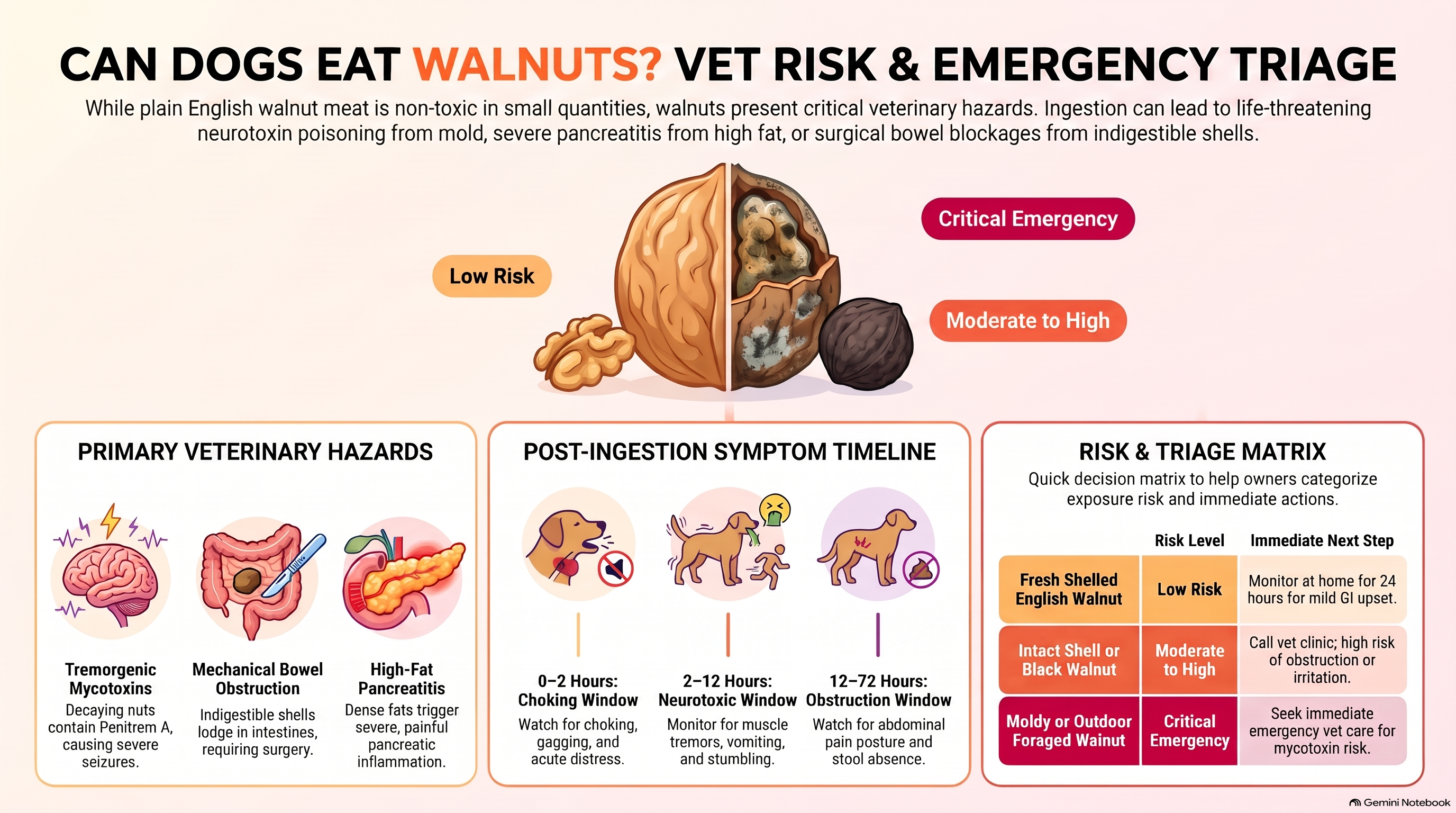
Dogs should not eat walnuts. While fresh, shelled English walnut meat is not directly poisonous, walnuts pose serious health hazards: dense fats that trigger severe acute pancreatitis, indigestible shells that cause mechanical bowel obstructions, and mold on decaying nuts producing life-threatening tremorgenic mycotoxins.
Dogs should not eat walnuts as a routine treat, but a single dropped piece of plain, fresh walnut is rarely an emergency. While English walnut meat is not directly poisonous to canines, walnuts present serious veterinary hazards: high fat content that triggers painful pancreatic inflammation, rigid shells that create mechanical intestinal obstructions, and dangerous molds capable of producing life‑threatening neurotoxins.
Whether your pet requires emergency veterinary intervention or simple home observation depends entirely on the variety of walnut, whether the shell or husk was swallowed, the presence of decay, and the quantity consumed. Owners often wonder what human foods are safe for dogs before sharing any snacks.
Can Dogs Eat Walnuts? Quick Vet Verdict on Plain English Walnuts
The short answer is no: dogs should not be fed walnuts intentionally. However, an accidental single bite does not warrant immediate panic if the nut meets specific criteria.
Plain English (shelled) walnuts
The common grocery store walnut—known botanically as the English walnut (Juglans regia)—is technically non‑toxic in its fresh, shelled form. If your medium or large dog vacuums up a dropped plain kernel from the kitchen counter, systemic poisoning is unlikely. English walnut meat does not contain intrinsic canine toxins like those found in macadamia nuts. Mild gastrointestinal upset, such as self‑limiting loose stool, may occur, but most dogs recover without intervention within 24 hours.

When a walnut becomes a health risk
A harmless kernel crosses the line into a clinical emergency under several specific conditions:
- Presence of shells or husks: Walnut shells are thick, fibrous, and completely indigestible. They create immediate choking hazards and abrasive physical blockages in the gastrointestinal tract.
- High fat content: Walnuts are packed with dense plant oils and lipids. A sudden load of dietary fat can provoke severe exocrine pancreatitis, especially in smaller dogs or breeds prone to metabolic sensitivity. Pet owners often wonder if can dogs eat peanuts safely as well.
- Decay and fungal growth: Walnuts harbor high moisture levels inside their crevices. Outdoor walnuts fallen from trees or stale pantry nuts quickly grow microscopic molds that release potent, tremor‑inducing mycotoxins.
- Commercial seasonings: Pre‑packaged snack walnuts frequently carry heavy salt, garlic, onion powder, or artificial sweeteners like xylitol, which is toxic; however, dogs can have honey safely as a natural alternative.
What to Do Right Now If Your Dog Just Ate a Walnut
If you caught your dog eating a walnut or discovered an empty bag, take these methodical triage steps immediately.
-
Secure the scene and secure your pet
Remove any remaining nuts, shells, or packaging from your dog’s reach. Check your dog’s mouth safely to remove loose shell fragments without risking a bite.
-
Check immediate airway and breathing
Check your dog for signs of acute choking or esophageal distress: frantic pawing at the mouth, exaggerated swallowing, gagging, or blue‑tinged gums. If your dog cannot breathe, call an emergency vet immediately or begin emergency canine choking maneuvers.
-
Identify the walnut profile
Determine whether the walnut was a fresh store‑bought English walnut or an outdoor foraged nut. Note whether it was shelled, whole in its hard shell, or still wrapped in a green or black hull. Look for visible black, white, or green mold.
-
Estimate dose and timeline
Note the approximate time of ingestion and the quantity missing. Calculate whether your dog consumed a single broken kernel or a massive volume (such as 1/2 cup or more).
-
Contact veterinary professionals
If your dog ate whole shells, black walnuts, moldy nuts, or secondary toxic ingredients, call your local veterinarian or an animal poison control hotline immediately.
Assessing the situation
Before calling a clinic, collect clear details about the exposure. A 70‑pound Labrador retriever swallowing one plain English walnut half faces an entirely different physiological risk than a 9‑pound Dachshund swallowing a whole, unshelled walnut or a moldy backyard husk. If the nut came from outdoors, inspect the ground where your dog found it. Damp, dark, or decomposing yard debris significantly elevates the clinical urgency.

When to monitor at home vs. call a vet
You can typically monitor your dog at home if they meet all the following low‑risk criteria:
- The dog is medium‑to‑large breed.
- The nut was a single, fresh, plain, unshelled English walnut kernel.
- No shells, toxic seasonings, or sweetening agents were consumed.
- The dog exhibits normal behavior, bright energy, and no signs of distress.
Never administer hydrogen peroxide, salt, or oils to force your dog to vomit up a walnut. Walnut shells have jagged, sharp edges that can lacerate the esophagus on the way back up. Furthermore, hydrogen peroxide frequently causes severe hemorrhagic gastritis and carries a severe risk of fatal aspiration pneumonia. The optimal veterinary window to safely evaluate gastric decontamination is within 2 hours of ingestion.
Black Walnuts, Moldy Walnuts, and Other High‑Risk Types Explained
Not all walnuts share the same botanical or chemical profile. In clinical practice, veterinary toxicologists categorize walnuts into three distinct risk tiers based on species and fungal contamination.
| Walnut Type | Primary Hazard | Typical Symptoms | Relative Risk (Low/Moderate/High) |
|---|---|---|---|
| Fresh English Walnut (Juglans regia) | Dietary fat, minor GI irritation | Mild loose stool, single vomiting episode | Low |
| Black Walnut (Juglans nigra) | Juglone content, hard woody husk | Hypersalivation, vomiting, abdominal colic | Moderate to High |
| Moldy Walnut (Any species) | Tremorgenic mycotoxins (Penitrem A) | Fine muscle tremors, stumbling, seizures | High (Critical Emergency) |
| Whole Walnut Shells | Rigid mechanical foreign body | Projectile vomiting, complete bowel blockage | High |
Juglone vs. mycotoxin toxicity
Much confusion across the internet stems from conflating juglone with tremorgenic mycotoxins. These are entirely different compounds with different biological targets:
- Juglone (5‑hydroxy‑1,4‑naphthalenedione): A naphthoquinone chemical compound produced naturally throughout the roots, leaves, bark, and husks of the American Black Walnut tree (Juglans nigra). While juglone is notoriously toxic to horses—triggering severe, life‑threatening laminitis from black walnut wood shavings—its canine effects are primarily focused on the digestive tract. When a dog ingests black walnut hulls, juglone acts as a direct chemical irritant to the gastric mucosa, resulting in acute hypersalivation, retching, vomiting, and abdominal pain. It does not independently trigger rapid full‑body neurological seizures.
- Tremorgenic Mycotoxins: Fungal metabolites produced by molds (predominantly Penicillium crustosum and Penicillium nigricans) that thrive on high‑fat, high‑moisture organic matter like decaying walnuts. The most dangerous of these compounds are penitrem A and roquefortine C. Once absorbed into the bloodstream, these mycotoxins cross the blood‑brain barrier and antagonize neurotransmitters (specifically disrupting GABA and glycine pathways), inducing violent, sustained muscle tremors, severe hyperthermia, and potentially fatal grand mal seizures. Additionally, the risk of almonds for dogs should be evaluated when offering any nut mixes.
Why mold changes the risk profile
Moldy walnuts are an unequivocal veterinary emergency. A dog foraging under autumn trees does not need to eat an entire pile of decaying nuts to absorb a lethal dose of penitrem A. Even chewing on a single decomposing black walnut hull saturated with fungal growth can flood the canine central nervous system with toxins, initiating neurological breakdown in as little as 1 to 6 hours.

Recognizing Symptoms – Neurological, Gastrointestinal, and Obstruction Signs
Do not assume a lack of immediate distress means your dog is clear. Track these distinct physiological phases:
- Phase 1: The Acute Window (0 to 2 Hours)
- Primary Concern: Choking, acute esophageal lodging, rapid‑acting chemical irritation.
- Check: Listen for gagging, retching, or labored breathing. Look for excessive lip‑licking, drooling, or sudden distress. In cases of massive mold ingestion, subtle muscle twitches or restlessness may begin toward the end of this window.
- Phase 2: The Neurotoxic & Gastric Window (2 to 12 Hours)
- Primary Concern: Tremorgenic mycotoxins (if moldy) and primary gastric upset.
- Check: Watch gait and coordination. Tremors typically start in the facial muscles and neck before spreading to full‑body stiffness or whole‑body shaking. Check for persistent, repeated vomiting or watery diarrhea.
- Phase 3: The Pancreatic & Mechanical Window (12 to 72 Hours)
- Primary Concern: Acute pancreatitis and lower intestinal blockage.
- Check: Look for posture changes—particularly the "prayer stretch" (front paws down, rear end up in the air to relieve gut pain). Track bowel movements: straining to defecate, producing ribbon‑thin stools, or producing no stool alongside repeated vomiting indicates a mechanical obstruction requiring immediate surgical evaluation.
Acute neurological symptoms
If your dog consumed moldy outdoor nuts or black walnut husks, neurological degradation can develop with alarming speed. Early signs include subtle facial twitching, flicking ears, restlessness, and hypersalivation. As the mycotoxins disrupt motor regulation, the dog exhibits ataxia (a wobbly, uncoordinated "drunken" gait), involuntary eye movements (nystagmus), rigid limb stiffness, hyperthermia (dangerously elevated body temperature driven by continuous muscle contractions), and progression into sustained tonoclonic seizures.
Gastrointestinal upset
Standard dietary intolerance or mild juglone irritation presents primarily through digestive rejection. A dog may develop loose stools, gas, and transient nausea. Mild upset typically resolves naturally within 24 hours. However, persistent vomiting—specifically vomiting more than twice in a 12‑hour window—signals systemic distress that warrants professional clinical care.

Physical blockage timeline
Unlike neurotoxins, an intestinal foreign body does not manifest immediately. While a large walnut shell may lodge in the esophagus within minutes, a shell that makes it into the stomach often bounces around before attempting to pass into the narrow duodenum. Symptoms of physical obstruction typically emerge between 24 and 72 hours post‑ingestion. Watch for total food refusal (anorexia), vomiting immediately after drinking water, painful abdominal guarding, and complete absence of bowel movements.
Pancreatitis warning signs
The exocrine pancreas responds aggressively to concentrated dietary fats. When overloaded, digestive enzymes activate prematurely inside the pancreatic tissue itself, essentially digesting the organ and triggering severe local and systemic inflammation. Symptoms usually arise 12 to 24 hours after the high‑fat meal. Warning signs include severe lethargy, persistent retching, fever, and acute cranial abdominal pain manifested by the classic hunched "prayer position." Severe canine pancreatitis can cause systemic inflammatory response syndrome (SIRS) and requires hospitalization with intensive IV fluid therapy.

How Many Walnuts Are Too Many? Why No Universal Toxic Dose Exists
A common question from anxious dog owners is: "How many walnuts per pound of body weight are poisonous?"
The evidence‑qualified medical reality is direct: there is no scientifically validated milligram‑per‑kilogram (mg/kg) toxic threshold for walnuts in dogs. Any website offering a rigid mathematical "walnut toxicity calculator" is fabricating numbers.
Walnut toxicity cannot be calculated like chocolate or xylitol because the primary threats do not stem from a uniform, predictable quantity of a single chemical in the nut meat. Consider the clinical variables:
- Mycotoxin Concentration Is Random: One decomposing walnut hull might contain a lethal payload of penitrem A, while a visually similar nut under the same tree contains none. It is impossible to calculate a safe number when fungal spore saturation varies wildly.
- Physical Dimensions Dictate Blockage: A single intact, unshelled walnut poses an almost zero mechanical obstruction risk to an 85‑pound German Shepherd, whose pylorus and small intestine can frequently pass larger smooth objects. That exact same walnut will cause a complete, life‑threatening intestinal blockage in a 7‑pound Yorkshire Terrier.
- Pancreatic Sensitivity Varies by Individual: A robust working dog might consume half a cup of crushed walnuts without outward illness, whereas a Miniature Schnauzer or an older dog with a history of metabolic disease can trigger full‑blown acute pancreatitis from two walnut halves.
Because veterinary medicine cannot define a universally safe threshold, the only responsible clinical rule is zero intentional feeding.
Separating the Four Risk Pathways: Juglone, Mycotoxins, Physical Blockage, Pancreatitis
To manage an ingestion effectively, veterinary clinicians untangle four distinct pathological pathways. Conflating these issues leads to incorrect treatments—such as watching for seizures when the real danger is a surgical bowel obstruction.
| Threat Pathway | Primary Toxic or Physical Agent | Target Organ / System | Typical Symptom Profile | Key Clinical Marker |
|---|---|---|---|---|
| Chemical Irritation | Juglone (5‑hydroxy‑1,4‑naphthalenedione) | Gastric mucosa, upper GI tract | Hypersalivation, acute vomiting, mild diarrhea | Mild, transient mucosal inflammation without muscle tremors |
| Tremorgenic Mycotoxicosis | Penitrem A and Roquefortine C (from Penicillium molds) | Central Nervous System (GABA / Glycine pathways) | Fine muscle tremors, ataxia (stumbling), hyperthermia, tonoclonic seizures | Rapid neurological onset; motor dysfunction absent in plain nut ingestion |
| Mechanical Obstruction | Indigestible shell fragments and fibrous husks | Pylorus, small intestine (ileocecal valve) | Projectile vomiting, complete anorexia, absence of stool, abdominal guarding | Visible foreign bodies on abdominal radiographs; painful, rigid abdomen |
| High‑Fat Pancreatitis | Dietary triglycerides (excessive lipid load) | Exocrine pancreas, secondary systemic inflammation | Hunched "prayer position," protracted vomiting, delayed lethargy, fever | Elevated Canine Pancreatic Lipase (Spec cPL); onset often delayed 12–48 hours |
Source and mechanism of each hazard
- Juglone: Sourced specifically from the Juglans nigra tree family. It is an allelopathic naphthoquinone that inhibits metabolic enzymes in competing plants and irritates mammalian epithelial tissue.
- Tremorgenic Mycotoxins: Sourced from mold growth on spoiled or outdoor organic material. They act directly on presynaptic receptors, causing sustained neuromuscular hyperexcitability.
- Foreign Body Obstruction: Sourced strictly from the hard, woody endocarp (the shell) and dense fibrous outer husk. Canine stomach acid cannot break down these lignin‑rich plant fibers.
- Pancreatic Inflammation: Sourced from the dense fatty acid concentration inherent to all walnut meats (roughly 65% fat by weight). The surge in blood lipids overwhelms normal lipid metabolism.
Diagnostic clues vets use to differentiate them
When a dog arrives at an emergency clinic, the veterinary team uses timing and diagnostic tools to isolate the problem:
- Rapid‑onset tremors with normal bloodwork points toward mycotoxins, which do not show up on routine in‑house blood chemistry panels but manifest via obvious neuromuscular excitability.
- Abdominal radiographs and ultrasound are deployed when vomiting starts 24 to 48 hours post‑ingestion to identify radiopaque shell fragments or localized intestinal plication.
- Spec cPL (Specific Canine Pancreatic Lipase) testing is run on dogs showing severe upper abdominal pain to differentiate simple dietary indiscretion from true acute pancreatitis.
| Threat Pathway | Primary Toxic or Physical Agent | Target Organ / System | Typical Symptom Profile | Key Clinical Marker |
|---|---|---|---|---|
| Tremorgenic Mycotoxicosis | Penitrem A and Roquefortine C (from Penicillium molds) | Central Nervous System (GABA / Glycine pathways) | Fine muscle tremors, ataxia (stumbling), hyperthermia, tonoclonic seizures | Rapid neurological onset; motor dysfunction absent in plain nut ingestion |
| High‑Fat Pancreatitis | Dietary triglycerides (excessive lipid load) | Exocrine pancreas, secondary systemic inflammation | Hunched "prayer position," protracted vomiting, delayed lethargy, fever | Elevated Canine Pancreatic Lipase (Spec cPL); onset often delayed 12–48 hours |
| Mechanical Obstruction | Indigestible shell fragments and fibrous husks | Pylorus, small intestine (ileocecal valve) | Projectile vomiting, complete anorexia, absence of stool, abdominal guarding | Visible foreign bodies on abdominal radiographs; painful, rigid abdomen |
| Chemical Irritation | Juglone (5‑hydroxy‑1,4‑naphthalenedione) | Gastric mucosa, upper GI tract | Hypersalivation, acute vomiting, mild diarrhea | Mild, transient mucosal inflammation without muscle tremors |
Hidden Hazards in Cooked or Baked Walnut Foods
Accidental walnut exposures rarely occur from plain raw nuts alone. Frequently, dogs consume walnuts through human kitchen baked goods: walnut banana bread, holiday cookies, brownies, or breakfast pastries. In these scenarios, the walnut itself is often the least dangerous ingredient present.
Common toxic add‑ins in baked goods
Before worrying about walnut toxicity, audit the food label or recipe immediately for these secondary ingredients:

- Xylitol (Wood Sugar / Birch Bark Extract): Commonly used as a low‑calorie sugar replacement in baked goods. In dogs, xylitol triggers a catastrophic, rapid release of insulin leading to profound hypoglycemia within 30 to 60 minutes, followed by acute, irreversible liver necrosis. It is rapidly fatal without emergency dextrose therapy.
- Chocolate: Frequently paired with walnuts in cookies and brownies. Theobromine and caffeine cause cardiac arrhythmias, severe tachycardia, tremors, and seizures.
- Raisins and Currants: Commonly mixed with walnuts in quick breads and fruit cakes. Grapes and raisins carry unpredictable nephrotoxic agents that can trigger sudden, irreversible acute kidney failure in dogs, regardless of the dose consumed.
- Nutmeg: Many spiced holiday walnut treats contain ground nutmeg, which contains the compound myristicin. In significant doses, myristicin is hallucinogenic and toxic to canines, producing extreme disorientation, tachycardia, dry mouth, high blood pressure, and seizures.
- Butter, Shortening, and Oils: The massive concentrations of butter and oil in pastries compound the natural fat of the walnut, creating an extreme risk environment for acute pancreatitis.
Baking or cooking a walnut does not deactivate the fat content, make walnut shells digestible, or eliminate mold mycotoxins that were present prior to baking. Never assume a baked treat is safe simply because the walnuts were cooked into the batter.
Safe‑sharing checklist for homemade walnut treats
If you want to bake homemade treats for your dog, omit walnuts entirely. Instead of risky tree nuts, use safe canine alternatives like pure pumpkin puree, plain unsweetened xylitol‑free peanut butter, or unsweetened applesauce. If your dog happened to grab a dropped baked item, only treat it as non‑urgent if you can prove beyond doubt that it contains zero xylitol, chocolate, raisins, or toxic spices.
Quick Decision Matrix: From Accidental Kernel to Emergency
Use this unified scenario‑to‑action matrix to instantly categorize your dog’s exposure and take appropriate action.
| Kernel Type & Condition | Shell / Husk Present | Mold Risk | Patient Size / Profile | Immediate Next Step |
|---|---|---|---|---|
| English Walnut (fresh, raw, plain) | Shelled (no shell) | Low / None | Medium to Large Breed | Monitor at home: Confine, check for self‑limiting diarrhea or vomiting over 24h. |
| English Walnut (fresh, raw, plain) | Whole (hard shell intact) | Low | Any size (high risk in small breeds) | Call Clinic: High mechanical obstruction risk. Vet may advise imaging or scheduled monitoring. |
| Black Walnut (Juglans nigra) | Green husk or intact shell | Moderate | Any size | Call Vet / Poison Control: Juglone causes chemical GI irritation; hard husk fragments create perforation risk. |
| Any Walnut (ground forage, damp, dark) | Husked, broken, or whole | Very High | Any size | Emergency Clinic Immediate: Presume tremorgenic mycotoxins (Penitrem A / Roquefortine C). Neurotoxicity hazard. |
| Walnut Baked Good (cookie, bread, muffin) | Shelled / chopped | Low | Any size | Immediate Screen: Audit ingredients for xylitol, chocolate, raisins, or high butter/oil. If toxic additives present, seek immediate care. |
Veterinarian‑Approved Safety Checklist & Next Steps
When contacting an emergency clinic or animal poison control hotline, having precise details ready helps the veterinary team make rapid, accurate decisions.
Before calling your local emergency vet or animal poison control—such as the ASPCA Animal Poison Control Center (888‑426‑4435) or the Pet Poison Helpline (855‑764‑7661)—gather the following facts:
- Patient Profile: Exact body weight, breed, age, and existing medical history (particularly past bouts of pancreatitis, diabetes, or sensitive digestion).
- Botanical and Nut Profile: Source (store‑bought English walnut vs. outdoor foraged black walnut) and physical form (shelled meat, cracked shell fragments, or intact fleshy green/black outer husk).
- Contamination Status: Condition of the nut (fresh, dry, wet, decaying, or visibly covered in green, black, or white mold).
- Time and Dose: Estimated time since ingestion, and total amount missing (e.g., one walnut half, several whole nuts, or approximately 1/2 cup of pieces).
- Concurrent Ingredients: If the walnut was part of a prepared food, whether the recipe contained xylitol, birch sugar, chocolate, raisins, alcohol, or heavy spices.
- Current Clinical Signs: Note any drooling, lethargy, whining, vomiting (count exact frequency), wobbly walking, or muscle twitches.
If you have a black walnut tree in your yard or walk through parks with mature walnut trees, clear fallen nuts from fenced runs every autumn. Keep your dog on a short leash during damp fall months when decomposing husks accumulate on trails and sidewalks.

By systematically identifying the exact walnut variety, checking for dangerous shells or mold, and monitoring your dog according to clinical timelines rather than guesswork, you can make the right call to protect your pet’s health.
FAQ
Is it safe to give my small-breed dog a single walnut as an occasional treat?
A single plain English walnut kernel is unlikely to cause fatal toxicity, but veterinarians advise against feeding it due to choking hazards and high fat content that can trigger pancreatitis in small breeds.
Can my dog develop a blockage from swallowing a walnut shell?
Yes. Walnut shells are rigid and completely indigestible, often lodging in the stomach outlet or narrow intestines and causing physical obstructions that manifest within 24 to 72 hours.
What should I do if I suspect my dog ate moldy walnuts from the yard?
Treat moldy walnut ingestion as an acute medical emergency. Decaying walnuts harbor tremorgenic mycotoxins like penitrem A, requiring immediate veterinary intervention to manage tremors and seizures.
Are there any health benefits to feeding dogs walnuts in moderation?
While walnuts contain omega-3 fatty acids and antioxidants, their high lipid concentration, foreign body risks, and mold susceptibility far outweigh any nutritional benefits for dogs.
How long should I monitor my dog after it eats a walnut before I feel it’s safe?
Monitor for acute choking in the first 2 hours, neurological tremors and stomach upset up to 12 hours, and delayed signs of intestinal blockage or pancreatitis for 24 to 72 hours.