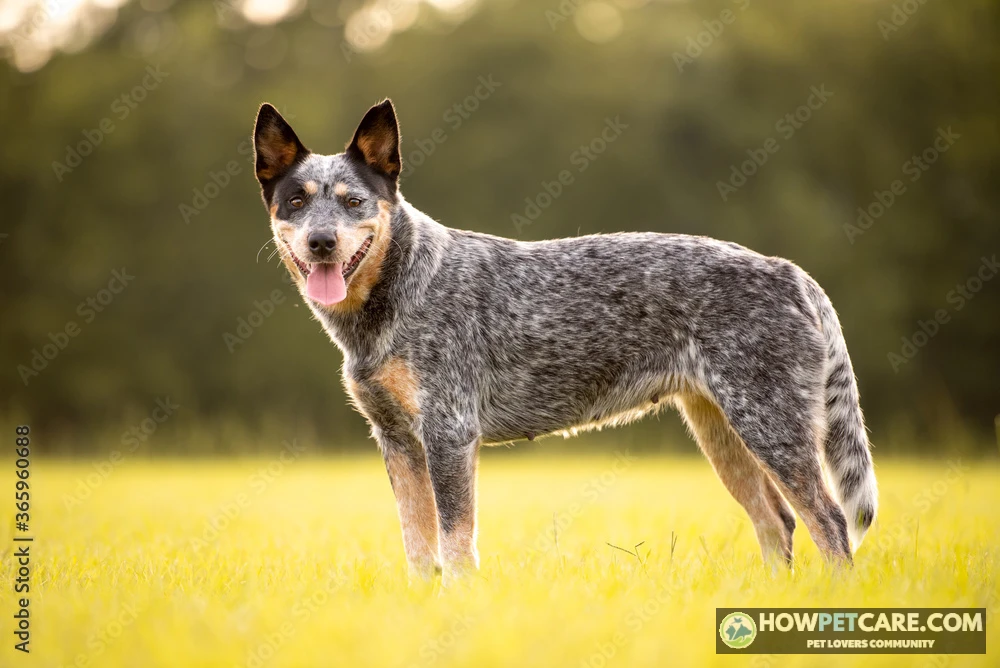

The Australian Blue Heeler is a blue speckled or mottled color variety of the Australian Cattle Dog, a compact herding breed developed in 19th-century Australia from Dingoes and imported collies. Adults stand 17 to 20 inches and weigh 35 to 50 pounds, living 12 to 16 years. The AKC recognizes the breed in its Herding Group.
An Australian Blue Heeler is a color variety of the Australian Cattle Dog (ACD), the compact, muscular herding breed developed in 19th-century Australia from crosses between native Dingoes and imported collies, including the Blue Smooth Highland Collie. The blue coat describes a speckled or mottled blue-gray pattern, not a separate breed. Adults typically stand 17 to 20 inches tall and weigh 35 to 50 pounds, with an average lifespan of 12 to 16 years. The AKC recognizes the breed and places it in the Herding Group, a status held since 1980.
If you want a loyal, highly trainable, physically durable partner for daily hiking, running, or dog sports — and you can commit to 1.5 to 2 hours of exercise plus mental work every day — a Blue Heeler can be an excellent match. If you need a low-energy apartment companion, or you can’t manage heel nipping around children and bikes, this breed is likely the wrong choice right now. The rest of this guide gives you the practical details to make that decision with confidence.
Australian Blue Heeler at a Glance: Breed Identity and Lifestyle Fit

The Australian Cattle Dog, commonly called the Blue Heeler, Red Heeler, or Queensland Heeler, is one breed with color varieties rather than separate breeds. Puppies are born white, with blue or red speckling beginning to appear around three weeks of age. The blue coat is a visual trait, not a personality trait. The breed’s double coat is weather-resistant, sheds heavily twice a year with light shedding in between, and stays low-maintenance for odor and dirt resistance.
Australian Cattle Dog vs. Australian Blue Heeler
There’s no meaningful distinction. "Blue Heeler" describes the blue speckled or mottled coat pattern; "Red Heeler" describes the red equivalent; "Queensland Heeler" is a regional nickname. All refer to the same Australian Cattle Dog recognized by the AKC. When you see a "rare blue heeler" marketed as a separate breed at premium prices, that’s a red flag, not a real category.

Quick fit test for prospective owners
Use this scorecard to gauge readiness before you fall in love with a puppy photo.
Blue Heeler Lifestyle-Fit Scorecard
- ☐ I can give this dog at least 1.5 to 2 hours of daily exercise and mental work, seven days a week
- ☐ I have a securely fenced yard or safe off-leash access for daily free running
- ☐ I am comfortable managing heel nipping, chasing, and herding behavior around children, bikes, and other pets
- ☐ I can commit to daily short training sessions for at least the first 6 to 12 months
- ☐ Someone is home or the dog has a structured midday break for most of the day
- ☐ My housing allows medium-large active dogs and does not restrict by breed or size
- ☐ I can budget $2,500 to $4,000 for core first-year setup and $1,400 to $3,000+ per year after that
- ☐ I accept a dog that is loyal but often reserved with strangers, not a naturally social greeting dog
- ☐ I am willing to visit the vet promptly for limping, vision changes, or hearing concerns
- ☐ I am prepared for a 12- to 15-year commitment, and possibly longer, with an active working dog
Score: 9-10 yes = strong fit. 6-8 yes = fit with major adjustments needed. 0-5 yes = this breed is likely not suitable right now.
Australian Blue Heeler Temperament and Personality in Real Homes

Blue Heelers are loyal, intelligent, alert, and driven. They form deep bonds with their people, often attaching most strongly to one or two family members. Their independence is a strength in working contexts but can read as stubbornness in casual training. They’re protective and watchful, often reserved with strangers rather than openly friendly, and they carry a strong working instinct that shapes daily behavior.
Herding instincts appear in ordinary home life as heel nipping, chasing moving objects, controlling movement, barking to manage space, and sensitivity to unfamiliar people and dogs. These behaviors are normal expressions of the breed’s purpose, not signs of aggression, but they require management.
Are Blue Heelers good family dogs?
They can be rewarding family dogs in active households with consistent supervision. Around young children, the breed’s nipping and herding instincts mean adults must supervise interactions, teach respectful handling, and avoid situations where running or squealing triggers chasing. Early puppy socialization, introduced gradually and positively, shapes a confident adult. The breed is neither universally easy nor universally difficult; outcomes depend heavily on training, exercise, and management.
Apartment, children, and multi-pet considerations
Apartments are workable only with an owner committed to structured daily exercise outside the home, since the breed’s energy and noise can strain neighbors. Barking tends to occur when the dog is alerting, bored, frustrated, or trying to control movement. Multi-pet households can succeed when introductions are slow and supervised, but the prey drive and herding tendency can stress cats or small animals. The breed isn’t reliably silent, and a full workday alone without a midday break is often a poor fit, especially for puppies.
How Much Exercise Does an Australian Blue Heeler Need by Age?

This high-energy breed needs both physical activity and mental work. Adults typically require 1.5 to 2 hours daily, split across sessions. Puppies need far less structured exercise but frequent short enrichment. Seniors need lower-impact, shorter sessions. Mental enrichment — obedience training, food puzzles, scent games, and impulse-control exercises — matters as much as walking or running.
Avoid forced running, repetitive jumping, and excessive impact while bones and joints develop. Signs of under-exercise include restlessness, destructive behavior, and nuisance barking. Signs of over-arousal include frantic pacing, inability to settle, and rough play. Fatigue, limping, or reluctance to move should change the plan and prompt veterinary advice.
Daily exercise plan for puppies through senior dogs
Use this framework, adjusting for your individual dog’s condition and your veterinarian’s guidance.
Australian Blue Heeler Exercise Plan by Life Stage
| Life stage | Daily physical activity | Mental enrichment | Safety focus |
|---|---|---|---|
| Puppy (8-20 weeks) | 5 minutes per month of age per session, 2-3 sessions daily; short leash walks and safe yard exploration | Food puzzles, gentle recall games, new surfaces and sounds | No forced running, repetitive jumping, or long hikes; protect growth plates |
| Adolescent (5-18 months) | 60-90 minutes split into two sessions; free running in secure areas, fetch, tug | Scent games, impulse-control drills, beginner obedience | Monitor for fatigue; avoid hard surface pounding and excessive jump repetitions |
| Adult (18 months-7 years) | 1.5-2 hours daily: running, hiking, fetch, structured play, optional herding or sport work | Advanced obedience, puzzle toys, nose work, agility or disc | Watch paw pads and joints; build endurance gradually for new activities |
| Senior (7+ years) | 30-60 minutes of low-impact activity: short walks, swimming, gentle play | Easy puzzle games, calm sniffing outings, light training | Shorter, more frequent sessions; watch for stiffness and weight gain |
Mental work that tires a cattle dog safely
Short obedience sessions, scent games, puzzle feeders, and impulse-control drills can tire a cattle dog faster than a long walk. Aim for 10 to 15 minutes of focused training twice daily. Keep sessions upbeat and end on success. Rotate activities to prevent boredom.

Blue Heeler Puppy Training: Stop Heel Nipping and Build Reliable Habits
Heel nipping is the single most common complaint from new owners. It’s rooted in the breed’s herding instinct, not malice. A structured response works better than punishment or chasing.
A step-by-step heel-nipping correction method
Use this protocol consistently for 4 to 6 weeks. Track nips per day to measure progress.
- Stop moving immediately the moment teeth touch skin or clothing. Freeze; don’t pull away, which triggers chase.
- Say nothing or use one calm word such as "ah-ah." Don’t yell, squeal, or wrestle.
- Offer an approved toy or chew immediately. Praise and treat the instant the puppy releases your hand or pant leg and takes the toy.
- If the puppy re-nips within 30 seconds, stand up and walk away for a 20- to 30-second reset behind a baby gate or closed door.
- Return calmly and offer the toy again. Resume play only when the puppy is chewing the toy, not your skin.
- Manage triggers proactively: put a toy in your hand before walks, keep play sessions short (5 to 10 minutes), and avoid roughhousing that encourages biting.
- Track nips per day. If bites break skin, escalate in force, happen with guarding or fear, or the puppy doesn’t calm after a reset, contact a certified force-free trainer or veterinary behaviorist.

8-to-24-week puppy socialization and training roadmap
Use a weekly ladder inside the bands of weeks 8 to 12, 12 to 16, and 16 to 24; keep exposures short and positive and avoid flooding.
| Week | Main goal |
|---|---|
| Week eight | Name response, handling, crate and toilet routine |
| Week nine | Gentle recall and bite inhibition |
| Week ten | Calm settling and new surfaces |
| Week eleven | Household sounds, vehicles, visitors |
| Week twelve | Loose-leash start, short dog exposure |
| Week thirteen | Visitor manners, recall with mild distraction |
| Week fourteen | Controlled dog greetings, grooming or vet handling |
| Week fifteen | Impulse control and stay foundations |
| Week sixteen | Confidence in new places |
| Week seventeen | Longer stays and polite greetings |
| Week eighteen | Alone-time practice and calm car rides |
| Week nineteen | Leash skills around movement triggers |
| Week twenty | Settle on mat and door manners |
| Week twenty-one | Recall with added distance |
| Week twenty-two | Play with rules, drop and leave-it |
| Week twenty-three | Adolescent proofing in busier settings |
| Week twenty-four | Consolidate routines and plan a class or sport |
Short daily obedience sessions support a confident adult. Controlled socialization, not overwhelming exposure, produces the best results.
Feeding, Grooming, and Everyday Australian Blue Heeler Care
Choose a complete and balanced diet appropriate to life stage, body condition, and workload, with large-breed puppy guidance when applicable and veterinary input for diet changes. The recommended daily dry food amount is 1.5 to 2.5 cups depending on size and activity.
Best food approach by life stage and activity level
Puppies need frequent meals and large-breed puppy formulas to support controlled growth. Adult companion dogs do well on maintenance formulas with measured portions. Highly active working dogs may need performance formulas with higher fat and calories. Seniors benefit from joint-supportive, lower-calorie diets. Judge body condition and adjust portions rather than relying only on package guidelines. Provide fresh water, limit treats to about 10 percent of daily calories, and monitor weight monthly.
Shedding and low-maintenance grooming routine
The short double coat is weather-resistant and low-odor. Brush weekly, increasing to daily during seasonal shedding bursts. Bathe only as needed. Trim nails every 2 to 4 weeks, clean ears weekly, brush teeth several times weekly, and check paws after outdoor activity. Manage heat by exercising during cooler hours, providing shade and water, avoiding hot pavement, and stopping for heavy panting, weakness, or confusion.

Australian Blue Heeler Health Issues, Screening, and Veterinary Planning
Commonly discussed concerns include hip dysplasia, elbow or joint problems, progressive retinal atrophy (PRA), congenital deafness, eye disease including primary lens luxation (PLL), activity-related injuries, and weight-related strain. Prevalence estimates vary by registry and study, so rely on documented health-test results and breed-club or veterinary sources rather than unsourced percentages.
Congenital deafness and PRA: what is verified before purchase
Before buying or adopting, request documented BAER hearing test results, ophthalmic evaluation records, hip and elbow assessments, pedigree records, and disclosure of affected relatives. The Australian Cattle Dog Club of America and AKC breed resources are reliable starting points for screening guidance. Ask for the underlying data whenever a seller or site quotes a prevalence figure.

Expected Australian Blue Heeler lifespan and preventive care
Average lifespan is 12 to 16 years. Preventive care includes vaccines, parasite control, dental care, body-condition checks, and prompt attention to hearing or vision changes. Puppies and adults should follow a veterinary schedule. Seek urgent care for sudden vision loss, collapse, severe pain, or heat distress.
Australian Blue Heeler Price and Lifetime Cost of Ownership
Separate responsible breeder prices from adoption fees and unusually low listings that may signal missing health records.
Australian Blue Heeler Ownership Cost by Category
| Cost category | Typical US range | One-time or recurring | What changes the cost |
|---|---|---|---|
| Acquisition (breeder) | $1,200-$2,500 | One-time | Health testing, pedigree, region |
| Acquisition (rescue/adoption) | $250-$600 | One-time | Shelter, age, included vet care |
| First-year setup including emergency reserve | $2,500-$4,500 | One-time-ish | Supplies, vaccines, sterilization, training, emergency reserve |
| Recurring annual | $1,400-$3,200 | Recurring | Food quality, insurance, sport or daycare |
| Pet insurance | $40-$80/month | Recurring | Age, coverage level, deductible |
| Emergency reserve | $2,000-$5,000 | Reserve | Major injury or illness |
Australian Blue Heeler puppy price in the US
Responsible breeder puppies typically range from $1,200 to $2,500. Adoption fees usually run $250 to $600. Unusually low prices without health records are a warning sign.
Budget checklist for the first year and beyond
Plan for supplies, initial veterinary visits, vaccines, sterilization, basic training, and an emergency reserve in year one. Recurring costs include food, parasite prevention, routine veterinary care, grooming supplies, enrichment, and optional insurance or daycare. Sport participation can add $1,000 to $3,000 per year.
Blue Heeler vs. Red Heeler, Border Collie, and Australian Shepherd
Blue Heeler and Red Heeler describe color varieties of the Australian Cattle Dog, not separate breeds with guaranteed personality differences. Choosing among herding breeds should rest on energy, trainability, grooming, and household fit.
Blue Heeler vs. Red Heeler differences
The difference is coat color: blue speckling versus red speckling. Temperament and working ability vary by individual and breeding, not by color.
Choosing among three high-drive herding breeds
Australian Cattle Dog vs. Border Collie vs. Australian Shepherd
| Trait | Australian Cattle Dog | Border Collie | Australian Shepherd |
|---|---|---|---|
| Adult size | 17-20 inches, 35-50 lbs | 18-22 inches, 30-55 lbs | 18-23 inches, 40-65 lbs |
| Daily exercise need | High (1.5-2 hours) | Very high (2+ hours) | High (1.5-2 hours) |
| Primary work style | Heeler: nips at heels to drive cattle | Eye and stalk: intense stare to control movement | Loose-eyed, upright, body-based herding |
| Trainability | High, independent, sometimes stubborn | Very high, highly sensitive to handler cues | High, eager to please but can be soft |
| Reserve with strangers | Often reserved, protective | Can be shy or aloof | Usually friendly to reserved |
| Grooming | Short double coat, weekly brushing, seasonal shed | Medium coat, regular brushing | Medium-long coat, more shedding |
| Best match | Active owner wanting a durable, independent partner | Handler wanting precision sports and intense focus | Active family wanting a versatile, people-oriented dog |
| First-time owner difficulty | Challenging | Very challenging | Moderate to challenging |

Individual temperament, breeder socialization, rescue history, and training matter more than breed stereotypes. Homes with young children, cats, limited outdoor access, or a preference for a people-oriented companion may lean toward other breeds.
Pre-Adoption Checklist: Is an Australian Blue Heeler Right for You?
This article is a breed guide, not a breeder directory or veterinary manual. Use this checklist to make a go or no-go decision.
First-time owner decision checklist
Before adoption or purchase, verify veterinary records, microchip information, temperament history, bite history, hearing or vision concerns, return policy, and household compatibility. For breeders, request documented health testing, meet the dam when possible, inspect living conditions, review the contract, and avoid sellers who pressure buyers or can’t answer genetic-health questions. For rescues, ask for foster observations, behavior around dogs and children, alone-time tolerance, triggers, and a decompression plan.
Pre-Adoption Checklist: Breeder, Rescue, and Home Readiness
Breeder questions and verification
- ☐ Ask for documented BAER hearing test results for both parents
- ☐ Ask for ophthalmic evaluation records (PRA, eye disease)
- ☐ Ask for hip and elbow assessment records for the parents
- ☐ Meet the dam when possible and observe her temperament
- ☐ Inspect the living conditions: clean, enriched, not overcrowded
- ☐ Review the written contract, health guarantee, and return policy
- ☐ Decline if the seller pressures you, won’t answer genetic-health questions, or offers a puppy under 8 weeks
- ☐ Avoid unusually low-priced listings with missing health records

Rescue questions and verification
- ☐ Ask for foster observations: behavior around dogs, children, cats, and visitors
- ☐ Ask about bite history and heel-nipping incidents
- ☐ Ask about alone-time tolerance and separation behaviors
- ☐ Identify known triggers (bicycles, skateboards, running children, other dogs)
- ☐ Request a decompression plan for the first 7 to 14 days after arrival
Home setup before pickup
- ☐ Secure fencing with no gaps at the bottom
- ☐ Crate or pen sized for an adult dog (about 36-42 inches)
- ☐ Chew-proof toys, long-line leash, and treat pouch ready
- ☐ Baby gates for separating the dog from young children during high-energy times
- ☐ Veterinarian selected and first appointment scheduled within 3 days of arrival
Red flags to walk away from
- ☐ No health testing or veterinary records
- ☐ Seller will not let you see the dam or the facility
- ☐ Puppy is fearful, aggressive, or unresponsive at 8 weeks
- ☐ Pressure to pay before meeting the dog or signing anything
- ☐ "Rare blue heeler" marketed as a separate breed with premium pricing
The first 30 days after bringing one home
Schedule a veterinary appointment within 3 days. Allow 7 to 14 days of decompression with a predictable schedule, safe confinement, and limited visitors. Use reward-based training, gradual socialization, and weekly progress reviews. Keep sessions short and positive. Track nips, settling, and alone-time tolerance. Adjust the plan as the dog reveals its personality.
| Breed Name | Adult Size | Daily Exercise Need | Primary Work Style | Trainability | Reserve with Strangers | Grooming Requirements | Best Match Profile | First-Time Owner Difficulty |
|---|---|---|---|---|---|---|---|---|
| Australian Cattle Dog | 17-20 inches, 35-50 lbs | High (1.5-2 hours) | Heeler: nips at heels to drive cattle | High, independent, sometimes stubborn | Often reserved, protective | Short double coat, weekly brushing, seasonal shed | Active owner wanting a durable, independent partner | Challenging |
| Border Collie | 18-22 inches, 30-55 lbs | Very high (2+ hours) | Eye and stalk: intense stare to control movement | Very high, highly sensitive to handler cues | Can be shy or aloof | Medium coat, regular brushing | Handler wanting precision sports and intense focus | Very challenging |
| Australian Shepherd | 18-23 inches, 40-65 lbs | High (1.5-2 hours) | Loose-eyed, upright, body-based herding | High, eager to please but can be soft | Usually friendly to reserved | Medium-long coat, more shedding | Active family wanting a versatile, people-oriented dog | Moderate to challenging |

FAQ
Do Blue Heelers bark a lot?
They can, especially when alerting, bored, frustrated, or trying to control movement. Consistent exercise, enrichment, quiet-behavior training, and reducing trigger exposure can limit nuisance barking, but the breed is not reliably silent.
Can an Australian Blue Heeler be left alone during a workday?
An adult may tolerate limited alone time after gradual training, but a full workday without a break is often a poor fit. Puppies need frequent toilet and social contact, while adults usually need a mid-day exercise or enrichment plan.
Are Australian Blue Heelers good pets for first-time dog owners?
They can be rewarding for prepared first-time owners who want an active training partner and can provide daily structure. Their intensity, herding behavior, heel nipping, and need for ongoing mental work make them a challenging choice for owners seeking an easygoing companion.
Do Blue Heelers do well in hot weather?
They can adapt, but their double coat and activity level increase heat risk. Exercise during cooler hours, provide shade and water, avoid hot pavement, and stop immediately for heavy panting, weakness, confusion, or collapse.