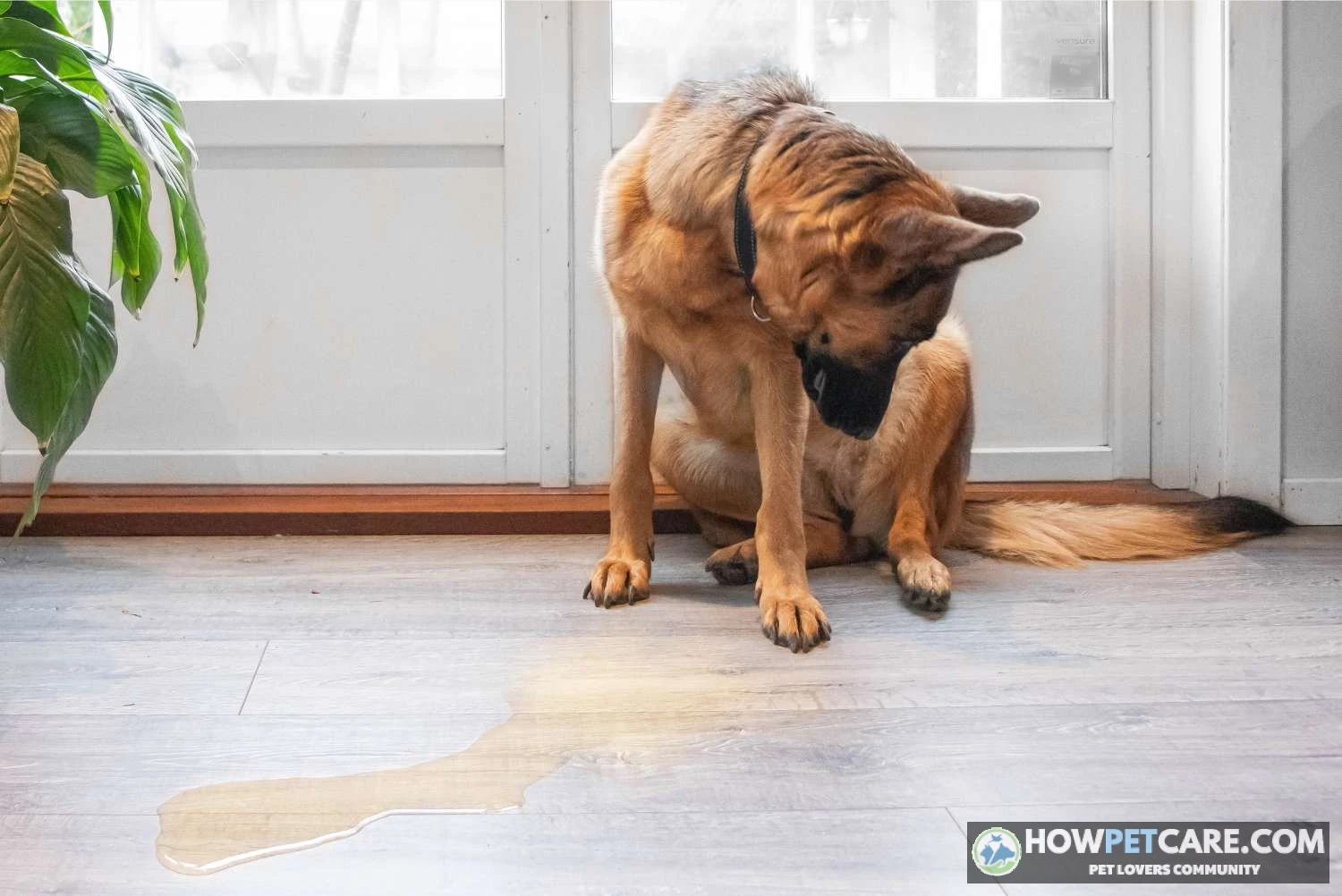

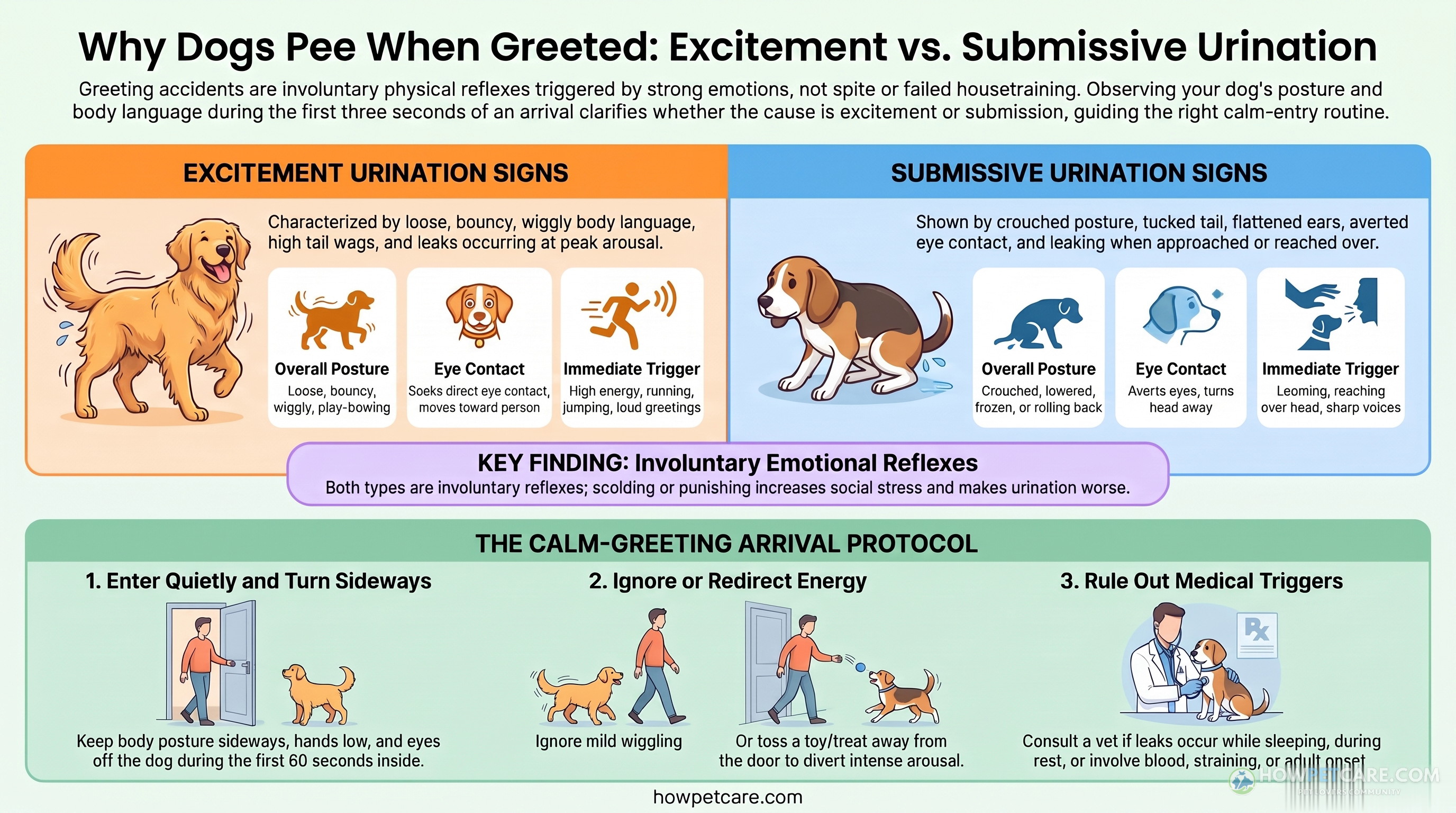
Dogs pee when they see you for one of two main reasons: excitement urination (loose, wiggly body, wagging tail, leaking at peak arousal) or submissive urination (crouching, tucked tail, flattened ears, averted eyes). Both are involuntary reflexes, not spite or failed housetraining. Watch the first three seconds of the greeting to tell which.
If you’re wondering why do dogs pee when they see you, start by watching their body language. Greeting accidents are usually not spite or poor house training. Many dogs have an involuntary response to strong emotion: overexcitement (excitement urination) or a desire to defer to a person (submissive urination). Medical issues, urine marking, and incomplete house training can look similar. The 60-second sorter below helps you spot the pattern, while the rule-out checklist covers medical causes and lookalikes. You’ll also find an arrival routine to start tonight and scripts for guests and delivery people.
The two-question first sort
Watch your dog during the first three seconds of a greeting:
- Energy and movement: Is the body loose, bouncy, and wiggly, with a high or broadly wagging tail? That points to excitement urination.
- Posture and appeasement: Is the body lowered, crouched, or rolled onto the back, with a tucked tail, flattened ears, and averted eyes? That points to submissive urination.
If you see a mix, note the dominant pattern. Both types respond to the same core approach: lower arousal and reduce social pressure at the door.
Why this is common and usually fixable
Puppies and young dogs can leak because their bladder sphincters are still maturing, and strong emotion overrides the control they have. Many improve as they grow, often by around 12 months, though sensitive or anxious dogs may need training [#N]. If an adult dog suddenly starts leaking or never outgrew it, get a veterinary workup before assuming the cause is behavioral.
Excitement vs. Submissive Urination: Body-Language Signs Side by Side
Use the table to identify the pattern in under a minute. Focus on the signs you see most often during greetings.
| Observable sign | Excitement urination | Submissive urination | What it suggests for your dog |
|---|---|---|---|
| Overall posture | Loose, bouncy, wiggly; jumping or play-bowing | Crouched, lowered, frozen, or rolling onto the back | Match the posture you see most often at greetings |
| Tail | Wagging broadly or carried high | Tucked, held low, or giving small nervous wags | A tucked or low tail points more toward submission |
| Ears and face | Neutral or forward; mouth often open and relaxed | Flattened ears, lip licking, tense mouth, or visible eye whites | Appeasement signals matter more than the puddle itself |
| Eye contact | Seeks the person and moves toward them | Avoids eye contact, turns the head, or looks away | Avoidance usually means the greeting feels socially intense |
| When the pee happens | At peak excitement while running, jumping, or wiggling | When someone looms, reaches over the head, picks the dog up, or speaks sharply | Identify the exact trigger so you can remove that pressure |
| What happens if interaction stops | Often settles once the excitement drops | May remain tense or continue offering appeasement signals | Excited dogs need calmer energy; submissive dogs need more space |
| Typical pattern | Most common in puppies and young dogs | Common in puppies, sensitive dogs, and dogs with uncertain histories | Age helps, but body language is the better classifier |
| First fix to try | Ignore mild wiggling or redirect to a treat/toy, then reward calm | Approach sideways, keep hands low, avoid head pats, and let the dog choose contact | If the pattern is mixed, address both excitement and social pressure |
How to read your dog’s greeting in the first three seconds
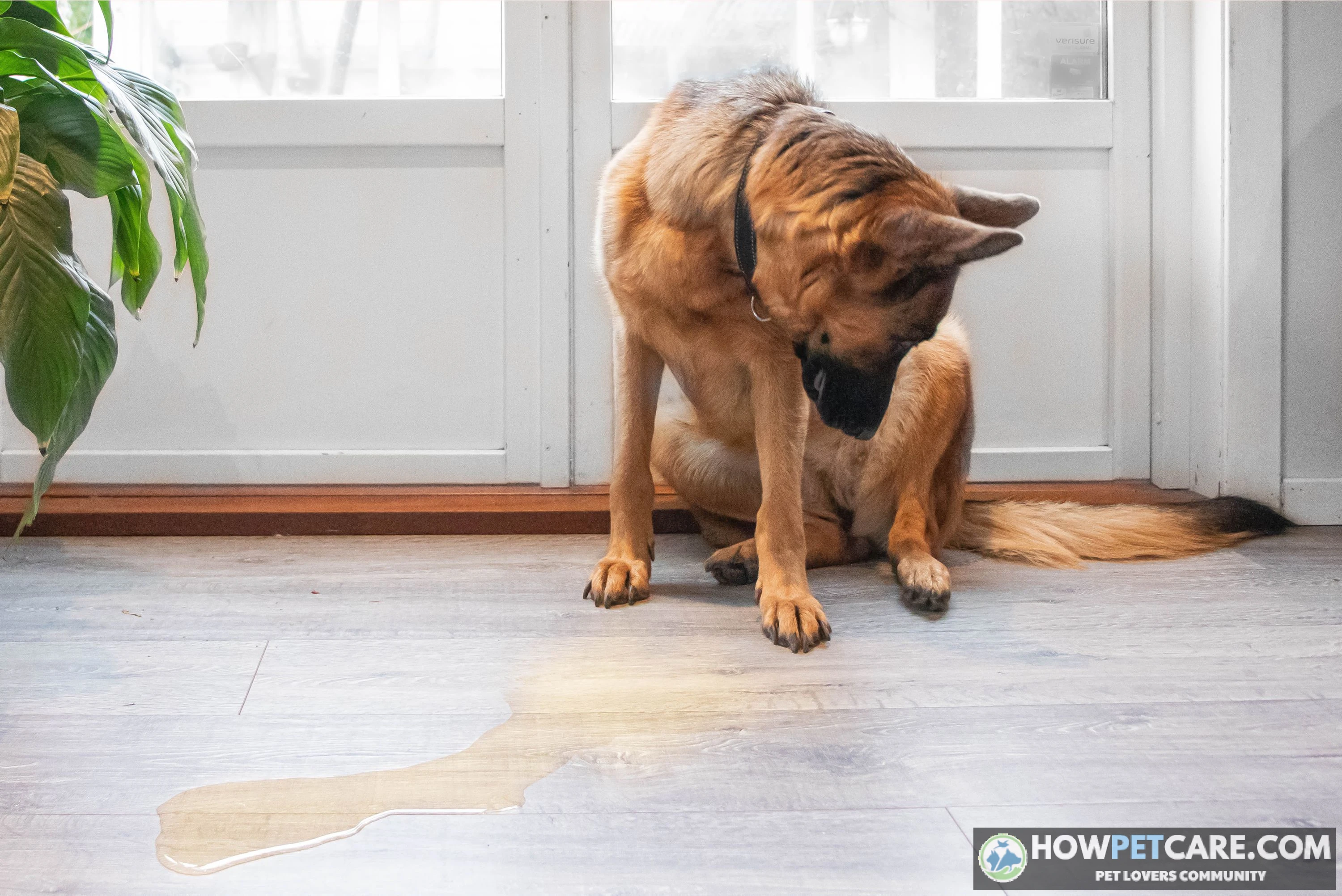
With excitement urination, a puppy may hit the floor running, tail up and mouth open, with a puddle appearing at the peak of the wiggle. A dog showing submissive urination may try to make itself small: crouching, tucking its tail, rolling over, licking its lips, or looking away. The leak often coincides with a person leaning over the dog, reaching for its head, or raising their voice. If your dog pees when you yell or reach to pet the top of its head, those are strong clues that submission, rather than excitement, is involved.
Why petting, reaching over, and picking up trigger it
Leaning over a dog, making direct eye contact, and touching the top of its head are socially intense gestures. A dog that uses appeasement signals to defuse perceived conflict may feel more pressure from those gestures, triggering the reflex. Try approaching sideways, keeping your hands low, and petting under the chin or on the chest instead.
Which dogs are more prone
Trainers and veterinarians report these patterns more often in shy or under-socialized dogs, rescues with unknown histories, soft-natured or people-pleasing retriever-type dogs, and young females. These are tendencies, not rules. Don’t rely on breed labels alone.
Is It Behavior, a Medical Problem, Marking, or Housetraining? A Home Rule-Out Checklist
This checklist helps you decide how urgently to call the vet. It does not replace an exam, urinalysis, or bloodwork. When in doubt, have your veterinarian evaluate your dog.
Work through the questions in order. If you visit the vet, bring a short video of a greeting accident and a log of when leaks happen.
- ☐ 1. Does urine appear only during greetings, petting, scolding, or another emotional peak?
Yes: Continue. No: Continue, but log every leak and its trigger. - ☐ 2. Does your dog leak while resting, sleeping, or relaxed?
Yes: Book a vet visit; this pattern can suggest a medical cause such as hormone-responsive incontinence. No: Continue. - ☐ 3. Is there straining, frequent small urination, blood, pain, strong odor, licking at the genitals, vomiting, lethargy, or a sudden change in thirst or appetite?
Yes: Call the vet promptly — same day for straining, blood, pain, or very little urine. No: Continue. - ☐ 4. Did the pattern start suddenly in an adult dog, or persist well past adolescence?
Yes: Book a vet exam before assuming it’s behavioral. No: Continue. - ☐ 5. Is your dog an adult female who was spayed months or years ago and leaks mainly while asleep or lying down?
Yes: Ask the vet about hormone-responsive incontinence. No: Continue. - ☐ 6. Are the spots small, targeted, and often on vertical surfaces or specific objects?
Yes: This looks more like marking than greeting-pee. Manage access and discuss neuter status, triggers, and marking prevention with a professional. No: Continue. - ☐ 7. Are there full-size puddles in chosen locations when no one is greeting the dog?
Yes: Consider a possible housetraining issue and review potty frequency, supervision, and access. No: Continue. - ☐ 8. Does the body-language table point mainly to excitement or submission?
Yes: Start the calm-arrival routine and log wet versus dry greetings. Bring a short video and the log to the vet if the pattern changes or doesn’t improve.
Decision flow: five questions in order
- Only at emotional peaks? → Behavioral greeting-pee is likely.
- Leaks at rest or during sleep? → Possible medical cause (e.g., hormone-responsive incontinence, UTI, ectopic ureters) — see vet.
- Straining, blood, odor, pain, systemic signs? → Possible medical urgency — see vet same day if straining or blood.
- Sudden onset in adult or persistence past adolescence? → Rule out medical causes first.
- Spayed female leaking mainly asleep? → Ask the vet about hormone-responsive incontinence and phenylpropanolamine or estrogen therapy.
Post-spay incontinence vs. emotional greeting-pee
Hormone-responsive incontinence typically appears months to years after spaying. Its hallmark is leaking while the dog is relaxed or asleep, with wet bedding and no emotional trigger [#N]. If your spayed female leaks only when you come home but wakes up dry, the cause is probably behavioral. If she wakes up wet, ask your vet about hormone-responsive incontinence.
Marking and housetraining lookalikes
- Marking: Small amounts aimed at objects, often on vertical surfaces, rather than a reflex during greetings.
- Housetraining regression: Full-volume urination in deliberately chosen spots, with normal behavior and no connection to a person’s arrival.
Red flags that mean call the vet today
- Straining with little or no urine produced
- Blood in the urine
- Signs of pain (whining, hunched posture)
- Lethargy, vomiting, or sudden change in thirst/appetite
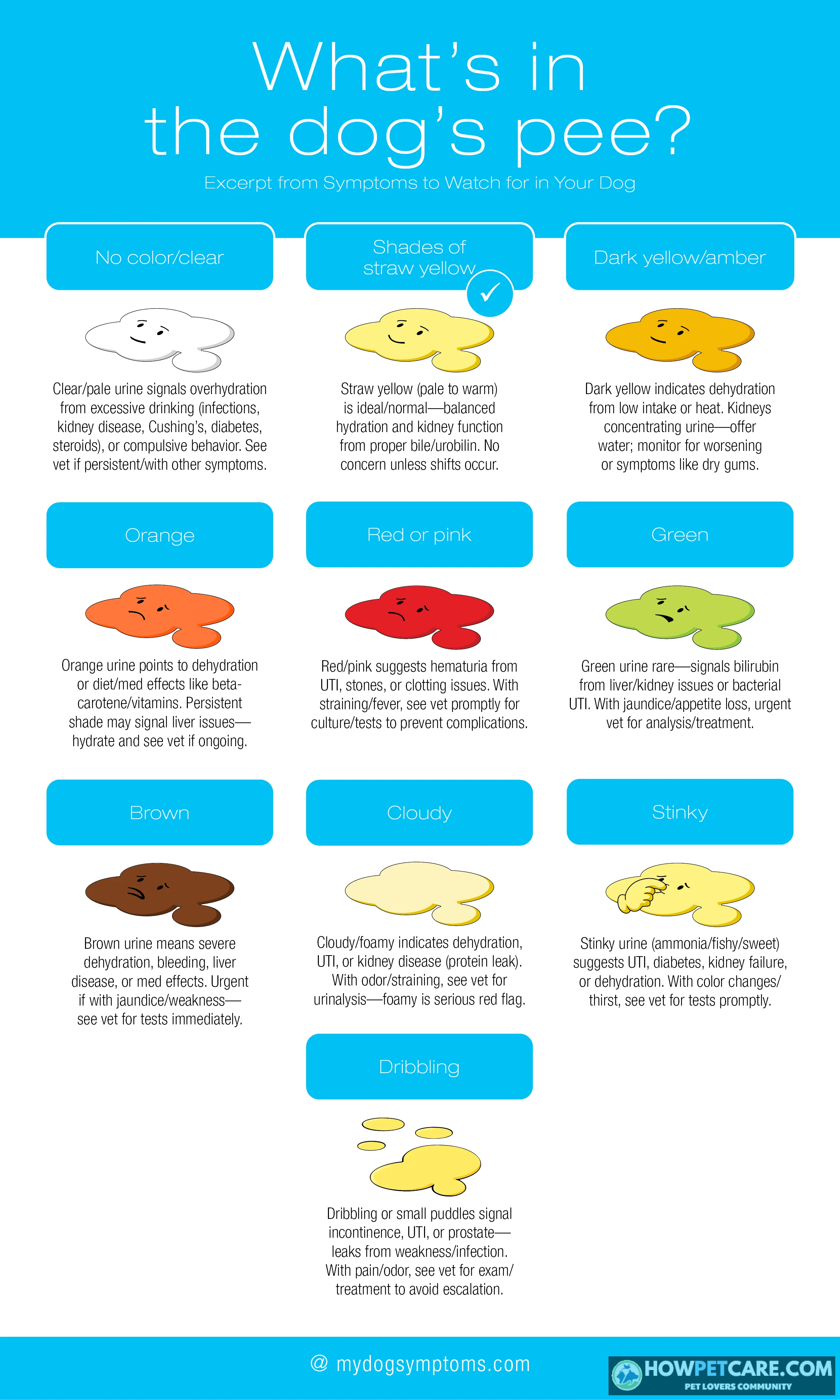
What to Do While Your Dog Is Peeing, and Why Scolding Makes It Worse
The dog cannot control the reflex. Scolding adds fear and social pressure. In submissive cases the dog responds with more appeasement — including more urination.
In the moment: ignore, interrupt, or clean up?
- Do not yell, loom, reach over, or make eye contact.
- Do not grab or pick the dog up — this adds arousal and pressure.
- Do stay quiet, turn sideways to the dog, and give it a moment.
- If the dog is mid-pee at a guest’s feet: Ask the guest to freeze, look away, and say nothing.
After the accident: quiet cleanup
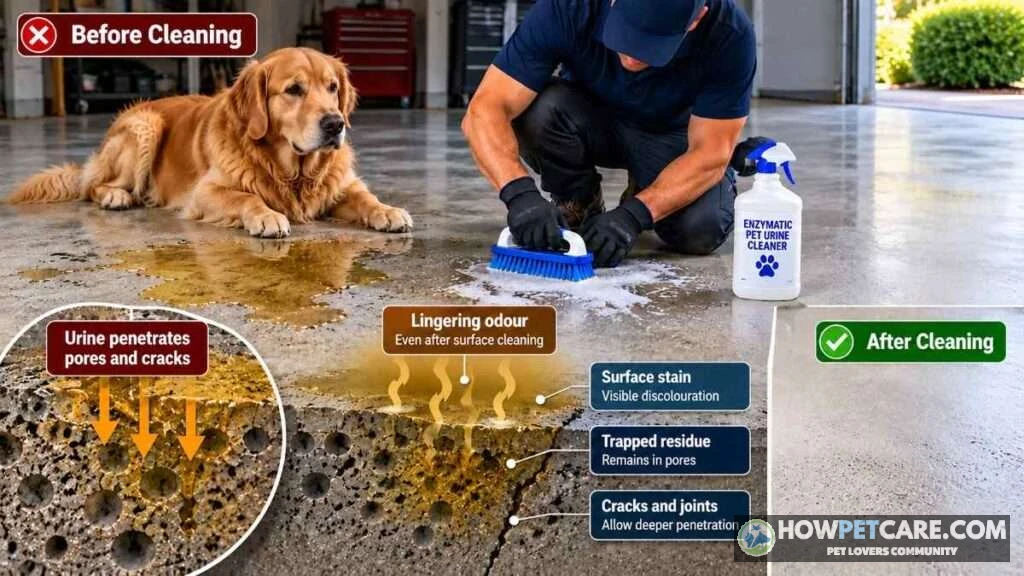
Wait until your dog is calm, then wipe up without comment. Use an enzymatic cleaner (e.g., Nature’s Miracle, Simple Solution) so the smell doesn’t invite repeat spots. Avoid ammonia-based cleaners — they smell like urine to dogs. Don’t make a fuss over the aftermath. Once your dog is calm, resume normal, quiet interaction.
The Calm-Greeting Protocol: A Step-by-Step Arrival Routine
-
Before leaving the house
Give your dog a real potty break so its bladder is as empty as possible when you return.
-
Minute 0: Enter quietly
Keep your body sideways, hands low, eyes off the dog, and voice silent. Do not bend over or reach toward the head.
-
If your dog cannot settle
Toss a small treat or toy several feet away as you enter. This gives the energy somewhere to go. If arousal is mild, skip the treat and simply ignore the dog.
-
Minutes 0–2: Be boring
Put down bags, remove your coat, or move to another room without greeting. Wait for four paws on the floor and softer body movement.
-
Minutes 2–3: Greet at dog level
Crouch sideways rather than leaning over. Let the dog approach. Pet under the chin or on the chest for two to three seconds, then pause.
-
If the dog crouches, tucks, rolls, or looks away
Stop petting and give more space. Do not talk cheerfully over the stress signals or force a greeting.
-
Minutes 3–5: Potty trip
Clip on a leash if needed and take the dog to its potty spot. Praise calmly or offer a treat after it urinates outside.
-
After the greeting
Resume normal activity. Do not turn the accident — or the recovery — into a big event.
-
Practice reps
Three to five times per session, pick up your keys, step out, return immediately, and follow the same boring entry routine. End while your dog is still calm.
Before you walk in the door
A potty break before you leave reduces the amount your dog can leak. Keep a leash and treats by the door so you can follow the routine without fumbling.
The first 60 seconds inside
Staying silent and turning sideways can lower both excitement and social pressure. Ask everyone in the household to follow the same script — one exciting greeting can undo the work.
Ignore, redirect, or both?
- Ignore for mild arousal: your dog wiggles but settles quickly when you don’t engage.
- Redirect with a tossed treat/toy if your dog can’t settle. It gives that energy somewhere to go and helps keep arousal below the leak threshold.
- You can combine the approaches: ignore your dog for the first minute, then redirect if it’s still buzzing.
Practice drills that lower arousal
Fake departures teach your dog that arrivals are boring. Pick up your keys, open the door, step out, and come back in. Do 3–5 reps per session, a few times a week, and end each rep while your dog is calm.
What to Tell Guests, Sitters, and Delivery People: Word-for-Word Scripts
Guest script you can read aloud
Text to send before a guest arrives
Please ignore [dog’s name] when you come in. Don’t talk to, look at, or reach toward them yet. I’ll tell you when they’ve settled and it’s okay to say hi.
At the door
Stand sideways, keep your hands low, and let [dog’s name] come to you. When they’re calm, pet under the chin or on the chest — not on top of the head.
Short door sign
Dog in training: please ignore the dog when entering. No talking, eye contact, or petting until invited.
Dog sitters and family members
Dog-sitter note
Arrival routine: Enter quietly and ignore [dog’s name] for two minutes. Keep your body sideways and hands low. Once all four paws are on the floor and the wiggling has settled, let the dog approach and pet under the chin or chest. Take them straight to the potty spot and reward after they urinate. If an accident happens, say nothing, clean it with the enzymatic cleaner under [location], and write down the time and trigger.
Deliveries and strangers you can’t brief
No-contact delivery routine
- Before a delivery window, put your dog behind a baby gate, in another room, in a crate, or on a mat.
- Give your dog a pre-stuffed food toy or long-lasting chew before opening the door.
- Open the door only after the dog is secured. Use delivery notes such as: “Please leave package at door; do not wait for a signature.”
- Don’t allow doorstep greetings or reaching through a gate.
- Once the delivery person has left, release your dog calmly and reward quiet behavior.
Doorbell practice: Pair the bell with going to a mat and getting a treat. Start with a helper ringing at low intensity, then build up to real deliveries.
Will My Puppy Outgrow Peeing When Excited? Age Benchmarks and Realistic Timelines
There is no reliable published percentage showing how many puppies outgrow greeting-pee.
Veterinary sources commonly describe puppy excitement urination as something many dogs grow out of as bladder and sphincter control mature — often by around 12 months. That’s a typical pattern, not a guarantee.
Use these practical benchmarks instead:
- Under 12 months: Emotional greeting-pee is commonly developmental, especially when the dog also wiggles, jumps, or offers appeasement signals.
- Around 12 months: Many puppies improve as physical control matures, but sensitive or anxious dogs may still need training.
- After adolescence: If the behavior remains frequent or gets worse despite consistent calm greetings, book a vet check rather than assuming your dog will outgrow it.
- Any adult-onset pattern: Rule out medical causes first.
- Progress benchmark: Improvement usually begins with smaller or less frequent leaks, not an immediate shift to perfectly dry greetings.
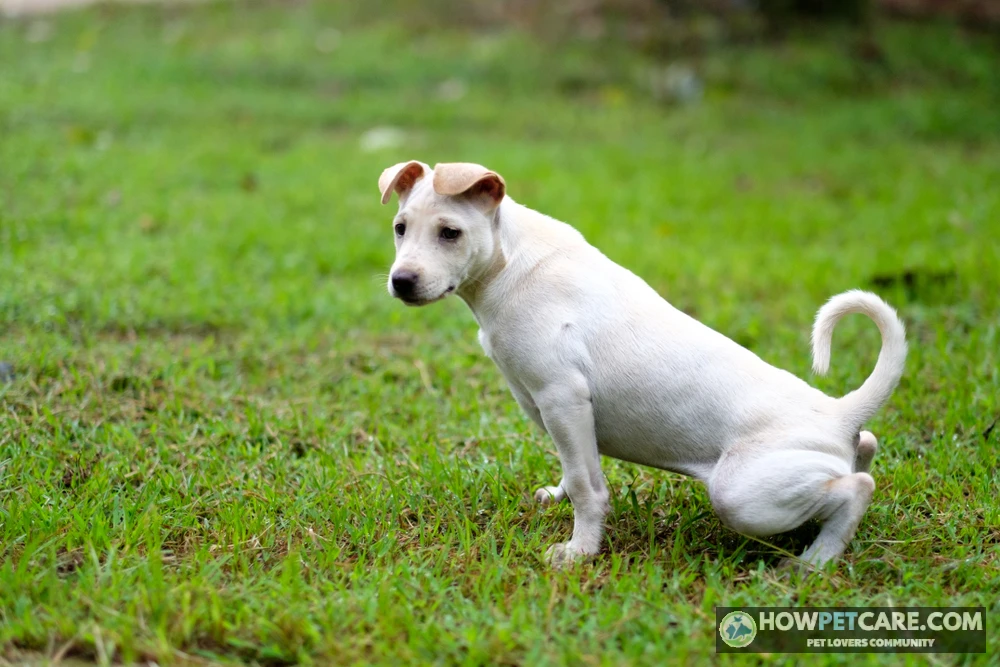
At what age should you start to worry?
If greeting-pee still happens regularly past 12–14 months, or begins suddenly in an adult dog, schedule a veterinary exam.
How long calm-greeting training takes
Dogs often show some change within a few weeks of consistent, calm greetings. Timelines vary with the dog’s temperament and how consistently everyone follows the routine. This is practitioner experience, not a measured statistic.
How to track progress
Keep a simple log of the date, trigger, wet or dry greeting, and leak size (none / few drops / palm-sized / larger). Look for smaller leaks and fewer of them before expecting zero.
Adult Dogs Who Still Pee When Greeted: Why It Persists and What Changes
Why greeting-pee persists past puppyhood
- An ingrained habit from years of rehearsed greetings
- Chronic anxiety in dogs
- A history of harsh handling or punishment
- A rescue background with unknown triggers
- A medical issue that was never ruled out (UTI, bladder stones, kidney disease, diabetes, ectopic ureters, arthritis) [#N]
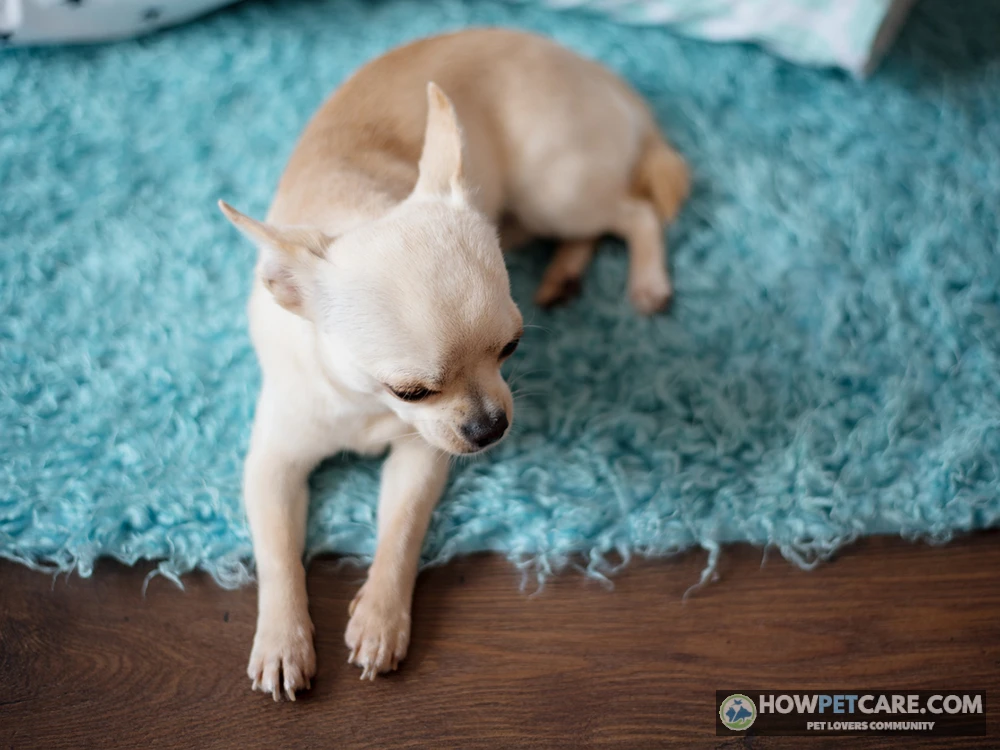
How the plan changes for adult dogs
- Start with a vet exam and urinalysis. Rule out medical causes before training.
- Add confidence-building work. Desensitize your dog to specific triggers, such as looming, direct eye contact, or reaching over the head.
- Reduce stress with predictable routines and choice. Let your dog choose whether to approach.
- Go slower. Adult patterns have had years to set in. Aim for gradual progress rather than a fast fix.
Medications vets may consider and what to ask about side effects
| Drug (active ingredient) | Targets | Common side effects to ask about | Key notes |
|---|---|---|---|
| Fluoxetine | Generalized anxiety, fear-related behaviors | Reduced appetite, GI upset, lethargy | Requires weeks to reach effect; must be tapered off |
| Phenylpropanolamine (PPA) | Hormone-responsive incontinence (urethral sphincter tone) | Restlessness, reduced appetite, raised blood pressure | Use with caution in dogs with heart or blood-pressure problems |
| Estrogen therapy (e.g., estriol, DES) | Hormone-responsive incontinence in spayed females | Rare at low doses; monitor for bone marrow suppression | Compounded or off-label; vet supervision required |
These drugs require a prescription and a veterinarian’s diagnosis. Dosing and suitability are the vet’s decision. Medication supports training and does not replace it.
| Observable sign | Excitement urination | Submissive urination | What it suggests for your dog |
|---|---|---|---|
| Overall posture | Loose, bouncy, wiggly; jumping or play-bowing | Crouched, lowered, frozen, or rolling onto the back | Match the posture you see most often at greetings |
| Tail | Wagging broadly or carried high | Tucked, held low, or giving small nervous wags | A tucked or low tail points more toward submission |
| Ears and face | Neutral or forward; mouth often open and relaxed | Flattened ears, lip licking, tense mouth, or visible eye whites | Appeasement signals matter more than the puddle itself |
| Eye contact | Seeks the person and moves toward them | Avoids eye contact, turns the head, or looks away | Avoidance usually means the greeting feels socially intense |
| When the pee happens | At peak excitement while running, jumping, or wiggling | When someone looms, reaches over the head, picks the dog up, or speaks sharply | Identify the exact trigger so you can remove that pressure |
| What happens if interaction stops | Often settles once the excitement drops | May remain tense or continue offering appeasement signals | Excited dogs need calmer energy; submissive dogs need more space |
| Typical pattern | Most common in puppies and young dogs | Common in puppies, sensitive dogs, and dogs with uncertain histories | Age helps, but body language is the better classifier |
| First fix to try | Ignore mild wiggling or redirect to a treat/toy, then reward calm | Approach sideways, keep hands low, avoid head pats, and let the dog choose contact | If the pattern is mixed, address both excitement and social pressure |
When to see a veterinary behaviorist
- No improvement after consistent training
- Signs of generalized anxiety (pacing, panting, destruction, avoidance)
- Other fear-related behaviors (noise phobia, stranger fear, resource guarding)
Your Next 7 Days: A Checklist and a Guide to Who to Call
Day-by-day checklist
- Day 1: Run the rule-out checklist, watch one greeting on video, and classify the dog’s pattern as excitement, submissive, or mixed.
- Day 1–2: Book a vet visit if you found any red flag, sleeping leaks, an adult-onset pattern, or a spayed-female pattern.
- Day 2–3: Set up the potty-before-departure routine, an enzymatic cleaner, and a greeting spot that’s easy to clean.
- Day 3–7: Start the arrival routine and fake-departure drills, and brief every household member with the script.
- Before next visit: Send the guest script ahead and set up a gate or mat for the door.
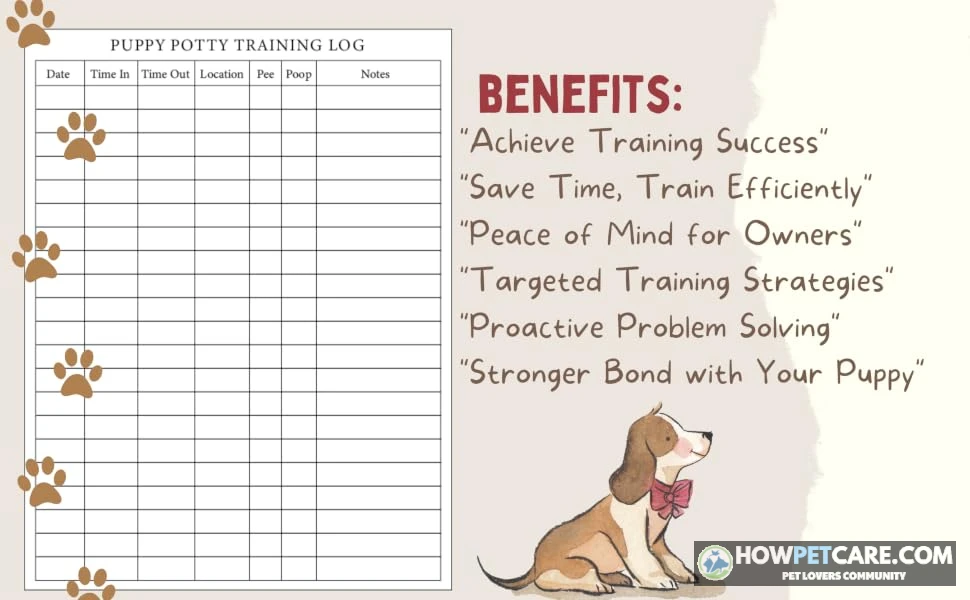
Who to call: vet, trainer, or veterinary behaviorist
- Veterinarian: Medical concerns (UTI, incontinence, ectopic ureters, sudden onset, systemic signs), a spayed female leaking asleep, or straining/blood/pain.
- Certified trainer (CPDT-KA, KPA-CTP, or similar): Greeting practice, calm-arrival coaching, desensitization to triggers, and household consistency.
- Veterinary behaviorist (DACVB): Anxiety-driven cases, plateaued training, multiple fear behaviors, and medication management alongside behavior modification.
Setbacks happen. Keep logging wet vs. dry greetings, leak size, and triggers. The log is a useful record to bring to your vet or trainer.
1A puppy bounds toward its owner at the door with a wiggly, bouncy body and a broadly wagging tail, then leaks urine while jumping up. Based on these observed body language signs, which type of urination is occurring and what is the recommended immediate strategy?
Loose, bouncy posture with a high or broad wag indicates excitement urination, which is best managed by keeping arrival energy low or redirecting peak excitement away from the person.
2An adult female dog spayed three years ago leaks urine predominantly while resting or asleep on her bed. However, she greets returning family members calmly and dry. Which condition is most strongly indicated by this pattern?
Leaking while relaxed or sleeping with wet bedding and no emotional trigger months or years post-spay is the classic presentation of hormone-responsive incontinence.
3A dog exhibits submissive urination during greetings, characterized by crouching, tail-tucking, and ear-flattening. Which human actions should be explicitly avoided during greetings because they increase social pressure and trigger this reflex?
Looming creates a dominant physical presence that heightened sensitive dogs interpret as a threat, triggering appeasement urination.
4What is the primary operational goal of performing 'fake departure' practice drills during calm-greeting training?
Repeatedly executing departure triggers (like picking up keys and stepping outside) without long absences desensitizes the dog so arrivals no longer evoke peak excitement or fear.
5Which of the following symptoms observed alongside urinary leaking are considered red flags requiring prompt, same-day veterinary attention?
Straining without urine output can indicate a life-threatening urinary tract obstruction or severe blockage requiring emergency intervention.
6Which parameter best differentiates urine marking from behavioral greeting urination?
Marking is a deliberate territorial or communicative behavior targeting specific structures, unlike involuntary greeting accidents triggered by social stimulation.
7An adult dog exhibits persistent greeting-pee along with severe generalized anxiety signs such as chronic pacing, panting, and destruction. The owner requires a professional who can prescribe behavioral medication alongside specialized behavior modification. Which specialist should be consulted?
A board-certified veterinary behaviorist holds clinical veterinary qualifications to prescribe psychoactive medications while designing comprehensive behavioral therapy plans.
FAQ
Why does my dog pee a little when happy?
Strong excitement can override a young dog’s still-developing bladder control, so a small amount of urine leaks out as a reflex. The dog is usually unaware of it and is not doing it on purpose.
Does peeing when I greet my dog mean they are afraid of me?
Not necessarily. Submissive urination is an appeasement signal that can occur in well-bonded dogs, especially soft-natured or shy ones. Harsh handling, yelling, or looming can make it worse and can add real fear.
Why does my dog pee when I yell at him?
Yelling raises social pressure, and a dog that defers to people may respond with appeasement behaviors, including urinating. Lower your voice, avoid looming, and wait until he is calm before interacting.
Can spaying or neutering cause or cure greeting-pee?
Spaying does not cure emotional greeting-pee. In some spayed females, hormone-responsive incontinence can develop months or years later, and it typically causes leaking while resting or asleep, so it needs a vet’s evaluation.
What is the best way to clean up after a greeting accident?
Wipe up quietly once the dog is calm, then use an enzymatic cleaner designed for pet urine so the smell does not draw the dog back to the same spot. Avoid ammonia-based cleaners, which smell like urine.