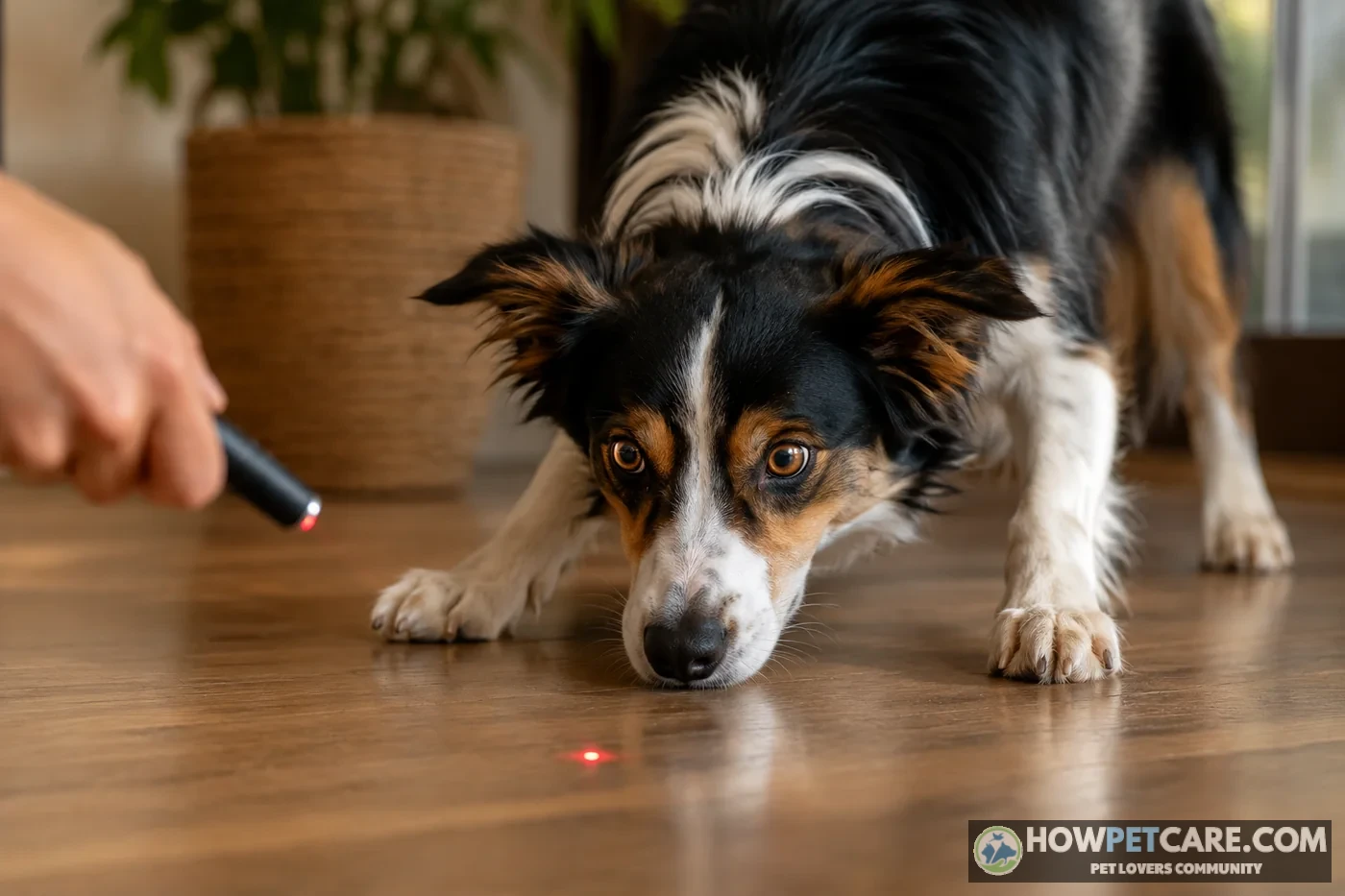

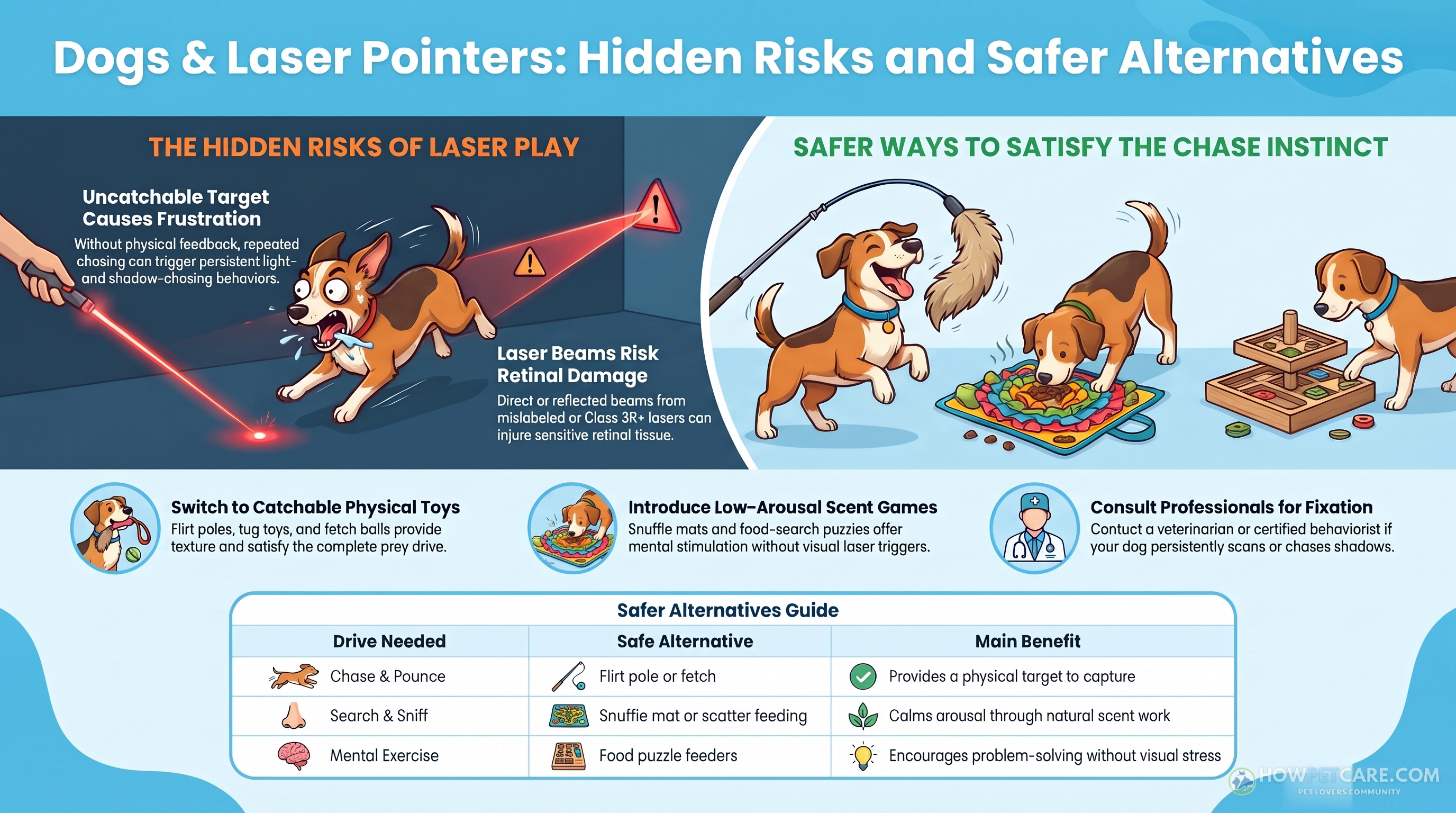
Yes—laser pointers are a poor toy choice for dogs. The dot can never be caught, which may fuel frustration and, in some dogs, lasting light- or shadow-chasing behavior. The beam can also injure an eye. Retire the laser, use catchable toys, and see your vet if your dog fixates on lights.
Are laser pointers bad for dogs? The short verdict
Yes. Laser pointers are a poor choice of toy for dogs, and the safest default is to stop using one. A moving dot can encourage intense chasing without giving your dog anything to catch. Some dogs later search for lights, shadows, or reflections outside the game, although research hasn’t established how often laser play causes this behavior.
A laser beam can also injure an eye, especially if the device is powerful or mislabeled. Ending the chase on a physical toy might reduce frustration, but it hasn’t been proven to prevent fixation.
If you’ve used a laser pointer with your dog, don’t panic: exposure doesn’t mean damage has been done. Stop the game, watch your dog’s behavior, and use the checklist below. Dogs already fixated on lights may improve with management and professional guidance, though recovery isn’t guaranteed.
Why dogs chase the red dot and why an uncatchable target can cause frustration
The chase sequence the dot triggers and where it breaks
Quick movement can activate a dog’s prey drive: the tendency to notice, pursue, and sometimes grab a moving target. It’s easy to make a laser dot dart across the floor, change direction, and disappear.
A physical toy provides feedback the dot can’t. A dog can grab a tug toy, carry a ball, or catch the lure on a flirt pole. Light has no texture, scent, or substance to capture. Behavior professionals reason that repeated, highly arousing pursuit without a satisfying catch may contribute to frustration in some dogs.
That’s a plausible explanation, not proof that every dog chasing a dot is frustrated or will develop a compulsive disorder. Dogs differ, and the chase alone can’t predict the outcome of a game.
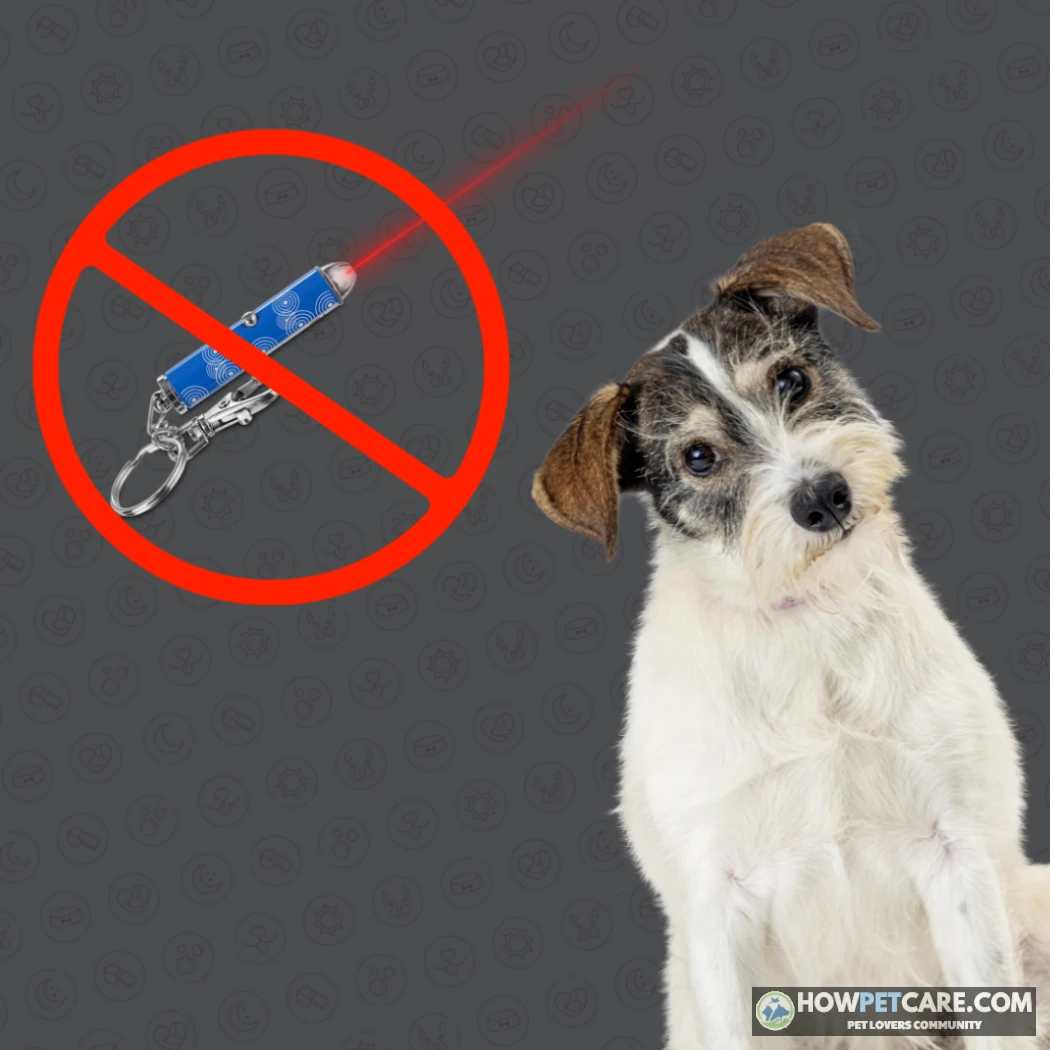
Why dogs may keep searching after play
Some dogs return to the last place they saw a dot or start watching for other moving lights. Owners have reported dogs staring at and chasing shadows, sunlight, and reflections from everyday objects after laser play. What matters is whether the dog can disengage and resume normal activities—not simply whether it noticed a reflection.
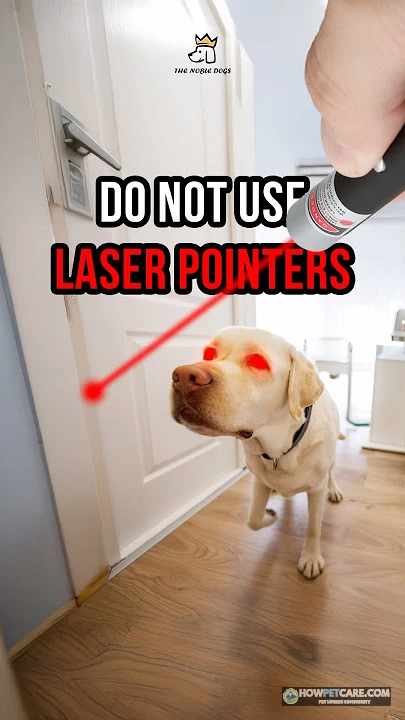
Are laser pointers safer for cats than dogs?
Cats can also become frustrated by an uncatchable target. Differences in reports about cats and dogs don’t establish that laser play is safe for either species, or that cats reliably walk away when dogs don’t. For cats as well as dogs, a physical toy offers a catchable alternative.
What laser pointer syndrome is, what the research supports, and how common it is
Laser pointer syndrome is an informal term for persistent light- or shadow-chasing associated with laser play; it isn’t a formal veterinary diagnosis. A veterinarian may evaluate repetitive behavior as a possible canine compulsive disorder, among other explanations. The comparison with obsessive-compulsive disorder (OCD) in dogs is useful shorthand, but it doesn’t mean an owner can diagnose OCD from a single behavior.
Symptoms of laser pointer syndrome in dogs
Signs worth noting include scanning floors or walls after a light disappears, repeatedly checking the last-seen spot, pouncing at shadows, whining at reflections, and struggling to settle. In more disruptive cases, a dog may scratch surfaces, interrupt meals or rest, or injure itself while pursuing light.
Record behavior that occurs naturally. Don’t shine a flashlight or laser to test whether your dog is affected: deliberately presenting a trigger can rehearse or intensify the behavior.
What the evidence shows and where it ends
A 2013 Tufts and Harvard MRI study reported structural brain differences in dogs with compulsive disorder. A 2010 Broad Institute and University of Massachusetts genetic study identified an association on canine chromosome 7 in research into compulsive behavior. Neither study established that laser pointers cause compulsive disorders.
The laser-specific concern rests largely on clinical observations and practitioner experience, rather than controlled experiments showing causation. A dog may chase lights for reasons unrelated to a laser, including medical or other behavioral factors.
How widespread is it? What we know and don’t
There is no reliable population-level prevalence figure for laser-associated fixation. Individual case reports and practitioner caseloads can’t tell an owner what percentage of dogs will be affected. Mild episodes may never be reported, and different causes of light chasing can be difficult to distinguish.
Normal light interest or fixation? A severity checklist for your dog
Use this checklist after an incident that happens naturally. The time ranges are practical observation guides, not validated diagnostic cutoffs. A dog can be distressed without meeting a particular time threshold, so look at the whole pattern and whether daily life is affected.
| Level | Observable behaviors | Can the dog disengage and settle? | Suggested action |
|---|---|---|---|
| Normal interest | Notices or briefly pursues a light, then returns to sniffing, playing, eating, or resting; no ongoing search. | Responds readily and settles within a few minutes. | Retire the laser and choose a physical toy. |
| Watch | Checks the last-seen spot or perks up at reflections, but the episode ends within roughly five minutes. | Usually responds to name or food and settles. | Stop light games and keep a two- to four-week log. |
| Concerning | Repeatedly scans walls or floors, pounces on shadows, whines, or returns to searching on most days. | May take food but return to scanning; settling can take 10–30 minutes. | Manage triggers, record a natural episode, and arrange a veterinary assessment, especially if the behavior is new or worsening. |
| Severe or urgent | Cannot be interrupted, misses meals or rest, panics around ordinary reflections, damages surfaces, or injures paws or nails. | Ignores familiar cues or food, cannot settle, or immediately resumes searching. | Contact a veterinarian promptly; seek urgent care for injury or sudden vision or neurological changes. |
A useful self-check is to ask: Can my dog notice an ordinary reflection, turn away when called, and return to normal life? If you have to repeat cues, lure your dog away repeatedly, or wait a long time for recovery, record that information for your vet. Don’t punish your dog for failing the test.
Which dogs may be at risk: breeds, drive level, and age
Take particular care with dogs that are highly responsive to movement, easily aroused, anxious, or prone to repetitive behavior. Herding dogs, terriers, and other working or sporting types may be especially interested in fast-moving targets, but there are no dependable breed-specific risk estimates for laser-associated fixation. Breed alone can’t predict an individual dog’s response.
Puppies and adolescents are still learning habits and impulse control, so give them catchable toys rather than introducing light games. For older dogs, a new change in behavior also warrants attention to possible vision, pain, or neurological problems. Any dog can need a medical assessment, regardless of age.
Observe naturally occurring behavior instead of shining a flashlight or producing a shadow on purpose. A short video of an episode that happens anyway can help your veterinarian assess it.
Can a laser pointer damage a dog’s eyes? Beam classes and retinal risk
Behavior isn’t the only concern. A beam entering the eye can injure the retina, the light-sensitive tissue at the back of the eye. The risk depends on the laser’s actual power, exposure, and other characteristics—not on whether the dot looks small.
Laser classes and what they mean for pets
- Class 1: Considered safe under reasonably foreseeable conditions of use; this can include products where a hazardous beam is enclosed.
- Class 2: Visible, low-power lasers for which brief accidental exposure is generally limited by an aversion response. Don’t deliberately stare into the beam or rely on a dog’s blink.
- Class 3R: Higher risk than Class 2; direct viewing can be hazardous. Many consumer pointers sold in the United States fall into this category.
- Class 3B and Class 4: Can cause serious eye injury and aren’t appropriate pet toys. Class 4 lasers can also present skin and fire hazards.
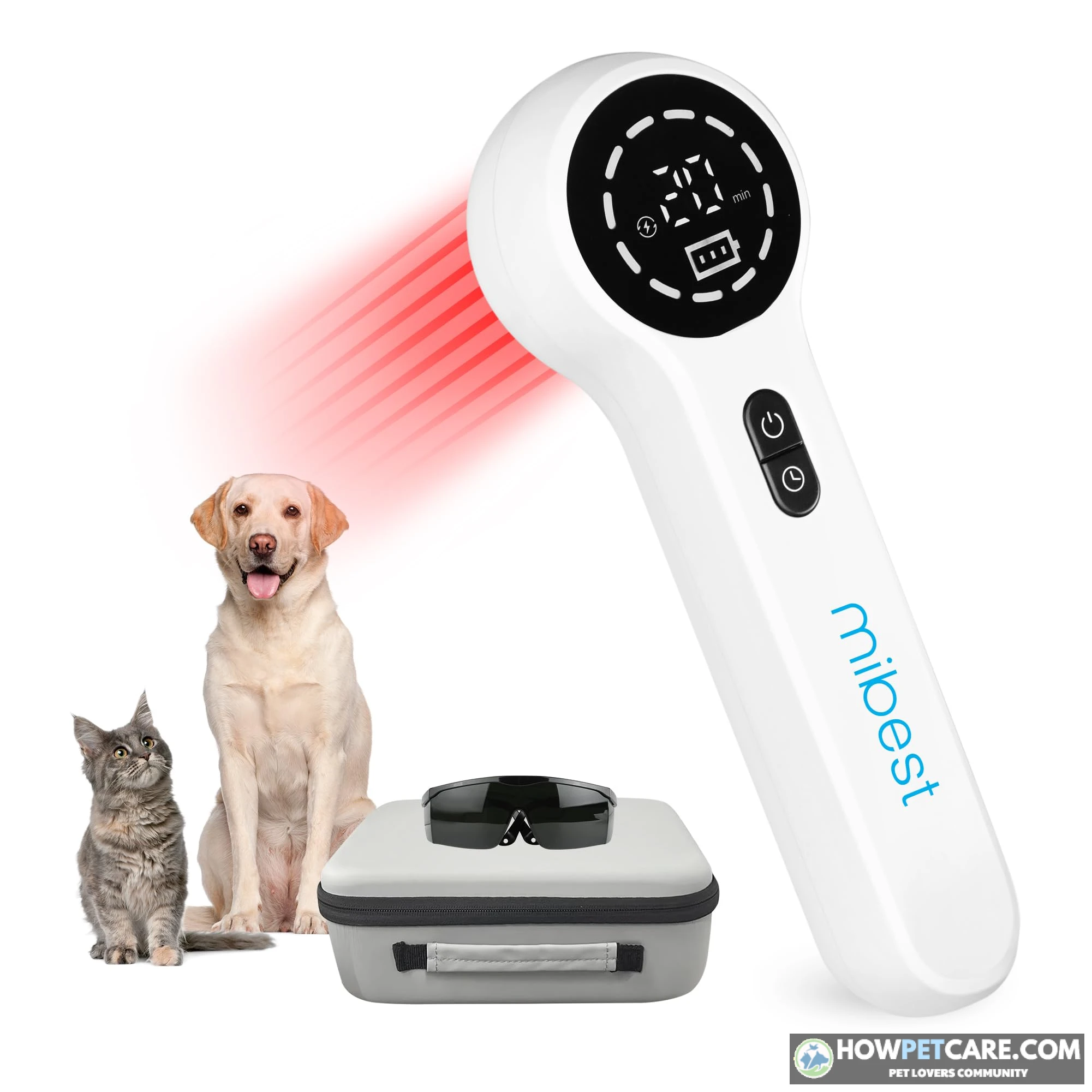
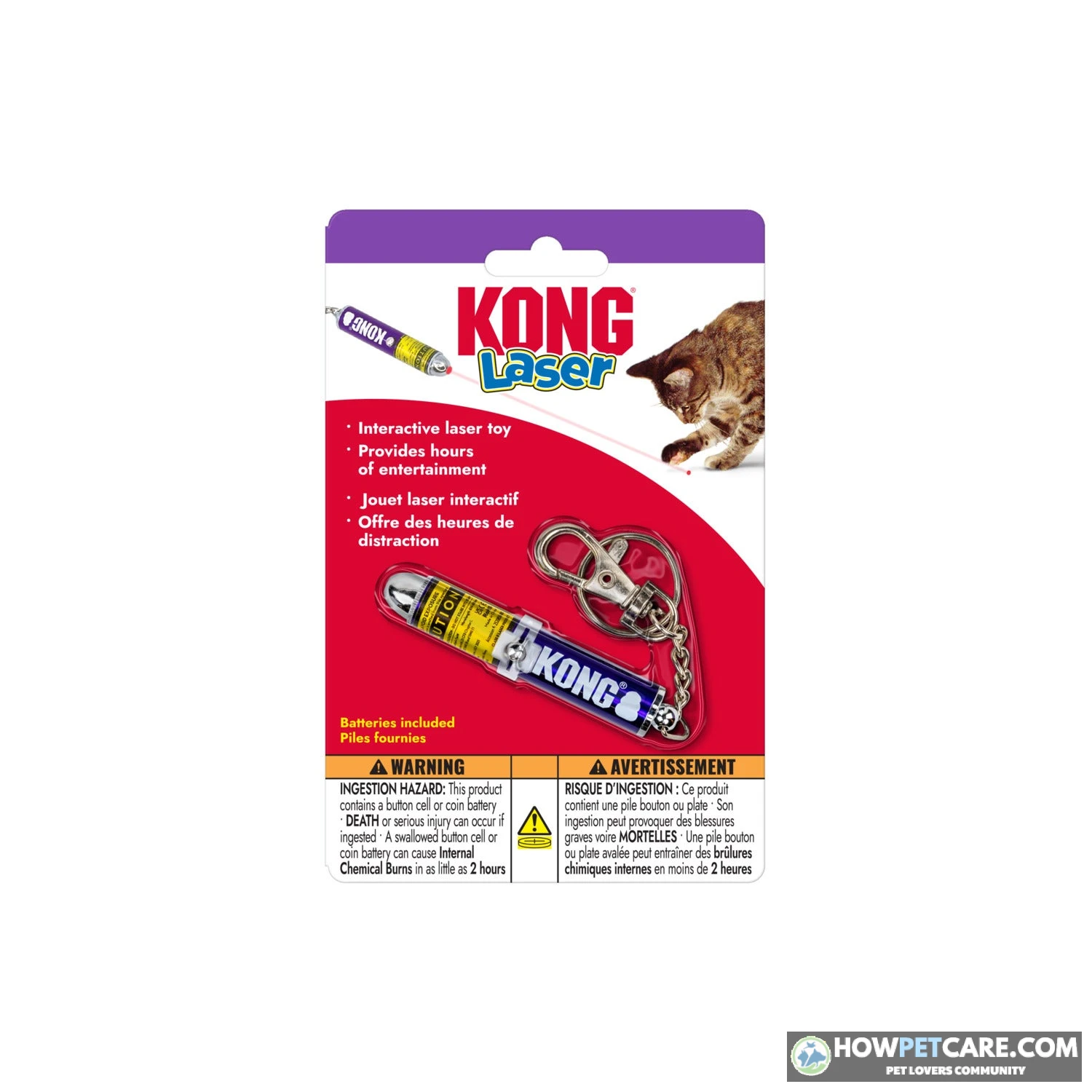
Labels aren’t a guarantee: a device can be mislabeled or exceed its stated power. Avoid devices with an unclear class or origin. A reputable seller and a clear label don’t make a laser pointer behaviorally safe to use with a dog.
How a dog’s eye could be injured
A dog might look toward the pointer, jump toward the handler’s hand, or encounter a beam reflected from a mirror or another shiny surface. Never aim a laser at or near an animal’s face, and keep laser devices away from children. Automatic laser toys raise the same concern, with less direct control over the chase and the beam.
Signs that warrant a vet visit
Sudden difficulty seeing, bumping into objects, squinting, pawing at an eye, or avoiding light warrants prompt veterinary advice. Retinal injury may not cause obvious discomfort or be visible from the outside, so don’t wait for these signs after a suspected direct exposure. Contact your veterinarian promptly and describe the device and circumstances; seek urgent care for sudden vision changes.

Can laser pointer obsession be reversed? Recovery timeline and a week-by-week plan
Used a laser a few times? Proportionate steps for puppies and new exposure
If your puppy or adult dog chased a laser once or a few times, stop using it and put it away. Offer a catchable toy or an easy food-search game instead. Over the next two to four weeks, notice whether your dog searches for the dot, reacts repeatedly to ordinary reflections, or has trouble settling.
No signs after a few exposures is reassuring, though it can’t predict every future response. There’s no need to provoke another chase to find out. If concerning behavior appears, book a veterinary appointment rather than assuming it’s simply a phase.
Realistic prognosis: what recovery may look like
Some dogs improve with trigger management, appropriate enrichment, and behavior treatment. Others may remain sensitive to lights or shadows and need ongoing management. There are no reliable laser-specific recovery rates or timelines, and a dog with severe or long-standing behavior may need specialist treatment and veterinary medication. A schedule is a planning tool, not a promise of a cure.
Week-by-week reset and retraining plan
Start with the veterinarian if the behavior is concerning, sudden, or disruptive. The following plan is a conservative example to discuss with your care team—not a substitute for a diagnosis.
-
Week 0–1: Remove and stabilize
Put away lasers and automatic light toys. Reduce predictable glare with blinds, rugs, or repositioned reflective objects where practical. Establish a predictable routine with rest, suitable walks, and easy food-search activities. Record naturally occurring episodes.
-
Weeks 1–3: Teach calm skills away from triggers
Use positive reinforcement to teach a name response, a mat settle, and a leave-it cue with ordinary food or toys. Reward the behavior you want; keep sessions short and stop while your dog can still participate comfortably.
-
Weeks 3–6: Review progress, not the calendar
If episodes are decreasing, continue management and practice. For dogs with persistent fixation, ask a qualified professional whether a carefully controlled desensitization and counterconditioning plan is appropriate. Do not deliberately introduce a flashlight or shadow on your own.
-
Week 6 onward: Maintain and adjust
Continue successful routines and add catchable play only if it does not increase arousal or searching. Review setbacks with your professional and keep environmental protections that help your dog rest.
In a professional-led exposure plan, the aim is to keep the dog below the point of fixation while pairing a manageable trigger with something positive. If the dog freezes, scans, whines, refuses food, or can’t recover, stop and consult the professional; more intense exposure isn’t a shortcut. Never force a dog to remain near a trigger until it gives up.

How to track progress
Write down the date, trigger if known, number of episodes, approximate duration, and how long your dog takes to return to a normal activity. Note whether your dog could respond to its name or accept food, and whether eating, sleep, or walks were affected.
For example, your log might show three episodes on Monday, with the longest lasting about 10 minutes, and one episode the following Monday lasting about four minutes. That’s encouraging information to discuss with your vet—not proof the problem has resolved. Compare several days rather than judging one good or bad afternoon.
Seek help sooner if behavior worsens, interferes with daily life, or causes injury. If a mild pattern isn’t measurably improving after several weeks of management, arrange a veterinary review and ask for a behavior referral.
Is there a harm-reduced way to use a laser pointer with a dog?
When harm-reduced laser play is a compromise—not a guarantee
Avoidance remains the lowest-risk choice. Some owners suggest ending the moving dot on a toy or treat so the dog gets a physical reward. That may address part of the missing-catch problem, but controlled studies haven’t shown that it prevents light fixation. A catchable toy from the start is the better recommendation.
If an owner nevertheless chooses to use a laser with a calm adult dog that has never shown light or shadow fixation, a risk-managed approach would mean a brief, supervised session; clear start and finish cues; ending on a physical reward; and stopping permanently at the first sign of scanning or difficulty settling. Keep the beam away from faces and reflective surfaces. These precautions reduce some foreseeable risks; they don’t establish safety.
When to skip it entirely
Don’t use a laser with a puppy or adolescent, an anxious or easily frustrated dog, or any dog with a history of light or shadow fixation. Avoid it in situations where dogs may compete over the final reward. For a previously fixated dog, don’t plan a future reintroduction: there is no established waiting period that makes it safe.
Flashlights and deliberately moving reflections aren’t good substitutes. For a dog already sensitive to light, they can become triggers too.
Safer ways to satisfy the chase instinct, matched to your dog’s drive
Choose an activity that provides a real object or reward and matches your dog’s ability to stay relaxed. For a dog currently fixated on light, start with calm scent or food activities rather than another fast visual chase.
| Drive or need | Activity or toy | How it replaces the chase | Cautions and best-fit dogs |
|---|---|---|---|
| Chase and pounce | Flirt pole or gentle fetch | The dog pursues and catches a physical target. | Keep sessions short, allow catches, and teach a release. Avoid sharp turns and slippery floors; ask your vet about joint or mobility concerns. |
| Grab and hold | Tug toys | A dedicated toy gives the dog something to grab and release. | Teach a trade or drop cue without force. Get guidance if the dog guards toys. |
| Search and sniff | Hidden treats, scatter feeding, or a snuffle mat | The dog follows scent to a tangible reward. | Start easy. Often a useful low-arousal choice for dogs recovering from light fixation. |
| Mental enrichment | Puzzle feeder, stuffed food toy, or short training game | The dog solves a manageable problem and earns food or interaction. | Begin at an easy level; an impossible puzzle can create frustration. |
| Multiple dogs | Separate scent searches or individual food toys | Each dog can search and succeed without competing for one target. | Separate dogs if food or toys lead to tension. |
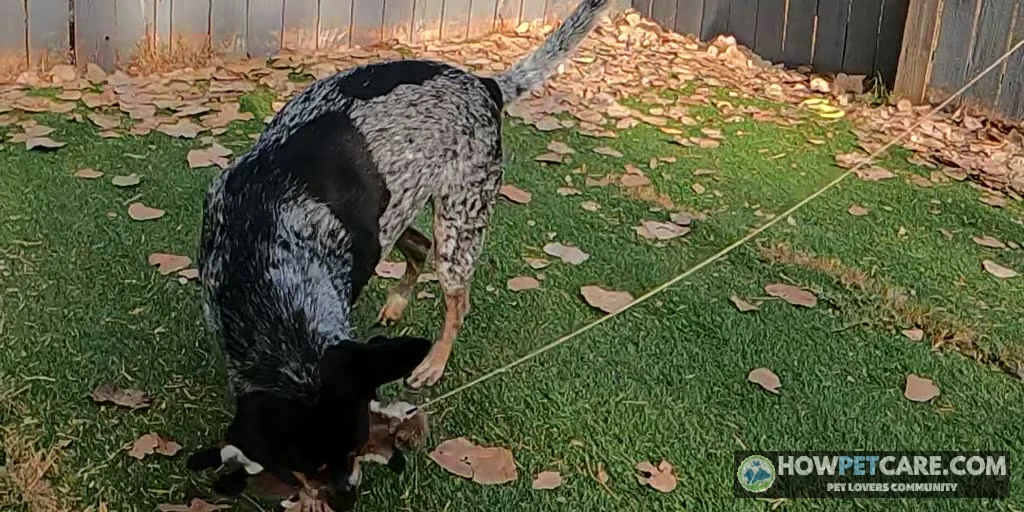
Flirt pole, tug, fetch, and lure-style play
A flirt pole is a toy on a line attached to a handle. Move the lure along the ground, let your dog catch it, and practice a positive-reinforcement trade before restarting. A reliable release matters more than making the chase longer. Fetch and tug can offer similar catch-and-release opportunities when your dog enjoys them and can stop comfortably.
Fast turns and repeated jumping may be unsuitable for dogs with orthopedic, heart, or other health concerns. Ask your veterinarian about appropriate movement, especially for a growing puppy or a dog with limited mobility.
Scent games and puzzle toys for dogs that need to wind down
Try scattering a few pieces of your dog’s regular food in grass or hiding them in easy-to-find places indoors. Let your dog search at its own pace. A simple feeder puzzle or a brief mat-training session can add mental work without encouraging a visual chase. Supervise toys and choose items your dog can’t swallow or easily destroy.

Getting professional help: when to call, who to see, what it costs, and your next step
When to see a vet before a behaviorist
Contact your veterinarian promptly if light chasing starts suddenly, your dog can’t be interrupted, or the behavior disrupts eating, sleeping, or normal activities. Seek urgent veterinary advice for suspected eye exposure, sudden vision change, seizures, or injury.
Vision problems, pain, neurological conditions, and other medical issues can contribute to unusual behavior. A veterinary examination helps rule out or address those causes before you assume the problem is behavioral. This guide is educational and can’t diagnose your dog.

Veterinary behaviorist vs. certified behavior consultant: roles and costs
Fees vary widely by location, appointment length, and case complexity. The ranges below are rough planning estimates, not verified quotes; call providers for current prices. Testing, medication, follow-ups, and travel may cost extra.
| Professional | Credential | What they can do | Approximate US cost to ask about | Best for |
|---|---|---|---|---|
| Primary veterinarian | DVM or VMD | Examine the dog, assess medical causes, discuss treatment, and refer. | Office exam roughly $60–$150 or more; diagnostics extra. | First assessment, sudden changes, suspected injury, or medical concerns. |
| Veterinary behaviorist | DACVB | A veterinarian with specialty training who can diagnose, design a treatment plan, and prescribe. | Initial consultation often several hundred dollars, roughly $300–$700 or more. | Severe or persistent cases, complex diagnoses, or possible medication needs. |
| Certified behavior consultant | CDBC or another relevant behavior credential | Develop and coach a management and behavior-change plan; cannot prescribe unless also a veterinarian. | Roughly $100–$250 per session; packages vary. | Structured support alongside veterinary care. |
| Credentialed trainer | For example, CPDT-KA or KPA-CTP | Teach practical skills and reinforcement-based routines; refer complex cases. | Roughly $75–$150 per session. | Early management skills or support under a behavior plan. |
Search the American College of Veterinary Behaviorists directory for a DACVB and the International Association of Animal Behavior Consultants directory for a certified consultant. Your veterinarian can also provide a referral. Ask about experience with compulsive or light-chasing behavior, positive reinforcement methods, a written plan, follow-up costs, and whether remote services are available. Insurance coverage and telehealth rules vary, so check both before booking.
Be cautious of anyone promising a guaranteed cure or recommending punishment for staring, chasing, or fear. Medication decisions belong to a veterinarian.
Your next step by situation
- Never used a laser: Skip it and choose a catchable toy.
- Used one a few times, with no signs: Stop now and observe your dog for two to four weeks without deliberately testing.
- Seeing repeated searching or shadow chasing: Manage triggers, keep a log, and arrange a veterinary assessment.
- Behavior is severe, sudden, worsening, or injurious: Contact your veterinarian promptly and ask whether specialist behavior care is appropriate.
- Possible eye exposure or sudden vision change: Call a veterinarian promptly; don’t wait for a behavior-training plan.
FAQ
Is it cruel to play with a dog using a laser pointer?
It is not cruel in intent, but it can frustrate a dog because the dot can never be caught. Some dogs show no problems, while others develop light-chasing that is hard to stop, so retiring the laser is the safer choice.
Do flashlights, reflections, and shadows cause the same problem as laser pointers?
They can for dogs already prone to light chasing, since they are also uncatchable moving targets. Avoid playing chase games with them, and use the severity checklist if your dog starts to fixate on them.
Are automatic laser toys safe for dogs?
They carry the same behavioral risk as a handheld pointer, with less human control over when play ends and where the beam goes. If your dog is unsupervised with one, the chase can continue with no catchable ending, so a toy that gives a physical reward is the better pick.
Can I use a laser pointer to help my dog exercise if they have limited mobility?
A laser isn’t a good fit, because it encourages fast, high-arousal movement and can lead to frustration. Gentle scent games, slow-paced puzzle toys, and short tug sessions give mental and physical work with less strain, and your vet can advise on safe activity levels.
How long should I wait before using a laser pointer again after my dog has shown fixation?
Plan on not using one again. For a dog that has shown fixation, relapse is a concern, and no data show when it is safe to reintroduce. If you want to revisit it, ask a veterinary behaviorist or certified consultant first.