

Best Saint Bernard food picks at a glance:
- Best overall (adults): Royal Canin Giant Adult — giant-breed nutrient profile, ~3,800 kcal/kg, ~$84.99/30 lb.
- Best budget kibble: IAMS Proactive Health Large Breed (~$54.99/30 lb).
- Best for puppies: Hill’s Science Diet Large Breed Puppy — controlled calcium for safe giant-breed growth.
- Best for seniors: Royal Canin Large Joint Care — lower calories, added joint support.
- Best for sensitive stomachs: Purina Pro Plan Sensitive Skin & Stomach (salmon & rice).
- Best fresh option: The Farmer’s Dog (~$220–$260/month for a 150 lb dog).
Best Saint Bernard Food: Top Picks by Life Stage and Need
Choosing Saint Bernard food for a 120–180 lb dog means considering life stage, budget, and giant-breed nutritional needs. Our top pick for most adult Saints is Royal Canin Giant Adult: it offers a complete giant-breed profile, appropriately sized kibble, controlled calorie density, and wide U.S. availability at a predictable price. The picks below are organized by life stage and need.
Best overall and best dry dog food for adult Saint Bernards
- Royal Canin Giant Adult – Formulated for dogs over 100 lb; protein 26%, fat 14%, calcium 1.1%, ~3,800 kcal/kg. 30‑lb bag (13.6 kg) ≈ $84.99 (2026‑11). Pros: giant‑breed specific nutrient ratios, large kibble that slows eating, and glucosamine and chondroitin for joint health. Cons: premium price; some owners report occasional loose stool during the transition.
- IAMS Proactive Health Large Breed – A budget‑friendly, vet‑trusted option; protein 24%, fat 12%, calcium 1.0%, ~3,600 kcal/kg. 30‑lb bag ≈ $54.99. Pros: lower cost per calorie, omega‑6 fatty acids for skin, and wide availability. Cons: slightly lower protein; smaller kibble may not slow a fast eater as well.
- Purina Pro Plan Large Breed Adult – Protein 26%, fat 12%, calcium 1.2%, ~3,750 kcal/kg. 34‑lb bag ≈ $71.99. Pros: high‑quality protein sources, added EPA/DHA, and good palatability. Cons: priced between Royal Canin and IAMS.
Best food for Saint Bernard puppies, seniors, and weight management
- Hill’s Science Diet Large Breed Puppy – Designed for controlled growth; protein 24%, fat 11%, calcium 1.2%, ~3,850 kcal/kg. 30‑lb bag ≈ $68.99. Pros: meets AAFCO growth standards for large breeds, has an optimal calcium‑to‑phosphorus ratio, and includes DHA. Cons: not exclusive to giant breeds; some puppies need higher calorie density.
- Royal Canin Large Joint Care (Senior) – Protein 22%, fat 10%, calcium 0.9%, ~3,500 kcal/kg. 30‑lb bag ≈ $79.99. Pros: enhanced glucosamine/chondroitin, fewer calories for an aging metabolism, and a focus on joint support. Cons: higher cost; may be too low in calories for very active seniors.
- Hill’s Science Diet Adult Perfect Weight Large Breed – Protein 24%, fat 9%, calcium 1.0%, ~3,400 kcal/kg. 30‑lb bag ≈ $72.99. Pros: calories calibrated for weight loss, L‑carnitine for lean muscle, and fiber for satiety. Cons: not a maintenance diet for dogs at ideal weight.

Best sensitive‑stomach and fresh‑food options
- Purina Pro Plan Large Breed Sensitive Skin & Stomach – Protein 26%, fat 12%, calcium 1.1%, ~3,700 kcal/kg. 30‑lb bag ≈ $74.99. Pros: easily digestible salmon & rice, prebiotic fiber, and no corn/wheat/soy. Cons: limited flavor variety.
- The Farmer’s Dog (Fresh Subscription) – Human‑grade cooked recipes; protein 30‑35% (as fed), fat 15‑20%, calcium balanced per recipe, ~1,200 kcal/kg (as fed). Monthly cost for a 150‑lb adult ≈ $220‑$260 (2026‑11). Pros: formulated by a board‑certified veterinary nutritionist, live feeding trials claimed superior to AAFCO, and no preservatives. Cons: substantially higher cost; requires freezer space and a managed delivery schedule.
- American Journey Active Life Large Breed – Budget fresh‑style kibble; protein 28%, fat 14%, calcium 1.1%, ~3,800 kcal/kg. 28‑lb bag ≈ $49.99. Pros: grain‑free if desired, high protein, and a lower price than premium fresh food. Cons: the grain‑free formulation may raise DCM questions (see section on grain‑free).
Affiliate disclosure: This article contains affiliate links. Recommendations are based on label data, cost comparisons, and published giant‑breed nutrition guidelines — not hands‑on feeding trials.
How to Compare Giant‑Breed Dog Food for Saint Bernard Nutrition
What to check on the label
The table compares the core numbers for a Saint Bernard. Values come from manufacturers’ guaranteed analyses (2026 labels) and package pricing snapshots from major U.S. retailers.
| Product and life stage | Format | Protein | Fat | Calcium | Calories per kg | Package size & price (2026‑11) | Est. cost/day (150 lb) | Est. cost/month (150 lb) |
|---|---|---|---|---|---|---|---|---|
| Royal Canin Giant Adult | Dry | 26% | 14% | 1.1% | 3,800 | 30 lb / $84.99 | $3.86 | $115.80 |
| IAMS Proactive Health Large Breed | Dry | 24% | 12% | 1.0% | 3,600 | 30 lb / $54.99 | $2.95 | $88.50 |
| Purina Pro Plan Large Breed Adult | Dry | 26% | 12% | 1.2% | 3,750 | 34 lb / $71.99 | $3.42 | $102.60 |
| Hill’s Science Diet Large Breed Puppy | Dry | 24% | 11% | 1.2% | 3,850 | 30 lb / $68.99 | $3.61 | $108.30 |
| Royal Canin Large Joint Care (Senior) | Dry | 22% | 10% | 0.9% | 3,500 | 30 lb / $79.99 | $3.73 | $111.90 |
| Hill’s Science Diet Perfect Weight Large Breed | Dry | 24% | 9% | 1.0% | 3,400 | 30 lb / $72.99 | $3.71 | $111.30 |
| Purina Pro Plan Sensitive Skin & Stomach | Dry | 26% | 12% | 1.1% | 3,700 | 30 lb / $74.99 | $3.51 | $105.30 |
| The Farmer’s Dog (Fresh) | Fresh | 30‑35% | 15‑20% | balanced | ~1,200 | Subscription / $240 mo (150 lb) | $8.00 | $240.00 |
| American Journey Active Life Large Breed | Dry | 28% | 14% | 1.1% | 3,800 | 28 lb / $49.99 | $2.78 | $83.40 |
Cost estimates assume a 150 lb adult needing ~2,800 kcal/day and use the formula shown in the cost section.
Puppy calcium and joint supplements
Giant‑breed puppies grow rapidly, and excess calcium can worsen developmental orthopedic disease. A complete large‑breed puppy formula already provides the correct calcium‑to‑phosphorus ratio (≈1.2:1) and includes glucosamine and chondroitin at levels shown to support joint health. A separate calcium supplement is unnecessary and can be harmful. Your veterinarian may recommend joint supplements (glucosamine/chondroitin) later if your puppy develops early joint changes, but not every puppy needs them.
Grain‑free diets and DCM evidence
The FDA continues to investigate a potential link between canine dilated cardiomyopathy (DCM) and certain grain‑free diets high in peas, lentils, or potatoes. There’s no definitive causal proof, but the signal is strongest for diets in which pulses replace grains as the primary carbohydrate source. If you choose a grain‑free food, look for one that has undergone AAFCO feeding trials, discuss it with your veterinarian, and monitor for cardiac signs. Grain‑free food isn’t inherently healthier for a Saint Bernard.
Saint Bernard Feeding Guide: Daily Calories, Cups, Grams, and Schedule
Daily feeding chart by age and weight
This chart uses a reference food of 400 kcal per cup (≈4,000 kcal/kg, 100 g per cup). Treat the amounts as starting points. Adjust them for body condition, activity, sex, neuter status, and your food’s actual kcal/cup.
| Life stage and age | Representative weight | Estimated daily calories | Food kcal per cup | Cups per day | Grams per day | Suggested meals per day |
|---|---|---|---|---|---|---|
| Puppy, 8‑12 weeks | 30‑50 lb | 1,300‑1,800 kcal | 400 | 3.25‑4.5 | 325‑450 g | 3‑4 |
| Puppy, 3‑5 months | 60‑95 lb | 2,100‑2,800 kcal | 400 | 5.25‑7 | 525‑700 g | 3 |
| Puppy, 6‑12 months | 100‑140 lb | 2,700‑3,500 kcal | 400 | 6.75‑8.75 | 675‑875 g | 2‑3 |
| Adolescent still growing, 12‑24 months | 130‑180 lb | 3,000‑3,800 kcal | 400 | 7.5‑9.5 | 750‑950 g | 2 |
| Adult maintenance, lower activity | 120 lb | 2,200‑2,600 kcal | 400 | 5.5‑6.5 | 550‑650 g | 2 |
| Adult maintenance | 150 lb | 2,600‑3,000 kcal | 400 | 6.5‑7.5 | 650‑750 g | 2 |
| Adult maintenance, larger frame | 180 lb | 3,000‑3,400 kcal | 400 | 7.5‑8.5 | 750‑850 g | 2 |
| Senior or weight‑loss plan | 140‑175 lb | 1,900‑2,700 kcal | 400 | 4.75‑6.75 | 475‑675 g | 2 |
For a food with a different calorie density, use these conversions: cups per day = daily kcal target ÷ your food’s kcal per cup; grams per day = daily kcal target ÷ kcal per gram. Don’t assume a cup of one formula is interchangeable with a cup of another.

How to adjust portions and transition foods
- Weigh your dog and check body‑condition score every two weeks (BCS 4‑5/9 ideal).
- If BCS >5, reduce daily calories by 10% and re‑evaluate in two weeks.
- To switch foods, mix 25% new / 75% old for 2‑3 days, then 50/50, then 75/25, reaching 100% new over 7‑10 days.
- Puppies typically transition to adult formula between 18‑24 months. The exact month depends on their growth rate and a veterinary assessment, not a fixed calendar date.
What Saint Bernard Food Costs per Day and per Month
Per‑day and monthly cost comparison
You can use the formula below for any food. Prices are snapshots from November 2026 and will change.
Reusable Cost‑per‑Day Formula With a 150 lb Worked Example
Formula in plain text:
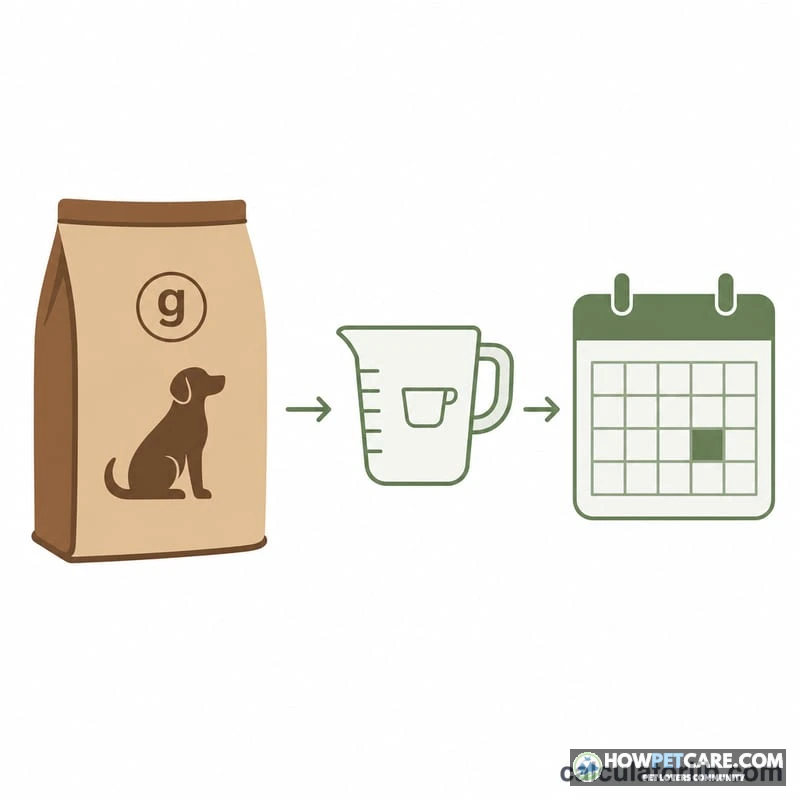
- Daily food amount in kg = daily calorie need ÷ food kcal per kg.
- Cost per kg = package price ÷ package weight in kg.
- Cost per day = daily food amount in kg × cost per kg.
- 30‑day cost = cost per day × 30.
- Days one bag lasts = package weight in kg ÷ daily food amount in kg.
Worked example: A 150 lb adult Saint Bernard is estimated to need 2,800 kcal/day. Example kibble: 30 lb bag = 13.6 kg, price 74.99, 4,000 kcal/kg. Daily amount = 2,800 ÷ 4,000 = 0.70 kg/day. Cost per kg =74.99 ÷ 13.6 = 5.51. Cost per day = 0.70 ×5.51 = 3.86/day. Thirty‑day cost =3.86 × 30 = $115.80. One bag lasts 13.6 ÷ 0.70 = about 19 days, so a 150 lb dog needs roughly 1.55 bags per month.
Adult reference points using the same 4,000 kcal/kg and $5.51/kg assumptions:
- 120 lb at 2,400 kcal = 0.60 kg/day, $3.31/day, $99.21/month, 22.7 days/bag.
- 150 lb at 2,800 kcal = 0.70 kg/day, $3.86/day, $115.80/month, 19.4 days/bag.
- 180 lb at 3,200 kcal = 0.80 kg/day, $4.41/day, $132.34/month, 17.0 days/bag.
Calculate fresh or wet food using its own kcal/kg or kcal per pack; never substitute kibble cups for fresh‑food packs.
Is fresh food worth the added cost?
A fresh subscription (e.g., The Farmer’s Dog) costs roughly $8‑$9 per day for a 150 lb Saint Bernard — 2‑3× the cost of premium kibble. Benefits include higher moisture, whole‑food ingredients, and formulation backed by veterinary nutritionists. The tradeoffs are price, freezer space, and delivery logistics. If your budget allows and you value minimal processing, fresh food can be a good choice. Otherwise, a high‑quality giant‑breed kibble meets all nutritional requirements at a fraction of the cost.
Lower Bloat Risk With a Saint Bernard Feeding Routine
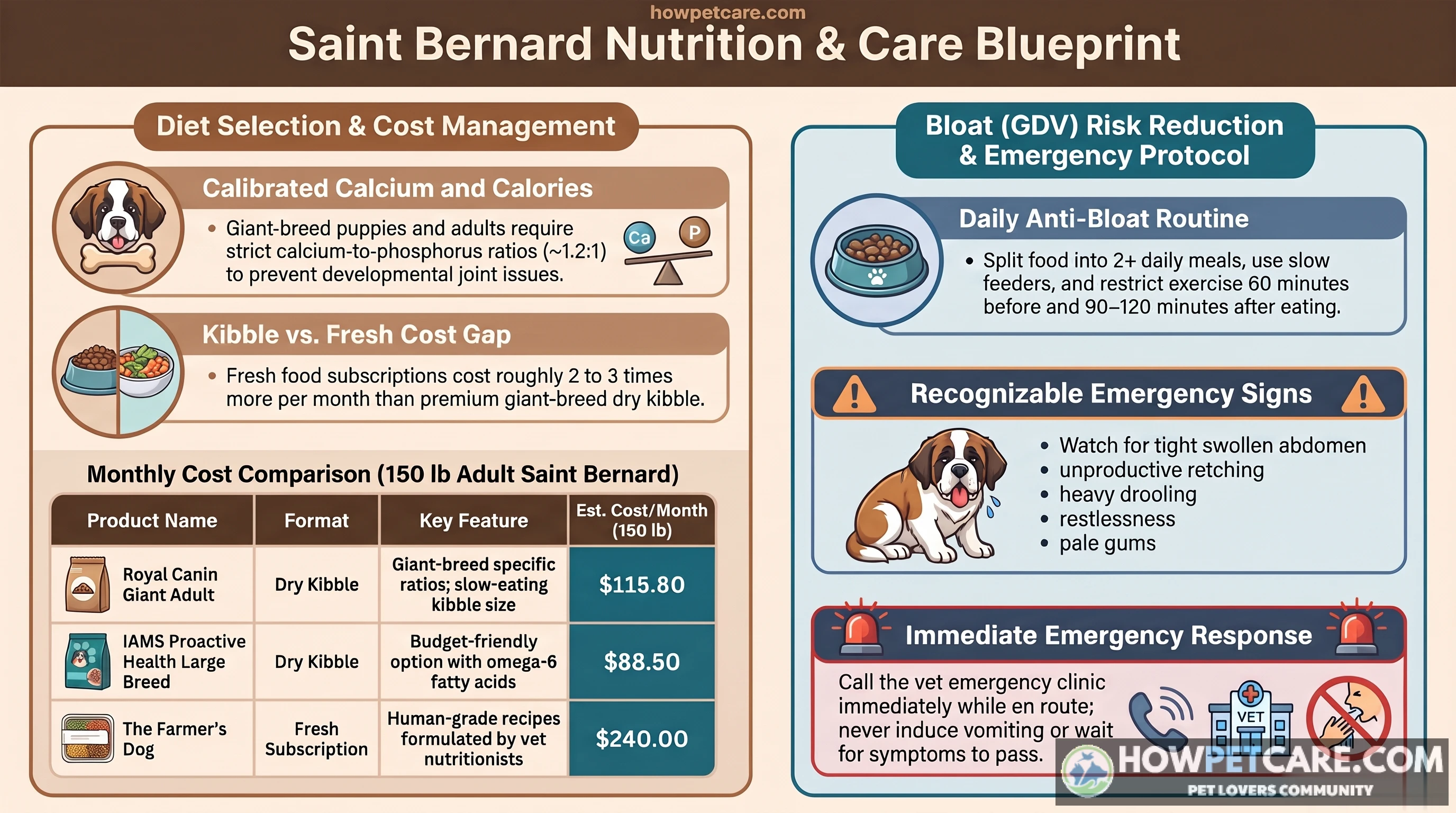
Deep‑chested Saint Bernards are at high risk for gastric dilatation‑volvulus (GDV), a life‑threatening emergency. No feeding routine eliminates the risk, but consistent habits can reduce contributing factors.
A practical daily GDV‑risk‑reduction routine
- Feed measured meals on a consistent schedule instead of free‑feeding.
- Split the daily amount into at least 2 meals for adults and 2‑4 for puppies. Use the chart’s daily total rather than adding extra ‘because he looks hungry.’
- Try a slow feeder, puzzle bowl, muffin‑tin scatter method, or timed feeder if your Saint Bernard finishes a meal in under about 5 minutes.
- Keep vigorous exercise, running, jumping, rough play, and training drills away from meals. A practical guardrail is about 60 minutes before and 90‑120 minutes after eating.
- Keep fresh water available all day. Around meals, prevent frantic gulping by offering smaller amounts calmly; ask your veterinarian before restricting normal water intake.
- Don’t let your dog eat immediately after stressful events, car rides, boarding pickup, or intense excitement.
- Recheck body condition every 2 weeks; extra fat and rapid eating both make giant breeds harder to assess in an emergency.
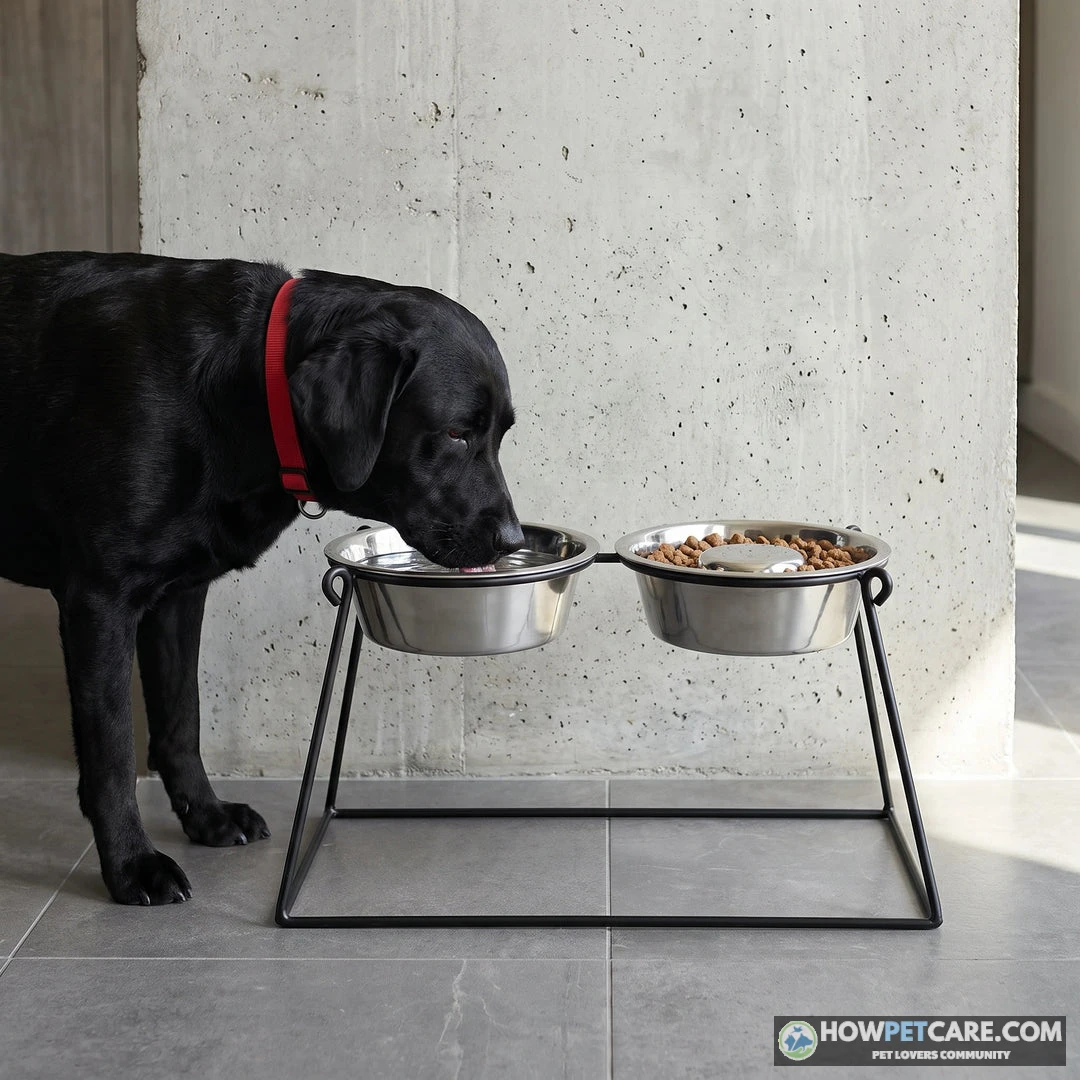
- Discuss raised bowls, individual anatomy, family history, and preventive gastropexy with your veterinarian. Don’t assume bowl height or surgery removes the risk.
Water, exercise, slow feeders, and veterinary prevention
Research on elevated bowls is mixed: some studies suggest they may increase GDV risk, while others show no effect. Discuss the choice with your veterinarian. Preventive gastropexy (surgical stomach tacking) dramatically reduces GDV mortality but carries surgical risk; talk with your vet about timing, often at spay/neuter. Slow feeders are low‑cost, evidence‑backed tools that reliably slow intake speed.
Suspected Bloat: Saint Bernard Emergency Checklist
Signs that mean go to an emergency vet now
Treat suspected gastric dilatation‑volvulus as an emergency. If several of these signs appear together, call the nearest emergency veterinary clinic and leave immediately.
Go now if you see:
- Swollen, tight, or drum‑like abdomen, even if it seems only mildly enlarged
- Repeated retching or gagging with little or nothing produced
- Restlessness, pacing, inability to get comfortable, stretching, or looking at the flank
- Heavy drooling or foamy saliva
- Rapid breathing, obvious pain, whining, or guarding the belly
- Pale or gray gums, weakness, staggering, or collapse
- A sudden change after eating, drinking heavily, or exercising
While arranging transport:
- Call the emergency clinic before you leave and say ‘possible bloat/GDV in a Saint Bernard’ so they can prepare.
- Keep your dog as calm and upright as practical, and use a ramp or help them into the vehicle if needed.
- Bring your regular vet number, medication list, feeding time, and when symptoms started.
- Don’t give food, water, treats, or medication.
- Don’t induce vomiting, give simethicone as a substitute for care, or try to decompress the stomach yourself.
- Don’t wait to see whether the abdomen gets bigger; early GDV can look subtle before shock develops.
What to do while arranging transport
Follow the critical actions in the checklist while you arrange transport. The only definitive treatment for GDV is emergency surgical decompression and gastropexy; no home remedy can replace it.

Choose the Right Saint Bernard Diet for Your Dog
Match the food to your dog’s life stage, body condition, digestion, budget, and veterinarian’s advice. Before buying, check the current label for AAFCO life‑stage adequacy, kcal/kg, calcium level, and package size. Start with the calculated portion, transition gradually over 7‑10 days, and track weight and BCS every two weeks. Reassess with your vet if growth, digestion, mobility, or weight changes. For homemade or raw diets, consult a board‑certified veterinary nutritionist for a complete formulation; don’t improvise calcium or supplements.
-
1. Lock life stage first
If your dog is under roughly 18‑24 months or still filling out, choose the only pick labeled for large/giant‑breed puppies or all life stages with appropriate growth nutrition. For an adult maintaining weight, choose an adult pick. For a senior or a dog losing muscle, shortlist the senior/lower‑calorie or weight‑management pick only if it still fits the dog’s calorie needs.
-
2. Match digestion
If your dog has chronic loose stool, gas, or repeated food sensitivity, choose the sensitive‑stomach pick even if another food is cheaper. Don’t rotate proteins randomly while the stomach is unstable.
-
3. Match format honestly
For the lowest prep and cost per calorie, choose a dry kibble row. Choose the fresh‑food row if you’ll budget for refrigerated delivery and freezer/fridge space; don’t rank fresh first and feed kibble anyway.
-
4. Break ties with monthly cost
Compare only the rows still eligible after steps 1‑3, then choose the lowest estimated cost per month at your dog’s weight. If two are within about $10/month, choose the one whose calories, kibble size, and availability make the feeding chart easiest to follow.
-
5. Final check before checkout
The row must show a suitable AAFCO life‑stage statement, a usable kcal/kg or kcal/cup number, a calcium level appropriate for that life stage, and a package size you can store while fresh. If any cell is missing, check the current label. If you can’t verify it, move to the next eligible row rather than guessing.
| Product Name | Format | Protein Content | Fat Content | Calcium Content | Calories per kg | Package Size & Price | Est. Cost per Day (150 lb) | Est. Cost per Month (150 lb) |
|---|---|---|---|---|---|---|---|---|
| Royal Canin Giant Adult | Dry | 26% | 14% | 1.1% | 3,800 | 30 lb / $84.99 | $3.86 | $115.80 |
| IAMS Proactive Health Large Breed | Dry | 24% | 12% | 1.0% | 3,600 | 30 lb / $54.99 | $2.95 | $88.50 |
| Purina Pro Plan Large Breed Adult | Dry | 26% | 12% | 1.2% | 3,750 | 34 lb / $71.99 | $3.42 | $102.60 |
| Hill's Science Diet Large Breed Puppy | Dry | 24% | 11% | 1.2% | 3,850 | 30 lb / $68.99 | $3.61 | $108.30 |
| Royal Canin Large Joint Care (Senior) | Dry | 22% | 10% | 0.9% | 3,500 | 30 lb / $79.99 | $3.73 | $111.90 |
| Hill's Science Diet Perfect Weight Large Breed | Dry | 24% | 9% | 1.0% | 3,400 | 30 lb / $72.99 | $3.71 | $111.30 |
| Purina Pro Plan Sensitive Skin & Stomach | Dry | 26% | 12% | 1.1% | 3,700 | 30 lb / $74.99 | $3.51 | $105.30 |
| The Farmer's Dog (Fresh) | Fresh | 30–35% | 15–20% | balanced | ~1,200 | Subscription / $240.00 mo (150 lb) | $8.00 | $240.00 |
| American Journey Active Life Large Breed | Dry | 28% | 14% | 1.1% | 3,800 | 28 lb / $49.99 | $2.78 | $83.40 |
FAQ
Can Saint Bernards eat grain-free dog food?
Some can, but grain-free is not inherently healthier, and the relationship between certain diets and canine DCM remains an active area of investigation. Choose a complete diet based on your dog’s needs and discuss grain-free feeding with your veterinarian, especially if it relies heavily on pulses or has no medical reason for excluding grains.
Is fresh food better than kibble for a Saint Bernard?
Neither format is automatically better if both are complete and appropriate for the dog’s life stage. Compare nutritional adequacy, calorie density, feeding practicality, and the substantially different cost per day before choosing.
Are Saint Bernard homemade dog food recipes safe?
A recipe is safe as a staple only when it is complete and balanced for the dog’s life stage, including appropriate minerals and calcium. Ask a board-certified veterinary nutritionist to formulate it; generic recipes may leave serious nutritional gaps.
Can I give a Saint Bernard joint supplements along with giant-breed food?
Not automatically: some complete foods already include joint-support ingredients, and supplement needs depend on the individual dog and product. Ask your veterinarian before adding glucosamine, chondroitin, calcium, or other supplements, particularly for a growing puppy.