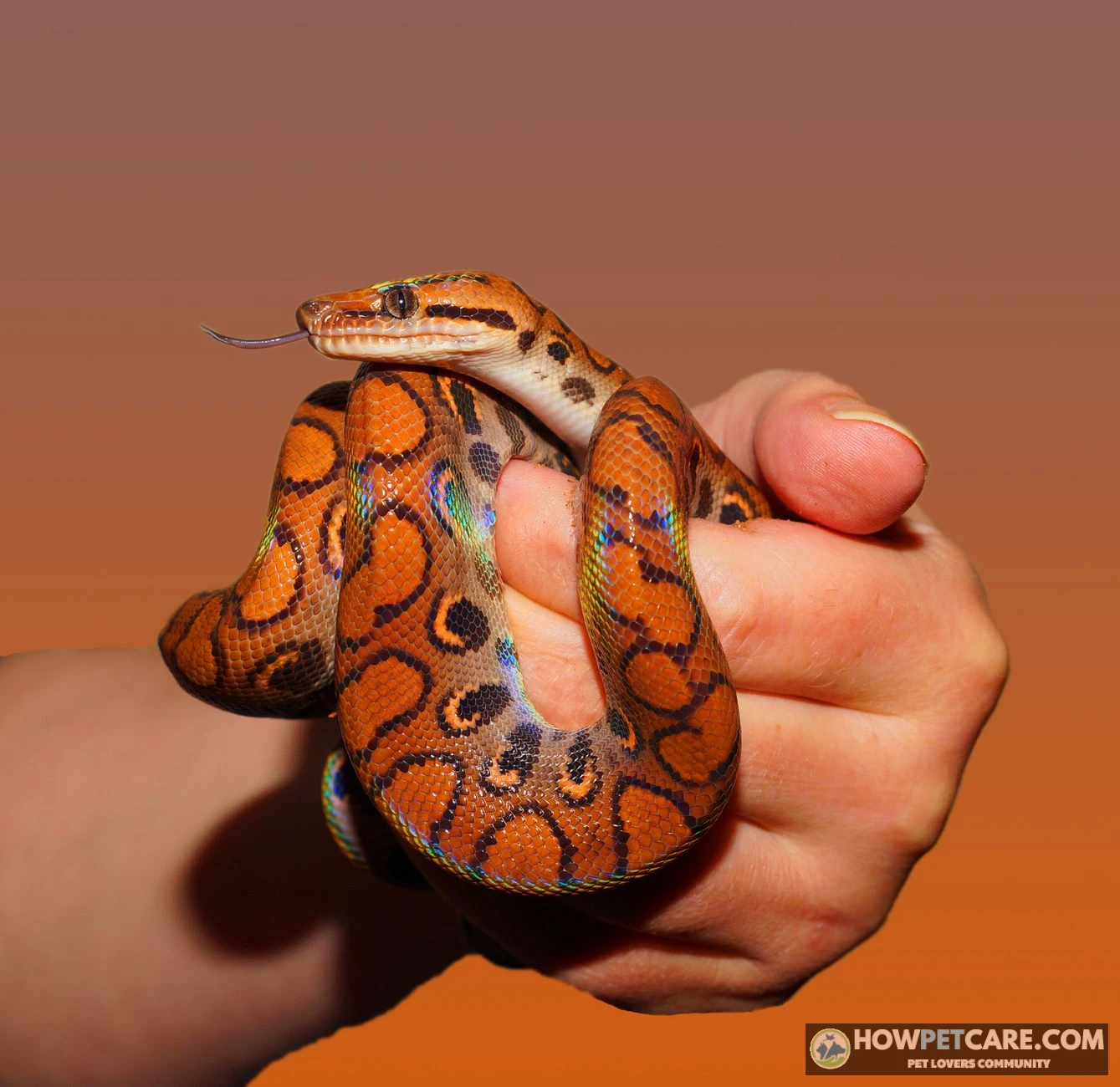

A rainbow boa snake suits committed keepers who can hold 70–80% humidity, tame a defensive hatchling, and commit for 20-plus years. Adults reach 4–6 feet and need a 4x2x2 ft enclosure. First-time snake owners are usually better off starting with a corn snake or ball python.
Is a Rainbow Boa Snake Right for You? The Short Verdict
A rainbow boa snake (Epicrates cenchria) can be rewarding to keep, but it isn’t the lowest-risk first snake. If you’ve never kept a reptile, a corn snake or ball python is a safer start. A committed beginner can keep a Brazilian rainbow boa successfully, provided they can manage high humidity, patiently handle a defensive hatchling, and accept a 20-plus year commitment.
The short facts: adults usually reach 4–6 feet, with some females up to about 7 feet; captive lifespan is commonly 20–25 years and can exceed 40 years with excellent care. These nocturnal, semi-arboreal constrictors have smooth, iridescent scales. They’re non-venomous, and their bite is painful but rarely medically serious.
Choose a rainbow boa if you want a medium-sized, iridescent boa, can check humidity daily, and are prepared to tame a baby over a few weeks. Choose a corn snake for the easiest first snake, or a ball python if you want a calm, heavy-bodied snake and can accept that it may fast. The rest of this Brazilian rainbow boa care sheet covers setup, feeding, budget, and long-term care for 2026.
A healthy rainbow boa can live two decades or more. Before buying, budget for its full lifespan, including housing upgrades, prey, substrate, and vet care. This isn’t a pet to rehome casually, especially given the confirmed introduced population in Florida from released pets.
What Is a Rainbow Boa? Size, Lifespan, Iridescence and Range
A rainbow boa is a medium-sized relative of the boa constrictor in the family Boidae. It’s native to humid forests and forest edges in Central and South America, and its scientific name is Epicrates cenchria. It shares the boa body plan with the much larger common boa constrictor but fits a 4x2x2 ft adult enclosure.
The famous shine comes from its scales, not pigment. Microscopic ridges and purine-containing epidermal cells refract light, producing the thin-film rainbow effect. The colors show most strongly after a clean shed and under focused light.
Like other boids, Epicrates cenchria retains tiny vestigial hind-limb spurs near the vent and has two functional lungs. Deep labial pits along the upper lip sense infrared heat from warm-blooded prey in darkness.

How Big Do Rainbow Boas Get and How Long Do They Live?
Captive adults usually measure between 4 and 6 feet. The total reported range is 4–7 feet (1.2–2.1 m), and large females can reach about 9 lbs (4.1 kg). Newborns are 15–20 inches (38–50 cm). Males mature around 4 ft (1.2 m), females around 4.5–5 ft (1.4 m). Growth is fast for the first two years, then slows. Typical captive lifespan is 20–25 years, with documented maxima near 42 years.
Reproduction is ovoviviparous: eggs develop and hatch inside the mother, who gives birth to fully formed young. Gestation depends on temperature, taking about 104–110 days at 86 °F or 129–135 days at 80 °F. Litter size ranges from 2 to 35 live young.

The Florida Population: How It Happened and Why It Matters to Owners
Epicrates cenchria has been documented as an introduced, breeding population in Homestead, Florida, confirmed established by 2024. It almost certainly came from escaped or released pets. Never release a pet, and check current state and local regulations before buying.
In the wild, rainbow boas occupy tropical forest, woodland edges, and savanna transition zones from the Amazon Basin north through the Guianas and Venezuela. Annual rainfall in their natural range can reach 58.5–136.5 inches, which helps explain their captive humidity needs.
CITES listing: Epicrates cenchria is on CITES Appendix II, which regulates international trade. It is not IUCN-assessed in most cited references. Buy only captive-bred animals from reputable breeders.
 You might be wonderingCorn snake careCorn Snake Care: A Complete Beginner Setup and Cost GuideRead the answer
Are Rainbow Boas Venomous or Dangerous? Bites, Temperament and Safe Handling
Rainbow boas are non-venomous constrictors. They have no venom glands or fangs; their small, recurved teeth are designed to grip prey. An adult bite usually leaves shallow punctures or lacerations. It’s painful and messy because of the many small teeth, but rarely serious beyond the wound. Clean it with soap and water, apply antiseptic, and watch for infection. Seek care for deep wounds or signs of infection. As with all reptiles, wash your hands after handling because of Salmonella risk.
The aggressive label often applied to baby rainbow boas mostly describes defensive fear. Neonates are food-motivated and programmed to strike at warm movement, and most bites from young snakes are feeding responses. With a calm taming protocol, most settle within 4–8 weeks.

Taming a Defensive Baby Rainbow Boa Step by Step
Use this six-week sequence, without skipping stages.
-
Week 1 — Total hands-off
Place the snake in its enclosure and don’t open it except to change water. Don’t handle or feed it for 5–7 days. Give it time to learn that the enclosure is safe.
-
Week 2 — First feed
After lights out, offer one appropriately sized frozen-thawed mouse, warmed to body temperature. If the snake refuses, wait 5 days and try again. Don’t handle it until it has eaten at least once, ideally twice.
-
Week 3 — Scent and presence
Sit near the open enclosure for 5–10 minutes daily. Place a worn, clean t-shirt nearby so your scent becomes familiar. Continue to avoid handling.
-
Weeks 4–5 — Hook training and first touches
Before opening, gently tap the snake’s mid-body with a hook or rolled paper towel tube to signal that it isn’t feeding time. Then handle it for 2–3 minute sessions every other day: support its body fully and let it move through your hands. End on a calm note.
-
Week 6 and beyond — Build duration
Extend sessions to 10–15 minutes, 3–4 times weekly. Handle in a different room from feeding. Always wash your hands before handling to remove rodent scent.
-
Rules that never expire
Don’t handle during shed — cloudy eyes mean defensiveness. Don’t handle for 48 hours after a meal. Stop if the snake balls up or S-coils; those are signs of fear, and pushing through rewards striking.
Handling an Adult Safely
Adults usually become tolerant and sometimes calm, but they remain food-motivated. Wash your hands before handling, support at least two-thirds of the body, and avoid gripping the head or tail. Don’t handle the snake in the feeding room, during shed, or for 48 hours after eating. An S-coil with a raised head is a strike posture; a tight ball means stress. Put the snake down and try later.
Adult bites can break skin and leave tiny punctures. They hurt, but they aren’t dangerous like a venomous snake. Infection is the main risk, so clean the wound thoroughly and seek care if swelling, redness, or oozing occurs.

Rainbow Boa Enclosure Setup: Size, Temperature, Humidity and Lighting
Set up the enclosure before your snake arrives and run it for at least a week to confirm temperature and humidity. A juvenile can start in a small tub or a 20-gallon long; an adult needs at least a 4x2x2 ft enclosure. Larger is better for a semi-arboreal, nocturnal snake. Front-opening PVC or sealed enclosures hold humidity far better than glass tanks with screen tops.

Heating and Ambient Temperature Setup
Provide a thermal gradient: cool side in the upper 70s °F, warm-side ambient low-to-mid 80s °F, and basking surface around 88–90 °F. The reported captive temperature range is 72 °F on the cool side to 85 °F on the warm side, showing why the gradient matters. Use a radiant heat panel, heat cable, or ceramic heat emitter on a quality thermostat. Every heat source must be on a thermostat — no exceptions. Unregulated bulbs can exceed 100 °F and cause burns or death. Avoid heat rocks.
Nighttime temperatures can drop into the low 70s °F. Don’t use red or blue bulbs at night; colored light still disrupts the day-night cycle. If the room drops below 70 °F, use a ceramic heat emitter or radiant panel on a thermostat.
Reaching and Holding the Right Humidity
Humidity is often the hardest part of care for first-time keepers. Rainbow boas tolerate 60–80% humidity in captivity; keepers usually target 70–80% and raise it to 75–85% during a shed. Annual rainfall in the wild can exceed 58 inches, so the species isn’t suited to a dry terrarium. But humidity doesn’t mean a swamp: the enclosure should be humid, with surfaces dry to the touch.
To stabilize humidity, use a deep, moisture-holding substrate layer of 3–4 inches, a large water bowl near the warm side, and a humid hide with damp sphagnum moss. Use misting only as a supplement. Digital hygrometers at substrate level on both sides are essential; cheap analog dials are usually inaccurate.

Substrate and Terrarium Setup Checklist
Cypress mulch, coco husk, or a coco-fiber and organic topsoil mix hold moisture well and resist mold when spot-cleaned. Avoid cedar, pine, and aspen: cedar and pine are toxic, while aspen dries out almost immediately and molds if misted heavily.
Furnish the enclosure with at least two hides — one cool, one warm — plus climbing branches, fake plants or leaf litter, and a heavy water bowl large enough for soaking. Rainbow boas are semi-arboreal and will use a sturdy branch and elevated cover at night.
UVB is optional but increasingly standard. A low-output LED or T5 UVB lamp on a 12-hour cycle may support immune and behavioral health. Provide plenty of hides and shade so the snake can opt out. UVB isn’t mandatory for nocturnal snakes, but it’s low-risk insurance if installed correctly.
Much of the advice online dates from 2010–2012. The species hasn’t changed; the equipment has.
| Legacy advice (~2011) | Current best practice |
|---|---|
| Heat mat under tank as main heat | Radiant heat panel or overhead emitter on a thermostat; heats air, not one floor spot |
| A heat lamp is fine with no regulation | Every heat source on a thermostat; unregulated bulbs can exceed 100 °F |
| Humidity via daily misting only | Deep substrate + large water bowl + humid hide = stable 70–80% without a swamp |
| UVB unnecessary for nocturnal snakes | Low-output UVB (T5 2.4–6% or LED equivalent) with shade is increasingly standard |
| Glass tank with screen top | PVC or sealed enclosures hold humidity; screen-top glass is hard to keep humid |
| Red heat bulb at night | Any light at night disrupts the cycle; use thermostat-controlled panel or ceramic emitter |
Be suspicious of a care sheet that doesn’t mention a thermostat. Every heat source in a rainbow boa enclosure should be on one.
What Do Rainbow Boas Eat? Feeding Schedule and Prey Size
Feed frozen-thawed rodents. They’re the standard for captive rainbow boas: safer for the snake and keeper, and cheaper over time. Thaw prey in the refrigerator or cold water, then warm it to roughly body temperature before offering it.
Choose prey about as wide as the thickest part of the snake’s body. Newborns start on small mice or rat pinkies, then progress to adult mice and small rats as juveniles. Most adults do well on small to medium rats.
Feeding frequency by age:
- Babies: one prey item every 5–7 days
- Juveniles: every 7–10 days
- Adults: every 10–14 days

Adjust for body condition. A rainbow boa should look round but not pear-shaped; a visible spine means underweight, while fat rolls near the tail base mean obesity. Many keepers reduce winter feeding slightly because cooler rooms and shorter days slow digestion.
Use a heavy water bowl and change the water when soiled. Rainbow boas often soak before a shed or when too warm; the bowl also raises humidity.
Feed in the enclosure rather than moving the snake to a separate tub. Moving a defensive baby adds stress and can trigger regurgitation. If you’re concerned about substrate ingestion, offer prey on a paper towel or small plate inside the enclosure.
Rainbow Boa Subspecies and Morphs: What Differs and What You’ll See in Listings
The taxonomy of Epicrates cenchria has been revised, and the exact number of subspecies depends on the authority. Buyers most often see two names: Brazilian rainbow boa (Epicrates cenchria cenchria) and Colombian rainbow boa (Epicrates cenchria maurus).
Brazilian vs Colombian Rainbow Boa Compared
| Feature | Brazilian rainbow boa (E. c. cenchria) | Colombian rainbow boa (E. c. maurus) | Notes for buyers |
|---|---|---|---|
| Typical adult size | 4–6 ft, females up to 7 ft | Usually 4–5 ft, more slender | Females larger in both |
| Base coloration | Rich red-orange to reddish-brown with bold black rings | Darker brown, often more muted pattern | Lighting affects appearance |
| Pattern contrast | High-contrast orange/black annuli | Lower contrast, sometimes more uniform | Regional variation exists |
| Temperament | Variable; babies usually defensive | Often reported as somewhat shyer/calmer | Individual personality matters most |
| US availability | Very common | Common but slightly less available | Ask for locality and lineage |
| Price (normal morph) | ~$100–$300 | ~$100–$250 | Market varies by breeder and season |
In Trinidad and Tobago, E. c. maurus tends to have a more uniform and less vivid pattern than the Brazilian nominate form. Some authorities split or lump these forms following taxonomic revisions, so ask the breeder for locality data.

Popular Rainbow Boa Morphs and How They Affect Price
Morphs are selectively bred color and pattern variants. Common ones in US listings include:
- Hypomelanistic (hypo): reduced black, cleaner orange and red tones
- Anerythristic (anery): little to no red or orange; black, gray, silver
- Albino: no dark pigment, pink or red eyes, yellow or cream tones
- Leucistic-type / whitish: very light or nearly white background, sometimes blue eyes

Prices climb with rarity. A normal Brazilian rainbow boa may cost $100–$300; common morphs add 50–150% to the base; rare or multi-gene combinations can run $500–$1,500 or more. Buy based on health and feeding history, not color alone.
When evaluating a listing, ask whether the snake is captive-bred, when it hatched, and whether it has consistently eaten frozen-thawed prey. Request a current photo or video, and ask if the seller offers a health or feeding guarantee.
How Much Does a Rainbow Boa Cost? Purchase, Setup and Yearly Expenses
The snake itself is usually the smallest expense over 20 years. The ranges below are realistic for the US pet trade in 2026, but prices change. Use them for planning, not as exact quotes.
First-Year Cost Breakdown by Budget Tier
| Expense | Budget tier | Mid-range tier | Premium tier |
|---|---|---|---|
| Snake (normal Brazilian, captive-bred) | $100–$150 | $150–$250 | $250–$400+ (morphs) |
| Enclosure (4x2x2 ft adult) | DIY or used PVC/wood, $150–$250 | New PVC, $350–$500 | Custom display, $600–$900 |
| Heat (radiant panel + thermostat) | $80–$120 | $130–$180 | $200–$280 |
| Monitoring (hygrometer + probes) | $25–$40 | $50–$70 | $80–$120 |
| Substrate, hides, bowl, branches | $60–$100 | $120–$180 | $200–$300 |
| UVB lighting (optional) | Skip | $60–$100 | $100–$160 |
| Setup subtotal | ~$415–$760 | ~$860–$1,180 | ~$1,430–$2,160 |
A wellness exam and fecal test at an exotics vet in the first month runs about $80–$200.
Ongoing Annual Costs and Vet Budget
Recurring costs are similar across tiers:
- Frozen-thawed prey: $80–$150
- Substrate replacement: $60–$120
- Electricity: $40–$80
- Equipment replacement: $30–$60
- Vet fund: $150–$300
Plan roughly $360–$710 per year, plus an emergency fund. Exotics vet visits for respiratory infections, regurgitation, or parasites can run $200–$800 once diagnostics and medications are included.
Over 20 years, mid-range figures total roughly $8,000–$15,000. The snake is the smallest line item. If that budget isn’t realistic, a corn snake is far cheaper.
Even a healthy snake should see an exotics vet for a wellness exam and fecal test within the first month. An emergency visit can cost several hundred dollars. Budget for both up front.
Rainbow Boa vs Corn Snake vs Ball Python: Which First Snake Should You Pick?
For prospective keepers, the differences in humidity needs and temperament are worth weighing before buying.
| Factor | Rainbow boa | Corn snake | Ball python |
|---|---|---|---|
| Adult size | 4–6 ft | 3–5 ft | 3–5 ft, heavy-bodied |
| Lifespan | 20+ years | 15–20 years | 20–30 years |
| Baby temperament | Defensive and nippy until tamed | Usually docile from day one | Shy but rarely bites |
| Humidity difficulty | Hard — 70–80% | Easy — 40–60% | Moderate — 50–60% with shed spikes |
| Feeding reliability | Good once established | Excellent | Notorious for hunger strikes |
| Purchase price (normal) | ~$100–$300 | ~$50–$150 | ~$50–$150 |
| Setup cost | Higher — needs humidity discipline | Lowest | Moderate |
| Handling tolerance as adult | Good once tamed, food-motivated | Excellent | Good — calm but sedentary |
| Beginner score | 2 out of 3 | 3 out of 3 | 2.5 out of 3 |

If this is your first snake and you want the lowest-risk path, pick the corn snake. It tolerates wider humidity and temperature ranges, eats reliably, and is cheap to house. Choose the rainbow boa if you can commit to daily humidity checks and want a medium-sized, iridescent, nocturnal display animal. Choose the ball python if you want a calm, heavy-bodied snake but can accept feeding fasts.
Rainbow boas also differ from the common boa constrictor, which can reach 6–10 feet and needs a much larger enclosure. If you like boas but worry about size, the rainbow boa is the more manageable choice.
Troubleshooting a Rainbow Boa: Food Refusal, Stuck Shed and Breathing Problems
Many problems involve temperature, humidity, or stress. Use this table to assess what you can check first and when to call an exotics vet.
| Problem | Try this first (DIY) | See an exotics vet when |
|---|---|---|
| Food refusal | Check warm side is 82–85 °F and humidity 70%+; confirm snake is not in blue phase; try smaller prey, different prey type, or feeding at night; reduce handling for a week | Juvenile refuses 3–4 weeks, or adult 2–3 months; any refusal with weight loss, lethargy, or spine showing |
| Stuck shed / retained eye caps | Raise humidity to 85%+ for 48 hours; add a humid hide; soak in shallow 85 °F water for 15–20 minutes, then offer a damp towel to crawl through. Never peel shed or eye caps with tools | Eye caps remain after two shed cycles; retained shed on tail tip; visible damage, swelling, or cloudy eye that does not clear |
| Respiratory symptoms (wheezing, bubbles, open-mouth breathing, mucus) | Verify warm side has not dropped below 80 °F and the enclosure is not cold and wet; correct the gradient and keep surfaces dry | Do not wait. Any open-mouth breathing, clicking/wheezing, or mucus bubbles needs a vet right away. Respiratory infections progress fast |
| Mites (tiny black or red dots, soaking constantly) | Wipe the snake with a white paper towel after a soak to confirm; strip the enclosure, bake or replace all substrate and decor; quarantine from other reptiles | Infestation returns after two clean-outs, or snake shows anemia (pale, lethargic) |
| Regurgitation | Stop handling for 7 days; verify temperatures; wait 10–14 days, then offer a much smaller meal | Two or more regurgitations in a row — this damages the esophagus and needs professional care |

Why Is My Rainbow Boa Refusing Food?
Food refusal is usually related to husbandry rather than illness. Check the warm side, humidity, and shed status. Make sure there are tight hides on both sides; exposed snakes do not eat. Offer food at night. New arrivals may need another week to settle. Keep a log of feed dates, prey size, sheds, and monthly weight so you can spot patterns.
Stuck Shed and Dented Eye Caps
A dull look before a shed is normal; retained shed afterward isn’t. Dented eye caps mean the enclosure is too dry. Raise humidity, add a humid hide, and give the snake a short soak. Never pull eye caps with tweezers or tape; the cornea can be damaged. If eye caps remain through two shed cycles, see an exotics vet.
Early Respiratory Infection Signs and Vet Thresholds
Respiratory infections are an emergency. Early signs include wheezing, open-mouth breathing, mucus bubbles, and lethargy. A classic trigger is cold plus wet. Correct the temperature gradient and keep surfaces dry, then book an exotics vet appointment. Antibiotics and supportive care are usually needed.
Open-mouth breathing, repeated regurgitation, a swollen limb, sudden weight loss, or a retained eye cap with a cloudy eye are not home fixes. An exotics vet should see the snake within 24–72 hours.
Your Rainbow Boa Buying and Prep Checklist
If you’re still leaning toward a rainbow boa, follow this sequence before you buy.
- Set up the enclosure at least one week before the snake arrives. Verify the temperature gradient with probe thermometers and humidity with a digital hygrometer on both sides.
- Confirm legality. Check state, county, and city laws, and be aware that regulations may tighten because of the Florida introduced population. Never release a pet.
- Find an exotics or reptile vet and ask about a wellness exam and fecal test before you bring the snake home.
- Vet the breeder. Ask for captive-bred status, hatch date, consistent frozen-thawed feeding history, and current photos or video of the actual animal.
- Run the budget. Add the setup tier to first-year vet and recurring costs. Make sure the 20-year commitment is realistic.
- Plan day one. Give the snake a full week to settle before handling. Schedule the first feed for day 5–7 and the first handling for after two successful meals.
If daily humidity checks, taming a defensive baby, or the long-term budget sound like too much, start with a corn snake or ball python. You can gain experience and revisit the rainbow boa later.
A rainbow boa isn’t a beginner snake like a corn snake, but it isn’t expert-only either. It’s a pet for a committed intermediate keeper: beautiful and rewarding, and manageable if set up correctly from the start.
FAQ
Do rainbow boas need UVB lighting?
UVB is not strictly required for a nocturnal rainbow boa, but low-output LED or T5 UVB with plenty of cover is increasingly used and may support overall health. If you use it, provide shade and hides so the snake can opt out.
Can rainbow boas live together?
No, keep them housed separately. Cohabitation causes stress, feeding competition, and injury, and makes it impossible to monitor each snake’s appetite and health.
Why does my rainbow boa look dull?
A dull or milky look usually means the snake is heading into a shed. The iridescence returns after the shed, though persistent dullness can point to humidity or health problems.
Are rainbow boas legal to own?
Legality varies by country, state, and sometimes city, and rules may be tightening given the Florida population. Check current local wildlife regulations before buying.
Do rainbow boas like to be handled?
They tolerate handling more as they mature, especially with consistent, calm, short sessions. Babies are often defensive and need patient taming before regular handling.