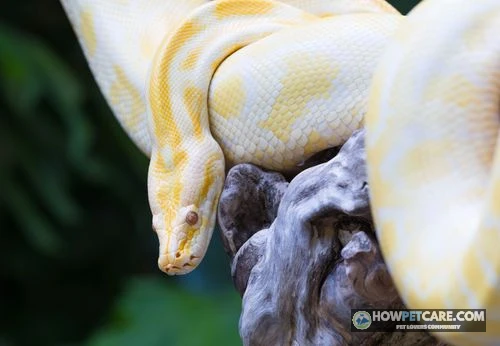

The reticulated python (Malayopython reticulatus) is the world’s longest snake, with mainland adults typically reaching 10 to 20 feet. Native to Southeast Asia, this athletic constrictor requires large, escape-proof enclosures, precise 88–92°F basking gradients, 60–80% humidity, and mandatory two-person handling protocols once exceeding 8 feet in length.
Reticulated Python Size, Records, and Reality
A reticulated python is the world’s longest snake species by reliably documented captive length, but length is not the same as mass, manageability, or safety. Mainland adults commonly fall within a broad 10-20 foot range, with males usually smaller and females capable of becoming substantially larger and heavier. Adult females are significantly larger than males. A large animal is a lifelong, room-scale husbandry commitment, not simply a bigger version of a juvenile pet.
How big do reticulated pythons get?
The species, Malayopython reticulatus, has a long, athletic body rather than the extremely heavy build associated with anaconda females. Size varies with sex, ancestry, age, body condition, diet, health, and how the animal is measured. A straight-line measurement along the body is more useful than stretching a snake under tension, while weight should be considered alongside visible body condition rather than treated as a growth contest.
A practical planning rule is simple: plan housing and safety procedures for the largest defensible adult size in the animal’s documented lineage, not its current length or a seller’s optimistic estimate. Mainland females may exceed 15 feet, while verified island-lineage animals can remain much smaller. Neither outcome is guaranteed by a hatchling’s appearance.
The reticulated python can reach a recorded maximum length of 9 meters, although extraordinary claims require strong documentation. Large individuals can also be very heavy; reported maximum body mass reaches 270 kilograms. Those figures describe exceptional animals, not expected outcomes for every captive snake.

Verified records versus viral snake myths
The documented captive female Medusa measured 25 feet 2 inches in 2011. That record is meaningful because it was measured and publicly documented; it is not proof that every report of a longer animal is true or that it represents a biological ceiling.
Treat viral claims such as the alleged 49-foot Curugsewu snake as unverified unless they include a clear identity, an unambiguous measurement method, raw visual documentation, and credible independent verification. Photos taken with forced perspective, unsupported field estimates, and stretched-skin measurements do not establish a record.
A 12-foot reticulated python may be more difficult to manage than a longer but calmer animal because body mass, feeding response, enclosure design, and keeper skill all affect risk. Never use a length claim as a substitute for a handling plan.
Malayopython reticulatus Taxonomy, Name, and Natural History
Why the species is now called Malayopython reticulatus
Reticulated pythons belong to the family Pythonidae and are non-venomous constrictors. The traditional name Python reticulatus remains common in older books, husbandry records, and trade listings. Modern phylogenetic work separated this species and close relatives into Malayopython because their evolutionary relationships do not fit cleanly inside a single broad Python genus. Specifically, molecular phylogenetic analyses of mitochondrial and nuclear DNA demonstrated that the reticulated python and the Timor python form a distinct monophyletic clade more closely related to Indo-Australian pythons (such as Morelia) than to Afro-Asian core members of the genus Python. Anatomical synapomorphies, including distinctive supraorbital bone morphology, specialized hemipenial architecture, and skull osteology, further justify placing the lineage within its own distinct genus. In practical terms, Malayopython reticulatus recognizes a distinct lineage; it does not describe a different animal from the reticulated python previously called Python reticulatus.
The name "reticulated" describes the net-like pattern formed by dark outlines and lighter internal markings across the body. That pattern offers disruptive camouflage in leaf litter, vegetation, water edges, and patchy light.
Sensory biology supports its active hunting style. Heat-sensitive pit organs help the snake detect thermal radiation from prey. It does not hear airborne sound through external ears; instead, it detects ground vibration through the columella bone.

Habitat, movement, and hunting mechanics
The reticulated python habitat spans South and Southeast Asia, from Bangladesh through Vietnam and islands of the Indo-Pacific. It uses forests, wetlands, waterways, agricultural edges, and human-modified landscapes. This adaptability helps explain why encounters can occur near settlements without making the species a routine human hunter.
It is an ambush-capable constrictor that can also move and climb effectively. Smaller animals show especially strong arboreal behavior, but large adults still benefit from structurally engineered climbing and elevated resting opportunities. The snake immobilizes prey through constriction, then swallows it whole. Verified prey capability includes animals as large as small deer or pigs.

Reticulated pythons are powerful predators, and rare fatal incidents involving people have been documented in Southeast Asia. These events should be understood through local predation ecology, habitat overlap, and the physical capacity of unusually large snakes rather than sensational claims that people are normal prey.
The species is listed in CITES Appendix II, which regulates international trade, including trade connected to skins. Reticulated pythons have also become an invasive exotic species in South Florida through the pet trade.
Reticulated Python vs Burmese Python and Green Anaconda
Length-to-weight differences among giant constrictors
The reticulated python is typically the longest-looking giant constrictor because its body is relatively narrow and extended. A green anaconda of equal length usually has far more midbody volume and therefore substantially more mass. There is no defensible universal "pounds per foot" difference: sex, condition, pregnancy status, prey intake, and measurement method make a single figure misleading.
| Species | Typical adult length | Exceptional length | Typical body build and weight | Primary habitat | Climbing or aquatic behavior | Captive handling considerations |
|---|---|---|---|---|---|---|
| Reticulated python, Malayopython reticulatus | Mainland adults broadly 10-20 ft; males usually smaller | Medusa measured 25 ft 2 in in 2011 | Long-bodied, athletic, and comparatively slender; large adults can weigh tens of kilograms | Southeast Asian forests, wetlands, waterways, and modified landscapes | Strong swimmer; climbing remains important | Reach, speed, and feeding response complicate management |
| Burmese python, Python bivittatus | Broadly 10-16 ft; females generally larger | A Florida female measured 19 ft in 2023 | Usually stockier than a same-length retic; large adults weigh tens of kilograms | South and Southeast Asian wetlands, grasslands, and forest edges | Strong swimmer; large adults are mainly terrestrial | Mass and food response require protected management |
| Green anaconda, Eunectes murinus | Broadly 10-16 ft for females; males are much smaller | Claims above 20 ft need careful verification | Very heavy-bodied; exceptional females exceed 100 kg | Tropical South American rivers, swamps, and flooded habitats | Highly aquatic | Water systems and submerged positioning add retrieval risk |

A useful comparison during professionally managed examinations is girth-to-length ratio: divide midbody circumference by total length using the same unit. A hypothetical 60-centimeter circumference on a 400-centimeter snake produces 0.15, while 90 centimeters on the same snake produces 0.225. This illustrates stoutness only; it is not a validated obesity score and is not a reason to restrain a giant snake just to collect a number.
Temperament, mobility, and risk in captivity
Reticulated python temperament is individual, not a species-wide promise. Captive origin, early experiences, feeding routine, enclosure security, handling history, health, and keeper behavior all matter. A retic may be alert and responsive rather than "aggressive," but that alertness becomes consequential as the animal gains strength and reach.
Burmese pythons are often described as more placid, while retics are often described as more active. Those stereotypes are not safety ratings. A calm 14-foot animal can still deliver a fast feeding strike or create a dangerous constriction situation if it is handled alone.
A reticulated python may be longer than a green anaconda yet lighter at the same length because the retic’s body is more elongated and athletic. Equal length never means equal force, mass, or housing needs.
Mainland Giants, Dwarf Localities, and Super Dwarf Morphs
Island locality sizing chart
Island populations can differ substantially from mainland animals, but "dwarf" and "super dwarf" are trade descriptions, not guarantees. Geographic isolation likely favored smaller bodies where island resources and prey availability differ, yet each locality has its own history and captive breeding record.
| Locality or lineage | Genetic status | Expected adult female length | Expected adult male length | Typical weight range | Housing implications | Lineage verification notes |
|---|---|---|---|---|---|---|
| Mainland | Broad mainland ancestry | Often 12-20+ ft | Often 10-15+ ft | Highly variable; large adults weigh tens of kilograms | Plan for room-scale housing if female size is plausible | Request parent and mature-relative records |
| Jampea dwarf | Named island dwarf lineage | Often about 8-12 ft | Often about 6-10 ft | Variable by line and condition | May still cross the team-handling threshold | Require separate Jampea ancestry records |
| Kayuadi dwarf | Named island dwarf lineage | Often about 8-12 ft | Often about 6-10 ft | Variable by line and condition | Do not assume it remains a one-person animal | Verify mainland outcrosses separately |
| Kalatoa super dwarf | Small-island lineage in trade | Often about 6-10 ft | Often about 5-8 ft | Variable by sex and condition | Reserve room to expand while growth is established | Seek pedigree and adult relative measurements |
| Madu super dwarf | Small-island lineage in trade | Often about 6-10 ft | Often about 5-8 ft | Variable by sex and condition | Smaller final housing may be possible, not automatic | Confirm locality rather than relying on a label |
These are planning ranges, not standardized population averages. Pure lineage, sex, feeding, selection, and outcrossing can all shift adult outcome. A percentage animal does not become proportionally smaller: 75% Kalatoa ancestry does not mean 75% of mainland adult length.

How to verify a dwarf or super-dwarf claim
Before placing a deposit, request the animal ID and sex; each parent’s ID, age, length, and feeding history; named locality ancestry for every branch; known mainland outcrosses; and measurements of mature same-sex siblings or relatives. A seller should be able to distinguish Jampea from Kayuadi and Kalatoa from Madu rather than combining them into an unsupported "super dwarf" label.
If one parent is documented as 100% Kalatoa and the other as 50% Kalatoa, the offspring has expected pedigree ancestry of 75% Kalatoa: add the parental percentages and divide by two. That calculation tracks ancestry, not final size.
Log weight, non-contact length estimates, prey intake, and body condition every three months. Do not restrict food to force a smaller adult. If a seller cannot document ancestry and a larger-than-expected snake would be unmanageable, decline the acquisition.
Reticulated python morphs and what they do not change
Reticulated python morphs are inherited color and pattern variations. Tiger, albino, sunfire, platinum, and other named morphs can change appearance, but color variation does not remove the species’ baseline instincts, potential body size, feeding response, or need for secure housing. A visually unusual animal still requires planning based on its locality, sex, lineage, and measured growth.

| Locality or Lineage | Genetic Status | Expected Adult Female Length | Expected Adult Male Length | Typical Weight Range | Housing Implications | Lineage Verification Notes |
|---|---|---|---|---|---|---|
| Mainland | Broad mainland ancestry | Often 12-20+ ft | Often 10-15+ ft | Highly variable; large adults weigh tens of kilograms | Plan for room-scale housing if female size is plausible | Request parent and mature-relative records |
| Jampea dwarf | Named island dwarf lineage | Often about 8-12 ft | Often about 6-10 ft | Variable by line and condition | May still cross the team-handling threshold | Require separate Jampea ancestry records |
| Kayuadi dwarf | Named island dwarf lineage | Often about 8-12 ft | Often about 6-10 ft | Variable by line and condition | Do not assume it remains a one-person animal | Verify mainland outcrosses separately |
| Kalatoa super dwarf | Small-island lineage in trade | Often about 6-10 ft | Often about 5-8 ft | Variable by sex and condition | Reserve room to expand while growth is established | Seek pedigree and adult relative measurements |
| Madu super dwarf | Small-island lineage in trade | Often about 6-10 ft | Often about 5-8 ft | Variable by sex and condition | Smaller final housing may be possible, not automatic | Confirm locality rather than relying on a label |
Adult Reticulated Python Care: Enclosure, Heat, and Humidity
Minimum enclosure dimensions by size and locality
Adult retic python care begins with a finished, tested enclosure rather than a promise to build one later. Use internal usable dimensions after furniture is installed. Give the snake a straight horizontal span at least as long as its measured body, then increase width, height, and overall space for turning, exercise, climbing, water access, and safe servicing.
| Animal size or locality | Minimum enclosure length | Minimum enclosure width | Minimum enclosure height | Basking temperature | Cool-zone temperature | Humidity target and cycle | Safety equipment |
|---|---|---|---|---|---|---|---|
| 6-ft small island-lineage adult | 6 ft | 3 ft | 3 ft | 88-92 F | 78-82 F | 60-80%; allow surfaces to dry between moisture additions | Lock, thermostat, hook, secure water bowl |
| 8-ft animal | 8 ft | 3 ft | 3 ft | 88-92 F | 78-82 F | 60-80%; ventilated, never persistently wet | Lock, hook, shift access |
| 10-ft adult | 10 ft | 4 ft | 4 ft | 88-92 F | 78-82 F | 60-80%; monitor warm and cool ends separately | Locks, shift box, two-handler procedure |
| 15-ft mainland adult | 15 ft | 6 ft | 4 ft | 88-92 F | 78-82 F | 60-80%; drainage, ventilation, and drying are essential | Protected service access, shift box, trained backup |
These are starting footprints, not universal zoological minimums. A 10-by-4-by-4-foot enclosure is not an adequate default for every adult reticulated python; a 15-foot snake requires a larger design. The environmental temperature range reported for the species is 24-34 C.
Thermal gradients and humidity management
Provide an accessible basking surface of 88-92 F, warm-zone air around 84-88 F, and a cool zone of 78-82 F. Guard heat sources, place each on thermostatic control, and verify temperatures with fixed probes plus an infrared thermometer on the actual resting surface. Overnight logging matters because a daytime gradient can disappear when room conditions change.
Maintain enclosure humidity around 60-80% while preserving ventilation and allowing surfaces to dry between moisture additions. Persistent condensation, soaked substrate, mold, or stale air are failures of enclosure management, not signs of successful humidity. Provide clean drinking water and a stable soaking vessel if soaking is offered.
Run the completed enclosure through seven consecutive day-and-night cycles. Log basking surface temperature, warm and cool air temperature, humidity at both ends, overnight minimums, thermostat alarms, and every door and shift-box lock check before the snake moves in.

Feeding schedule and body-condition control
What do reticulated pythons eat in captivity? They should receive appropriately sized, humanely sourced prey matched to body condition, age, and feeding response. Young snakes generally eat more frequently than established adults; intervals should lengthen as prey size and body mass increase. Avoid rigid calendar feeding and avoid overfeeding for rapid growth.
Feed in secure primary housing or a purpose-built feeding compartment. Do not move a giant snake by hand solely to feed it. Record meal date, prey size, shed history, weight when safely obtainable, and any abnormal refusal or regurgitation. Establish a reptile-veterinary relationship before a medical problem makes transport urgent.
Safe Handling: Two-Person Rules, Tap-Training, and Feeding Protocols
When one-person handling is no longer acceptable
Adopt 8 feet as a conservative mandatory two-person handling trigger. The threshold can begin earlier for heavy, defensive, unfamiliar, ill, or strongly food-responsive animals, and 10 feet should never be treated as permission for solo work. Two competent adults are a minimum precaution, not a guarantee that an interaction is safe.
For animals over 15 feet, protected-contact infrastructure, trained backup coverage, secure transport, veterinary access, and liability arrangements are part of basic ownership. The cost of a large enclosure is only one part of the commitment.
Hook conditioning and feeding-strike prevention
Tap-training is better understood as hook conditioning. It does not erase predatory behavior. Instead, it creates a consistent non-feeding cue that can interrupt an enclosure-door routine in which opening access predicts prey.
-
Assign roles
Handler A manages the cue or transfer; Handler B controls doors, watches the entire snake, and can activate the emergency plan. Cancel if either trained adult is unavailable.
-
Secure the work area
Close the room, exclude children and pets, clear exits, verify hooks and locks, and keep a phone and written emergency address accessible.
-
Present one consistent cue
When the snake is not in an active feeding response, use the hook from protected position and apply a gentle midbody touch or guide. Never jab, pin, or provoke repeated strikes.
-
Shift before service
Guide the snake into a connected, lockable shift box. Confirm the full body and tail are clear, lock it, and have Handler B verify containment before opening the service area.
-
Separate feeding from maintenance
Offer prey through a secure port with tools that keep hands beyond strike reach. Do not hand-feed or retrieve dropped prey during an active food response.
-
Lock and record
After swallowing is confirmed from outside, secure access and avoid routine handling for at least 48-72 hours. Record strikes, failed shifts, and equipment faults.
Shift boxes, emergency planning, and keeper liability
A shift box allows cleaning, water changes, and repairs without placing a person inside the primary enclosure with an unrestrained adult. It must be remotely securable, large enough for comfortable temporary containment, and checked by both handlers.

If a person is bitten, trapped, or constricted, the second handler should activate the prearranged emergency response immediately; impaired breathing is an emergency. Do not rely on online chemical-release tricks or improvised restraint techniques. Rehearse a facility-specific rescue plan with qualified personnel before acquiring the snake.
Never drape a large reticulated python around a person’s neck or torso. Calm behavior does not remove the risk created by a powerful constrictor’s body position.

Diet, Reproduction, and Parthenogenesis in Reticulated Pythons
Captive diet and feeding mechanics
A reticulated python locates prey using sensory cues, strikes, holds, constricts, and swallows whole. Its metabolism changes after feeding, so feeding intervals should account for meal size, temperature, body condition, and activity. Fresh water, clean substrate, and minimal disturbance support normal digestion.
Clutch size and incubation
Females lay 8-107 eggs per clutch, with 25-50 reported as a typical range. Incubation averages about 90 days. A brooding female coils around her eggs and uses muscular shivering thermogenesis to help warm them. Hatchlings use an egg tooth on the upper jaw to cut through the shell.
Breeding should never be an impulse extension of pet keeping. It requires confirmed sex, healthy adult animals, genetic records, incubation capacity, offspring housing, and a plan for every hatchling. The species may live up to 32 years in captivity, making breeding decisions long-term obligations.

How facultative parthenogenesis occurs
Facultative parthenogenesis has been documented in captive female reticulated pythons kept without males. In this process, an unfertilized egg can restore a diploid chromosome set through fusion involving the egg’s own meiotic products. The resulting offspring are not evidence that ordinary mating occurred in isolation, and they are genetically different from conventionally fertilized offspring.
When an isolated female produces eggs or viable young, keep complete breeding records and seek genetic testing where parentage matters. Stored sperm, an undocumented prior pairing, and record errors must be considered before declaring parthenogenesis.
Before You Acquire a Reticulated Python: A Decision and Compliance Checklist
Legal and logistical checks
Owning a reticulated python in the United States may be legal, restricted, permit-based, or prohibited depending on state, county, city, zoning, landlord rules, insurance, and changing animal-control regulations. Check every applicable rule before money changes hands, then confirm whether secure transport, veterinary care, and emergency services are realistically available.
Complete the enclosure first. Test its climate and locks. Confirm that frozen-prey storage, electrical backup, cleaning access, structural support, and a trained second handler are in place. A standard glass aquarium is not appropriate for an adult; adult animals need purpose-built, escape-resistant housing with substantial floor space, ventilation, climate control, and service access.

A responsible keeper readiness test
Do not acquire a reticulated python unless you can answer yes to each point:
- I can house the animal at its credible adult size, including expansion space if locality predictions are wrong.
- I have written locality, morph, feeding, health, and parentage records rather than relying on a verbal label.
- I have a documented tap-training, shift-box, feeding, and two-person handling plan before the snake reaches 8 feet.
- I have local legal clearance, veterinary access, emergency contacts, secure transport, and realistic long-term operating funds.
- I will decline or rehome responsibly if the animal’s adult size, behavior, or legal status exceeds what I can safely manage.
A reticulated python is suitable only when its finished adult needs already fit your space, skills, support network, and legal obligations. If the plan depends on the snake staying small, staying calm, or being manageable alone, the responsible answer is not to acquire it.
FAQ
Why is it called a reticulated python?
The name refers to the species’ reticulated, or net-like, pattern of dark lines and lighter markings across its body. Reticulated pythons are non-venomous constrictors native to Southeast Asia.
Are reticulated pythons dangerous to humans?
They can be dangerous because large adults are powerful constrictors with fast feeding strikes, even when captive-bred. Risk depends on size, handling practices, enclosure security, individual behavior, and whether trained assistance is available.
Is a reticulated python legal to own in the United States?
Legality varies by state, county, and city, and some jurisdictions require permits or prohibit the species entirely. Check current local regulations, zoning rules, and insurance requirements before acquiring one.
What is the difference between a reticulated python and a Burmese python?
Reticulated pythons are generally longer, more slender, and more agile, with stronger climbing behavior. Burmese pythons are typically shorter but heavier-bodied, although both species can become very large and require serious safety planning.
Can reticulated pythons live in a glass aquarium?
A juvenile may temporarily use a suitably secure enclosure, but an adult requires a purpose-built, escape-resistant habitat with substantial floor area, ventilation, climate control, and service access. Standard household aquariums are not appropriate for adult specimens.