

Pet insurance reimburses you for eligible veterinary bills after you pay the clinic. You choose a deductible, a reimbursement rate (often 70–90%), and an annual limit; a $3,000 bill on a $500-deductible, 80% plan pays back about $2,000. Coverage applies only after waiting periods, and pre-existing conditions are typically excluded.
Pet insurance can help with a large, unexpected veterinary bill, but it rarely covers the entire cost. You usually pay the veterinarian first, then submit a claim for reimbursement of eligible expenses. Whether a policy makes financial sense depends on its premium and exclusions, what it would actually reimburse, and whether you could cover an emergency from savings.
This guide breaks down the numbers, compares the main plan types, and explains what to do if a claim is denied. The dollar examples are calculations, not insurer quotes. Actual prices and policy terms depend on your pet and where you live.
Pet Insurance Explained: You Pay the Vet, Then the Insurer Reimburses You
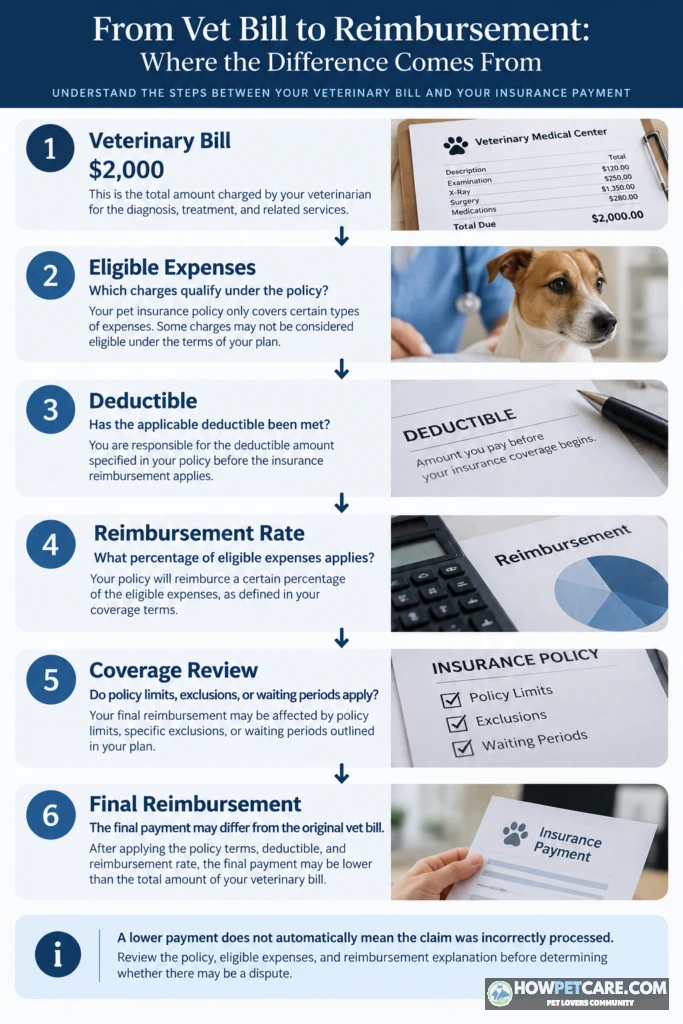
Pet insurance reimburses eligible veterinary expenses according to the terms of a contract. Unlike a savings account, it can provide substantial protection before you’ve paid years of premiums—but only for covered expenses, after applicable waiting periods and subject to the policy’s limits.
The pay-first, reimbursed-later model in one example
Suppose your dog needs emergency treatment costing $3,000. Assume every charge is eligible, your $500 annual deductible is still unmet, your reimbursement rate is 80%, and you have enough coverage left under your annual limit.
- You pay the veterinary hospital $3,000.
- You submit the itemized bill and any required medical records.
- With a deductible-first calculation, the insurer subtracts $500, leaving $2,500.
- It reimburses 80% of $2,500, or $2,000.
- Your final share is $1,000, plus the premiums you pay separately.
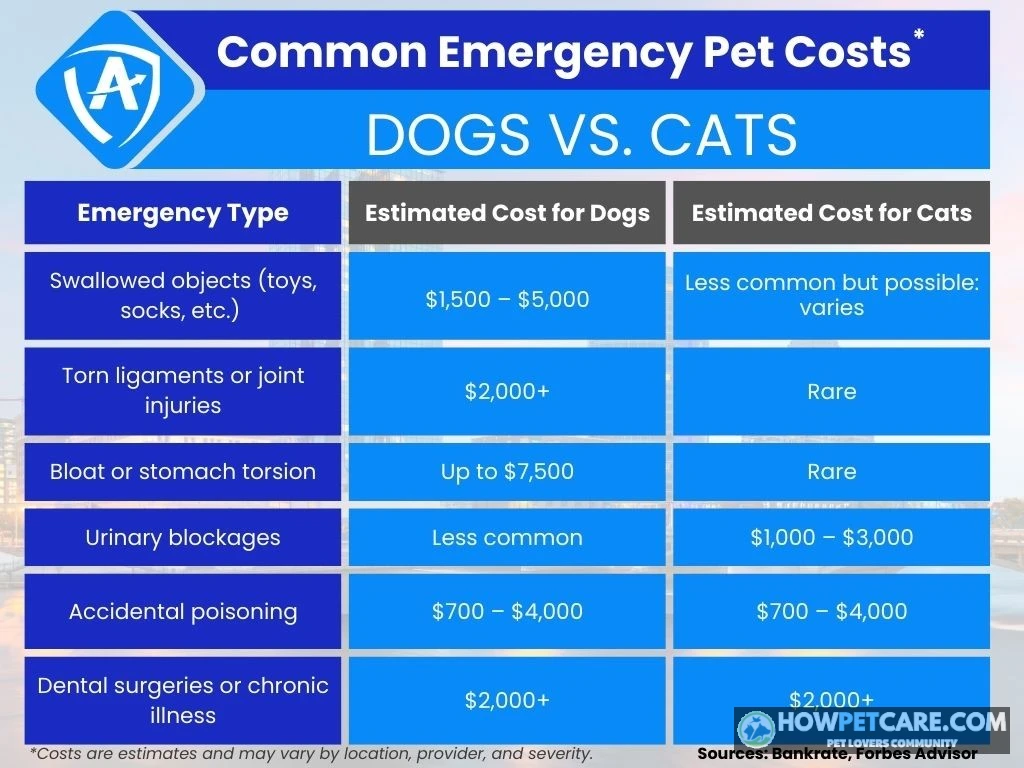
This example assumes the claim is approved and the policy uses that calculation order. An excluded exam fee, a previous claim, a coverage cap, or a different formula could change the result. Some insurers offer direct payment arrangements, but confirm that both your clinic and policy support them.
The six terms that decide what you actually get paid
- Premium: The recurring cost of keeping the policy, whether or not you file a claim.
- Deductible: The amount you must satisfy before reimbursement is calculated. It may reset annually or apply by condition or incident.
- Reimbursement rate: The percentage the insurer pays according to its formula, such as 80%.
- Copay: Your percentage share of eligible expenses. With an 80% reimbursement rate, your share is generally 20%, separate from the deductible and exclusions.
- Annual coverage limit: The maximum the insurer will pay during the relevant policy year, if the plan has one.
- Exclusions: Expenses or conditions the policy won’t cover, even when the bill is large.
Many plans let you use licensed veterinarians instead of requiring a health-insurance-style provider network. Still, not every charge will be reimbursed. Check the policy’s eligible-provider rules, how it values charges, and how to file a claim.
A policy can take effect before all its waiting periods have ended. Signs that appear before enrollment or during an applicable waiting period may affect future coverage, so confirm the dates in your policy.
Accident-Only vs. Accident-and-Illness vs. Wellness Plans: What Each Covers and Excludes
Accident-only: cheapest, narrowest
An accident-only plan is designed for eligible injuries, such as a broken bone or treatment after swallowing an object. It generally won’t pay for illnesses such as cancer, infections, or allergies. It typically costs less than accident-and-illness coverage, but you’ll be responsible for potentially expensive disease treatment.
Accident-and-illness: what “comprehensive” really includes
Accident-and-illness coverage addresses eligible injuries and illnesses. Depending on the contract, it may cover diagnostic tests, surgery, hospitalization, and prescription medications related to a covered condition. This is the more relevant category if you want protection from both accidents and major unexpected illnesses.
“Comprehensive” doesn’t mean unrestricted. Pre-existing conditions, routine care, particular procedures, exam fees, and expenses above a limit may be excluded or subject to special terms. Check whether hereditary and congenital conditions are covered and whether you’ll need an additional benefit for exam fees.
Wellness plans: insurance or prepaid routine care?
A wellness plan or rider generally helps pay for predictable care, such as vaccinations, checkups, or preventive treatments, up to stated allowances. Some include an allowance for spay or neuter surgery. These benefits don’t replace protection against a major accident or illness.
To evaluate a plan, add the yearly wellness charge and compare it with the scheduled reimbursement for services you expect to use. A plan can make budgeting easier even if the financial advantage is modest; unused allowances can make it a poor deal. Wellness coverage alone doesn’t replace an emergency fund or accident-and-illness insurance.
 You might be wonderingCat groomingCat Grooming Guide: Home Care, Tools and Professional HelpRead the answer
How Much Does Pet Insurance Cost per Month? Premium Ranges by Species, Breed and Age
A useful estimate requires your pet’s age, breed, ZIP code, and matching deductibles, reimbursement rates, and limits across quotes. The evidence available for this guide doesn’t establish reliable breed-and-age quote ranges or a current national cat average. The table therefore separates the one historical benchmark from prices you’ll need to obtain yourself.
| Species | Breed or size example | Age | Plan settings: deductible / reimbursement / annual limit | Monthly premium | Source and date |
|---|---|---|---|---|---|
| Dog | All breeds in the industry average | All ages in the industry average | Accident-and-illness; settings not specified in the available evidence | About $53 | NAPHIA figure cited for 2022; historical benchmark, not a 2026 quote [#N] |
| Dog | Small breed, such as a beagle | Young adult or senior | Choose identical settings across quotes | Obtain quotes | No verified breed- and age-specific figure available |
| Dog | Large breed, such as a Labrador | Young adult or senior | Choose identical settings across quotes | Obtain quotes | No verified breed- and age-specific figure available |
| Dog | French bulldog | Young adult | Choose identical settings across quotes | Obtain quotes | No verified breed-specific figure available |
| Cat | Domestic shorthair | Kitten, adult, or senior | Choose identical settings across quotes | Obtain quotes | No verified age-specific figure available |
The historical dog average combines different animals, locations, and policies. It can’t tell you what a particular Labrador or cat will cost, or show the effect of a deductible on its own. Get a quote for your pet before using it to set a budget.
Monthly premium ranges for dogs and cats by age
For a useful personal range, request at least three written accident-and-illness quotes using the same settings. For example, ask for a $500 deductible, an 80% reimbursement rate, and a $10,000 annual limit. If a company doesn’t offer those exact settings, note the difference instead of treating its price as directly comparable.
If the first set is unaffordable, repeat the exercise with a higher deductible or lower limit. Before choosing the lowest premium, check how much you’d pay out of pocket. The premium figures in this section should be refreshed when reliable, dated comparison data becomes available; for budgeting, your own current quotes are more useful.
Breed examples: small, large, and hereditary-risk breeds
Breed can affect price and the risks you want a policy to address. When comparing a small dog, a large dog, and a breed with known inherited health risks, don’t assume a cheaper quote offers the same coverage. Ask whether relevant hereditary or congenital conditions are eligible, whether exam fees are included, and whether a special waiting period applies.
A breed label can’t predict your particular pet’s future bills. Your veterinarian can help identify health concerns to check against a policy, and the insurer can explain how its contract treats them.
How premiums rise as your pet ages
A first-year premium isn’t a lifetime price. Renewal premiums can change as a pet ages and when an insurer changes rates more generally. The evidence provided for this guide doesn’t verify a broadly applicable annual age-related increase, so a standard percentage would create false precision. Ask each insurer about its renewal practices and whether an individual claim can affect your premium under its rules and your state’s requirements.
For a simple ten-year baseline, multiply the first monthly premium by 120. At a hypothetical $60 a month, that’s $7,200 if the price never changes—not a forecast. To model increases, add your own assumed renewal prices year by year and label them as assumptions, not promises. Compare the resulting total with what you could save and the policy’s potential payouts.
Cheap cat plans and senior-dog coverage: what to expect
For a lower-premium cat plan, compare accident-and-illness policies with a deductible you can afford and without an optional wellness rider. An accident-only plan may cost less, but illness bills won’t be covered. Read the dental language and other exclusions rather than assuming a low price is a bargain.
For a senior dog, ask about new-enrollment age limits and get the actual premium. Existing diagnoses and earlier symptoms can reduce the value of a new policy, even if the dog is accepted. A senior pet can still develop a new, unrelated covered condition, so compare the remaining protection with the cost. Don’t assume enrollment is pointless—or automatically worthwhile.
How Deductibles, Reimbursement Rates and Annual Limits Change Your Payout (Worked Math)
Walking through one $3,000 claim step by step
Start with the eligible amount, which may not be the full invoice. If a $3,000 invoice includes a $200 excluded exam or other charge, only $2,800 is eligible in this simplified example. With a $500 unmet deductible and 80% reimbursement calculated deductible-first, the insurer pays $1,840: ($2,800 − $500) × 0.80. You pay $1,160, including the excluded $200.
The examples below assume each bill is a separate first claim in a new policy year, all charges are eligible, the deductible is unmet, and the insurer calculates reimbursement deductible-first. The plan labels describe settings, not verified premiums.
| Bill amount | Plan configuration: deductible / reimbursement / annual limit | Calculation method | Insurer pays | You pay | Notes |
|---|---|---|---|---|---|
| $400 | $1,000 / 70% / $5,000 | Deductible-first | $0 | $400 | Bill is below the deductible |
| $400 | $500 / 80% / $10,000 | Deductible-first | $0 | $400 | Bill is below the deductible |
| $400 | $250 / 90% / unlimited | Deductible-first | $135 | $265 | $150 remains after the deductible |
| $3,000 | $1,000 / 70% / $5,000 | Deductible-first | $1,400 | $1,600 | 70% of $2,000 |
| $3,000 | $500 / 80% / $10,000 | Deductible-first | $2,000 | $1,000 | 80% of $2,500 |
| $3,000 | $250 / 90% / unlimited | Deductible-first | $2,475 | $525 | 90% of $2,750 |
| $9,000 | $1,000 / 70% / $5,000 | Deductible-first | $5,000 | $4,000 | The $5,600 calculated payout is capped at $5,000 |
| $9,000 | $500 / 80% / $10,000 | Deductible-first | $6,800 | $2,200 | Below the annual limit |
| $9,000 | $250 / 90% / unlimited | Deductible-first | $7,875 | $1,125 | No annual cap in this example |

The amounts in the final column don’t include premiums. If you’ve already met part of an annual deductible or used part of the annual limit, substitute the amounts remaining.
Deductible-first vs. copay-first: the same bill, two payouts
Two policies with the same advertised deductible and reimbursement rate can pay different amounts if they apply the percentage and deductible in a different order. In this comparison, all $3,500 is eligible, the deductible is unmet, and a $10,000 annual limit remains available.
| Bill | Deductible / reimbursement | Method | Insurer pays | You pay | Calculation |
|---|---|---|---|---|---|
| $3,500 | $500 / 90% | Deductible-first | $2,700 | $800 | ($3,500 − $500) × 90% |
| $3,500 | $500 / 90% | Copay-first | $2,650 | $850 | ($3,500 × 90%) − $500 |
| $3,500 | $500 / 80% | Deductible-first | $2,400 | $1,100 | ($3,500 − $500) × 80% |
| $3,500 | $500 / 80% | Copay-first | $2,300 | $1,200 | ($3,500 × 80%) − $500 |
| $3,500 | $250 / 70% | Deductible-first | $2,275 | $1,225 | ($3,500 − $250) × 70% |
| $3,500 | $250 / 70% | Copay-first | $2,200 | $1,300 | ($3,500 × 70%) − $250 |

The difference in these examples is $50 to $100. You won’t necessarily see the same difference on every claim: the deductible remaining, how it accrues, and when it resets all matter. Don’t assume the lower-deductible, 70% example has the lower premium; get a quote.
Insurer-by-insurer calculation methods haven’t been verified here. Find the reimbursement or claims-payment clause in each sample policy and ask for a written calculation using your own example.
Reusable calculator:
- Remove ineligible charges from the invoice and identify the remaining deductible and coverage limit.
- Apply the policy’s formula: subtract the deductible from the eligible amount, then multiply by the rate; or multiply first, then subtract the deductible. Don’t use a negative payout.
- Apply the remaining limit. Subtract the reimbursement from the full invoice to find your share, then add premiums separately when comparing total costs.
When the annual limit runs out
An annual limit caps what the insurer pays in the policy year, not the size of the bill. A $5,000 limit with $4,000 already paid leaves just $1,000 for later covered claims that year. An unlimited annual limit removes that particular cap, but deductibles, exclusions, and other applicable limits still apply.
Check how the deductible resets, too. An annual deductible is generally satisfied across eligible claims in a policy year. A per-incident deductible may apply to each separate event. A per-condition deductible may apply separately to different conditions; whether it resets annually or follows a condition for the pet’s life depends on the contract. For a recurring condition, that difference can materially affect the cost over time.
Some plans base payment on a benefit schedule or an insurer-defined amount instead of the full veterinary charge. Before calculating reimbursement, ask how the policy defines eligible charges and whether a usual-and-customary limit applies.
Pre-Existing Conditions, Hereditary Exclusions and Waiting Periods: What a Policy Won’t Pay For
How insurers define “pre-existing”
A pre-existing condition is generally an illness or injury with signs, symptoms, or treatment before coverage begins or during an applicable waiting period, as defined by the policy. A formal diagnosis isn’t always required. For example, an old note about limping may prompt a review of a later orthopedic claim—but it doesn’t automatically prove that every future limp is the same condition.
Some insurers distinguish conditions they consider curable from those they consider incurable. A curable condition may become eligible after a specified period without symptoms or treatment, if the contract allows it. Other conditions may remain excluded. Ask how recurrence, medication, follow-up visits, and the insurer’s review of medical history affect that decision.
Hereditary, congenital and bilateral conditions
A hereditary condition is associated with inherited traits; a congenital condition is present at birth. A policy may cover these conditions if they meet its terms and weren’t pre-existing, but a breed’s risk doesn’t guarantee coverage. Hip dysplasia is one example to check for a large dog.
A bilateral clause can link matching body parts. If one knee showed a cruciate ligament problem before coverage, the policy may also exclude a later problem in the other knee. Ask for the exact clause and a written explanation of how it would apply to your pet’s history.
Waiting periods by claim type
Waiting periods can differ for accidents, illnesses, and orthopedic conditions. Ask for the exact effective dates of each rather than relying on an advertised general waiting period. A policy may have a short accident wait, an illness wait measured in days, and a longer orthopedic wait measured in months; the actual durations and any waiver depend on the contract and state.
There’s no universal last safe day to enroll before a pet becomes ill. Apply while your pet is healthy and allow the relevant waiting periods to end. If your pet already has symptoms, seek veterinary care promptly and disclose the history accurately. Delaying an appointment doesn’t erase an earlier symptom from the insurer’s analysis.

Exclusion comparison across major insurers
The following is a verification worksheet, not a statement that these companies have identical terms. Current state-specific policy language and insurer-by-insurer waiting periods weren’t independently verified in the available evidence. Get the applicable sample policy or state endorsement before comparing or buying.
| Insurer | Hereditary or congenital conditions | Bilateral condition rule | Curable pre-existing conditions | Illness waiting period | Orthopedic waiting period | Policy source and date checked |
|---|---|---|---|---|---|---|
| Lemonade | Verify in current policy | Verify | Verify | Verify | Verify | Current state-specific policy not verified |
| Trupanion | Verify in current policy | Verify | Verify | Verify | Verify | Current state-specific policy not verified |
| Healthy Paws | Verify in current policy | Verify | Verify | Verify | Verify | Current state-specific policy not verified |
| Embrace | Verify in current policy | Verify | Verify | Verify | Verify | Current state-specific policy not verified |
| Spot | Verify in current policy | Verify | Verify | Verify | Verify | Current state-specific policy not verified |
| Pets Best | Verify in current policy | Verify | Verify | Verify | Verify | Current state-specific policy not verified |
| Nationwide | Verify in current policy | Verify | Verify | Verify | Verify | Current state-specific policy not verified |
| MetLife | Verify in current policy | Verify | Verify | Verify | Verify | Current state-specific policy not verified |
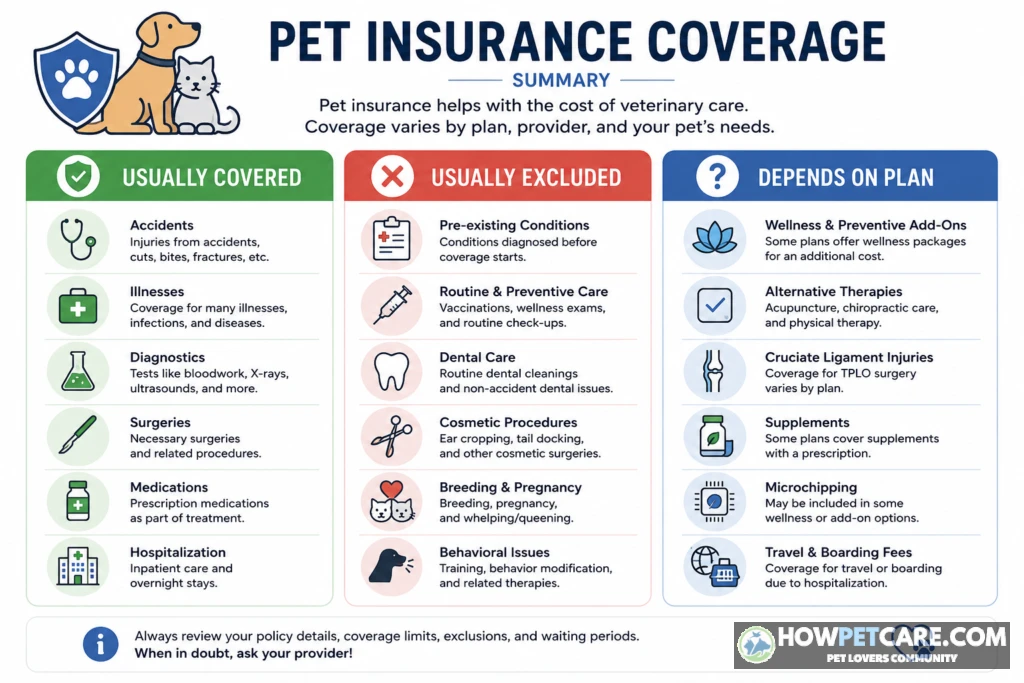
Ask each insurer to point you to the page and clause that support each answer. Other common exclusions to investigate include cosmetic procedures, breeding or pregnancy, and routine care outside a wellness benefit. Coverage and availability can differ by product and state, so marketing summaries aren’t a substitute for the issued contract.
When to Enroll: Waiting Periods, Age Limits and the Free-Look Cancellation Window
The last practical moment to enroll a healthy pet
Apply, confirm acceptance and the effective date, then let each relevant waiting period expire. Accident coverage may begin on a different date from illness or orthopedic coverage. Keep the confirmation showing each date.
Enrolling before symptoms appear gives you a clearer starting history, but it doesn’t guarantee that every later claim will be covered. Keep previous medical records and answer application questions honestly. If a condition has already appeared, ask the insurer how that history could affect the condition and unrelated future claims.
Free-look periods: what to expect and how to confirm yours
A free-look or money-back provision may give a new buyer a limited time to cancel and receive a refund. Conditions may apply, such as whether a claim has been paid or filed. The number of days, how the deadline is counted, and refund conditions depend on the policy and state. The available evidence doesn’t verify a reliable general day count or the applicable model-act wording, so don’t assume a particular window.
Use the review period in your documents to read the declarations, exclusions, calculation clause, and state amendments. Ask the insurer in writing: “What is my final cancellation date, what refund will I receive, and does filing a claim change it?” Check any state protection with your state insurance department. Save proof of your cancellation request and confirm the effective cancellation date.
Cancellation after the initial review period, renewal, nonrenewal, and rescission are separate issues. Check the policy and state rules; don’t assume a refund or continued renewal is guaranteed. If you’re moving, ask how the move affects availability, coverage, and price.
Enrolling a mid-life or senior pet
Some products restrict the age at which a pet can first enroll. Continuing an existing policy and starting a new one are different questions, so check eligibility before spending time comparing a product. For an older pet, request a medical-history review if available, but ask whether its result is binding and whether a later claim can still be reviewed.
Don’t cancel an existing policy before you understand what a replacement excludes. A condition covered under the old policy may be pre-existing under the new one, and new waiting periods may apply.
How to File a Pet Insurance Claim and What to Do If It’s Denied as Pre-Existing
Filing a claim in five steps
- Get care and pay the clinic, unless you’ve confirmed an approved direct-pay arrangement in advance.
- Collect the paperwork: an itemized invoice, proof of payment if required, and relevant medical notes. Request records from earlier clinics if the insurer needs them.
- Submit the claim through the insurer’s portal, app, or other accepted channel before the contractual filing deadline.
- Respond to requests for missing records, and save the submission confirmation and claim number.
- Review the explanation of benefits against the invoice, deductible, reimbursement rate, exclusions, and remaining limit. Ask about discrepancies.

The examples in this guide don’t guarantee a processing time. Ask the insurer for its expected timeline and what happens if records are delayed. If direct payment matters to your finances, confirm it with both the insurer and clinic before relying on it.
Why claims get denied
Common issues include a pre-existing-condition determination, treatment during a waiting period, an excluded service, missing records, late submission, or an exhausted limit. A claim may also be partly paid: for example, the insurer might cover treatment but exclude an exam fee.
The available evidence doesn’t establish a reliable, comparable public denial rate for each insurer. State insurance department complaint information and the NAIC consumer complaint search can help you investigate service concerns, but complaint counts or indices aren’t denial rates and don’t show the percentage of claims rejected. Where the tool allows it, check that you’re looking at the relevant underwriting company and product.
Appealing a pre-existing condition denial: the exact steps
- Get the decision in writing. Request the specific policy provision, the reason for denial, appeal instructions, and the deadline.
- Request the evidence. Ask for the records and documents the insurer relied on, including the note it believes shows an earlier symptom. Request the claim file; access to particular internal materials can depend on applicable rules.
- Build a dated timeline. Collect records from every relevant veterinarian, the policy effective date, waiting-period dates, and records of symptoms, tests, and treatment. Don’t omit unfavorable notes; address them accurately.
- Ask your veterinarian for clarification. A useful letter explains the clinical basis for the likely onset date and, when supported by the records, whether an earlier symptom involved a different or resolved condition. The letter is evidence, not a guarantee of reversal.
- Submit a written appeal. Quote the disputed clause, explain how the documented facts do or don’t meet its definition, attach the records, and ask for reconsideration or reprocessing. Meet the stated deadline and keep proof of submission.
- Escalate if needed. Ask for the insurer’s final position in writing, then consider filing a complaint with your state department of insurance. Include the policy, denial, appeal, supporting records, and correspondence. The department can review the complaint and applicable rules, but can’t promise a particular outcome.

Adapt this short appeal to your facts:
Policy number: [number]; claim number: [number]. I request reconsideration of the denial dated [date]. The denial cites [policy clause] and identifies [record or symptom] as evidence of a pre-existing condition. My records show [dated timeline]. My veterinarian’s attached statement explains [clinical clarification]. Please review the attached documents and reprocess the claim under the policy, or explain in writing why the exclusion applies.
Keep a log of calls, including dates, names, and reference numbers. If a record is inaccurate, ask the veterinary practice about its correction or clarification process; don’t alter the record yourself.
Escalating to your state insurance regulator
Find your state insurance department’s consumer complaint process and identify the actual underwriting insurer on your policy. Submit copies, not your only originals, and describe the remedy you requested. A regulator’s review is separate from the insurer’s internal appeal, so follow both processes and their deadlines where applicable.
Is Pet Insurance Worth It? A Break-Even Framework Against Saving the Money
Insurance is financially worthwhile for a particular period when reimbursements exceed the premiums paid for that period. Over a longer period, compare total reimbursements with total premiums. That result in hindsight doesn’t tell you in advance which choice will win. Coverage also has value based on whether you can pay a large bill before savings have had time to grow.
The break-even formula with two worked examples
For a simplified deductible-first plan, assume all expenses are eligible, the annual deductible is unmet, and no cap applies. To find the annual eligible bill that would produce reimbursement equal to one year’s premium:
Break-even eligible bill = annual premium ÷ reimbursement rate + remaining deductible.
For a hypothetical young dog, suppose the quote is $45 a month, or $540 a year, with a $500 annual deductible and 80% reimbursement. The break-even eligible bill for that year is $540 ÷ 0.80 + 500 =1,175. A fully eligible $5,000 bill would produce a $3,600 reimbursement: ($5,000 − $500) × 0.80. The owner would pay $1,400 of the bill plus the $540 premium.
For a hypothetical older large dog, suppose the quote is $120 a month, or $1,440 a year, with the same deductible and rate. Its one-year break-even eligible bill is $1,440 ÷ 0.80 + $500 = $2,300. A fully eligible $5,000 claim again produces $3,600, but the owner pays $1,400 of the bill plus $1,440 in premiums. These are invented quote scenarios for calculation, not market rates; pre-existing exclusions could make the actual eligible bill much smaller.
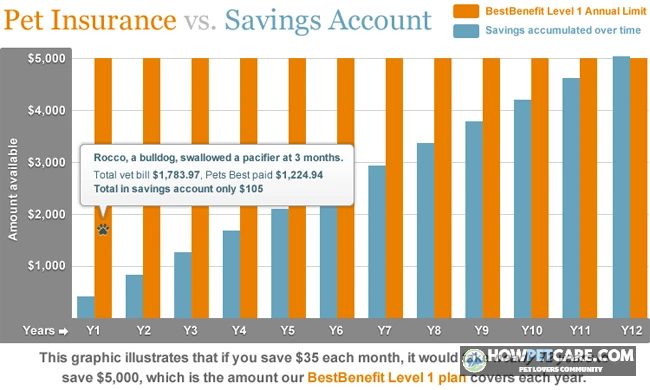
A $3,600 payout equals roughly 6.7 years of $540 premiums if premiums never change and there are no other claims. That arithmetic doesn’t predict that such a claim will occur every 6.7 years. Before treating it as a lifetime break-even test, consider when claims might occur, future premium changes, exclusions, and investment or savings returns.
When insurance wins and when saving wins
Work through these questions:
- Could you pay a $5,000–$10,000 veterinary bill this week without jeopardizing essential expenses or your core emergency fund? If not, consider eligible accident-and-illness coverage while you build a reserve, provided you can afford the premium and your share of a claim.
- How long will the fund take to build? At $100 saved per month, a $7,500 target takes 75 months before interest. An emergency could happen before the fund is complete; insurance can also leave you exposed during waiting periods or for excluded conditions.
- What would the plan actually pay? Run a realistic estimate through the policy’s formula, remove ineligible charges, and account for remaining limits. Compare the payout with the annual premium.
- What remains uncovered? Include the deductible, copay, exclusions, and possible need to pay the clinic upfront. If those amounts are unmanageable, a generous-looking reimbursement rate may not solve the cash problem.
- Can you accept the risk of saving instead? A substantial accessible reserve and expensive or heavily excluded coverage can favor self-funding. A young pet with fewer known conditions and an owner without a large reserve may be a stronger candidate for insurance, assuming the policy is affordable and covers relevant risks.
Neither choice guarantees a lower lifetime cost. Accident-only coverage may suit a constrained budget, but it doesn’t replace illness protection. If you can’t afford premiums or a large deductible, start a dedicated fund at an achievable rate and discuss payment options with your veterinary practice before an emergency.
The hybrid approach: high deductible plus a pet fund
A hybrid combines a higher-deductible accident-and-illness policy with savings for the deductible, copay, excluded services, and upfront payment. Compare actual quotes: a higher deductible may lower the premium, but it also increases what you must fund before reimbursement. Choose a deductible you could pay, not simply the largest one offered.
How to Choose Pet Insurance for Your Dog or Cat: A Five-Step Checklist
The five-step shortlist
- Choose the risk to cover. Run the savings test. Choose accident-and-illness if you need protection against eligible diseases as well as injuries; consider accident-only if you accept the illness gap. Evaluate wellness separately.
- Set an affordable configuration. Use the payout calculator with a plausible bill. Check the deductible type, reimbursement method, annual limit, and whether exam fees and medications are eligible.
- Compare at least three quotes on matching terms. Record the premium, deductible, rate, limit, waiting periods, exclusions, and underwriting company. If settings differ, note that the prices aren’t directly equivalent.
- Read the contract before committing. Find the definitions of pre-existing, hereditary, congenital, and bilateral conditions; the claims deadline; renewal terms; and the free-look or cancellation provision. Ask for unclear answers in writing.
- Enroll and keep a record. Save the policy and application, collect veterinary records, note each coverage start date and the cancellation deadline, and calendar renewal. Review the new premium and coverage before making changes.

No single pet insurance policy is best for every U.S. household. Rank options against your pet’s medical history, the conditions you want covered, the money you can pay upfront, and how the contract treats future claims—not a list of winners from a previous year.
Pick by situation: puppy, adult, senior, tight budget
- Puppy or kitten: Compare accident-and-illness coverage while the health history is relatively short; for kitten insurance basics, check the minimum enrollment age and let waiting periods finish before assuming protection is active.
- Healthy adult: Get records first, compare matching quotes, and ask about prior symptoms that could affect a later claim.
- Senior dog: Confirm new-enrollment eligibility, price, and how existing conditions are treated. Compare protection for genuinely new conditions with a dedicated savings fund.
- Tight budget: Price a higher-deductible illness plan and an accident-only plan, then compare the coverage gap and the cash each would require. Keep a separate reserve for routine care and uninsured expenses.
Before buying, run a real veterinary estimate through the policy’s formula and write down what you’d still owe. That amount, alongside the premium and exclusions, gives you a basis for comparison.
 You might be wonderingPet grooming dogsDog Grooming Guide: Costs, Schedules and DIY vs. ProRead the answer
FAQ
Does pet insurance pay the vet directly?
Most plans reimburse you after you pay the vet, although some insurers and clinics offer direct payment. Check whether your vet participates before you rely on it, and keep enough cash or credit available to cover the bill up front.
Does pet insurance cover vaccines, checkups and spay or neuter surgery?
Standard accident-and-illness plans generally do not cover routine care. A wellness add-on typically reimburses set amounts for vaccines, exams, and sometimes spay or neuter surgery. Read the schedule to see the dollar amounts.
Can I use any veterinarian with pet insurance?
In most cases yes. U.S. pet insurers typically let you choose any licensed vet, including emergency and specialty clinics. Confirm this in the policy before you buy.
Will my premium go up after I file a claim?
Premiums usually rise with age and with the insurer’s rate changes. Whether an individual claim affects your rate depends on the insurer and the state, so check the policy’s renewal terms and ask the insurer.
Can I switch pet insurers without losing coverage for an ongoing condition?
Usually not. A new insurer typically treats a condition that appeared under your old policy as pre-existing, so it won’t be covered. Consider this before you switch, especially if your pet has a chronic or recurring condition.
Is pet insurance tax deductible?
For most pet owners, no. Premiums for a pet are generally a personal expense. Some working animals or business uses may qualify, so check with a tax professional.