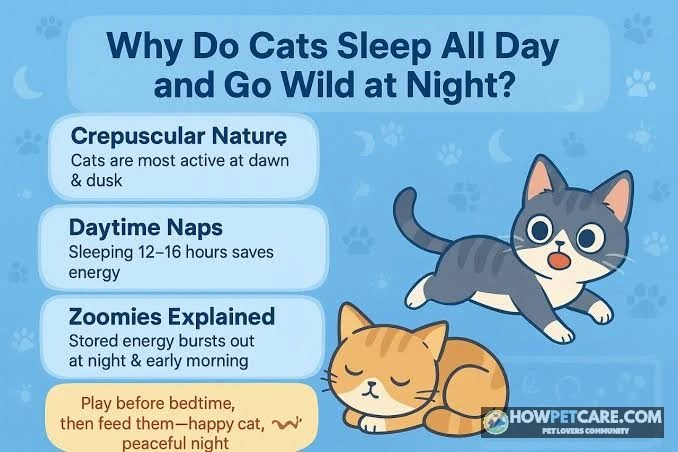

Domestic cats are not truly nocturnal; they are crepuscular, meaning their peak activity occurs at dawn and dusk. Most of their hunting and play happens during these low‑light periods, while true night accounts for only a small fraction of their active time.
Are Cats Nonocurnal, Diurnal, or Crepuscular?
Cats are not strictly nocturnal. In the wild, domestic cats (Felis catus) are crepuscular. Their strongest activity peaks occur around dawn and dusk rather than across the whole night or day. This rhythm tracks the habits of their typical prey: small birds and rodents are out foraging during twilight, making them easiest to intercept. The word crepuscular stems from the Latin crepusculum, meaning “twilight.” Hunting at twilight balances energy expenditure against risk, giving small felids enough light to stalk prey while keeping them out of sight from larger predators that hunt in pitch darkness.
Crepuscular: a behavioral classification indicating peak activity during the low‑light periods of sunrise and sunset, driven by the predatory instinct and prey availability.
Because this label outlines a biological baseline rather than a rigid rule, individual cats can still exhibit midnight running sessions or daytime bouts of play. Indoor routines frequently alter these signals. Asking are cats nocturnal, diurnal, or crepuscular helps owners make sense of why their pet might be pacing at 3 a.m. instead of sleeping through until 5 a.m.
What crepuscular means for cats
- Activity spikes at 04:00‑06:00 (pre‑dawn) and 18:00‑20:00 (twilight).
- Light levels drop without reaching total darkness; the feline tapetum lucidum maximizes vision under these exact conditions.
- Hormonal shifts (a rise in melatonin and a drop in cortisol) coincide with these windows, triggering predatory drive.
Why cats are often mistaken for nocturnal hunters
- Indoor cats often receive affection, treats, or playtime during human sleeping hours, reinforcing late-night alertness.
- Post-nap energy bursts mimic midnight prowling even when rooted in crepuscular biology.
- Popular culture routinely brands any after‑hours feline movement as “nocturnal,” blurring the underlying science.
What Research Shows About the Cat Activity Cycle
Actigraphy and accelerometer data reveal how cats distribute their movement across a full 24‑hour cycle. Motion is rarely uniform. Daily activity budgets shift depending on whether a cat lives strictly indoors, has yard access, or works on a farm.

| Activity at Dawn/Dusk vs. True Night | Study Details | Reported Activity Share |
|---|---|---|
| Study A (indoor cats, n=30, 2‑week monitoring) | Light‑controlled home, 2024 | Dawn/Dusk ≈ 42 % of active bouts; Night (22:00‑04:00) ≈ 15 % |
| Study B (free‑roaming farm cats, n=22, 3‑month) | Natural daylight, seasonal | Dawn/Dusk ≈ 55 %; Night ≈ 8 % |
| Study C (mixed indoor/outdoor, n=18) | Urban apartment + backyard access | Dawn/Dusk ≈ 48 %; Night ≈ 12 % |
These findings confirm that the majority of feline activity clusters around twilight, with true night accounting for only a modest share of active time.
How polyphasic sleep differs from human sleep
Cats sleep polyphasically. Rather than taking one consolidated block of rest, they cycle through numerous brief catnaps and deeper sleep phases over 24 hours. Domestic cats average 18 hours per day of total rest. A standard cycle runs through 5‑15 minute light naps, a brief REM stage, and a 30‑45 minutes phase of slow‑wave deep sleep. This setup keeps cats primed for quick hunting windows while protecting their metabolic reserves across the rest of the day.

Why study results vary among cat populations
- Environment: Outdoor cats encounter live prey, shifting temperatures, and rival scents, which push their activity peaks earlier.
- Age: Kittens and young cats display more frequent night‑play bursts, whereas senior cats show fragmented sleep due to medical conditions.
- Feeding regime: Free‑choice dry kibble removes timed satiety signals, smoothing out natural peaks and valleys in activity.
Why Cats Get Night Zoomies and Wake Their Owners
Why does my cat go crazy at night?
Sudden late‑night sprints combine pent‑up energy, under‑stimulation, and the completion of a predatory sequence. Cats that spend long stretches of the day resting build up physical tension. A short, explosive dash discharges that drive. If an owner is already asleep, the sudden noise feels magnified.

Predatory instinct, stored energy, and learned rewards
- Hunt – the cat spots moving prey or a wand lure.
- Catch & Kill – paws and teeth physically trap the target.
- Eat – a protein meal triggers satiety hormones like CCK that induce sleepiness.
- Groom – licking and washing quiet the central nervous system.
- Sleep – the cat curls into a restful deep‑sleep cycle.
Skipping step 3 or delaying it (such as waiting to feed until the cat wakes up crying) resets the loop. The predatory motor pattern restarts, ending in mid‑night running.
Why dawn wake‑ups can feel like nocturnal behavior
Early sunrises at 5 a.m. during summer prompt cats to wake up naturally. Human sleep schedules categorize this as an overnight disruption, but it is biologically a crepuscular awakening. When a cat meows during the classic 4:45‑5:00 a.m. window and receives immediate kibble, the human unintentionally reinforces the alarm clock behavior.
Environmental triggers
- Outdoor noises: Small rodents scratching, bird calls, or passing neighborhood cats prompt predatory focus.
- Temperature changes: Ambient drops during the night encourage movement.
- Household sounds: Footsteps, humming appliances, or late‑night television provide sporadic stimulation.
Tapetum lucidum and low‑light vision
Cats possess a retroreflective tissue layer behind the retina called the tapetum lucidum. It collects and reflects incoming photons through photoreceptors, letting cats navigate low‑light conditions with minimal ambient illumination. This ocular structure equips cats for dawn and dusk, but it does not make cats true nocturnal predators.

Indoor vs. Outdoor Cats: How Lifestyle Reshapes Sleep and Activity
| Factor | Indoor‑only cats | Outdoor‑access or free‑roaming cats | Likely effect on nighttime activity |
|---|---|---|---|
| Peak wakeful windows | Synchronized to human homecomings (5:00 PM – 9:00 PM) and early breakfast demands (5:00 AM – 7:00 AM). | Bimodal crepuscular spikes: sharp dawn spike (4:00 AM – 6:00 AM) and broad dusk‑to‑midnight hunting patrol. | Indoor cats display shifted or erratic night activity driven by household schedules; outdoor cats follow solar and prey cues. |
| Total daily rest / sleep | 14‑18 h per day, marked by prolonged bouts of low‑arousal daytime catnapping due to under‑stimulation. | 11‑14 h per day, with more fragmented rest interrupted by territorial defense, weather, and hunting. | Under‑stimulated indoor cats bank sleep during working hours, leaving high reserve energy for 2:00‑4:00 AM zoomies. |
| Environmental drivers | Predictable ambient temperature, artificial lighting (LED/screens), and human auditory cues (footsteps, kitchen noises). | Ambient temperature swings, moonlight, prey movement (rodents/insects), and predator/competitor scent marking. | |
| Foraging distribution | Bolus feeding once or twice daily, or constant ad‑libitum dry kibble grazing from a stationary bowl. | Multiple opportunistic small meals across 24 h requiring active stalking, capturing, and ingestion. |

Key takeaway: Indoor cats do not need outdoor access to stay healthy, but they do need structured enrichment that mimics the hunt‑catch‑eat sequence and timed feeding to keep their crepuscular rhythm aligned with the household.
Artificial Light and the Feline Circadian Rhythm
How light‑dark cues set biological time
The suprachiasmatic nucleus (SCN) tracks photon signals sent from retinal ganglion cells to regulate circadian clocks. In cats, bright morning light triggers a rise in melatonin suppression, which drives daytime alertness. Conversely, dim evening light allows melatonin to rise, readying tissues for rest. When living rooms remain lit by overhead LEDs and screens until midnight, that artificial exposure dampens the transition into twilight rest.
What is known about blue light and feline melatonin
Direct feline data on blue wavelengths remain sparse, but studies on mammals show that exposure to high‑intensity blue wavelengths can delay melatonin onset. While researchers have not defined an exact threshold for cats, keeping harsh blue screens away from resting spots after 9 p.m. prevents unwanted arousal.
Building stronger daytime and nighttime signals indoors
- Consistent dimming: Cut ambient indoor lighting by 50 % about an hour prior to your regular bedtime.
- Day‑time brightness: Maximize natural daylight or use full‑spectrum lighting during morning hours to anchor circadian timing.
- Blackout curtains: Block sharp dawn sunlight in rooms where cats sleep to prevent premature waking.
- Avoid night‑time “night‑lights” unless an older cat has significant vision loss; warm amber illumination is far less disruptive than cool white or blue LEDs.

Feeding Timing, Wet vs. Dry Food, and Nighttime Sleep
The predatory sequence as a sleep cue
Feeding a protein‑rich wet meal triggers the release of cholecystokinin (CCK) and insulin during digestion. These hormones bring on post‑prandial lethargy, recreating the quiet rest that follows an outdoor kill. When scheduled right after vigorous play, this meal steers the cat straight into restorative sleep.
What macronutrients and meal size may change
- High‑protein wet food (≥ 10 g protein per 100 g) provides faster, deeper satiety than high‑carbohydrate dry kibbles, which digest at a different pace.
- Portion control: Supplying a measured 60‑70 g wet portion (≈ 5 % of daily caloric needs) as the day’s final feeding prevents hunger‑driven midnight pacing.
- Fiber and water content: High moisture in wet food supports smooth digestion, reducing the odds of uncomfortable midnight litter box runs.
Scheduled meals, free feeding, and timed feeders
| Feeding Style | Typical Impact on Nighttime Activity |
|---|---|
| Scheduled meals (twice daily) | Predictable satiety signals; reduced early‑morning begging. |
| Ad‑libitum dry kibble | Constant grazing maintains low‑level arousal; higher chance of night‑time food‑request vocalizations. |
| Timed feeder (early‑morning 5:30 a.m.) | Removes owner‑dependent breakfast; cat learns to wait for automated delivery, breaking the “wake‑me‑up‑for‑food” loop. |

Veterinary caution: Cats with diabetes, kidney disease, or specific prescription diets require individualized feeding plans. Never alter meal composition without consulting a veterinarian.
When Nighttime Howling Is a Medical Red Flag
Behavioral wake‑up or health problem?
Most vocalizations at night trace back to simple behavioral causes like boredom, appetite, or crepuscular arousal. Certain presentations, however, point toward systemic pathology:
- Sudden onset in an older cat (≥ 10 years).
- Persistent, loud yowling that occurs without an environmental cue.
- Accompanying signs: weight loss, increased drinking and urination, vomiting, unsteadiness, or changes in vision.

Senior‑cat vocalization and cognitive decline
Feline Cognitive Dysfunction Syndrome (FCDS) commonly causes:
- Spatial disorientation (getting trapped in corners or staring blankly at walls).
- Alterations in social engagement (new clinginess or sudden withdrawal).
- Pacing through hallways paired with loud nocturnal vocalization.
- Decreased self‑grooming and litter box avoidance.
What a veterinarian may test
- History & video: Reviewing home recordings of nighttime episodes.
- Physical & neurologic exam to isolate focal deficits.
- Blood pressure measurement to screen for hypertension.
- Blood panel: CBC, serum chemistry, and total T4 to rule out hyperthyroidism.
- Urinalysis: Assessing concentration, proteinuria, and glucose.
- Optional imaging (radiographs or ultrasound) to assess joint pain or internal organ changes.
If any medical red flag appears, schedule a veterinary exam before implementing behavioral modifications.
A 7‑Day Plan to Adjust Your Cat’s Sleep Schedule
This routine translates feline chronobiology into a predictable evening schedule. Log variables such as sleep periods, meal times, exercise, and nighttime vocalizations in a journal or simple sheet.
-
Days 1‑2: Measure patterns and rule out urgent problems
Observe your cat’s current night‑time schedule for 48 hours. Note any of the red‑flag signs listed in the Senior‑Cat Night Distress Checklist. If any appear, seek veterinary care immediately; do not proceed with the plan.
-
Days 3‑5: Shift play, food, and light cues
Implement the 90‑Minute Evening Predatory Routine (see sidebar) ending with the final wet meal 30 minutes before your bedtime. Dim household lights by 50 % after the meal and turn off all screens.
-
Days 6‑7: Remove accidental rewards and assess results
If the cat still wakes you, avoid feeding or petting until the scheduled automated feeder delivers breakfast. Record any residual vocalizations and their triggers.
Nighttime Disturbance Troubleshooting Flowchart
Work through these steps sequentially to match your cat’s behavior to its root cause:
- Is the behavior sudden, in a senior cat (10+ years), or accompanied by weight loss, altered thirst, or confusion?
- YES: Medical Trigger. Schedule a veterinary workup (blood pressure, total T4, urinalysis, orthopedic check). Do not modify routines until clinical issues are resolved.
- NO: Proceed to Step 2.
- Does the wake‑up occur between 4:00 AM‑6:00 AM with door‑scratching or meowing?
- YES: Intermittent Reinforcement (Learned Habit). The cat has learned that persistence yields food or attention. Move breakfast to a programmable microchip‑ or timer‑feeder set for 5:30 AM so food comes from an appliance, not your waking.
- NO: Natural Crepuscular Awakening. Install blackout shades, provide a quiet foraging puzzle, and keep night‑lights low.
- Is the disturbance 1:00 AM‑3:00 AM high‑speed running, rug‑shredding, or wall‑bouncing (“Zoomies”)?
- YES: Under‑stimulation & Accumulated Daytime Sleep. Add automatic daytime food puzzles and implement the 90‑Minute Evening Predatory Routine before bedtime.
- NO: Proceed to Step 4.
- Does the cat sit by closed windows, growl low, or spray near external doors?
- YES: Nocturnal Territorial Intruder. Outdoor wildlife (feral cats, raccoons, rodents) may be triggering the response. Close lower blinds, install motion‑activated deterrent sprinklers, or move perches away from perimeter windows.
- NO: Attention‑Seeking Boredom. Ensure clean water, litter, and comfortable bedding are accessible outside the bedroom, and maintain neutrality (no feeding or petting) during disruptions.
Nighttime Vocalization Triage
| Observed sign | Possible behavioral cause | Possible medical cause | Recommended next step | Urgency |
|---|---|---|---|---|
| Repeated meowing at 4‑5 a.m. with no food | Hunger‑driven habit, learned breakfast request | Hyperthyroidism (increased metabolism) | Check food schedule, consider timed feeder; if persistent, vet thyroid panel | Moderate |
| Loud, continuous yowling after 9 p.m., no obvious trigger | Stress, territorial aggression, estrus (intact females) | Feline Cognitive Dysfunction, sensory loss | Video behavior, assess age; senior cats → vet neurologic workup | High |
| Howling accompanied by pacing, stumbling, or falling | Boredom, lack of enrichment | Arthritis, spinal pain | Provide enrichment; senior → assess pain management with vet | High |
| Vocalization only when door opens to let cat outside | Territorial marking, desire for outdoor access | Hypertension (causes restlessness) | Close door, use indoor perch; vet check if hypertension suspected | Moderate |
Senior Cat Night Distress Checklist
Use this triage checklist if a cat aged 10 or older develops sudden nighttime waking, pacing, or loud howling (yowling). Check all clinical indicators that apply:
Feline Cognitive Dysfunction (FCDS / “Cat Dementia”)
- ☐ Spatial Disorientation: Stares at walls, gets trapped behind doors, seems confused in familiar rooms at night.
- ☐ Altered Interactions: Unexpected clinginess, withdrawal, or failure to recognize family routines.
- ☐ Aimless Pacing: Wanders hallways repeatedly between midnight and 5 a.m. while vocalizing.
Hyperthyroidism & Systemic Hypertension
- ☐ High‑volume open howling: Urgent, loud yowls in dark hallways without external trigger.
- ☐ Metabolic Restlessness: Unable to settle despite apparent fatigue.
- ☐ Physical Hallmarks: Ravenous appetite, weight loss, rapid heartbeat, greasy coat.
Sensory Loss & Chronic Pain (Arthritis / Renal)
- ☐ Startle vocalization: Howls abruptly upon waking, subsides when owner speaks or turns on a night‑light (sign of hearing/vision loss).
- ☐ Litter Box Hesitancy: Eliminates outside the box or cries before/after stepping over a high litter pan lip (indicative of hip/spine arthritis).
- ☐ Increased Nighttime Thirst: Repeatedly visits water fountain or licks faucets during night (flags chronic kidney disease or diabetes).
Action Threshold: Checking any single box under Hyperthyroidism or Sensory/Pain warrants a comprehensive veterinary exam with blood pressure measurement, total T4 screening, and a senior blood/urine panel.
The 90‑Minute Evening Predatory Routine
Follow this timed sequence nightly between dinner and lights out to trigger the natural biological chain: Hunt → Catch → Kill → Eat → Groom → Sleep.

-
T‑90 to T‑60 min: Aerobic Play (The Hunt)
Use a wand toy (feather teaser or fleece ribbon) to mimic errant prey. Move the lure away from the cat, pausing behind table legs and under rugs. Gradually increase speed for 15‑20 minutes until the cat’s pupils dilate and breathing quickens.
-
T‑60 to T‑45 min: The Physical Catch & ‘Kill’
Transition to a weighted kicker toy or plush prey. Allow the cat to grasp, bite, and hind‑leg kick the target, satisfying predatory arousal without redirecting aggression toward hands.
-
T‑45 to T‑30 min: The Protein‑Dense Final Meal
Serve the cat’s final scheduled meal of the day (ideally high‑protein wet food or a warm meat‑based portion). Protein ingestion triggers cholecystokinin release, inducing satiety and metabolic lethargy.
-
T‑30 to T‑10 min: Biological Grooming Buffer
Avoid handling or stimulating the cat. Allow a 15‑20 minute self‑grooming period, a natural post‑meal behavior that decelerates the nervous system.
-
T‑10 to T‑0 min: Environmental Downshifting
Dim overhead lights by 50 % or switch to warm, low‑wattage floor lamps. Turn off interactive toys. Place a heat‑safe thermal mat or fleece pad in the preferred nighttime sleeping station away from the bedroom door.
Quick Reference Tables
Nocturnal vs. Diurnal vs. Crepuscular Activity
| Activity pattern | Peak activity period | Typical biological cues | How well it describes domestic cats |
|---|---|---|---|
| Nocturnal | Full night (22:00‑04:00) | Low light, hunting instinct without daylight cues | Poor – most domestic cats are not continuously active at night. |
| Diurnal | Daytime (06:00‑18:00) | Sunlight, social interaction with humans | Fair – indoor cats may align with owners but still show twilight peaks. |
| Crepuscular | Dawn & dusk (04:00‑06:00, 18:00‑20:00) | Low‑light vision, prey activity, melatonin cycle | Best fit – aligns with natural predatory drive and observed activity data. |
Closing Thoughts
Cats are crepuscular predators wired for twilight activity. Modern indoor life, artificial lighting, and ad‑hoc feeding routines can dislocate these natural rhythms, surfacing as 3 a.m. sprints across the bedroom floor. By aligning meals with evening play, respecting predatory sequences, and controlling lighting cues, owners can guide their cat toward undisturbed sleep without fighting feline biology. If an older cat vocalizes loudly or paces after dark, treat that change as a potential medical symptom and schedule a veterinary exam before adjusting household habits.

| Observed Sign | Possible Behavioral Cause | Possible Medical Cause | Recommended Next Step | Urgency |
|---|---|---|---|---|
| Repeated meowing at 4‑5 a.m. with no food | Hunger‑driven habit, learned breakfast request | Hyperthyroidism (increased metabolism) | Check food schedule, consider timed feeder; if persistent, vet thyroid panel | Moderate |
| Loud, continuous yowling after 9 p.m., no obvious trigger | Stress, territorial aggression, estrus (intact females) | Feline Cognitive Dysfunction, sensory loss | Video behavior, assess age; senior cats rightarrow vet neurologic workup | High |
| Howling accompanied by pacing, stumbling, or falling | Boredom, lack of enrichment | Arthritis, spinal pain | Provide enrichment; senior rightarrow assess pain management with vet | High |
| Vocalization only when door opens to let cat outside | Territorial marking, desire for outdoor access | Hypertension (causes restlessness) | Close door, use indoor perch; vet check if hypertension suspected | Moderate |
FAQ
Is it cruel to keep a cat out of the bedroom at night?
Not if the cat has safe access to water, litter, comfortable sleeping areas, enrichment, and any required food. Introduce the boundary consistently and address medical problems, anxiety, or unmet activity needs rather than using isolation as punishment.
What is the 3-3-3 rule for cats?
The 3-3-3 rule is an informal adoption guideline suggesting roughly three days to decompress, three weeks to learn a routine, and three months to feel settled. It is not a scientific deadline, and some cats adjust much faster or slower.
Should I leave a light on for my cat at night?
Healthy cats usually navigate familiar spaces in very low light, so bright overnight lighting is rarely necessary. A dim night-light may help a senior cat with vision loss or confusion, but new disorientation should be evaluated by a veterinarian.
Can I give my cat melatonin or a human sleep aid?
Do not give melatonin, human sleep medication, herbal sedatives, or calming supplements without explicit veterinary guidance. Products may contain unsafe ingredients, interact with medication, or mask an underlying medical condition.