
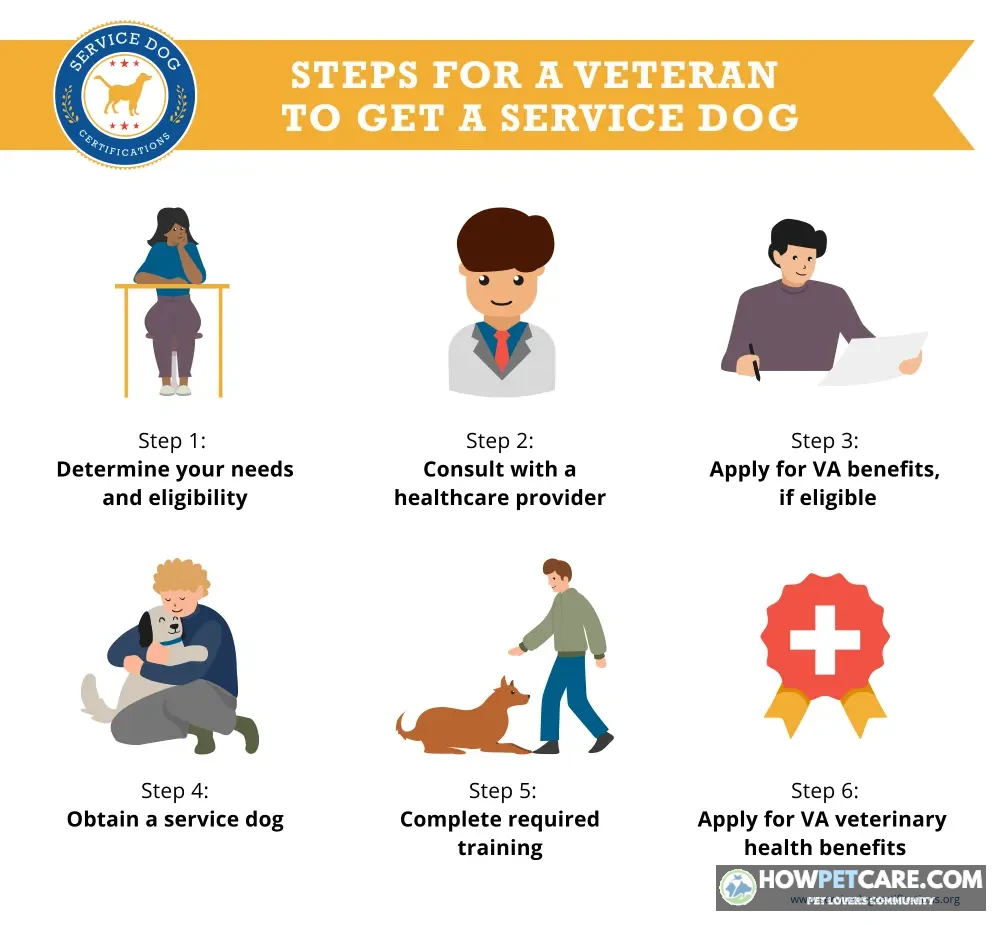
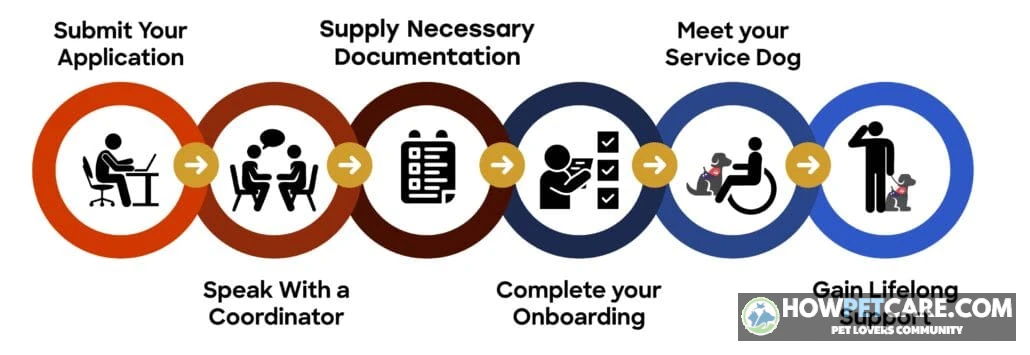
To get a service dog as a veteran, follow these core steps:
- Get a formal diagnosis and a written functional-limitations assessment from your VA or private clinician.
- Identify two to three ADI- or IGDF-accredited nonprofits that train dogs for your disability.
- Submit a complete application packet: DD-214, VA rating letter, medical forms, references, and housing proof.
- Pass screening interviews and a home video assessment, then wait for a canine match (typically 6–18 months).
- Attend 2–3 weeks of team training, pass the Public Access Test, and activate VA veterinary benefits if eligible.
To get a service dog as a military veteran, you have to navigate two systems that run in parallel: accredited nonprofit service dog organizations and the U.S. Department of Veterans Affairs (VA). A common misconception is that the VA breeds, trains, and hands out service dogs directly. In reality, the VA does not provide or pay for the dog itself. Instead, eligible veterans receive their specially trained dogs at no cost through accredited nonprofits, while the VA contributes secondary support — specifically a comprehensive veterinary health insurance benefit and assistive equipment — for certain qualifying physical disabilities.
Qualifying for a veteran service dog requires a diagnosed disability that substantially impairs your ability to perform daily life activities, formal clinical documentation from your medical or mental health provider, and the physical and lifestyle stability needed to care for a working animal. The entire process, from your first medical consultation to bringing a matched dog home, typically spans 12 to 24 months.
Veterans do not buy service dogs from the government. You obtain your dog through an accredited nonprofit training organization (usually at zero cost for the animal itself), and you obtain medical approvals, prosthetic equipment, and veterinary benefits through your local VA medical center.
Am I Eligible for a Veteran Service Dog? PTSD, TBI, MST, Mobility and Discharge Status
Eligibility hinges on one fundamental legal standard established under the Americans with Disabilities Act (ADA): you must have a diagnosed physical or mental impairment that substantially limits one or more major life activities. For veterans, this diagnosis is typically tied to military service, though nonprofit programs evaluate clinical need regardless of whether your condition is officially rated as service-connected by the VA.
Accredited training programs assess applicants on three criteria: clinical need, handler capability, and home environment stability. A veteran must demonstrate that a service dog will perform specific, identifiable tasks that directly mitigate their functional limitations. Nonprofits also evaluate whether the veteran can independently command, feed, exercise, and care for a high-energy working animal. If an applicant relies on a caregiver for primary daily functioning, the caregiver must often attend team training alongside the veteran.
Use the following five-question router to identify where your situation fits best before investing months into application paperwork.
Five-Question Eligibility Router: Where You Most Likely Fit
Answer each question in order to determine your application pathway and flag potential hurdles early.
What is your character of discharge on your DD-214 (Block 24)?
- Honorable or General Under Honorable Conditions: You meet the service requirement for nearly all veteran service dog organizations and VA benefits. Proceed to Question 2.
- Other Than Honorable (OTH), Bad Conduct, or Dishonorable: Do not immediately self-disqualify. Several independent nonprofits accept OTH discharges on a case-by-case basis if your clinical record demonstrates that service-related trauma contributed to your discharge. Consult an accredited Veterans Service Officer (VSO) about seeking a VA Character of Discharge review or a military discharge upgrade while researching open-door nonprofits.
Which primary disability will the service dog mitigate?
- Mobility impairment, blindness, severe hearing loss, or seizure disorder: You qualify for both the nonprofit training pipeline and direct VA veterinary health benefits under Title 38 Code of Federal Regulations (CFR) § 17.148. Pursue both tracks simultaneously.
- Post-Traumatic Stress Disorder (PTSD), Traumatic Brain Injury (TBI), or Military Sexual Trauma (MST) without physical mobility limits: The nonprofit path is your primary pipeline. Standalone mental health conditions have historically not qualified for standard VA veterinary benefits, though programs like the PAWS Act pilot provide alternative VA touchpoints.
- Medical alert needs outside standard mobility or psychiatric work (e.g., diabetic alert): Major veteran-specific providers rarely train for these conditions. You will need a specialized dual-placement organization or an owner-trainer model.
Do you currently have other domestic pets in your home?
- No: You have a straightforward path with no household pet screening required.
- Yes: Most accredited programs permit family pets, but they enforce strict temperament criteria. Your existing pets must be non-aggressive, up to date on all vaccinations, spayed or neutered, and able to cohabitate peacefully with a working service animal without interfering with its tasks.
Is your housing stable and secure?
- Yes (own or lease stable residence): Continue to Question 5.
- Unstable, transitional, or unhoused: Service dog providers require a stable, safe physical address for placement. A pending eviction or stay in a temporary shelter will pause an application. Secure permanent housing before submitting an application.
Are you actively engaged in ongoing clinical treatment?
- Yes: Clinicians must document your functional limitations and confirm that you are medically stable enough to participate in intensive handler training.
- No: Gaps in treatment are the leading cause of application deferral, particularly for psychiatric service dogs. Re-engage with your VA or private therapist for at least six continuous months to establish clinical documentation before applying.
PTSD, TBI, and MST-Related Conditions
Psychiatric service dogs for veterans suffering from combat-related PTSD, TBI, or MST represent the highest-demand category in the United States. Programs requiring documentation of these conditions look for established medical records from a psychiatrist, clinical psychologist, or licensed clinical social worker. The documentation must state your diagnosis and specify how your mental health condition limits major life functions — such as leaving your home, sleeping, managing hypervigilance in public spaces, or navigating crowded environments.
A VA disability rating letter confirming a service connection (ranging from 0% to 100%) strengthens your documentation packet, but accredited nonprofits make independent determinations based on functional disability rather than VA percentage ratings alone.
Mobility, Hearing, Vision, and Seizure Conditions
Physical disabilities follow an objective clinical assessment path. For mobility assistance, applicants generally present conditions such as spinal cord injuries, amputations, severe joint deterioration, or neuromuscular disorders. The evaluating clinician must detail specific functional deficits: loss of balance, inability to pick up dropped items, difficulty transferring between sitting and standing, or an inability to open doors independently.
For guide dogs (vision) and hearing dogs (auditory), programs require formal audiograms or ophthalmological exams showing that sensory loss severely restricts environmental awareness and safe navigation. Seizure response dogs require clinical documentation establishing seizure frequency, presentation, and safety risks during an episode.
Does Discharge Status Matter?
Discharge characterization matters significantly depending on which entity you approach. The VA requires an honorable or general under honorable conditions discharge to access comprehensive healthcare and prosthetic services. An Other-Than-Honorable (OTH) discharge generally bars access to Title 38 benefits unless the veteran receives a favorable administrative Character of Discharge review.
Nonprofit organizations establish their own independent rules. Flagship programs like K9s For Warriors, America’s VetDogs, and Canine Companions require a copy of your DD-214 Member-4 copy. While an honorable discharge is preferred across the board, several organizations review OTH applicants individually, particularly when clinical records tie the underlying conduct to undiagnosed combat trauma or MST.
PTSD Service Dog Tasks vs. Emotional Support Animals
Under Title II and Title III of the Americans with Disabilities Act, only dogs (and in rare instances, miniature horses) qualify as service animals. A service animal must be individually trained to perform specific tasks directly related to the handler’s disability. Dogs whose sole function is to provide comfort, companionship, or emotional support do not qualify as service animals under federal law.
This legal boundary is absolute. The examples below illustrate the difference between trained psychiatric mitigation tasks and general emotional comfort:
- Nightmare Interruption: The service dog recognizes physiological distress cues (thrashing, vocalizing, elevated pulse), turns on bedside lights, pulls away blankets, and nudges the veteran awake to break night terrors. In contrast, an emotional support animal (ESA) simply sleeps on the bed without purposeful training.
- Crowd Buffering / "Block" and "Post": The dog stands perpendicularly in front of or behind the handler on command, creating a physical 3-to-4-foot protective boundary in public spaces to eliminate surprise approaches and lower hypervigilance. An ESA stands passively next to the owner.
- Tactile Grounding and Deep Pressure Therapy (DPT): During a panic attack or dissociative flashback, the dog applies sustained body weight across the veteran’s lap, thighs, or chest on command, triggering parasympathetic nervous system calming. An ESA provides comfort only when petted.
- Environmental Safety Checks ("Search"): The dog enters an empty room or hallway ahead of the veteran, checks the space, and returns with a trained physical alert confirming the area is clear. An ESA cannot evaluate structural safety on command.
Because emotional support animals lack individualized task training, they do not possess public access rights under the ADA. They cannot accompany veterans into restaurants, grocery stores, medical facilities, or retail establishments.
Does the VA Provide or Pay for a Service Dog? What the VA Covers and What Nonprofits Do
The VA does not purchase, breed, raise, or directly issue service dogs to veterans. When you see a veteran with a professionally trained service dog, that dog was almost certainly acquired through a specialized 501(c)(3) nonprofit foundation or an independent private trainer.
The VA’s formal involvement is strictly regulatory and financial, administered through the Veterans Health Administration (VHA) Prosthetic and Sensory Aids Service (PSAS). Rather than funding dog acquisition, the VA steps in after a dog is trained to provide medical equipment, specialized hardware, and comprehensive veterinary insurance benefits for eligible veterans.
What 38 CFR 17.148 Qualifies and What It Leaves Out
The statutory foundation governing VA service dog support is codified in 38 CFR § 17.148. This regulation establishes narrow medical parameters regarding who qualifies for VA-funded service dog benefits.
Under 38 CFR § 17.148, the VA authorizes benefits exclusively for veterans with:
- A severe visual impairment (best corrected visual acuity of 20/200 or less in the better eye, or severe field deficit);
- Profound hearing impairment with severe communication limits;
- A chronic, severe physical impairment that substantially limits mobility (such as an inability to navigate stairs, transfer independently, or operate doors);
- Mobility limitations secondary to neurological disorders, including seizure conditions.
The critical gap in 38 CFR § 17.148 is mental health: standalone psychological diagnoses, including combat PTSD and depression, are omitted from the regulation’s qualifying list. A veteran with 100% service-connected PTSD but no physical mobility impairment does not qualify for ongoing VA veterinary health benefits under this standard regulation. To access these benefits, the impairment must have a direct, documented physical mobility or sensory component.
The standard VA veterinary insurance benefit requires an Assistance Dogs International (ADI) or International Guide Dog Federation (IGDF) accredited dog and an approved physical, visual, hearing, or neurological mobility impairment. Do not count on the VA to fund veterinary care for a psychiatric service dog unless you are participating in a dedicated clinical pilot program.
What the VA Veterinary Health Benefit Covers and Excludes
For veterans who meet the strict eligibility standards of 38 CFR § 17.148, the VA Prosthetic and Sensory Aids Service provides an extensive veterinary benefit package. This coverage is managed through a commercial pet insurance administrator under contract with the VA.
The VA Veterinary Health Benefit Covers:
- Annual wellness and comprehensive physical examinations.
- Core and non-core vaccinations (rabies, DHPP, bordetella, leptospirosis).
- Year-round parasite prevention (flea, tick, and heartworm medications).
- Emergency medical treatments and surgical procedures for illness or trauma.
- Prescription medications prescribed by a licensed veterinarian.
- Assistive working gear (harnesses, specialized pull-straps, guide handles, and backpacks) issued directly through PSAS.
The VA Veterinary Health Benefit Explicitly Excludes:
- Commercial daily dog food, prescription diets, and nutritional supplements.
- Routine grooming services, nail trims, and medicated baths.
- Non-medical boarding fees or pet-sitting expenses.
- Elective or routine cosmetic dental cleanings not tied to active dental pathology.
- Over-the-counter flea collars, toys, beds, and standard travel crates.
The PAWS Act Pilot Program and PTSD Service Dogs
To bridge the gap between 38 CFR § 17.148 and veterans suffering from post-traumatic stress, Congress enacted the Puppies Assisting Wounded Servicemembers (PAWS) for Veterans Therapy Act. This statute established a pilot program directing the VA to partner with accredited service dog organizations to provide work-therapy dog training programs for veterans diagnosed with combat-related PTSD.
Under the PAWS Act pilot model, veterans participate in the active, hands-on training of prospective service dogs as a clinical therapeutic intervention. Upon successful completion of the curriculum and determination of clinical appropriateness, veterans may adopt the trained dog as a permanent service animal.
The PAWS Act also established a path for the VA to provide veterinary health insurance for these specific pilot-placed psychiatric service dogs. However, implementation is restricted to designated pilot VA Medical Centers (VAMCs). If you are seeking a PTSD service dog outside these pilot facilities, you must obtain your dog through an independent nonprofit organization and cover ongoing veterinary costs through personal funds or alternative charitable assistance.
To clarify how responsibilities divide across the entire landscape, consider the operational boundaries:
- The VA Medical Center (VHA / PSAS): Conducts clinical evaluations, verifies mobility deficits, approves 38 CFR § 17.148 eligibility, and funds contracted veterinary insurance policies for qualifying physical impairments.
- Accredited Nonprofit Organization: Breeds, raises, trains, and custom-matches the service dog; covers all training costs; hosts the multi-week handler team training; and provides lifetime recertification.
- The Veteran Handler: Submits applications, travels to team training, commands and maintains the dog daily, and covers non-insured costs such as food, standard gear, grooming, and housing.
Veteran Service Dog Application Process, Step by Step: From VA Evaluation to Team Training
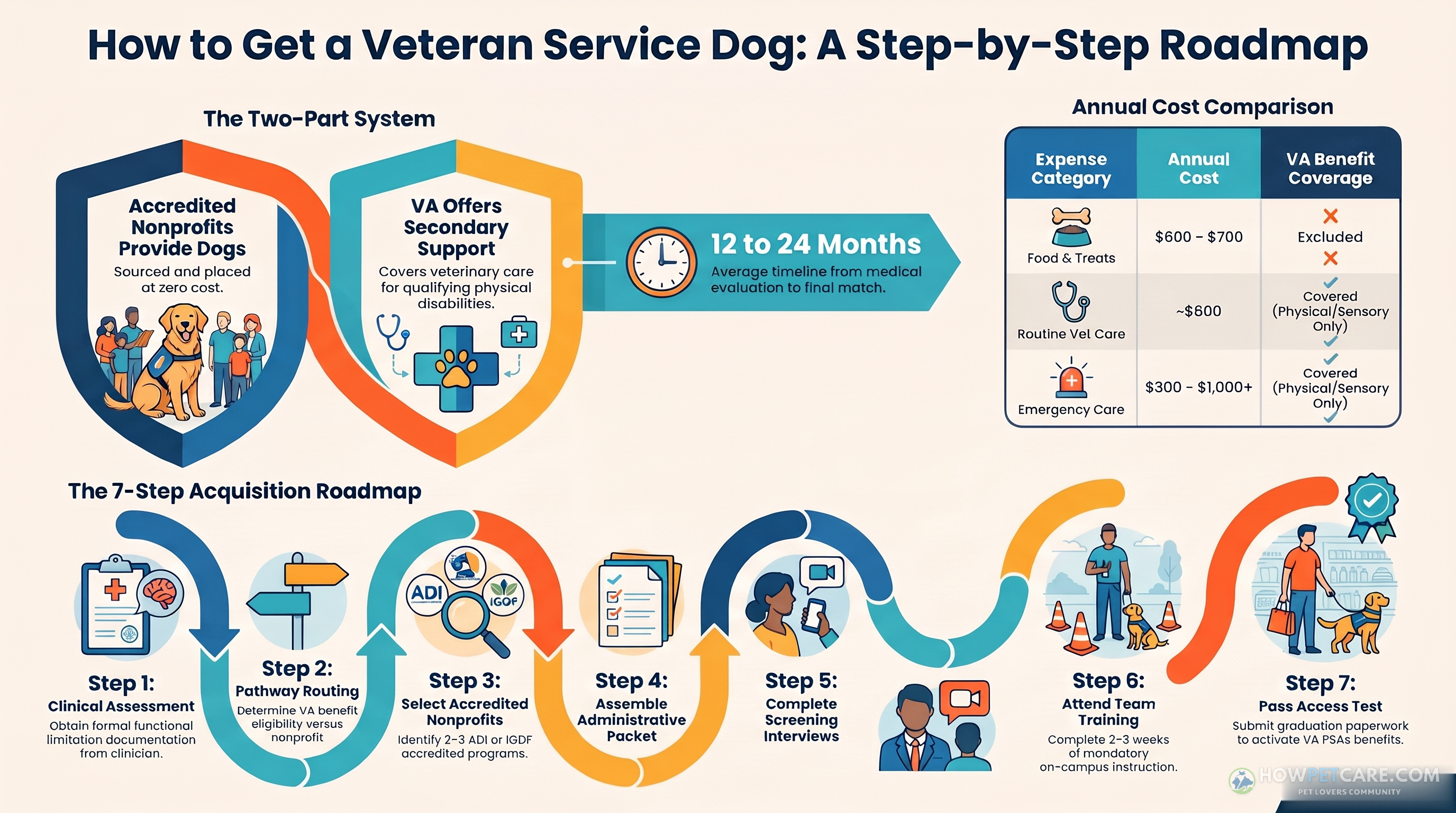
Applying for a service dog is a structured, multi-stage process that requires patience, extensive administrative paperwork, and active participation. Below is the complete sequential roadmap from initial clinical consultation to final graduation.
-
Step 1: Clinical Evaluation and Functional Documentation
Schedule an appointment with your primary care provider or mental health clinician (within the VA system or through private care). Request a formal functional assessment documenting your diagnosis, treatment history, and specific daily limitations. The clinician must state in writing that your condition is stable and that a service animal is an appropriate assistive aid.
-
Step 2: Pathway Routing and Benefit Pre-Screening
Determine your primary pathway. If you have severe physical mobility limitations, blindness, or hearing loss, notify your VA clinician to enter a consult to the Prosthetic and Sensory Aids Service (PSAS) for service dog evaluation under 38 CFR § 17.148. If your primary condition is PTSD, TBI, or MST without qualifying physical mobility limits, bypass the PSAS benefit application for now and focus your efforts on accredited nonprofit placement programs.
-
Step 3: Nonprofit Organization Selection and Verification
Identify two to three accredited service dog programs that serve your disability type and geographic area. Confirm their accreditation status on the official Assistance Dogs International (ADI) or International Guide Dog Federation (IGDF) member directories. Verify that their waitlists are open before preparing application packages.
-
Step 4: Application Submission and Document Packaging
Assemble your administrative packet: DD-214 Member-4 copy, VA disability rating letter, specialized medical history packets completed by your physicians, personal reference letters, background release forms, and proof of housing stability. Submit the complete package according to each organization’s intake guidelines.
-
Step 5: Screening Interviews and Video Home Assessment
Pass the organization’s initial screening. Once your paperwork clears, the program will conduct extensive video or telephone interviews with you and your family. You will be required to submit a recorded video walkthrough of your home, yard, and immediate neighborhood to ensure a safe, escape-proof living environment.
-
Step 6: Custom Matching and Dedicated Team Training
The organization identifies a canine partner whose temperament, energy level, physical size, and task strengths match your height, walking pace, and specific disability triggers. You travel to the provider’s campus for a mandatory 10-to-21-day residential team training camp, learning public access laws, canine handling mechanics, command execution, and task management.
-
Step 7: Certification and Post-Placement Benefit Activation
Pass the formal Public Access Test (PAT) and graduate as a certified service dog team. Upon returning home, submit your official ADI or IGDF graduation certificate and microchip registration paperwork to your local VA PSAS department if your disability qualifies under 38 CFR § 17.148, activating your contracted veterinary insurance coverage.
Documents to Gather Before You Apply
Missing documentation is the single most frequent reason applications are delayed or returned unprocessed. Before starting an intake portal, create a dedicated digital folder containing scanned, high-resolution PDF copies of the following records:
- Military Service Record: DD-214 (Member-4 copy showing character of service, discharge date, and separation authority).
- VA Benefits Documentation: Your most recent VA Rating Decision Letter detailing service-connected disabilities and assigned percentage ratings.
- Medical and Psychological History Forms: Provider-specific clinical forms completed and signed by your treating physician, psychiatrist, or psychologist within the past 60 days.
- Comprehensive Treatment Summary: Clinical progress notes covering the past 6 to 12 months demonstrating treatment compliance and stability.
- Character References: Three to four formal letters of recommendation (non-relatives, such as former commanding officers, colleagues, VSO representatives, or long-term neighbors).
- Residential Verification: Mortgage deed or formal lease agreement, accompanied by written authorization from the property owner or landlord acknowledging the placement of a working service dog.
- Home and Yard Video Walkthrough: A continuous 5-minute video showing all indoor living spaces, sleeping areas, perimeter fencing, gate latches, and outdoor relief areas.

What Happens at Matching and Team Training
Matching is a deliberate process guided by canine behavioral science. Service dog organizations do not match dogs based on coat color, breed preference, or application timestamps. Instead, program trainers evaluate your physical stride, core strength, tone of voice, personality type, household activity level, and specific disability triggers.
Once a candidate dog is selected, you will be invited to attend a mandatory team training class (often referred to as "Handler Academy"). These courses generally run for two to three weeks on the nonprofit’s training campus. Training is demanding, typically running from 0800 to 1700 daily. Handlers spend classroom hours studying canine psychology, federal disability statutes, state service dog laws, and health maintenance routines. Practical sessions take place in high-distraction public environments — including busy airports, shopping malls, mass transit centers, and crowded restaurants.
The training culminates in the Assistance Dogs International Public Access Test. This evaluation assesses the dog’s focus, reliability, and handler control under pressure. The dog must demonstrate zero aggression, ignore dropped food, remain calm through sudden loud noises, navigate tight spaces, and execute required disability mitigation tasks on the first or second command.
Activating VA Benefits After Placement
If you graduated with an ADI or IGDF accredited service animal and have a qualifying condition under 38 CFR § 17.148, you can activate your veterinary health benefit immediately upon returning home. Follow this sequence:
- Contact the Prosthetic and Sensory Aids Service (PSAS) office at your local VA Medical Center.
- Submit a formal packet containing: your accredited certificate of graduation showing the canine’s registered name and microchip ID, the organization’s ADI/IGDF accreditation verification, and your clinician’s prosthetic prescription.
- The PSAS coordinator enrolls your service dog into the VA’s contracted commercial pet insurance database.
- You will receive an insurance membership card and policy packet outlining billing instructions for your local commercial veterinary clinic. Participating clinics bill the VA’s contractor directly for approved procedures, exams, and medications.
Best Service Dog Organizations for Veterans, Compared Side by Side
Choosing the right service dog organization requires evaluating supported disabilities, geographic scope, wait times, and training logistics. The organizations in the comparison table below are accredited charities that place fully trained service dogs with military veterans at zero cost for the animal itself.
| Provider | Disabilities Supported | Discharge Requirement | Geography | Reported Wait Time (as Disclosed by Provider) | Training Format | Cost to Veteran | Accreditation Status |
|---|---|---|---|---|---|---|---|
| K9s For Warriors | PTSD, TBI, Military Sexual Trauma (MST) | DD-214 required; uncharacterized/honorable evaluated (confirm specifics) | Nationwide service area; campuses in Florida and Texas | Variable by class volume; verify current waitlist with provider | ~3-week residential camp (lodging and meals provided) | $0 for the dog; handler covers ongoing care | ADI Accredited |
| America’s VetDogs | PTSD, mobility impairments, hearing loss, seizure response | Honorable or General Under Honorable conditions (DD-214 required) | Nationwide service area; campus in Smithtown, New York | Roughly 12 months, per provider disclosures | ~2-week on-campus team training | $0 for the dog; handler covers ongoing care | ADI Accredited |
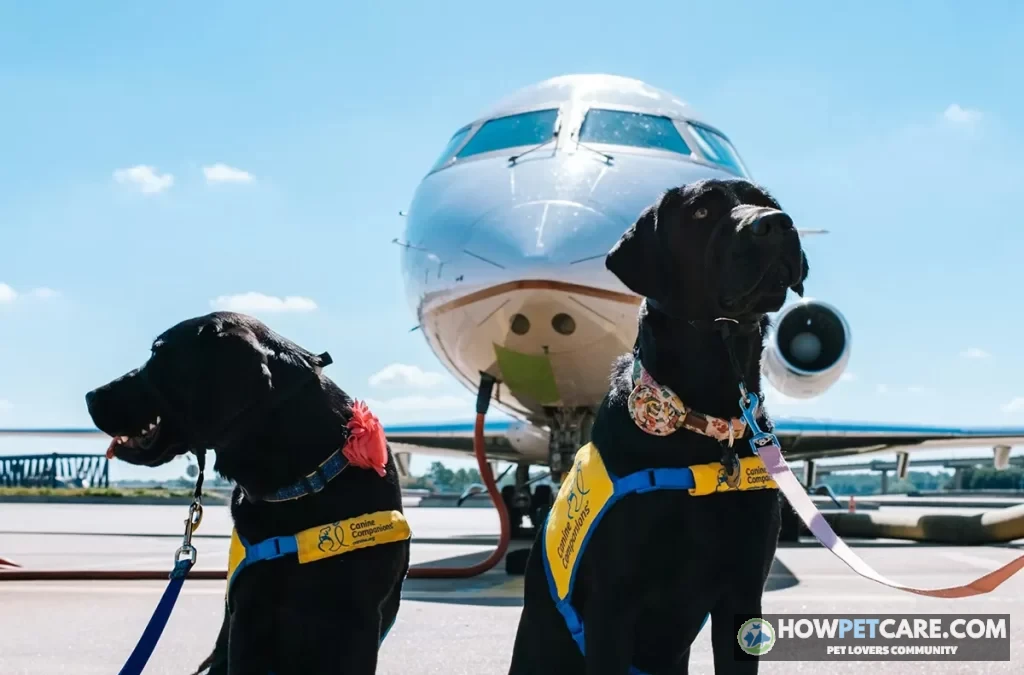
| Canine Companions | Physical mobility limitations, hearing loss, PTSD (veterans initiative) | Service documentation required; check specific criteria | Nationwide service area; regional centers in CA, TX, OH, NY, FL | Varies by region and placement specialty | ~2-week residential team training | $0 for the dog; handler covers ongoing care | ADI Accredited |
| Canines for Service | Physical mobility impairments, balance/stability, TBI | Honorable discharge preferred; DD-214 required | Primarily North Carolina and contiguous southeastern states | Up to approximately 2 years, per provider | Blended residential campus instruction and in-home follow-up | $0 for the dog; handler covers ongoing care | ADI Accredited |
| Guide Dogs of America / Tender Loving Canines | Blindness/severe visual impairment, mobility limitations, PTSD | DD-214 required; specific veteran program intake | Nationwide service area; campus in Sylmar, California | Variable based on specialized harness/guide pairing | ~2-to-3-week on-campus residential training | $0 for the dog; handler covers ongoing care | IGDF and ADI Accredited |
How to Verify ADI or IGDF Accreditation Before You Apply
Before submitting personal identifying information, medical records, or military discharge papers to any service dog program, verify its official accreditation. Assistance Dogs International (ADI) and the International Guide Dog Federation (IGDF) serve as the global accrediting authorities for working dog organizations, enforcing rigorous standards for animal welfare, ethical training practices, client rights, and public safety.
To verify an organization:
- Visit the official Assistance Dogs International website and navigate to their "Member Search" or "Locate a Program" database.
- Search by the program’s full corporate legal name and operating state.
- Verify that the program holds full "Accredited Member" status rather than a provisional, candidate, or suspended listing.
- For guide dog programs, cross-check the International Guide Dog Federation membership registry.
Accreditation matters because the VA strictly conditions its Title 38 veterinary insurance benefits on graduation from an ADI or IGDF accredited program. If you acquire a dog through an unaccredited organization, the VA will categorically reject your application for veterinary benefits, regardless of how well the animal performs.
Why Service Dog Certification and Registry Sites Are Not Required
A cottage industry of commercial websites sells "official" service dog registration numbers, digital ID cards, embroidered vests, and embossed certificates for fees ranging from $50 to $300. The U.S. Department of Justice has repeatedly stated that these commercial registries convey zero legal standing under the ADA.
Under federal ADA regulations, employees and business operators are legally permitted to ask only two questions when an animal’s working status is not obvious:
- Is the dog a service animal required because of a disability?
- What work or task has the dog been trained to perform?
Staff members cannot demand medical documentation, require the dog to demonstrate its task, or demand an ID card, certification paper, or registry number. Legitimate service dog providers issue their own graduation credentials to assist with housing verifications and airline travel, but commercial registry websites are unnecessary and have no legal weight.
How Long Does It Take to Get a Service Dog as a Veteran? A Combined Timeline
One of the most common surprises for veterans is the duration of the placement pipeline. When combining initial VA medical documentation appointments, provider application vetting, canine training schedules, and team matching backlogs, the realistic timeline runs between 12 and 24 months.
| Phase | What Happens | Typical Range | What Can Slow It Down | How to Speed It Up |
|---|---|---|---|---|
| Phase 1: Medical & Records Documentation | Clinical evaluations, functional limitations write-ups, DD-214 retrieval | 1 to 3 months | Clinician delays, missing service records, incomplete forms | Request records via VA portal early; book dedicated intake appointments |
| Phase 2: Provider Screening & Review | Application review, background checks, phone/video interviews, home video tour | 2 to 4 months | Incomplete application packets, non-responsive references, questionable fencing | Double-check packet checklists; brief your personal references in advance |
| Phase 3: The Waitlist & Canine Matching | The organization identifies, trains, and custom-pairs a dog to your specific height, pace, and triggers | 6 to 18 months (VetDogs reports ~12 mos; Canines for Service up to ~2 yrs) | High demand, unique task requirements, complex household dynamics | Maintain quarterly check-ins with your intake coordinator; keep contact info updated |
| Phase 4: Team Training & Certification | On-campus residential instruction, public access tests, handler education | 2 to 3 weeks | Scheduling conflicts, physical inability to handle training tempo | Prepare physical endurance; arrange family care and work leave well in advance |
| Phase 5: Post-Placement & Benefit Setup | Transition home, community acclimation, VA PSAS veterinary benefit processing | 1 to 3 months | VA administrative backlog, local vet unfamiliar with direct billing | Submit graduation records to PSAS within 48 hours of returning home |

Worked Example: 18–20 Months from First VA Appointment to a Matched Dog
To understand how these phases unfold in practice, consider the timeline of an illustrative applicant:
Profile: An Army veteran diagnosed with combat-related PTSD, an Honorable discharge, stable suburban rental housing, and two years of continuous outpatient therapy through a VA Medical Center. Because the veteran has no physical mobility impairment, the VA will not cover ongoing veterinary expenses under 38 CFR § 17.148, making an accredited nonprofit the primary path.
- Month 0–1: The veteran schedules an appointment with their VA clinical psychologist. The clinician completes the functional limitation assessment and treatment stability paperwork. The veteran downloads their DD-214 Member-4 copy and VA Rating Decision Letter from the VA.gov portal. Elapsed time: 1 month.
- Month 1–2: The veteran films a continuous 5-minute video of their residence and yard, gathers reference letters from two colleagues, and submits complete application packages to two ADI-accredited organizations specializing in combat PTSD. Elapsed time: 2 months.
- Month 2–4: The primary provider’s admissions board reviews the submission, conducts an initial telephone screening, and schedules an extensive 90-minute video interview with the veteran and their spouse. The board confirms approval and places the veteran on the active match waitlist. Elapsed time: 4 months.
- Months 4–16: The 12-month waitlist phase begins, tracking the typical timeframe disclosed by organizations like America’s VetDogs. The provider’s training staff assesses candidate dogs nearing the end of their advanced training cycles. The veteran remains in regular therapy to maintain required medical stability, checking in with the organization quarterly. Elapsed time: 16 months.
- Months 16–17: The organization calls to notify the veteran that a 2-year-old Lab/Golden retriever cross has been selected as their match. The veteran coordinates travel dates, schedules two weeks of leave from employment, and arranges for family members to cover home responsibilities. Elapsed time: 17 months.
- Months 17–18: The veteran attends a 14-day residential team training camp at the provider’s training campus. The program provides room and board, while the veteran covers $450 in personal travel expenses. The team trains in public spaces daily, passes the ADI Public Access Test, and graduates. Elapsed time: 18 months.
- Months 18–20: The veteran brings the service dog home. The pair spends the first 60 days establishing routines and reinforcing training in home and work settings. The provider’s field trainer conducts a 30-day post-placement video consultation to resolve initial boundary adjustments. Total elapsed time: approximately 19 months.
If this veteran applied to an organization with longer waitlists — such as Canines for Service, which discloses waits of up to two years — the overall timeline would extend toward 26 to 30 months.
What a Service Dog Costs Per Year After Placement: A Handler Budget
Accredited service dog organizations provide the animal, two years of advanced training, and handler academy tuition at zero direct cost to the veteran. However, bringing a working service dog into your home introduces substantial recurring financial responsibilities. Many veterans are unprepared for the lifetime ownership costs required to maintain a high-performing working dog.
| Expense Category | Estimated Annual Cost | Covered by VA Benefit (38 CFR § 17.148)? | Handler Financial Notes |
|---|---|---|---|
| Premium Food and Nutritional Treats | $600 to $700 per year (per VetDogs disclosures) | No (Statutorily Excluded) | High-protein working dog diet; treats for daily task reinforcement |
| Routine and Preventive Veterinary Care | $600 per year (per VetDogs disclosures) | Yes (For Qualifying Physical Impairments Only) | Annual wellness exams, core vaccinations, monthly flea/tick/heartworm preventives |
| Emergency Illness, Trauma, and Medications | $300 to $1,000+ per year (or insurance policy) | Yes (For Qualifying Physical Impairments Only) | Diagnostics, bloodwork, unexpected injury recovery, prescription therapies |
| Professional Dental Prophylaxis | $250 to $600 per cleaning (as needed) | No (Excluded Unless Pathological) | Routine preventive cleaning excluded; extraction of broken working teeth covered |
| Grooming, Coat Care, and Hygiene | $100 to $400 per year | No (Statutorily Excluded) | Self-grooming saves money; double-coated or long-haired breeds require regular clipping |
| Travel Boarding and Alternative Pet Care | $100 to $350 per year | No (Statutorily Excluded) | Required only if handler is hospitalized or traveling where the dog cannot work |
| Municipal Licensing and Local Registration | $10 to $50 per year | No | Many local municipalities waive standard pet licensing fees for service animals |
| Working Equipment Maintenance and Replacement | $50 to $150 per year | Hardware Covered via PSAS for Qualifying Handlers | Replacement service vests, high-friction boots, leashes, harnesses, and patches |
| Commercial Pet Insurance (Psychiatric Teams) | $400 to $800 per year | No | Highly recommended for veterans without 38 CFR § 17.148 coverage |
Up-Front Costs: Travel and Team Training
While accredited organizations provide the dog without charging an adoption or placement fee, you must budget for initial out-of-pocket setup costs during the transition phase:
- Travel to Campus: Most organizations provide on-campus dormitory lodging and cafeteria meals during the two-to-three-week team training course. However, handlers are generally responsible for their own round-trip airfare, fuel, baggage fees, and transit to and from the facility ($300 to $800).
- Home Equipment Setup: You must equip your home before bringing the dog back from academy. Basic requirements include an airline-approved crate, orthopedic sleeping beds, specialized vehicle restraint harnesses, heavy-duty grooming tools, and food storage bins ($250 to $500).
- Lost Wages and Leave: You must account for two to three weeks of missed work or coordinate paid time off with your employer to attend team training.
Annual Costs the VA Does Not Cover
As shown in the budget matrix above, the baseline annual cost to maintain a healthy service dog ranges from $1,400 to $2,500 per year. If you are a veteran with a psychiatric service dog who does not qualify for 38 CFR § 17.148 benefits, you will cover the entire amount out of pocket.
Food and preventive health products make up the core of this baseline. Service dogs burn significant calories during public work and require high-grade, commercial diets to maintain physical condition. Daily task maintenance requires regular training treats. Monthly heartworm, tick, and flea preventatives run between $35 and $55 per month, and emergency veterinary clinics routinely charge upwards of $1,500 for sudden diagnostic work, obstruction surgeries, or joint injuries.
If you do not qualify for VA-funded veterinary insurance under 38 CFR § 17.148, establish a dedicated emergency savings fund of at least $1,500 before your dog is placed, or carry a comprehensive private pet health insurance policy with accident-and-illness coverage.
Retirement and Succession: Who Pays for an Aging Service Dog?
Working service dogs generally retire between the ages of 8 and 10, depending on their physical stamina, joint health, and task complexity. When a service dog can no longer work safely and comfortably, programs initiate retirement procedures.
Veterans must plan for the legal and financial realities of retirement:
- Can You Keep the Dog? Almost all accredited programs grant the veteran handler the right of first refusal to keep the retired service dog as a companion pet. If your living arrangements or financial situation make caring for two dogs impossible, the nonprofit organization will assume custody of the retired animal and place it in a vetted adoptive home.
- Financial Responsibilities in Retirement: Once an animal is formally decommissioned, it loses its legal status as a service animal under the ADA. For veterans receiving VA veterinary benefits under 38 CFR § 17.148, VA insurance coverage terminates on the date of the dog’s retirement. The veteran handler must pay for all ongoing medical, prescription, and palliative costs for the retired dog.
- Succession Planning: If you continue to require a working service animal, you must re-enter the application queue for a successor dog. Many accredited providers maintain accelerated fast-track placement streams for active alumni handlers, but the process still requires 6 to 12 months of planning to avoid a gap between your current dog’s retirement and your new dog’s placement.
Can I Train My Own Dog or Use a Pet? Owner-Trainers, Existing Pets, and Non-Standard Situations
Many veterans ask whether they can train their existing pet dog to become a certified service animal. The answer requires looking separately at federal public access law and VA benefit regulations.
Owner-Trained Dogs: ADA Protections vs. VA Benefit Rules
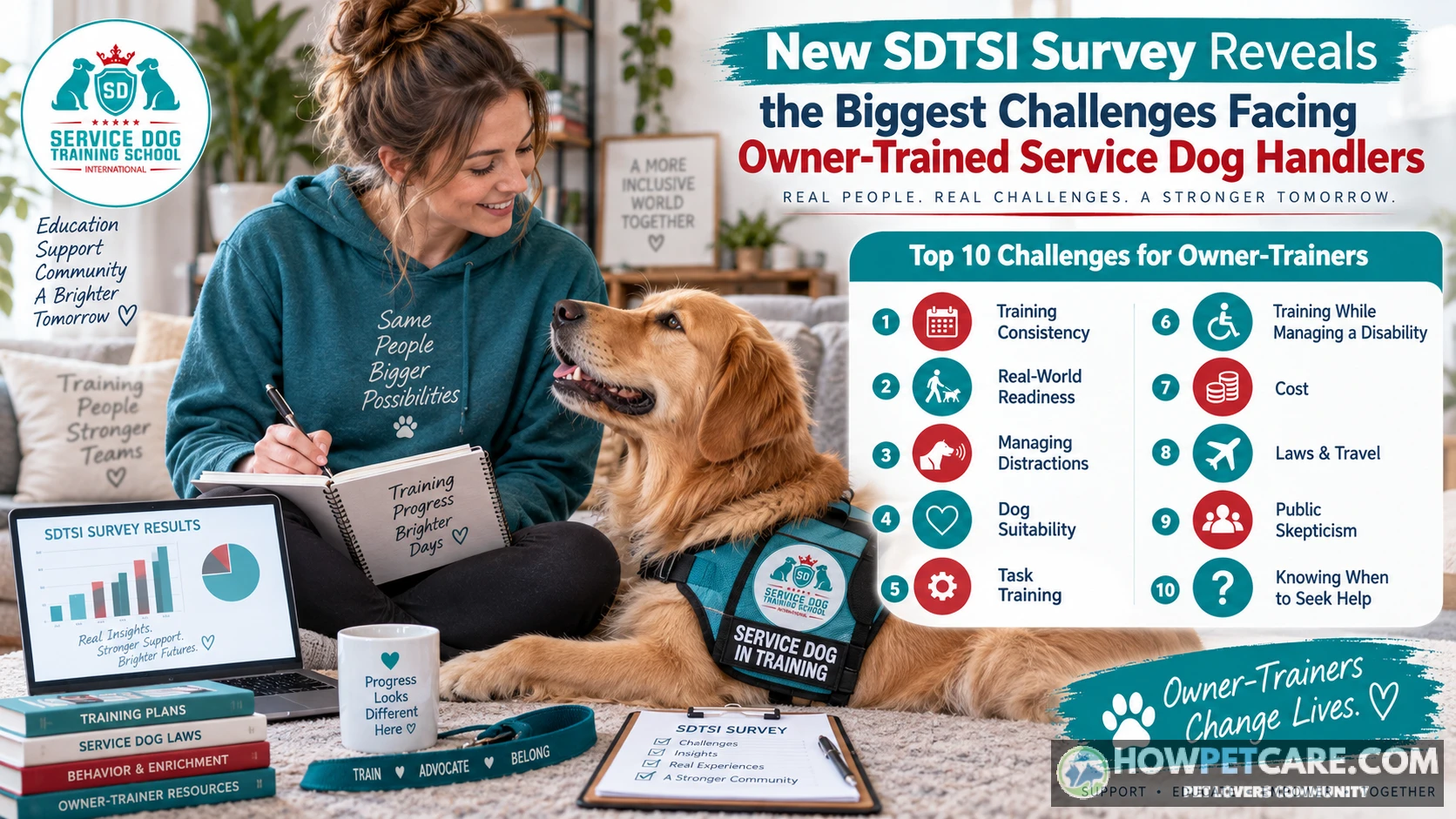
Under Title II and Title III of the Americans with Disabilities Act, owner-training is 100% legal. The federal government does not require you to send your dog through an accredited school, institutional academy, or professional facility. If you personally train your dog to perform specific disability-mitigating tasks and ensure the dog meets basic public access behavior standards, you and your dog enjoy full ADA legal protections in housing, public spaces, and transportation.
However, there is a major regulatory trade-off: an owner-trained dog cannot qualify for VA veterinary benefits or prosthetic equipment under 38 CFR § 17.148. The VA strictly conditions its financial support on graduation from an Assistance Dogs International (ADI) or International Guide Dog Federation (IGDF) accredited facility. Because an owner-trained dog lacks institutional accreditation, the VA will not enroll the animal in its veterinary health program.
Training your own dog also carries a high failure rate. Professional service dog programs select from generations of purposeful breeding lines, and even with specialized breeding, roughly 30% to 50% of candidate puppies wash out due to minor medical or behavioral issues. Converting an everyday pet into a reliable service animal requires hundreds of hours of advanced training and carries a substantial risk of disqualification if the dog shows fear, environmental reactivity, or dog-distraction behaviors.
Less-Than-Honorable Discharge
Veterans with an Other-Than-Honorable (OTH) or Bad Conduct discharge face administrative hurdles, but they are not entirely without options:
- VA Barrier: The VA generally withholds healthcare and prosthetic benefits from veterans with OTH discharges unless an administrative review confirms their discharge was not issued under dishonorable conditions. If your discharge blocks VA benefits, you will not be able to access VA veterinary coverage.
- Nonprofit Flexibility: Several independent nonprofits review applicants with non-honorable discharges on a case-by-case basis. These programs typically require an interview, references from a clinical care team, and verification that your separation was related to trauma incurred during service.
- Discharge Upgrades: Work with an accredited VSO through organizations such as the DAV, VFW, or American Legion to submit a formal discharge upgrade request (DD Form 149) or request a VA Character of Discharge review.
Pets at Home, Housing Instability, and Treatment History
Other common situations can complicate your application:
- Existing Household Pets: Bringing a working service dog into a home with existing dogs or cats requires careful planning. Accredited programs will require your existing pets to pass behavioral screenings to confirm they are non-aggressive, non-territorial, and spayed or neutered. If an existing household pet shows resource guarding or dog aggression, the program will defer your placement until the pet dynamic is resolved.
- Rental Housing and Pet Fees: Under the federal Fair Housing Act (FHA), service dogs and emotional support animals are categorized as assistive aids rather than pets. Landlords, property managers, and homeowner associations are legally prohibited from charging service dog handlers pet deposits, monthly pet rent, or cleaning surcharges. They also cannot enforce breed bans, size limits, or weight restrictions against a legitimate service dog team.
- Substance Abuse and Mental Health Crises: Every accredited provider requires documented stability before admitting a veteran to team training. A recent psychiatric hospitalization, active substance abuse disorder, or acute suicidal crisis will put an application on hold. Programs typically look for a minimum of 6 to 12 months of sustained, documented sobriety and clinical stability before resuming the intake process. If an active handler experiences a severe mental health crisis or relapse after placement, the program’s client services department will work with the family to arrange temporary respite boarding for the dog until the handler is clinically cleared to resume handling.
What to Do If a Provider or the VA Denies Your Request
Receiving a rejection letter does not mean your path to getting a service dog is closed. A nonprofit program rejection and a VA benefit denial are two different administrative problems that require different recovery strategies.
Denial-Recovery Playbook: Two Separate Tracks
Follow the relevant recovery process based on whether your denial came from the federal government or an independent training foundation.
Track A: The VA Denies the 38 CFR § 17.148 Veterinary Benefit
- Secure the Written Denial Letter: Request a formal written copy of your denial from the local VA Prosthetic and Sensory Aids Service (PSAS) office or your facility’s Patient Advocate. Do not accept a verbal rejection from a clinic coordinator.
- Review the Regulatory Grounds: Check the stated reason against 38 CFR § 17.148. If the VA denied your claim because your primary diagnosis is PTSD without documented mobility limitations, the rejection is based on standard regulatory limits rather than your personal service record. If the denial alleges a lack of documented mobility deficits despite a qualifying physical impairment, this points to a documentation gap that can be resolved.
- Request a Clinical Statement of Support: Meet with your primary care physician, physiatrist, or neurologist. Ask them to write an addendum to your medical record detailing your specific physical functional deficits, confirming your ADI/IGDF dog mitigates those deficits, and establishing the clinical necessity of the service dog team.
- Initiate a Clinical Appeal: File a formal Clinical Appeal through your VA Medical Center’s Patient Advocate office. Clinical decisions regarding prosthetic suitability follow the Veterans Health Administration (VHA) Clinical Appeal Process rather than the Board of Veterans’ Appeals, directing the case to the facility’s Chief of Staff for secondary administrative review.
- Engage an Accredited VSO: If the local medical center upholds the denial, contact a National Service Officer through a Veterans Service Organization (VSO). They can review your case file, identify administrative errors, and escalate the matter through regional VISN prosthetic directors.
Track B: A Nonprofit Organization Rejects or Defers Your Application
- Request Detailed Feedback: Contact the organization’s admissions director and ask for a detailed explanation of the decision. Nonprofits commonly defer applicants because of incomplete medical forms, lack of physical yard fencing, an uncooperative household pet, or a recent change in psychiatric medication.
- Determine Reapplication Eligibility: Ask directly whether your application was definitively rejected or simply deferred pending resolution of an identified concern. Most programs permit candidates to reapply after a designated waiting period (typically 6 to 12 months) once the underlying issue is resolved.
- Address Specific Deficiencies: If the denial stemmed from treatment instability, establish 6 months of steady clinical progress notes. If it was due to residential fencing, complete necessary property modifications before submitting a new packet.
- Apply to Alternative Accredited Providers: Because each nonprofit operates under its own charter, criteria vary significantly between organizations. A rejection from one provider has no bearing on your standing with another. Submit applications to two or three other ADI-accredited programs that serve your disability type.
- Maintain Parallel Timelines: Remember that nonprofit placement and the VA veterinary benefit run independently. If your nonprofit application is approved, continue forward even if your VA benefit request is still pending appeal. You can self-fund initial care and activate VA benefits later once your appeal clears.
Steps When a Nonprofit Provider Says No
When a nonprofit program denies your application, focus on identifying the specific issue that triggered the decision. Organizations want to place their dogs successfully, but they are limited by canine availability and client safety standards. If their decision was driven by an unmanaged home environment or an unsupportive landlord, resolving your living situation directly resolves the hurdle.
If the rejection was based on medical criteria — such as the provider determining their dogs are not trained for your specific combination of conditions — shift your focus to specialized dual-placement organizations. Many smaller regional charities specialize in complex cases, such as combined TBI, seizure, and balance disorders, that larger standardized providers may refer elsewhere.
Appealing a VA Veterinary Benefit Denial
If you disagree with a formal VA PSAS determination regarding your service dog’s veterinary insurance eligibility, you have administrative appeal rights under the Veterans Appeals Improvement and Modernization Act. This route applies when the denial was issued as a formal benefits decision; if it was a clinical prosthetic-suitability determination, use the VHA Clinical Appeal Process described in Track A above instead.
Depending on how your determination was classified, you can pursue three decision review lanes:
- Supplemental Claim: Submit new and relevant medical evidence, such as updated gait analyses, physical therapy assessments, or neurological evaluations demonstrating mobility deficits.
- Higher-Level Review: Request a de novo review of your existing record by a senior prosthetic specialist without submitting new evidence.
- Board of Veterans’ Appeals: Appeal your case directly to a Veterans Law Judge in Washington, D.C., for a formal legal hearing.
Work with an accredited VSO to ensure you select the appropriate procedural track and meet all formal filing deadlines.
Your Action Plan: A Checklist to Start Your Service Dog Application This Month
Transitioning from research to action requires an organized approach. Use the following structured checklist to launch your service dog application this month.
Decision Framework: Choose Your Path
- Path 1 (Mobility / Vision / Hearing / Seizures): Pursue the nonprofit application process and request an immediate VA PSAS clinical evaluation under 38 CFR § 17.148.
- Path 2 (PTSD / TBI / MST Only): Focus your application efforts on accredited nonprofit providers. Inquire with your VA care team about local PAWS Act pilot availability, and establish a personal budget for ongoing veterinary expenses.
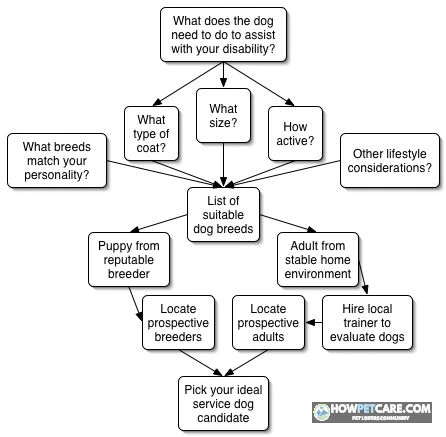
- Path 3 (Owner-Training Route): Verify that you are prepared to cover all canine acquisition, training, and lifetime healthcare costs without VA financial support. Partner with a professional trainer who uses the ADI Public Access Test as their training standard.
Printable Document and Action Checklist
Week 1: Records Retrieval and Medical Scheduling
- ☐ Download your official DD-214 (Member-4 copy) showing separation authority and discharge characterization.
- ☐ Access your VA.gov account and download your most recent VA Disability Rating Decision Letter.
- ☐ Schedule an appointment with your primary care provider or mental health clinician to discuss service dog placement.
- ☐ Inform your clinician that you will need written documentation of your diagnosis, functional limitations, and treatment stability.
Week 2: Program Screening and Shortlisting
- ☐ Cross-reference the Assistance Dogs International (ADI) member directory to identify organizations serving your state.
- ☐ Select three accredited providers that train dogs for your specific disability category.
- ☐ Verify that each program’s application waitlist is open and confirm their specific intake requirements.
- ☐ Review your personal household budget to confirm you can support ongoing care costs of $1,400 to $2,500 annually.
Week 3: Document Compilation and Home Prep
- ☐ Download and print the specific medical history forms required by your chosen service dog programs.
- ☐ Deliver the medical forms to your treating clinician and set a follow-up date for completion.
- ☐ Contact three personal references (former colleagues, military supervisors, or long-term neighbors) and confirm their willingness to write recommendation letters.
- ☐ Verify that all existing household pets are fully vaccinated, licensed, spayed or neutered, and free of behavioral issues.
Week 4: Application Submission and Video Documentation
- ☐ Record a steady, 5-minute continuous video walkthrough of your home, yard, and neighborhood perimeter.
- ☐ Secure a written letter from your landlord or mortgage servicer acknowledging your plan to bring a service dog into the residence.
- ☐ Complete all digital intake forms for your selected service dog providers.
- ☐ Review your application packets for missing signatures or incomplete fields, and submit your materials.
- ☐ Create a physical and digital record of every submitted form, confirmation receipt, and contact name for your records.
1A veteran diagnosed with 100% service-connected PTSD and no physical mobility or sensory impairments receives a service dog from an accredited nonprofit organization. What is the expected outcome when the veteran applies for VA veterinary health insurance benefits for the dog?
Standard VA regulation 38 CFR § 17.148 restricts veterinary coverage to severe visual, hearing, or physical mobility impairments, excluding standalone mental health conditions.
2Which of the following actions represent trained, disability-mitigating psychiatric service dog tasks under the Americans with Disabilities Act (ADA)? (Select all that apply)
Deep Pressure Therapy (DPT) is an individually trained physical task that directly mitigates physiological panic distress.
3A veteran successfully owner-trains their pet dog to perform mobility assistance tasks and meets standard public access behavior criteria. What is the legal and financial status of this team?
Owner-training is legally recognized for public access under the ADA, but the VA strictly conditions Title 38 veterinary insurance on graduation from an ADI- or IGDF-accredited program.
4During the admissions vetting process, accredited service dog organizations evaluate an applicant's living environment. Which specific residential submission is standardly required as part of a complete application packet?
Accredited programs require a continuous video walkthrough of indoor living spaces and outdoor relief/fencing areas to verify a safe, secure environment for a working dog.
5For a veteran who meets all eligibility criteria under 38 CFR § 17.148, which of the following items are covered by the VA's contracted veterinary health benefit? (Select all that apply)
Wellness exams and core vaccinations (such as rabies and DHPP) are explicitly included in the VA veterinary health package.
6An applicant seeking a psychiatric service dog stopped attending outpatient clinical therapy six months ago. What impact will this treatment gap most likely have on their application with an accredited nonprofit organization?
Gaps in ongoing therapy are a primary cause of application deferral, as accredited programs require documented medical stability and active clinical engagement.
7A veteran purchases a 'service dog registration certificate,' digital ID card, and vest from a commercial online registry. What legal standing do these items convey under the Americans with Disabilities Act (ADA)?
The Department of Justice has affirmed that commercial registration websites carry no legal weight, and businesses cannot demand ID cards or certificates.
8A veteran has an Other-Than-Honorable (OTH) discharge characterization on Block 24 of their DD-214 due to service-related trauma. What is the most accurate assessment of their options for acquiring a service dog and related benefits?
Several independent nonprofits consider OTH applicants if clinical records link conduct to service trauma, and a VSO can help request administrative discharge reviews to potentially unlock VA benefits.
FAQ
Do I need to register or certify my service dog to have ADA protections?
No. The ADA does not require certification or registration for service dogs, and online registries carry no legal weight. Businesses may ask only whether the dog is required because of a disability and what task it has been trained to perform.
What is the difference between a service dog, an emotional support animal, and a therapy animal?
A service dog is individually trained to perform tasks that mitigate a disability and has ADA public-access rights. An emotional support animal provides comfort without task training and does not have those public-access rights. A therapy animal visits facilities to comfort other people and is not a handler’s service animal.
What happens to a service dog when it retires?
Policies vary by provider. Many let the handler keep the dog, while others have rehoming or succession rules. Ask the provider in writing who owns the dog and who pays for care after retirement, since VA benefits are tied to the working service dog.
Can a caregiver or family member help me apply?
Yes. Caregivers can help gather documents, schedule evaluations, and complete forms. Providers still require the veteran to be the applicant, and the veteran’s clinician must usually complete the medical sections.
Can I get a medical alert dog as a veteran?
Some accredited programs place dogs for medical alert needs, such as seizure response, but many major veteran programs focus on PTSD, TBI, and mobility. Check each provider’s accepted disabilities before applying.