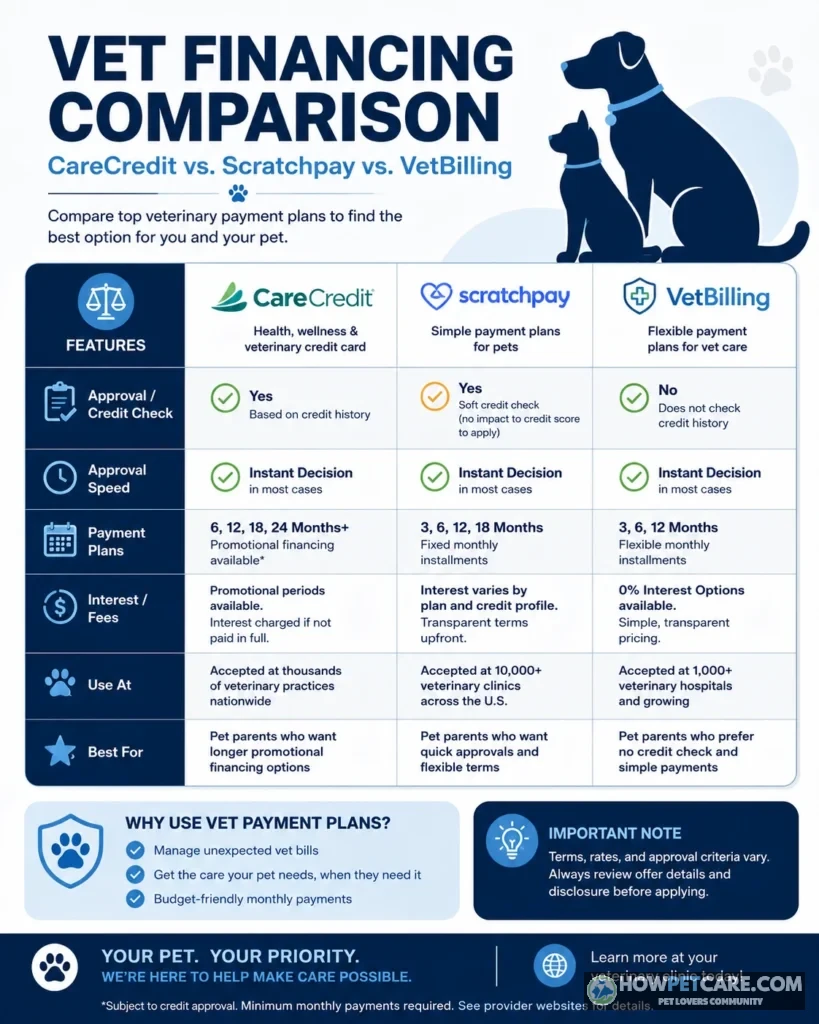

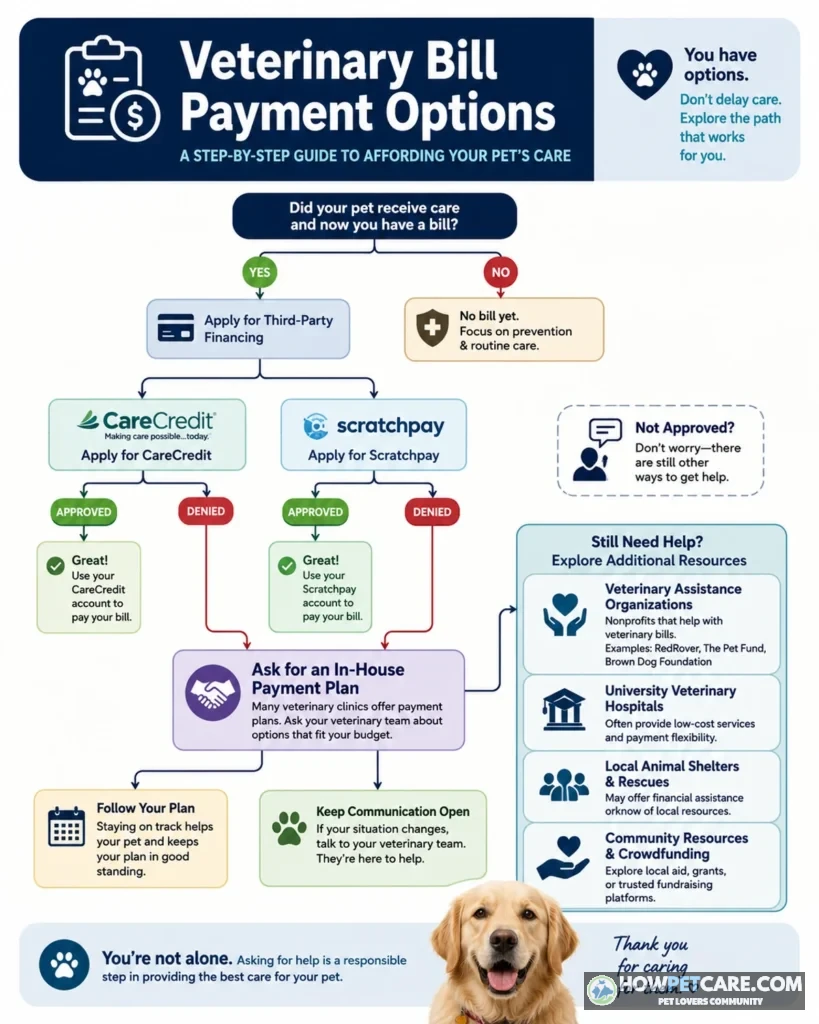
Yes. Some veterinarians offer true in-house payment plans, but many “payment plans” are third-party financing such as CareCredit, Cherry, Scratchpay or Sunbit. Ask what is due today, who holds the debt, the APR/fees, credit-check type and total of payments before authorizing treatment.
Do Veterinarians Offer Payment Plans? Yes, but Few Run Their Own
Yes — but mostly through third-party financing. Some veterinarians offer payment plans, but many practices that let you pay over time use a third-party financing company rather than lending you the money themselves. A true in-house plan means you pay the clinic directly in installments. Each practice decides whether to offer one.
If your pet needs care now, ask the clinic what you’ll owe today, whether it offers an in-house plan, and which outside financing providers it accepts. Get an estimate and the payment terms before you agree to treatment or credit.
A veterinary payment plan spreads a bill across multiple payments. But the phrase can describe arrangements that work quite differently:
- In-house plan: The clinic agrees to accept payments over time, so you owe the clinic. The practice sets the down payment, schedule and any charges. Some clinics use a billing service to administer these plans.
- Third-party financing: A separate financing company or its lending partner pays the clinic. You then repay that company under its agreement. Approval, interest and fees depend on the product and your application.
Find out who will hold the debt. When a clinic says it offers “payment plans,” it may mean that it accepts a financing card—not that you can pay the practice directly.
In-house plans vs third-party financing at a glance
An in-house agreement may give a practice more room to work with an established client, but it can still require fees, a down payment or a credit check. Third-party financing generally requires an application and may charge interest. Neither option is guaranteed, and some clinics offer neither.
The same questions apply whether your pet is a cat, dog, rabbit, bird or another animal. Confirm that the clinic treats your pet’s species and accepts the payment method for the care being considered.
Why payment plans, pet insurance and wellness plans are not interchangeable
Financing spreads out a bill you owe; it doesn’t lower the cost of treatment. Pet insurance generally reimburses eligible expenses under a policy, though some arrangements pay a veterinarian directly. Coverage rules, waiting periods and exclusions for pre-existing conditions matter. A new policy generally won’t solve the cost of an illness that’s already underway.
Pet wellness plans typically spread the cost of specified routine services. Read the contract: a wellness plan isn’t a substitute for emergency coverage or a way to finance an unexpected surgery.
How CareCredit Deferred Interest Works and Where Owners Get Trapped
Does CareCredit work for vet bills?
CareCredit is a healthcare credit card accepted by participating veterinary practices. Before applying, ask the clinic whether it accepts the card and whether the proposed charge qualifies for a promotion. Offers are subject to approval, and not every promotion applies to every purchase.
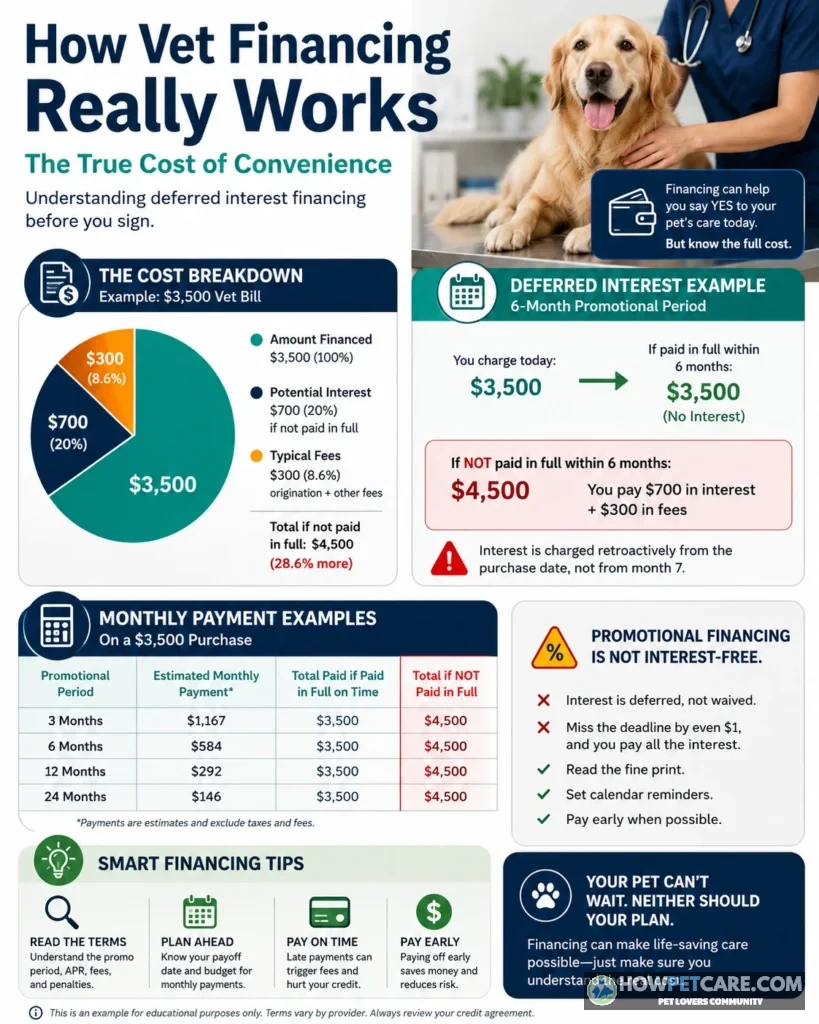
The deferred-interest trap, explained with a timeline
A deferred-interest promotion might say “no interest if paid in full” within a stated period. That’s different from a true 0% APR offer. Interest is calculated from the purchase date, then waived if you meet the promotion’s payoff conditions. If a balance remains when the deadline passes, the accumulated interest is charged under the agreement.
The amount of interest depends on the balance over time and the issuer’s calculation method. It isn’t necessarily a full year of interest on the original amount: payments that reduce the balance during the promotion can lower the interest that accumulates.
For example, a $1,500 charge split evenly across a hypothetical 12-month promotion requires payments of $125 a month to clear the principal. The statement’s required minimum may be lower. Confirm the actual expiration date and leave time for your final payment to post.
A true 0% APR period doesn’t add interest retroactively just because a promotional balance remains at the end. The remaining balance can, however, accrue interest afterward. An ordinary installment loan generally accrues interest according to its contract, often on the remaining principal; it doesn’t automatically have a deferred-interest feature.

For a deferred-interest purchase, calculate a payment that clears the promotional balance before its deadline. Read the agreement for payment allocation rules if your account also has other balances.
What protections exist, and what they don’t cover
Deferred-interest promotions are generally legal when they meet applicable disclosure and consumer-credit requirements. Federal law doesn’t ban them outright for veterinary bills. State rules and protections vary by product and location; consult the Consumer Financial Protection Bureau (CFPB) and your state attorney general for guidance.
Read the clause that explains what happens if you don’t pay the balance in full. Keep the offer and approval documents, consider automatic payments for the amount needed to finish on time, and set a reminder at least a month before the deadline. Ask whether checking an offer or submitting an application involves a soft or hard credit inquiry.
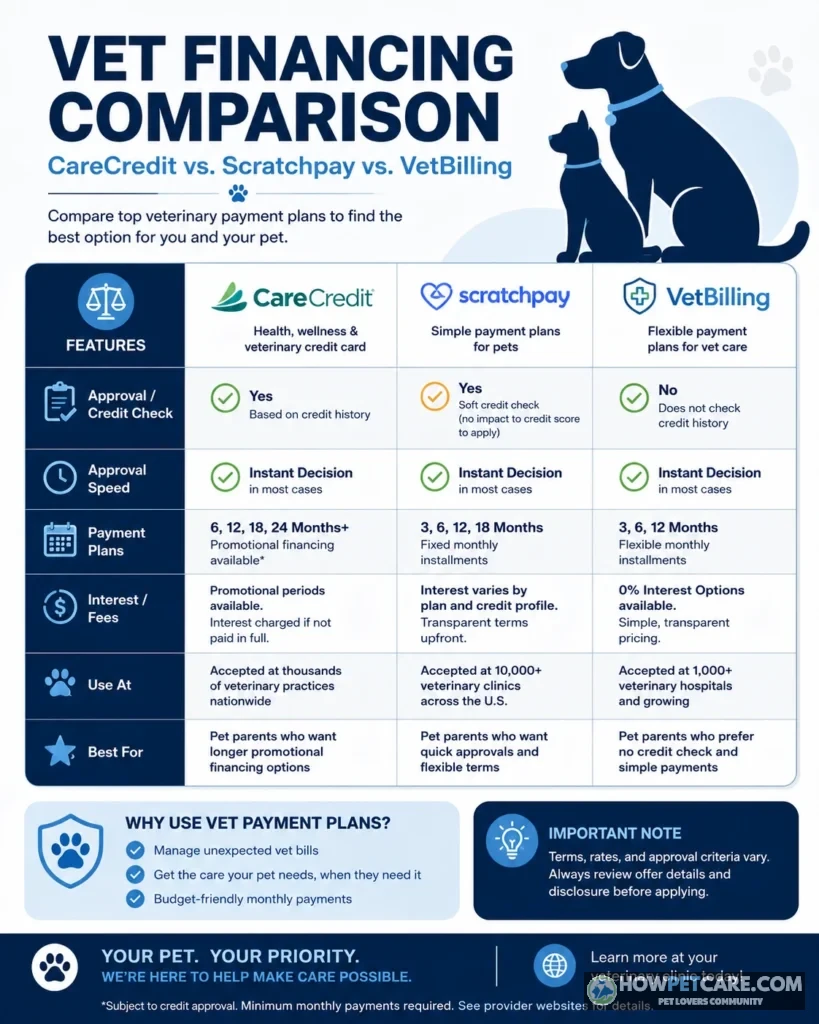
Vet Financing Compared Side by Side: CareCredit, Cherry, Scratchpay, Sunbit, VetBilling and In-House Plans
Lender comparison table
Use this table as a starting point, not a quote. Rates, promotional periods, fees, credit checks and provider arrangements can change, and they depend on the offer and state. Available evidence doesn’t establish current published terms for every product, so confirm details with the provider and clinic before applying. VetBilling is a billing administrator, not necessarily the lender; an in-house plan isn’t a separate lender.
| Option | How it works and who you owe | Promo or term structure | APR and interest type | Fees to check | Credit requirement and approval likelihood | How to confirm clinic acceptance |
|---|---|---|---|---|---|---|
| CareCredit | Healthcare credit card; you owe the card issuer | Qualifying promotional or other card terms vary | Some promotions use deferred interest; other terms may apply | Late fees and other account charges | Credit application; approval and limit vary. Ask which inquiry applies | Ask the clinic or check the provider’s acceptance search |
| Scratchpay | Financing through Scratchpay or its lending partner; check your agreement | Installment offers vary by applicant and practice | Offer-dependent; check APR and whether any promotion is true 0% | Late, returned-payment and other disclosed fees | Credit and eligibility checks vary; no approval guarantee | Ask whether the clinic participates |
| Cherry | Financing arranged through Cherry or a lending partner | Installment terms and any promotional offers vary | Check the offer’s APR and interest terms | Late, returned-payment and other disclosed fees | Eligibility and approval vary; confirm inquiry type | Ask whether the clinic accepts Cherry |
| Sunbit | Financing through Sunbit or its lending partner | Installment terms vary by offer | Check the offered APR and repayment terms | Late and other applicable fees | Eligibility varies; ask whether checking an offer affects your credit | Ask the clinic whether it participates |
| Varidi | Clinic-based pay-over-time arrangement; confirm the contracting party and who owns the debt | Set out in the clinic’s offer and agreement | Check whether interest applies | Setup, processing, late and returned-payment charges, if any | Ask what identity, bank or credit checks apply; acceptance is not guaranteed | Ask whether the practice uses Varidi |
| VetBilling | A service helps administer a clinic’s plan; confirm who owns the debt | Terms are set with the practice | May be interest-free; verify the agreement | Enrollment, administrative, late and returned-payment fees, if applicable | Ask the practice what it checks and whether you qualify | Ask the clinic or use a provider search if available |
| True in-house plan | You owe the clinic directly | Schedule and down payment are negotiated with the practice | None or an agreed charge; verify | Administrative, late and returned-payment fees | Entirely at the practice’s discretion; ask about checks | Ask specifically for a plan you repay to the clinic |
| Credit card or personal loan | You owe the card issuer or lender | Revolving card or fixed loan; introductory offers vary | Card APR or loan interest; check promotional conditions | Annual, origination, late and other fees, as applicable | Approval, rate and limit depend on the lender | Ask whether the clinic accepts the card or how it accepts loan proceeds |
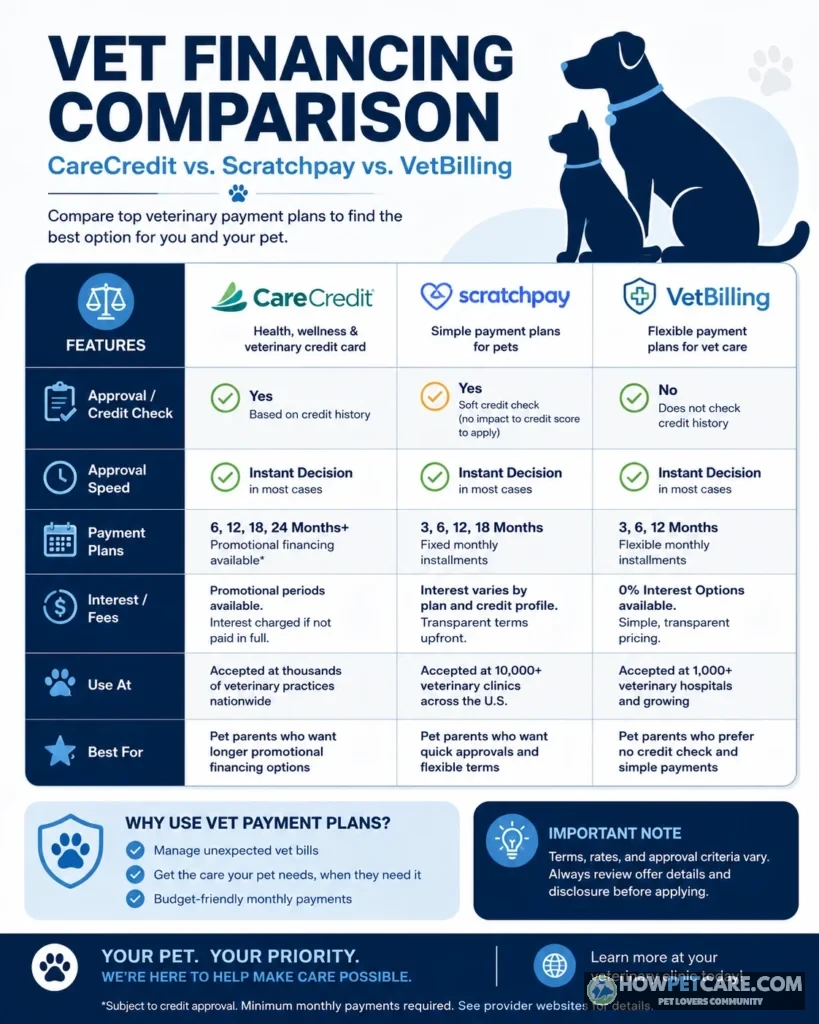
Don’t assume a 0% offer, fee-free plan or particular term is available just because another borrower received one. Ask for the APR, payment schedule, fees and total of payments in writing. Third-party providers generally require a participating practice. A general-purpose card or loan may offer more flexibility, depending on the clinic’s accepted payment methods.
Bad credit, thin credit or no credit: realistic options
Approval standards vary, and a lender may consider more than your credit score. That doesn’t make approval likely or guaranteed. If you have a limited credit history, ask whether a provider offers prequalification, permits a co-applicant and would approve enough to cover the deposit.
Ask the practice manager about an in-house agreement, a VetBilling-administered plan or an angel fund, too. A clinic may consider a down payment and a manageable schedule, but it can say no.
Soft pull vs hard pull: protecting your score while you shop
A soft inquiry generally doesn’t affect your credit score. A hard inquiry can affect it, usually modestly, though the effect depends on your credit history. Prequalification isn’t final approval. Before each application, ask whether the initial check and any final application use a soft or hard inquiry.

What a $1,500 and a $3,000 Vet Bill Really Cost Under Each Option
These examples use illustrative terms, not quotes from CareCredit, Cherry, Scratchpay, Sunbit, VetBilling or any clinic. The same installment calculation can help you compare an offer with the stated rate and schedule, but it can’t predict which offer you’ll receive. Monthly installment figures assume equal payments, monthly interest on the declining balance, no down payment and no fees. Rounded totals may differ slightly from a lender’s schedule.
| Financing route | Bill amount | Assumed APR and term | Monthly payment | Total interest and fees | Total repaid | Notes and risk |
|---|---|---|---|---|---|---|
| In-house plan | $1,500 | 0% for 5 months | $300 | $0 | $1,500 | Only if the clinic agrees; add any actual fees |
| In-house plan | $3,000 | 0% for 5 months | $600 | $0 | $3,000 | A down payment changes the financed balance |
| Deferred interest, paid in time | $1,500 | 12-month promotion | $125 | $0 | $1,500 | Clear the whole promotional balance by its deadline |
| Deferred interest, paid in time | $3,000 | 12-month promotion | $250 | $0 | $3,000 | The required minimum may not be enough |
| Installment loan | $1,500 | 25% APR for 6 months | About $268.59 | About $111.54 | About $1,611.54 | Illustrative declining-balance loan |
| Installment loan | $1,500 | 25% APR for 12 months | About $142.56 | About $210.72 | About $1,710.72 | Longer repayment increases interest |
| Installment loan | $3,000 | 25% APR for 6 months | About $537.18 | About $223.08 | About $3,223.08 | Higher monthly commitment |
| Installment loan | $3,000 | 25% APR for 12 months | About $285.13 | About $421.56 | About $3,421.56 | Compare the actual payment schedule |
| Installment loan | $3,000 | 25% APR for 24 months | About $160.11 | About $842.64 | About $3,842.64 | Lower monthly payment, more total interest |
| Regular credit card | $1,500 | 24% APR; fixed $40 monthly, no new purchases | $40 until a smaller final payment | About $440 | About $1,940 | Rough illustration, not a minimum-payment schedule; actual daily interest varies |
A card’s issuer sets the actual minimum payment, which can decline as the balance falls. Paying only that minimum can take longer and cost more than the fixed-$40 example. Use the payoff disclosure on your statement or ask the issuer for an estimate based on its minimum-payment rules.
How to calculate your own total cost in three steps
- Find the amount financed. Subtract your down payment from the estimate and add any fee financed into the balance.
- Get the payment schedule. For a no-interest plan or deferred-interest promotion you intend to clear, divide the balance by the available months. For an interest-bearing loan, use the lender’s payment schedule or a loan calculator; simple division leaves out interest.
- Compare total dollars. Add the down payment, every scheduled payment and any fees paid separately. Ask for the total of payments in writing, and check what changes if you pay late or miss a promotional deadline.
Deferred-interest worst case on a $3,000 bill
Consider an illustrative $3,000 purchase with a 12-month deferred-interest promotion and a 28.99% APR. If the balance stayed near $3,000 for almost the entire year and a last-minute payment left $1 unpaid at the deadline, accumulated interest could be close to $870: $3,000 multiplied by 28.99% for approximately one year. The total cost would be close to $3,870, before any further interest or fees.
This illustrates a balance that stays high throughout the period; it isn’t the cost of making equal monthly payments. If you steadily reduce the balance, accumulated interest would generally be lower. The exact amount depends on daily balances, timing, the agreement and how the issuer calculates and allocates payments. Still, owing $1 at the deadline can trigger the accumulated interest charge.
When a higher monthly payment saves you the most
In the illustrative $3,000 installment example, moving from 24 months to 12 months raises the payment by about $125 a month but saves roughly $421 in interest. Choose a payment you can reliably afford. A cheaper schedule on paper can become expensive if missed payments lead to fees or default.
Emergency Vet Visits and Surgery: Deposits, Timing and Payment Options for Cats, Dogs and Other Pets
Do emergency vets require payment upfront?
Emergency and specialty practices may ask you to approve an estimate and pay a deposit before or during treatment. Policies vary. The cost of an emergency visit without insurance can differ widely depending on location, the problem, tests and treatment. A national average can’t tell you what your pet will need.
In the lobby or on the phone, say: “My limit today is $____. What is due now, what does the estimate cover, and what is medically essential first?” Ask for a written low-to-high estimate, with separate prices for initial stabilization and further care when possible. Tell the team right away if you can’t authorize the quoted amount.
If your pet may be in immediate danger, contact an emergency veterinary practice promptly. Ask the team what to do while you discuss the deposit and treatment options.
Ask which financing partners the practice accepts and whether it can make an application decision quickly. If you’re approved, check the amount, terms and expiration before authorizing the charge. If not, turn to the fallback options later in this guide.

Do vets offer payment plans for surgery?
Some do, either through their own agreement or a financing partner. For planned surgery, ask for an itemized estimate early, compare offers and, if appropriate, get another veterinary opinion. Ask whether any part of the care can safely be scheduled separately; only the veterinarian can assess whether delaying it is safe.
Emergency surgery leaves less time to compare options. The hospital may require a substantial deposit even if financing is available. Ask what the deposit covers and how the team will communicate changes to the estimate.
Cats and non-dog pets: what changes and what doesn’t
The financing questions are much the same for cats, dogs, rabbits, birds and reptiles, but each practice chooses which services and payment methods it accepts. Confirm that the clinic treats your species and that the financing offer applies to its estimate. Don’t buy a new insurance policy expecting it to cover an emergency already in progress; check existing policies for coverage and reimbursement details.

How to Ask Your Vet for a Payment Plan: Questions, a Script and Ways to Lower the Bill
Questions to ask your vet before you agree to anything
Ask the receptionist who handles payment arrangements, then request the practice manager if needed:
- Do you offer a genuine in-house plan where I owe the clinic, or only third-party financing?
- How much is due today, and when is the remaining balance due?
- Which partners do you accept, and will checking or applying involve a soft or hard credit inquiry?
- What are the APR, promotional deadline, administrative fees and total of all payments?
- What happens if a payment is late, returned or missed?
- Which care is essential now, and can any part safely be staged?

A script for requesting an in-house payment plan
Be clear about what you can pay, and don’t promise more than your budget allows. Ask before treatment if possible. If the bill is already overdue, ask anyway.
Spoken request:
“The estimate for my pet’s procedure is $1,500. I can pay $300 today and $300 on the first of each month for four months. Would the practice consider an in-house plan, or a plan administered through VetBilling? I can put the proposal in writing.”
Written request:
Subject: Payment plan request for my pet
Hello, I’m writing about the $1,500 estimate for my pet’s procedure. I can pay $300 upfront and $300 on the first of each month for four months, with the final payment on [date]. Does the practice offer an in-house plan on those terms? If not, which financing options do you accept, and what credit checks do they involve? Thank you, [name and phone number].
Replace the example amounts and date with a schedule you can meet. If it makes sense, mention your history with the practice and offer proof of income, but don’t assume either guarantees acceptance. A larger down payment may help if you can afford it. Get the balance, due dates, charges, late policy and contact person in writing.
How to find vets near you that offer payment plans
For a planned visit, confirm payment options directly with the practice before scheduling. Financing-provider sites may list participating practices where a locator is available, including VetBilling and financing companies, but confirm directly before relying on a listing.
Ask plainly: “Do you offer an in-house payment plan that I repay to the clinic, or do you only accept third-party financing?” A logo or a financing page alone doesn’t tell you whether you’ll qualify or whether a specific promotion applies to your pet’s procedure.
Lowering the amount you need to finance: itemized bills and staged treatment
Request an itemized estimate or bill, and ask the veterinarian to explain unfamiliar charges. Ask whether a medically appropriate, lower-cost diagnostic or treatment path is available, whether a generic medication would be suitable, and whether an outside pharmacy can fill the prescription. You can ask about discounts or a revised estimate, but the practice isn’t required to lower its price.
For nonurgent care, consider contacting low-cost veterinary clinics, spay and neuter clinics, or veterinary teaching hospitals. These may help reduce the bill, but they aren’t automatically sources of financing. Availability and pricing vary.
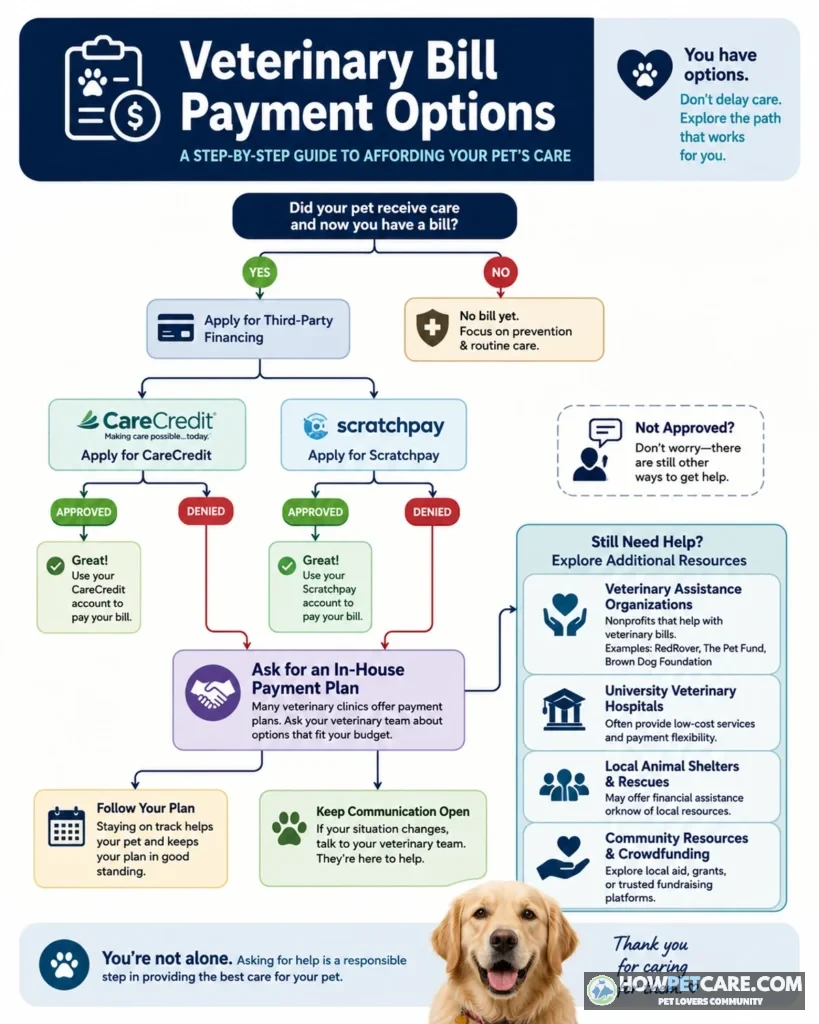
Denied Financing or Still Can’t Cover the Bill? A Step-by-Step Fallback Path
Step-by-step: what to do the day you are denied
A denial doesn’t rule out every other option. Tell the veterinary team what you can pay, and pursue alternatives in parallel if treatment is urgent.

-
Ask about another arrangement
Ask whether the clinic accepts another provider, offers its own plan or has a clinic-based assistance fund. Check the inquiry type before another application.
-
Revisit the treatment estimate
Ask what is essential now, what can safely wait and whether a less expensive medically appropriate plan exists.
-
Apply for assistance
Gather the diagnosis, written estimate, evidence of hardship and clinic contact details. Check eligibility and deadlines before applying.
-
Raise or borrow the remaining amount carefully
Consider crowdfunding, a written family loan, a credit-union loan or an employer advance. Compare costs and repayment obligations.
-
Discuss other care pathways
If the gap remains, ask about a lower-cost referral, palliative care, or, as a last resort, a rescue or surrender arrangement.
Types of assistance and how each one works
| Type of help | Who it may help | What it may cover | How to apply | Typical limits or timing |
|---|---|---|---|---|
| National vet bill assistance programs | Owners who meet a program’s eligibility criteria | Part of an eligible veterinary bill | Review requirements and submit the requested diagnosis and estimate | Funding, conditions and application windows vary |
| Breed-specific rescue or club funds | Eligible pets of a particular breed | Treatment assistance or referral to another resource | Contact a relevant rescue or breed club and ask about owner assistance | May be limited by breed, location or available funds |
| Condition-specific funds | Pets with an eligible diagnosis | Part of treatment for the covered condition | Ask the clinic about relevant funds and submit medical documentation | Diagnosis and treatment rules vary |
| Local humane societies and animal welfare charities | Owners in a served community | Grants, referrals or reduced-cost services | Contact the organization and explain the diagnosis and financial gap | Geographic restrictions and limited budgets are common |
| Clinic angel funds or charity care | Clients who meet a practice’s criteria | A contribution toward care or a reduced bill | Ask the practice manager whether a fund exists and how decisions are made | Not every clinic has a fund; funds can run out |
| Low-cost or teaching clinics | Owners who can use the clinic’s services | Potentially lower-cost treatment, rather than a grant | Ask about the needed service, estimate and appointment timing | Referral, eligibility and wait times vary |

Ask each program whether it must approve assistance before treatment, whether it pays the clinic directly, and whether it can combine its contribution with another grant. Don’t assume a fund will reimburse a bill you’ve already paid. Search using the diagnosis, breed or location plus “veterinary financial assistance,” then confirm requirements with the organization.
Crowdfunding a vet bill the right way
Write a short, accurate account of the diagnosis, treatment estimate and amount still needed. Share an estimate with personal information removed, and ask the clinic before publishing its contact details. Start by sending the request to people you know; share it more widely if you’re comfortable. Check platform and payment-processing fees, withdrawal timing and what happens if you don’t reach the goal.
Put a family loan’s repayment terms in writing. A credit-union loan or employer advance may also help, but compare the actual charges and repayment dates. Be especially cautious with payday and vehicle-title loans: a short-term cash fix can turn into unmanageable debt.

If treatment remains out of reach, ask the veterinarian about comfort-focused care and realistic outcomes. Rehoming or surrender can be a last resort if a reputable organization can take responsibility. Ask about its process before deciding. There’s no shame in being honest about your financial limit.
What Happens If You Miss Vet Payments or Default
Missed one payment: what to do this week
Contact the lender or clinic as soon as you know you may miss a due date. Ask about a hardship arrangement, a change to the payment date or a temporary adjustment, and get any agreed change in writing. Don’t assume an automatic draft will be retried without a returned-payment fee.
What happens next depends on your agreement. You might first receive a late charge or reminder. The account can become delinquent, and a lender may restrict future use or eventually declare it in default. A clinic can also seek to collect an unpaid in-house balance. The timeline varies by provider.
A payment problem doesn’t automatically extend a deferred-interest promotion’s payoff deadline. Ask whether the original deadline still applies and how to clear the promotional balance.
Collections and credit reports: what to expect
A lender that reports to credit bureaus may report a payment once it’s at least 30 days past due. Further delinquency can lead to additional reporting, charge-off or collection activity, depending on the account and creditor. A charge-off is an accounting action; it doesn’t erase the debt. Depending on the agreement and applicable law, an unpaid in-house clinic balance may also be referred or sold to a collector.
Negative information can stay on a credit report for years; many late payments and collection accounts can generally remain for up to seven years under the federal Fair Credit Reporting Act. Check your reports and dispute inaccurate information. Ask the clinic whether an unpaid balance affects future appointments, and make other arrangements for your pet’s ongoing care if needed.
Your rights when a vet bill goes to collections
The federal Fair Debt Collection Practices Act generally restricts the conduct of covered third-party debt collectors, but it doesn’t apply identically to every original creditor. A collector must provide validation information, and you can dispute a debt in writing. Acting within the applicable validation period can trigger additional protections, so read the notice promptly. State law may provide further rights.
If several debts are becoming unmanageable, consider a reputable nonprofit credit counselor. For a disputed debt or a lawsuit, seek qualified legal help. This is general information, not legal advice.
Which Option Fits Your Situation: A Decision Checklist and Next Steps
Pick your path in one minute
- You can clear the balance within a promotional period: Compare a genuine 0% offer, a deferred-interest offer and any fee-free clinic plan. Use deferred interest only if you have a reliable payoff plan and understand the deadline.
- You need longer to pay: Compare fixed installment schedules by total cost as well as monthly payment. Check fees and whether early repayment is allowed without penalty.
- You have bad, thin or no credit: Ask about soft-check prequalification, clinic-managed plans and assistance funds. Approval and terms are never guaranteed.
- Your pet needs emergency care now: Tell the team your limit, ask for the deposit and essential-care estimate, and pursue financing and assistance in parallel.
- You are already behind: Call whoever holds the debt before the next due date and request a written hardship arrangement.
Before-you-sign checklist
- Get a written, itemized estimate and identify the amount due today.
- Ask the practice about an in-house plan and the third-party options it accepts.
- Compare the down payment, monthly payment, APR, fees and total of all payments.
- Read the late-payment, credit-check and promotional-expiration terms. Treat unclear fees, missing written terms and pressure to apply immediately as reasons to pause and ask questions.
- Set a payment reminder or affordable automatic payment. For deferred interest, set a separate reminder before the payoff deadline.

Prepare for the next vet bill
Once you’ve dealt with the immediate decision, consider a dedicated emergency fund, pet insurance or a wellness plan for future costs. Compare exclusions and benefits rather than assuming they cover the same care. For today’s bill, start by calling the clinic with the down payment you can manage and a monthly amount you can sustain.
1A pet owner uses a promotional credit card offer described as "no interest if paid in full in 12 months" to cover a 1,500 veterinary bill. The monthly statement lists a required minimum payment of 40. If the owner pays only the 40 minimum each month for 12 months, what will happen when the promotional deadline passes?
Under a deferred-interest promotion, failing to pay off 100% of the balance by the deadline results in interest accumulated since the purchase date being added to the account.
2An owner faces an unexpected 2,000 veterinary bill and wants to compare financing options without negatively impacting their credit score during initial inquiries. Which of the following strategies help protect the owner's credit score while exploring payment options?
Prequalification relying on a soft pull allows borrowers to view potential loan terms without triggering a hard inquiry that lowers credit scores.
3Which statement accurately describes the role of VetBilling in veterinary financial arrangements?
VetBilling helps manage and collect payment installments for the practice, but the underlying plan terms are established in agreement with the clinic.
4When arriving at an emergency veterinary clinic with budget constraints, which communication strategy is recommended before authorizing treatment?
Communicating a clear financial limit immediately enables the veterinary team to prioritize essential lifesaving stabilization within available funds.
5Which of the following statements correctly distinguish pet insurance from third-party veterinary payment plans?
Insurance reimburses policyholders for covered expenses according to policy terms, while payment plans spread out the bill owed.
6A pet owner finances a 1,500 procedure using an installment loan at a 25% APR. Which change to the loan terms would decrease the total interest paid over the life of the loan?
Shortening the term pays down the principal faster, reducing the time interest accrues and lowering total interest costs.
7If a client is denied third-party credit for an urgent surgery and the clinic does not offer in-house plans, which non-profit fallback resource is explicitly organized around a pet's specific biological heritage?
Breed-specific rescues and breed clubs frequently maintain owner-assistance funds targeted toward supporting specific breeds of animals.
8Which of the following steps are required to accurately calculate the total out-of-pocket cost of a veterinary installment plan?
The financed principal represents the total care estimate minus money paid upfront plus any financed fees.
9In a genuine in-house payment plan created directly with a veterinary clinic, who holds the underlying debt?
In a true in-house plan, the client owes the veterinary practice directly, and the practice sets the schedule, down payment, and terms.
| Option | How it works and who you owe | Promo or term structure | APR and interest type | Fees to check | Credit requirement and approval likelihood | How to confirm clinic acceptance |
|---|---|---|---|---|---|---|
| CareCredit | Healthcare credit card; debt owed to the card issuer | Qualifying promotional or other card terms vary | Deferred interest on some promotions; other terms may apply | Late fees and other account charges | Credit application required; approval and limit vary (ask which credit inquiry applies) | Ask the clinic directly or check the provider's online acceptance search |
| Scratchpay | Financing arranged through Scratchpay or its lending partner; confirm contracting party in agreement | Installment offers vary by applicant and practice | Offer-dependent APR; check whether any promotion is true 0% interest | Late fees, returned-payment charges, and other disclosed fees | Credit and eligibility checks vary; no approval guarantee | Ask the clinic directly whether it participates |
| Cherry | Financing arranged through Cherry or a lending partner | Installment terms and promotional offers vary | Check the specific offer's APR and interest terms | Late fees, returned-payment charges, and other disclosed fees | Eligibility and approval vary; confirm credit inquiry type | Ask the clinic directly whether it accepts Cherry |
| Sunbit | Financing through Sunbit or its lending partner | Installment terms vary by offer | Check the offered APR and repayment terms | Late fees and other applicable charges | Eligibility varies; ask whether checking an offer affects your credit score | Ask the clinic directly whether it participates |
| Varidi | Clinic-based pay-over-time arrangement; confirm contracting party and debt owner | Set out in the clinic's specific offer and agreement | Check agreement to see whether interest applies | Setup fees, processing fees, late fees, and returned-payment charges (if any) | Ask what identity, bank, or credit checks apply; approval is not guaranteed | Ask the practice directly whether it uses Varidi |
| VetBilling | Third-party service administering a clinic's payment plan; confirm who owns the debt | Terms and schedules are set directly with the practice | May be interest-free; verify terms in the agreement | Enrollment fees, administrative fees, late fees, and returned-payment charges (if applicable) | Ask the practice what eligibility checks apply and whether you qualify | Ask the clinic directly or use a provider search if available |
| True in-house plan | Debt owed directly to the veterinary clinic | Payment schedule and down payment are negotiated directly with the practice | None or an agreed charge; verify terms with practice | Administrative fees, late fees, and returned-payment charges | Entirely at the practice's discretion; ask about credit/background checks | Ask the clinic directly for a plan you repay directly to them |
| Credit card or personal loan | Standard revolving card or fixed loan; debt owed to card issuer or lender | Revolving credit card or fixed loan term structure; introductory promotional offers vary | Card APR or fixed loan interest rate; check promotional conditions | Annual fees, origination fees, late fees, and other applicable charges | Approval, interest rate, and credit limit depend on the lender | Ask whether the clinic accepts the card or how it accepts loan proceeds |
FAQ
Do vets require a credit check for payment plans?
Third-party financing usually involves a credit check, and some lenders let you prequalify with a soft inquiry first. A true in-house plan often needs no credit check, because the clinic is relying on your history with them. Ask which type of inquiry applies before you apply.
Can I use pet insurance to pay a vet bill I already have?
Usually not. Pet insurance is typically reimbursement-based and does not cover pre-existing conditions or care that started before your coverage began. If you already have a policy, ask the clinic whether it can bill the insurer or give you paperwork to file a claim, and check how long reimbursement takes.
Can I pay a vet bill with a regular credit card instead?
Yes, most clinics accept credit cards. Check your card’s APR first, because interest on a regular card can exceed a promotional financing offer, and ask whether your card has a 0% introductory offer you could use.
Do payment plans work for cats, rabbits and other non-dog pets?
Yes. Lenders and clinics generally finance care for any pet the clinic treats. Exotic and specialty practices may accept fewer financing partners, so ask which ones before you apply.
Will applying for vet financing hurt my credit score?
It can. A hard inquiry may cause a small, temporary drop in your score, while a soft inquiry does not. Ask whether the lender offers prequalification with a soft pull, and avoid applying to several lenders with hard pulls at once.
Can I get vet financing with no credit history?
Some lenders consider more than a credit score, but approval is never guaranteed and approved amounts may be lower. A co-signer, an in-house plan with a down payment, or an assistance fund may work better when you have thin or no credit.