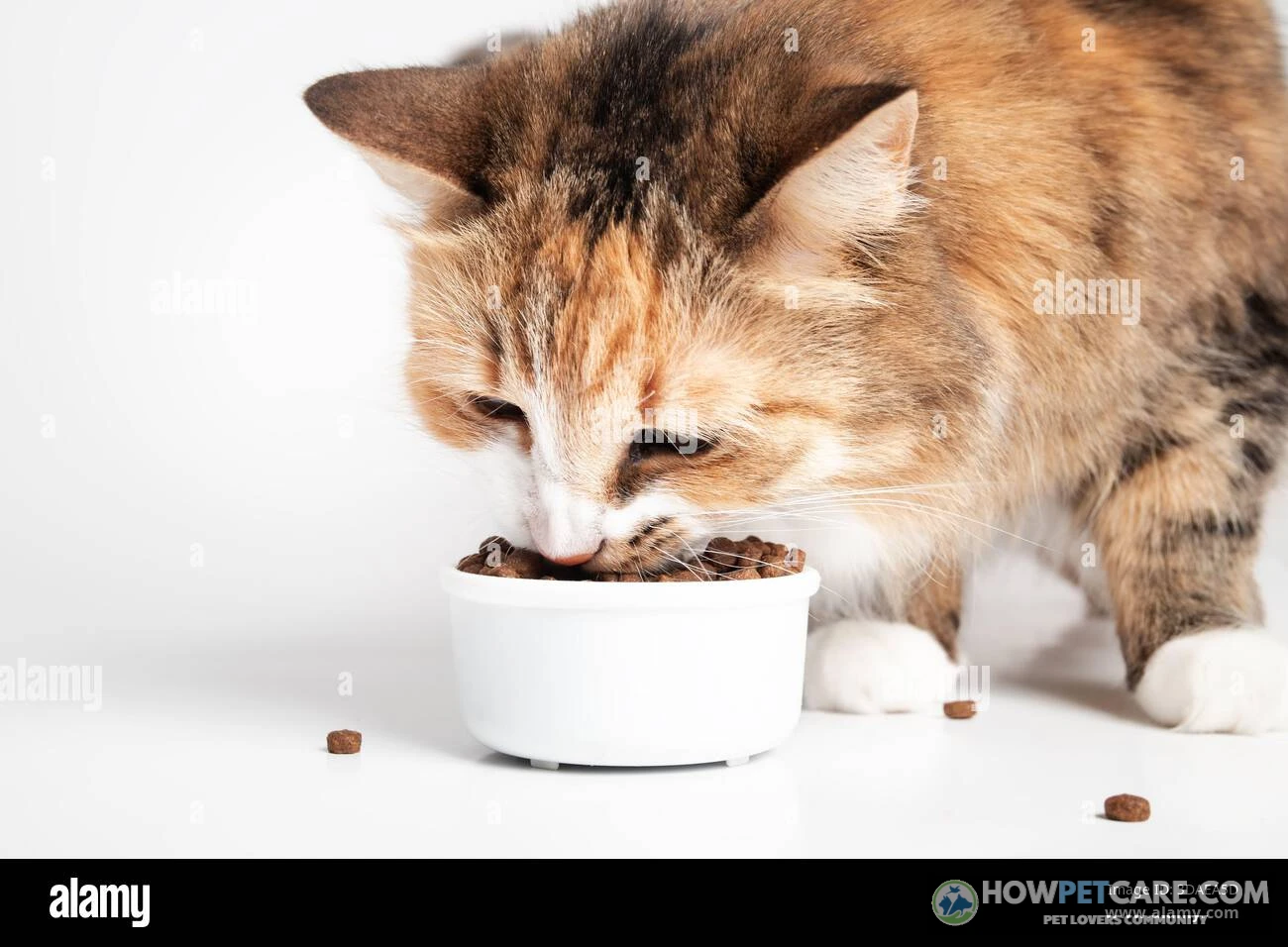

For a typical neutered indoor cat, the core food rules are:
- Start at about 20–26 calories per pound of ideal body weight per day (a 10-lb cat: roughly 260 kcal).
- Split the daily ration into two measured meals; kittens need three to four smaller ones.
- Feed a food labeled complete and balanced for your cat’s life stage.
- Convert calories into grams or cans using the label’s kcal/kg, kcal/cup, or kcal/can.
- Keep treats at or under 10% of daily calories and provide fresh water at all times.
Start a typical neutered indoor adult cat at roughly 20–26 calories per pound of ideal body weight per day, then adjust as weight and body condition change. A 10-pound cat might begin near 260 calories a day using the calculation below—a starting estimate, not a fixed prescription. Split that amount into two measured meals, or more if that suits your cat. Pick a food labeled complete and balanced for the right life stage, measure portions from its calorie statement, and keep treats to about 10% of daily calories. Cats are obligate carnivores, so a diet built for dogs or made from unbalanced table scraps won’t meet their needs. Fresh water matters too, and wet food can supply a good share of it.
Every number here is a starting estimate. Ideal weight, age, activity, health, and the calorie density of the specific food all shift the answer. Convert calories into grams or cans using the label, then check weight and body condition every two to three weeks.
How Much to Feed Your Cat by Weight and Life Stage
A 10-pound neutered indoor cat with a typical activity level can start near 260 calories a day, provided 10 pounds is its ideal weight. That’s about 75 grams of kibble at 3.4 calories per gram, or roughly three 3-ounce cans at 80 calories each. Your food will likely differ, so work from its label rather than treating those figures as universal.
Kittens need food formulated for growth and generally do best with several small meals. Most adult cats do well on two measured meals a day. Seniors may prefer two or three smaller ones, especially if a large serving puts them off. Keep feeding a growth-labeled kitten food until the food’s life-stage guidance and your veterinarian’s advice support a switch to adult maintenance.
Feeding schedule by life stage: kitten, adult, senior
- Kittens: Offer three or four small meals a day while they’re growing. Kittens are generally weaned at six to eight weeks.
- Adolescents: Two or three meals a day is a workable routine. Follow the growth-food label and keep an eye on weight.
- Adults: Start with two measured meals. Cats naturally eat many small meals—research reports eight to 16 a day—so a puzzle feeder or automatic feeder can split a measured daily ration into smaller portions.
- Seniors: Two or three smaller meals may be easier to manage. Any change in appetite or weight deserves attention, especially if it persists.

Free-feeding vs. scheduled meals and portion control
Leaving kibble available all day can work for some cats that reliably self-regulate, but it makes intake harder to measure. Scheduled meals give you a clearer view of appetite and portion size. If you use a puzzle feeder, put part of the already-measured daily ration in it rather than adding extra food.
Package feeding guides are useful starting points, not individualized prescriptions. They can’t account for every cat’s ideal weight, activity, or metabolism. Weigh the daily ration, include treats in the total, and adjust gradually based on the trend rather than a single weigh-in.

Calculate Your Cat’s Daily Calories and Convert to Grams or Cans
Use this three-step estimate:
- Convert ideal weight to kilograms: pounds divided by 2.2.
- Calculate resting energy requirement (RER): 70 × weight in kilograms raised to the 0.75 power.
- Multiply RER by an estimated activity factor: about 1.0 for a sedentary or weight-loss-prone cat, 1.2 for a typical neutered indoor adult, and 1.4 for an active or intact adult.
These factors are estimates, not clinical targets. Growing kittens need a different allowance, and cats with disease or a weight-loss plan need individualized veterinary guidance. For an overweight cat, calculate from a veterinarian-agreed ideal weight rather than current weight.
To turn calories into food, divide the daily calorie target by the food’s calories per gram, can, or cup. If a label lists only kcal/kg, divide by 1,000 to get kcal/g. A typical dry food may provide around 350–400 calories per cup, while a 3-ounce can may provide around 70–100 calories; recipes vary, so check the package in front of you.

Worked example: the 10-pound indoor cat
Suppose Milo is a neutered indoor adult whose ideal weight is 10 pounds (about 4.5 kg). His RER is 70 × 4.5^0.75, or about 220 calories. Applying the 1.2 indoor estimate gives about 264 calories per day, rounded to roughly 260.
His dry food provides 380 calories per cup and weighs about 110 grams per cup, or approximately 3.5 calories per gram. His wet food provides 85 calories per 3-ounce can. One mixed day could look like this:
| Time | Food | Estimated calories |
|---|---|---|
| 7:00 a.m. | One 3-ounce can of wet food | 85 |
| 12:30 p.m. | 25 g dry food in a puzzle feeder | About 88 |
| 6:30 p.m. | One 3-ounce can of wet food | 85 |
| Total | About 258 |
The example uses the stated label values; your own food may require different portions. A kitchen scale is more reliable than estimating kibble by eye. If Milo receives two treats worth 10 calories each, subtract 20 calories from meals. Treats should stay at or below about 10% of daily calories; research guidance places the suggested limit below 10–15%.
Portion table by weight, activity level, and food type
The table uses the RER formula above, multiplied by 1.0 for sedentary cats, 1.2 for typical indoor cats, and 1.4 for active adults. Dry portions assume 3.4 calories per gram; wet portions assume 80 calories per 3-ounce can. Values are rounded estimates. Confirm your label’s calorie content and use ideal weight.
| Ideal weight (lb / kg) | Activity level | Estimated kcal/day | Dry food (g/day) | Wet food (3-oz cans/day) | Meals/day |
|---|---|---|---|---|---|
| 5 / 2.3 | Sedentary | 130 | 40 | 1.5 | 2 |
| 5 / 2.3 | Typical indoor | 155 | 45 | 2 | 2 |
| 5 / 2.3 | Active | 185 | 55 | 2.25 | 2 |
| 8 / 3.6 | Sedentary | 185 | 55 | 2.25 | 2 |
| 8 / 3.6 | Typical indoor | 220 | 65 | 2.75 | 2 |
| 8 / 3.6 | Active | 260 | 75 | 3.25 | 2–3 |
| 10 / 4.5 | Sedentary | 220 | 65 | 2.75 | 2 |
| 10 / 4.5 | Typical indoor | 260 | 75 | 3.25 | 2 |
| 10 / 4.5 | Active | 305 | 90 | 3.75 | 2–3 |
| 12 / 5.5 | Sedentary | 250 | 75 | 3 | 2 |
| 12 / 5.5 | Typical indoor | 300 | 90 | 3.75 | 2–3 |
| 12 / 5.5 | Active | 350 | 105 | 4.25 | 3 |
| 15 / 6.8 | Sedentary | 295 | 85 | 3.75 | 2–3 |
| 15 / 6.8 | Typical indoor | 355 | 105 | 4.5 | 3 |
| 15 / 6.8 | Active | 415 | 120 | 5.25 | 3 |
| 20 / 9.1 | Sedentary | 365 | 105 | 4.5 | 3 |
| 20 / 9.1 | Typical indoor | 440 | 130 | 5.5 | 3 |
| 20 / 9.1 | Active | 510 | 150 | 6.5 | 3 |
For an overweight cat, use the ideal-weight row agreed with your veterinary team, not the current-weight row. A cat who is 16 pounds today but whose target is 12 pounds, for example, should be portioned using the 12-pound estimate as a starting point.
Body condition check at home
At a healthy body condition, you should be able to feel the ribs under a thin layer of fat, see a waist from above, and notice a slight abdominal tuck from the side. If ribs are difficult to feel or the waist is absent, the cat may need a lower calorie target; ask a veterinarian to help determine ideal weight rather than imposing a rapid diet.
Reweigh every two to three weeks. If weight is trending up or down, make a small adjustment and check again. Sudden or unexplained weight change, repeated vomiting, or loss of appetite deserves veterinary attention.

Why Cats Need Meat: Taurine, Vitamin A, and Obligate Carnivore Basics
An obligate carnivore is an animal whose nutritional needs are adapted to a diet containing animal tissue. Cats require nutrients that they cannot reliably obtain by eating plants alone. They must consume taurine in safe amounts and arachidonic acid from animal tissues, and they cannot make preformed vitamin A from beta-carotene.

Nutrients cats cannot make themselves
Taurine supports essential body functions, and deficiency can cause serious health problems. Arachidonic acid is an essential fatty acid for cats. Preformed vitamin A is also required; plant beta-carotene does not replace it for cats. These are reasons to choose a complete feline diet rather than trying to assemble a menu from meat scraps or supplements.
Dog food is not a suitable long-term diet for cats: it does not meet feline nutritional needs, including needs for taurine, preformed vitamin A, and protein. A label saying “high protein” or “grain-free” does not by itself show that a food is complete for a cat.
Can cats be vegetarian or vegan?
A taurine supplement alone does not make a plant-only diet reliably complete. Cats need multiple nutrients in appropriate forms and amounts, and vegetarian or vegan diets are not recommended because safety evidence is lacking and deficiency is a concern. Choose a food formulated for cats and verify its nutritional adequacy statement.
Wet vs. Dry Cat Food: Side-by-Side Comparison
Neither format is automatically best for every cat. A complete and balanced wet or dry food can be appropriate; the useful choice depends on hydration, calorie control, budget, storage, and what the cat will eat.
| Factor | Wet food | Dry food (kibble) | Notes |
|---|---|---|---|
| Moisture | Often about 75–80% | Often about 10% | Canned food is reported at 68–78% water and kibble at 6–10%; check the package. |
| Typical serving calories | About 70–100 kcal per 3-oz can | About 350–400 kcal per cup | Recipe and serving size vary; calculate from the label. |
| Calorie density | Lower per gram | Higher per gram | Weigh portions, especially dry food. |
| Hydration | Contributes meaningful water | Contributes relatively little water | Wet food can support water intake; canned food has a high water content. |
| Cost | Often higher per calorie | Often lower per calorie | Compare cost per 100 calories using actual shelf prices. |
| Dental claims | Does not mechanically clean teeth | Ordinary kibble should not be assumed to clean teeth | Do not choose a format as a substitute for dental care. |
| Palatability | Aroma and texture may appeal to some cats | Some cats prefer the crunch; easy to use in feeders | Individual preference matters. |
| Storage | Refrigerate promptly after opening; follow package instructions | Keep sealed and dry; easier to portion into feeders | Follow the manufacturer’s storage guidance. |
| Practical fit | Useful for cats that benefit from extra dietary water or prefer it | Convenient for measured feeding and puzzle feeders | Mixed feeding is also an option if calories are counted. |

Hydration: how much water a cat needs and dehydration signs
Water needs vary with food moisture, body size, temperature, activity, and health, so a single daily volume is not a reliable target for every cat. Keep clean water available in more than one location. Some cats drink more readily from a fountain; others prefer a wide, still bowl. Wet food supplies water as part of the meal.

A sudden change in drinking or urination is more useful to notice than trying to force a fixed amount. Weakness, marked lethargy, or inability to keep water down needs prompt veterinary advice. If you suspect dehydration, contact a veterinary professional rather than relying on a home test.
Mixed feeding without overfeeding
Pick a calorie split, then calculate each portion. For example, at a 260-calorie daily target, a 60% wet and 40% dry split means 156 calories from wet food and 104 from dry. At 85 calories per can, that is about 1.8 cans; at 3.5 calories per gram, the dry share is about 30 grams. Subtract treat calories from the daily total.
Read a Cat Food Label in the Aisle: AAFCO and FEDIAF Checklist
Use this sequence before putting a food in your cart. The key question is not whether the front of the package says “natural,” “premium,” or “grain-free”; it is whether the food is nutritionally complete for your cat’s life stage and how many calories it provides.
The 60-second aisle checklist
- Find the nutritional adequacy statement. Look near the guaranteed analysis or on the back or side panel. The wording should say the food is complete and balanced for a stated life stage.
- Check the life stage. Look for adult maintenance, growth, gestation/lactation, or all life stages. Match it to your cat; a kitten needs a growth-appropriate food.
- Read the AAFCO wording. One common form says the food is “formulated to meet the nutritional levels established by the AAFCO Cat Food Nutrient Profiles” for the named life stage. Another says that animal feeding tests using AAFCO procedures substantiate the food as complete and balanced for that stage. These statements describe different substantiation routes; neither means every cat will thrive on the food.
- Reject incomplete-use statements for a sole diet. “For intermittent or supplemental feeding only” means the product is not intended to be the cat’s only food.
- Find calories. Look for kcal/kg and a household measure such as kcal/cup or kcal/can. Use those values to calculate grams or servings, rather than relying on a generic portion chart.
- Check the manufacturer details. Look for a way to contact the company and ask who formulates the food, what quality controls are used, and whether feeding trials or nutrient formulation support the adequacy claim.
- Treat marketing claims as clues, not proof. “Human-grade,” “natural,” “grain-free,” and a named ingredient do not replace a nutritional adequacy statement.

FEDIAF is a separate European pet-food nutrition framework. If a food uses FEDIAF language, look for a clear statement that it is complete for cats and appropriate for the stated life stage. Do not assume that a vague claim such as “meets European standards” tells you whether it is a complete sole diet; ask the manufacturer for the exact basis.
Decoding guaranteed analysis and dry-matter comparison
Guaranteed analysis lists minimum or maximum percentages of nutrients, often “as fed.” Because wet food contains much more water, comparing protein percentages directly can mislead. To estimate protein on a dry-matter basis, use: protein percentage ÷ (100 − moisture percentage) × 100. For example, a food with 10% protein and 78% moisture calculates to about 45% protein on a dry-matter basis. This comparison does not establish overall nutritional adequacy; the adequacy statement still matters.
Newer Formats and Special Diets: Freeze-Dried, Insect Protein, Fresh, Raw, and Veterinary Diets
Different formats are not automatically complete or appropriate. Apply the same core checks: a clear complete-and-balanced statement for cats and the correct life stage, calorie information, safe handling instructions, and a manufacturer able to explain how the food is formulated and controlled.
Is freeze-dried or insect-protein food complete and balanced?
It can be nutritionally adequate if the product is specifically formulated as a complete cat food for the relevant life stage and carries an appropriate adequacy statement. A freeze-dried product labeled for supplemental feeding is not a complete diet, even if it looks like food. Follow rehydration directions where provided; do not assume that adding water changes a supplemental product into a balanced meal.
Insect protein is an ingredient source, not an adequacy guarantee. Read the same statement and calorie details you would for a conventional food. If your cat has a suspected allergy, do not choose an ingredient based only on marketing; a controlled veterinary elimination diet is more informative.

Raw food safety
Raw pet food can carry Salmonella and Listeria risks for pets and people, and public-health and veterinary groups do not recommend feeding raw diets. Freeze-drying and “human-grade” wording do not, by themselves, prove pathogens have been eliminated. Handle raw products as potentially contaminated, keep them away from ready-to-eat food, wash hands and surfaces, and follow the package’s storage instructions. A homemade raw diet also risks nutritional imbalance.
Homemade cooked diets have similar formulation challenges. Online recipes may omit essential nutrients or use incorrect amounts. If you want to feed a homemade diet, ask a board-certified veterinary nutritionist to formulate a recipe for your cat and follow it precisely, including supplements.

Veterinary diets and monthly cost by feeding style
Veterinary diets are designed for specific nutritional needs, such as kidney, urinary, digestive, or allergy management. They are not interchangeable with ordinary foods that make similar front-of-package claims. Use them under veterinary guidance.
There is no dependable universal monthly price for dry, wet, fresh, or raw feeding: prices vary by location, product, package size, and calories per unit. Calculate a comparable cost for your own options:
Monthly cost = (daily calories ÷ calories per unit) × price per unit × 30.
For a 260-calorie daily target, if a bag costs $30 and contains 12,000 calories, the arithmetic is (260 ÷ 12,000) × $30 × 30, or $19.50 per month. If a case costs $36 and supplies 24 cans at 85 calories each, it contains 2,040 calories; the estimate is (260 ÷ 2,040) × $36 × 30, or about $138 per month. These are worked examples using stated hypothetical package prices and calorie totals, not market-price claims. Apply the same calculation to fresh or raw foods using their package calories and price.
For affordable cat food for indoor cats, compare cost per calorie among foods that meet the adequacy and life-stage checks. A cheaper food that requires a much larger portion may not be cheaper per day. No single brand is the right choice for every cat.
Safe vs. Toxic Human Foods for Cats
Cats can eat a few plain human foods as occasional treats, but treats should not displace a complete diet. Keep them within roughly 10% of daily calories. For a cat eating about 260 calories a day, that is up to about 26 calories from treats, including all extras. Milk is a separate question for many adult cats; see whether cats can have milk.
Safe foods and serving sizes
Plain cooked chicken or turkey without skin, bones, sauces, or seasoning; cooked egg for cats; and a small amount of plain cooked fish can be occasional treats. Small bites of plain pumpkin, steamed carrot, or cooked green beans may also be tolerated. Keep portions small and introduce one new food at a time. Avoid salty, fatty, seasoned, or heavily processed foods.
Human food is not a substitute for a complete cat diet. Do not feed a cat dog food as its regular diet: it does not provide the nutrients cats require.
Toxic foods list by severity
Contact a vet or poison service immediately:
| Item | Main concern | What to do |
|---|---|---|
| Lilies, including pollen and vase water | Potentially severe kidney injury | Treat any exposure as urgent, even if the cat seems normal. |
| Onion, garlic, chives, and leeks, including powders | Allium compounds can damage red blood cells | Record amount and time; call promptly because signs can be delayed. |
| Chocolate | Theobromine and caffeine can affect the nervous and cardiovascular systems | Note type, amount, and time; call before symptoms appear. |
| Grapes and raisins | Potential kidney injury; individual risk is difficult to predict | Call promptly rather than waiting for symptoms. |
| Alcohol, caffeine, and raw yeast dough | Toxic effects; dough can expand and produce alcohol | Remove access and call for advice. |
| Xylitol-containing products | Risk depends on the product and exposure | Check the ingredient list and call a veterinary professional or poison service. |

Monitor and contact a vet if symptoms develop:
| Item | Concern | What to watch for |
|---|---|---|
| Milk and other dairy | Many adult cats lose the ability to digest lactose after about 12 weeks; dairy can cause digestive upset. | Vomiting or diarrhea; do not give more. |
| Cooked bones | Choking, injury, or obstruction risk | Gagging, drooling, vomiting, straining, or unusual lethargy. |
| Fatty or heavily seasoned scraps | Digestive upset and possible illness | Vomiting, abdominal discomfort, or appetite loss. |
| Frequent tuna or tuna-only feeding | Nutritional imbalance if it displaces complete food | Keep tuna as an occasional treat, not a diet. |
Safe in small amounts: the plain cooked chicken, turkey, egg, fish, pumpkin, carrot, and green beans listed under “Safe foods and serving sizes”—kept small, unseasoned, and within the roughly 10% treat allowance.
Do not use a “monitor” category to delay a call when the amount is unknown, the cat has symptoms, or the food could be toxic. The quick-reference list cannot determine a safe dose for an individual cat. For a just-happened exposure, take the first-hour action right away: remove the food, note the item, amount, and time, and call an emergency veterinarian or animal poison service. The 60-minute action sequence below walks through it step by step.
What to Do in the First Hour If Your Cat Eats Something Toxic
Act calmly and call for professional instructions. Do not wait for symptoms after a possible exposure to lilies, alliums, chocolate, or another potentially toxic food.
The 60-minute action sequence
- First five minutes: Move the food or plant out of reach. Check that your cat is breathing normally and responsive. Note what was eaten, the estimated amount, and when it happened. Save packaging or take a clear photo.
- Next: Call an emergency veterinarian or an animal poison service, such as ASPCA Animal Poison Control or Pet Poison Helpline. Follow their instructions about whether to travel immediately.
- While arranging care: Keep the cat contained and bring the package, ingredient list, plant sample or photo, and any relevant vomit sample. Be ready to give the cat’s weight and the time and estimated amount of exposure.
- Do not try home treatment: Do not induce vomiting or give milk, salt, oil, or another remedy unless a veterinary professional specifically instructs you to do so.
- Go urgently when advised: If the cat has trouble breathing, collapses, has tremors or seizures, or is exposed to a lily, seek emergency veterinary care without delay.

Onion, chocolate, and lilies: what changes
Onion, garlic, and related alliums can damage red blood cells; anemia signs may not appear immediately. Chocolate contains theobromine and caffeine, and the risk depends on the type and amount. Lilies are an emergency exposure because kidney injury can develop before obvious illness. For all three, the amount, timing, and cat’s weight help professionals assess risk; do not wait to see whether symptoms appear.
Switch Foods Safely: Day-by-Day Transition Schedule and Picky Eater Fixes
A gradual transition can reduce digestive upset. A seven-day plan is a common practical starting point, while a slower 10–14-day schedule can suit cats that are sensitive or have struggled with changes. Research evidence also gives a 4–7-day transition as a recommendation. Use the slower pace if needed, and follow veterinary directions for a prescribed diet.
Transition schedule table, day by day
| Day | Old food % | New food % | What to watch for |
|---|---|---|---|
| 1 | 75% | 25% | Willing eating; stool remains formed. |
| 2 | 75% | 25% | Appetite and litter-box habits remain usual. |
| 3 | 50% | 50% | Check for vomiting or softer stool. |
| 4 | 50% | 50% | Hold this ratio if the cat needs more time. |
| 5 | 25% | 75% | Confirm the cat is eating enough. |
| 6 | 25% | 75% | Watch stool and appetite. |
| 7 | 0% | 100% | Continue only if the cat is tolerating the change. |
| 8–10, if needed | 0% | 100% | Maintain the new food and monitor. |
| 11–14, if needed | 0% | 100% | Use the extended period for sensitive cats or a difficult transition. |

For a healthy cat that tolerates changes, the steps can be compressed by moving to 25%, 50%, 75%, and then 100% new food at roughly two-day intervals. For a slower transition, keep each ratio for two or three days and advance only when appetite and stool are normal.
If your cat refuses the mixture, return to the last ratio it accepted for a couple of days, then try again. Slightly warming wet food can increase its aroma; stir it carefully and check that it is not hot. Change one thing at a time—food, bowl, or feeding location—so you can tell what helps.
If stool softens, hold the current ratio until it has been normal for 48 hours, then advance in a smaller step. If vomiting repeats or your cat stops eating, pause the change and seek veterinary advice. Do not let a cat go a full day without food; prolonged fasting can be dangerous, especially for an overweight cat.
Elimination diet basics
Vomiting or itching alone does not prove a food allergy. A veterinarian may recommend an elimination diet when signs suggest a food reaction. The trial uses a carefully selected novel-protein or hydrolyzed diet and avoids every other food exposure, including treats, table scraps, flavored medications, and access to another pet’s bowl. Follow the veterinary plan for the trial’s duration and any food challenge afterward; changing ingredients casually makes the result hard to interpret.
What works for a fussy eater
Offer food at consistent times in a calm place and serve small portions. For wet food, warming it slightly may help. Use a clean, familiar bowl and avoid changing several variables at once. Keep track of what was offered and eaten. A cat that refuses all food for 24 hours, or has other concerning symptoms, needs veterinary attention rather than repeated food experiments.

Your Next Steps: A One-Page Feeding Plan
- Write down your cat’s age, current weight, and veterinarian-agreed ideal weight.
- Calculate a starting daily calorie target using RER and an appropriate activity estimate; adjust for life stage and health with veterinary guidance.
- Use the food label’s kcal/kg, kcal/cup, or kcal/can to convert calories into a measured daily portion. Split it across meals and include treats in the total.
- Run the label checklist: adequacy statement, life stage, calories, manufacturer details, and any supplemental-only warning.
- Put fresh water in accessible places, and choose wet, dry, or mixed feeding based on your cat’s needs and what you can measure consistently.
- If changing foods, write down the old-to-new ratios and move forward only while appetite and stool remain normal.
- Save an emergency veterinary contact and a poison-service number. Keep lilies and toxic foods inaccessible.
- Recheck weight and body condition in two to three weeks. Arrange veterinary help for persistent appetite loss, repeated vomiting, sudden weight change, or suspected toxin exposure.

| Food Item | Safety Status | Primary Health Concern | Symptoms to Watch For | Recommended Action |
|---|---|---|---|---|
| Lilies, including pollen and vase water | Toxic / Emergency | Potentially severe kidney injury | Not in source | Treat any exposure as urgent, even if the cat seems normal. Move food/plant out of reach, note item, amount, and time, save packaging/photo, call emergency vet or animal poison service immediately, keep cat contained, and do not induce vomiting. |
| Chocolate | Toxic / Emergency | Theobromine and caffeine can affect the nervous and cardiovascular systems | Not in source | Note type, amount, and time; call before symptoms appear. |
| Grapes and raisins | Toxic / Emergency | Potential kidney injury; individual risk is difficult to predict | Not in source | Call promptly rather than waiting for symptoms. |
| Alcohol, caffeine, and raw yeast dough | Toxic / Emergency | Toxic effects; dough can expand and produce alcohol | Not in source | Remove access and call for advice. |
| Xylitol-containing products | Toxic / Emergency | Risk depends on the product and exposure | Not in source | Check the ingredient list and call a veterinary professional or poison service. |
| Onion, garlic, chives, and leeks, including powders | Toxic / Emergency | Allium compounds can damage red blood cells (causes anemia) | Anemia signs (can be delayed) | Record amount and time; call promptly because signs can be delayed. |
| Milk and other dairy | Monitor / Upset Risk | Many adult cats lose the ability to digest lactose after about 12 weeks; dairy can cause digestive upset. | Vomiting or diarrhea | Do not give more. Contact a vet if symptoms develop. |
| Cooked bones | Monitor / Upset Risk | Choking, injury, or obstruction risk | Gagging, drooling, vomiting, straining, or unusual lethargy. | Monitor and contact a vet if symptoms develop. |
| Fatty or heavily seasoned scraps | Monitor / Upset Risk | Digestive upset and possible illness | Vomiting, abdominal discomfort, or appetite loss. | Monitor and contact a vet if symptoms develop. |
| Frequent tuna or tuna-only feeding | Monitor / Upset Risk | Nutritional imbalance if it displaces complete food | Not in source | Keep tuna as an occasional treat, not a diet. Contact a vet if symptoms develop. |
| Plain cooked chicken or turkey (without skin, bones, sauces, or seasoning) | Safe in Small Amounts | None listed when kept plain, small, and within treat limits (overfeeding displaces complete diet) | Not in source | Keep portions small, unseasoned, and within the roughly 10% treat allowance; introduce one new food at a time. |
| Cooked egg | Safe in Small Amounts | None listed when kept plain, small, and within treat limits | Not in source | Keep portions small, unseasoned, and within the roughly 10% treat allowance; introduce one new food at a time. |
| Plain cooked fish | Safe in Small Amounts | None listed when kept plain, small, and within treat limits | Not in source | Keep portions small, unseasoned, and within the roughly 10% treat allowance; introduce one new food at a time. |
| Plain pumpkin | Safe in Small Amounts | None listed when kept plain, small, and within treat limits | Not in source | Keep portions small, unseasoned, and within the roughly 10% treat allowance; introduce one new food at a time. |
| Steamed carrot | Safe in Small Amounts | None listed when kept plain, small, and within treat limits | Not in source | Keep portions small, unseasoned, and within the roughly 10% treat allowance; introduce one new food at a time. |
| Cooked green beans | Safe in Small Amounts | None listed when kept plain, small, and within treat limits | Not in source | Keep portions small, unseasoned, and within the roughly 10% treat allowance; introduce one new food at a time. |
FAQ
Can cats drink milk?
Most adult cats are lactose intolerant, so cow’s milk often causes diarrhea and offers no benefit. Fresh water is the best drink, and lactose-free cat milk can be an occasional treat counted within the treat budget.
Is grain-free cat food better?
Not necessarily. Cats need adequate protein and a complete, balanced diet, and true grain allergies are uncommon, so check the AAFCO adequacy statement rather than the grain-free claim.
How long can a cat go without eating?
A cat that refuses food for more than 24 hours should be seen by a vet, because prolonged fasting can lead to serious liver problems, especially in overweight cats.
Should I leave dry food out all day?
Free-feeding works for some lean cats but often leads to overeating and weight gain. Measured meals or puzzle feeders make portion control easier.
Can I feed my cat only wet food?
Yes, as long as the food states it is complete and balanced for your cat’s life stage. Wet-only feeding boosts water intake but usually costs more per day than dry.