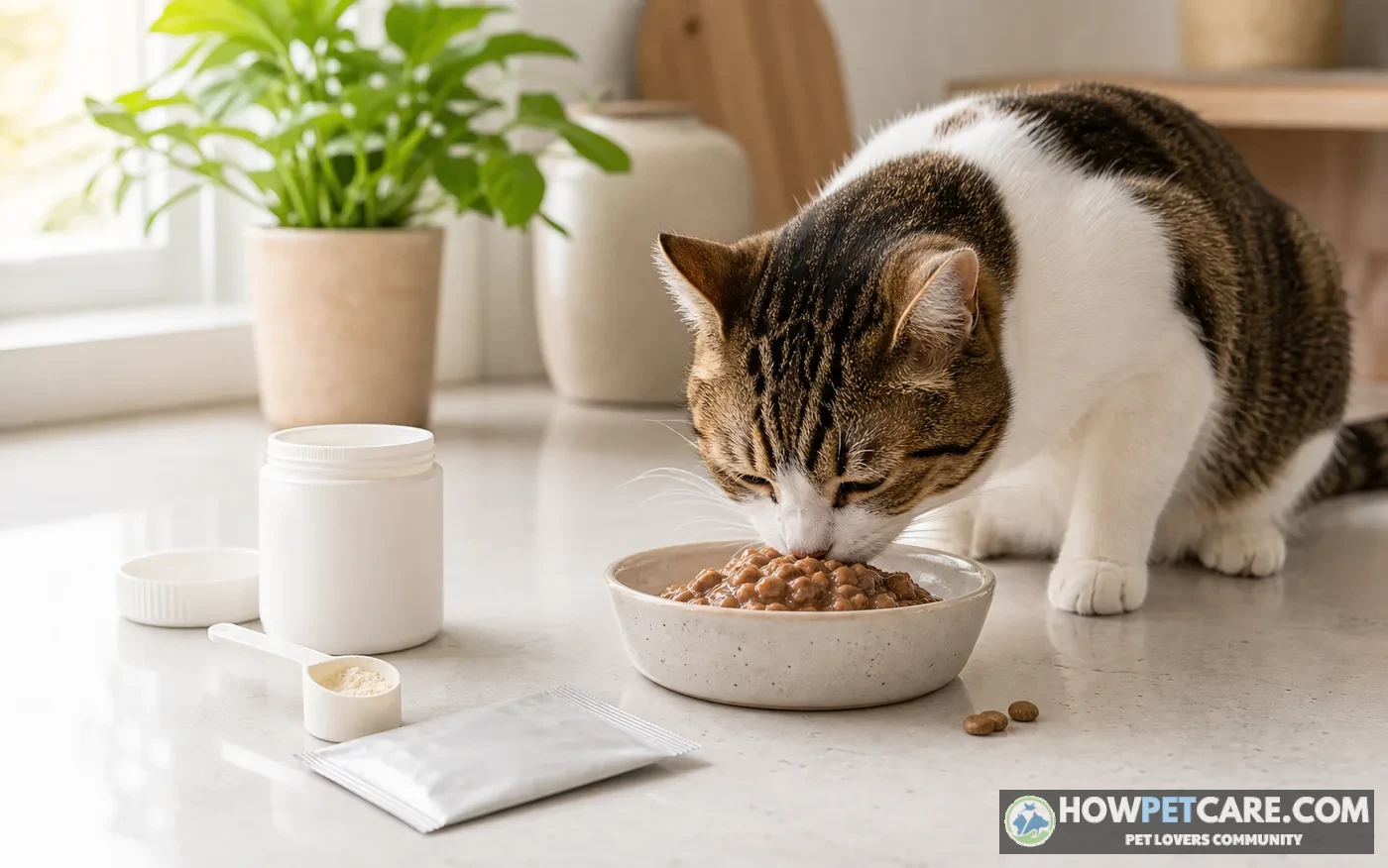

Choose a cat-specific probiotic by symptom: use Enterococcus faecium or Saccharomyces boulardii for acute diarrhea, a multi-strain blend after antibiotics, and paste or chews for picky cats. Expect firmer stools in days and fuller support in 2-4 weeks; call the vet for red flags.
If your cat has diarrhea or is recovering from antibiotics, a cat-specific probiotic can help rebalance the gut microbiome. A healthy adult cat with normal stools usually does not need daily supplementation. The right choice depends on matching strain and format to the situation: Enterococcus faecium or Saccharomyces boulardii for acute diarrhea, a multi-strain blend for post-antibiotic recovery, and a paste or chew for picky eaters. Most cats with acute diarrhea show firmer stools within a few days, with fuller microbiome support over two to four weeks. Chronic conditions like CKD, diabetes, or inflammatory bowel disease require veterinarian sign-off before starting.
Do Cats Need Probiotics, or Only Sick Cats?
When a probiotic is worth trying
A probiotic is worth trying when a cat shows soft stools, diarrhea after antibiotics, stress-related digestive upset, or a sensitive stomach. The gut microbiome supports both digestive health and the immune system, so restoring bacterial balance can ease symptoms and reduce recurrence. Short-term use after antibiotics is one of the most common, evidence-backed reasons to supplement, because antibiotics disrupt intestinal bacteria along with the infection they target.

When to skip and see a vet instead
Skip probiotics and contact your vet if your cat has blood in the stool, black tarry stool, vomiting, lethargy, dehydration, weight loss, fever, or pain. These are not probiotic problems; they signal conditions that need diagnosis. Healthy cats on a consistent diet with normal stools gain little from daily probiotics, so routine maintenance dosing is optional rather than necessary.
Stop and call your veterinarian for blood in stool, repeated vomiting, lethargy, dehydration, or weight loss. Probiotics support gut balance; they do not treat infection, parasites, or chronic disease.
Which Strains and CFU Counts Actually Matter for Cats
Evidence grading for strain claims
Evidence for feline probiotics is often inferred from dog or human data and remains preliminary. Still, certain strains have stronger track records:
- Enterococcus faecium: commonly used in veterinary products; supported for general intestinal health and stool quality.
- Lactobacillus acidophilus: supports digestive health and competitive exclusion of harmful bacteria; evidence is moderate.
- Saccharomyces boulardii: a yeast probiotic with the strongest acute-diarrhea support, including post-antibiotic recovery; evidence is comparatively strong.
- Bifidobacterium lactis: supports immune and gut barrier function; evidence is preliminary.
- Bacillus coagulans: spore-forming and shelf-stable; useful for convenient storage; evidence is limited.

CFU count (colony-forming units) tells you how many live organisms are in a serving. Read the label for CFU per serving, not per package, and note whether the number is guaranteed at manufacture or at expiry. Higher is not always better; match the count to the condition.
Why human probiotics are not ideal for cats
Human probiotics often lack feline-relevant strains and may include additives, sweeteners, or flavorings unsafe for cats. Species-specific strains matter because cats have a distinct gut microbiome shaped by their carnivorous diet. Choose a product formulated for cats.
Prebiotics such as FOS (fructooligosaccharides) feed beneficial bacteria and appear in synbiotic products. They can support probiotic colonization but may cause gas if introduced too quickly.
| Strain | Evidence Level | Best For | Notes |
|---|---|---|---|
| Enterococcus faecium | Moderate | General gut balance, stool quality | Common in vet products |
| Saccharomyces boulardii | Stronger | Acute diarrhea, post-antibiotic recovery | Yeast, antibiotic-resistant |
| Lactobacillus acidophilus | Moderate | Digestive health, sensitive stomach | Often paired with Bifidobacterium |
| Bifidobacterium lactis | Preliminary | Immune support, gut barrier | Research mostly canine/human |
| Bacillus coagulans | Limited | Convenient shelf-stable dosing | Spore-forming, heat-tolerant |
Head-to-Head: Cat Probiotics by CFU, Strains, Format, and Cost per Serving
How to read the comparison table
Compare products by CFU per serving, key strains, format, cost per serving, and storage type. Cost per serving equals package price divided by number of servings, not package price alone. A large tub can be cheaper per serving than a small box even at a higher total price. This table reflects common product archetypes rather than endorsing any single brand; check the label of the specific product you buy.
What real products cost
Product prices range widely, from about $11.50 for a daily chewable with 120 million CFU per chew to $84.99 for premium blends. Extra Strength Gut Health for Dogs & Cats supplies 7.5 billion CFU per capsule and is pitched for allergies, itchy skin, and occasional diarrhea and gas, from $35.50. Quick Action Diarrhea Aid is a probiotic paste for dogs and cats with added B vitamins, claimed to support and soothe the GI tract within 24 hours, from $27.50. All of these are marketed as claims; expect a slower, gentler response in most cats.
| Product archetype | CFU count | Key strains | Format | Cost per serving | Storage |
|---|---|---|---|---|---|
| Single-strain E. faecium sachet | ~100 million | Enterococcus faecium | Powder | $0.70-$1.00 | Shelf-stable |
| Multi-strain blend | ~5 billion | Lactobacillus + Bifidobacterium blend | Capsule or powder | $0.45-$0.75 | Shelf-stable |
| S. boulardii yeast supplement | 5-10 billion | Saccharomyces boulardii | Capsule or powder | $0.35-$0.60 | Shelf-stable |
| Probiotic paste | 1-2 billion | Mixed lactic acid bacteria | Paste | $0.90-$1.40 | Refrigerated or shelf-stable |
| Probiotic chew | ~1 billion | Mixed strains | Chew | $0.25-$0.45 | Shelf-stable |

Cost per serving = package price divided by number of servings, not package price alone.
Look for the NASC quality seal as a manufacturing-quality signal. Gut Health for Cats is the only cat-exclusive probiotic in one reviewed lineup: a daily chewable with 120 million CFU per chew, marketed for all life stages at $11.50.
Powder, Chews, Paste, or Capsules: Which Format Fits Your Cat
Picky-cat dosing tactics
Powder mixes into wet food but can be refused if the volume is large. Chews work well for treat-motivated cats. Paste can be applied to a paw or given directly and is often accepted by picky cats. Capsules can be opened and sprinkled or hidden in a small amount of highly palatable food.
For a picky cat that refuses powder mixed into food, try a paste, chew, or capsule hidden in a treat. Introduce gradually and avoid forcing large volumes of medicated food. Missed dose: skip it and resume at the next scheduled dose; do not double up.
Timing and combination rules
Give probiotics with or shortly after a meal so stomach acid is buffered by food, improving survival of live organisms. Separate probiotic doses from antibiotics by two to three hours. Combining with other supplements is usually fine, but introduce one change at a time so you can identify any reaction. For diarrhea after antibiotics, use S. boulardii or a multi-strain product and separate doses from the antibiotic.
| Situation | First-line strain focus | Format that usually works | Avoid or adjust |
|---|---|---|---|
| Acute diarrhea | E. faecium or S. boulardii | Powder mixed into wet food | Do not use human probiotics |
| After antibiotics | Multi-strain blend or S. boulardii | Powder or capsule opened into food | Separate from antibiotic dose by 2-3 hours |
| Picky eater | Any tolerated strain | Paste, chew, or capsule hidden in a treat | Avoid large powder volumes in dry food |
| Kitten | Vet-approved, cat-specific low dose | Paste or small powder dose | No adult-dose sharing |
| Senior cat | Easy-to-administer mixed strain | Paste or chew | Watch for swallowing difficulty |

Can Probiotics Help Cat Diarrhea, and How Long Until Improvement
Acute diarrhea timeline
Probiotics can help acute diarrhea by restoring microbial balance, but improvement is gradual. Some cats show firmer stools within a few days, while full microbiome support often takes two to four weeks. Transient diarrhea from a diet change may resolve in three to five days; infectious or stress-related cases can take one to two weeks. Chronic issues may need longer and veterinary guidance.

Post-antibiotic recovery timeline
After antibiotics, expect loose stools to begin firming within three to seven days, with more stable gut function over two to four weeks. Continue supplementation for the full recommended course even if stools improve early, then reassess. Red flags requiring veterinary attention include blood, black stool, dehydration, fever, pain, or no improvement after seven to fourteen days.
Some cats firm up in a few days, but plan on two to four weeks for full microbiome support. If there is no improvement after 7-14 days, stop and consult your vet.
Chronic Conditions: CKD, Diabetes, and Inflammatory Bowel Disease
IBD and probiotic evidence
For inflammatory bowel disease, probiotics may support gut barrier function and immune modulation, but evidence in cats is limited and mixed. Any use should be veterinarian-directed, with monitoring of stool quality, appetite, and weight.
CKD and diabetes precautions
Cats with CKD or diabetes should use probiotics only with veterinarian approval. Research on probiotic effects on kidney and liver health exists but is preliminary, and probiotics are not a treatment for these diseases. Be skeptical of claims of cure or fastest fix. Species-specific, low-dose, cat-formulated products are preferred, and any change in appetite, drinking, or urination should be reported promptly.
Safety for Kittens, Seniors, and Cats on Antibiotics
Kitten and senior precautions
Many probiotics are used in kittens and during antibiotic therapy, but dosing and timing should follow product labels and veterinary advice, especially for very young or immunocompromised cats. Kittens have developing microbiomes; use vet-approved, cat-specific low doses and never share adult doses. Senior cats may have swallowing difficulty, so paste or chew formats are often easier; watch for aspiration.
Side effects to monitor
Mild gas, softer stools, or temporary appetite changes can occur during the first few days. Stop and contact your vet if symptoms worsen or persist. Immunocompromised cats and those on immunosuppressive medication need vet consultation before starting.
- Mild gas or softer stool for 1-3 days: continue and monitor.
- Diarrhea worsening after 48 hours: stop and call the vet.
- Vomiting, refusal to eat, or lethargy: stop and call the vet the same day.
- Blood in stool, black stool, or repeated vomiting: stop and seek veterinary care urgently.
- New itching, swelling, or breathing changes: stop and seek care urgently.
- No improvement after the expected timeline: stop and reassess with the vet.
- For kittens, seniors, or immunocompromised cats: call before starting or if any new symptom appears.
Storage, Shelf Life, and CFU Viability at Expiry
Refrigerated vs shelf-stable
Refrigerated products generally maintain CFU viability better over time but require consistent cold storage. Shelf-stable products, especially spore-forming strains like Bacillus coagulans, tolerate room temperature better. Keep refrigerated products at refrigerator temperature and do not freeze. Keep shelf-stable products in a cool, dry cupboard away from heat and humidity.
Reading expiry and viability
Read expiry as a viability date, not just a safety date. Reseal tightly after every use and avoid dipping a wet spoon into powder. Do not leave probiotics in a hot car, near a stove, or in direct sunlight. If a refrigerated product warms for several hours, discard it unless the label says otherwise. When traveling, use single-serve packets or a shelf-stable backup.
| Storage Type | Typical Shelf Life | CFU Viability at Expiry | Handling Tips |
|---|---|---|---|
| Refrigerated | 12-24 months | Higher if kept cold | Do not freeze; minimize door openings |
| Shelf-stable (spore-forming) | 18-24 months | Moderate to high | Cool, dry cupboard; avoid humidity |
| Shelf-stable (non-spore) | 12-18 months | Lower; declines faster | Keep sealed; use before expiry |

- Check whether the label says refrigerated or shelf-stable before opening.
- Keep refrigerated products at refrigerator temperature; do not freeze.
- Keep shelf-stable products in a cool, dry cupboard away from heat and humidity.
- Reseal tightly after every use and avoid dipping a wet spoon into powder.
- Do not leave probiotics in a hot car, near a stove, or in direct sunlight.
- Read expiry as a viability date, not just a safety date.
- If refrigerated product warms for several hours, discard it unless the label says otherwise.
- When traveling, use single-serve packets or a shelf-stable backup.
Self-Assessment Checklist and Vet-Consultation Triggers
Symptom self-assessment steps
Use this checklist to match symptoms to a probiotic type and decide when to call the vet:
- Soft stool for 1-2 days with normal energy: try a cat-specific probiotic and monitor.
- Diarrhea after antibiotics: use S. boulardii or a multi-strain product and separate doses from antibiotics.
- Picky eating with no diarrhea: use paste, chew, or capsule-in-treat instead of powder.
- Kitten diarrhea: call the vet before using any probiotic.
- Senior cat with chronic disease: use only with veterinarian approval.
- Weight loss, dehydration, blood in stool, fever, or pain: call the vet first.
- No improvement after 7-14 days: stop and consult the vet.
- Reassess every 2-4 weeks and record stool quality, appetite, and energy.

When to call the vet
Call your veterinarian before starting probiotics for kittens, seniors, pregnant cats, immunocompromised cats, or cats on medication. Call urgently for red-flag symptoms. Chronic disease management belongs under veterinary care; probiotics are a support tool, not a cure.
-
Choose the strain
Match E. faecium or S. boulardii to acute diarrhea, and a multi-strain blend to post-antibiotic recovery.
-
Pick the format
Use powder for cooperative eaters, paste or chews for picky cats, and capsules when precise dosing matters.
-
Check storage
Confirm refrigerated or shelf-stable and follow label storage to protect CFU viability.
-
Dose and monitor
Give with food, separate from antibiotics by 2-3 hours, and track stools for 2-4 weeks.
-
Reassess
Stop and consult the vet if there is no improvement after 7-14 days or any red flag appears.

| Product Archetype | CFU Count | Key Strains | Format | Cost per Serving | Storage Requirements |
|---|---|---|---|---|---|
| Single-strain E. faecium sachet | ~100 million | Enterococcus faecium | Powder | 0.70-1.00 | Shelf-stable |
| Multi-strain blend | ~5 billion | Lactobacillus + Bifidobacterium blend | Capsule or powder | 0.45-0.75 | Shelf-stable |
| S. boulardii yeast supplement | 5-10 billion | Saccharomyces boulardii | Capsule or powder | 0.35-0.60 | Shelf-stable |
| Probiotic paste | 1-2 billion | Mixed lactic acid bacteria | Paste | 0.90-1.40 | Refrigerated or shelf-stable |
| Probiotic chew | ~1 billion | Mixed strains | Chew | 0.25-0.45 | Shelf-stable |
FAQ
Can I give my cat human probiotics?
It is not recommended because species-specific strains matter for cats; human products may not contain feline-relevant bacteria and can include additives unsafe for cats. Choose a product formulated for cats.
How long does it take for probiotics to work in cats?
Some cats show firmer stools within a few days, while full microbiome support often takes two to four weeks. Chronic issues may need longer and veterinary guidance.
What side effects can cat probiotics cause?
Mild gas, softer stools, or temporary appetite changes can occur during the first few days. Stop and contact your vet if symptoms worsen or persist.
How do I give probiotics to a picky cat that refuses food with powder mixed in?
Try chewable treats, paste, or capsules hidden in a small amount of highly palatable food, and introduce gradually. Avoid forcing large volumes of medicated food.
Are probiotics safe for kittens and cats on antibiotics?
Many are used in kittens and during antibiotic therapy, but dosing and timing should follow product labels and veterinary advice, especially for very young or immunocompromised cats.