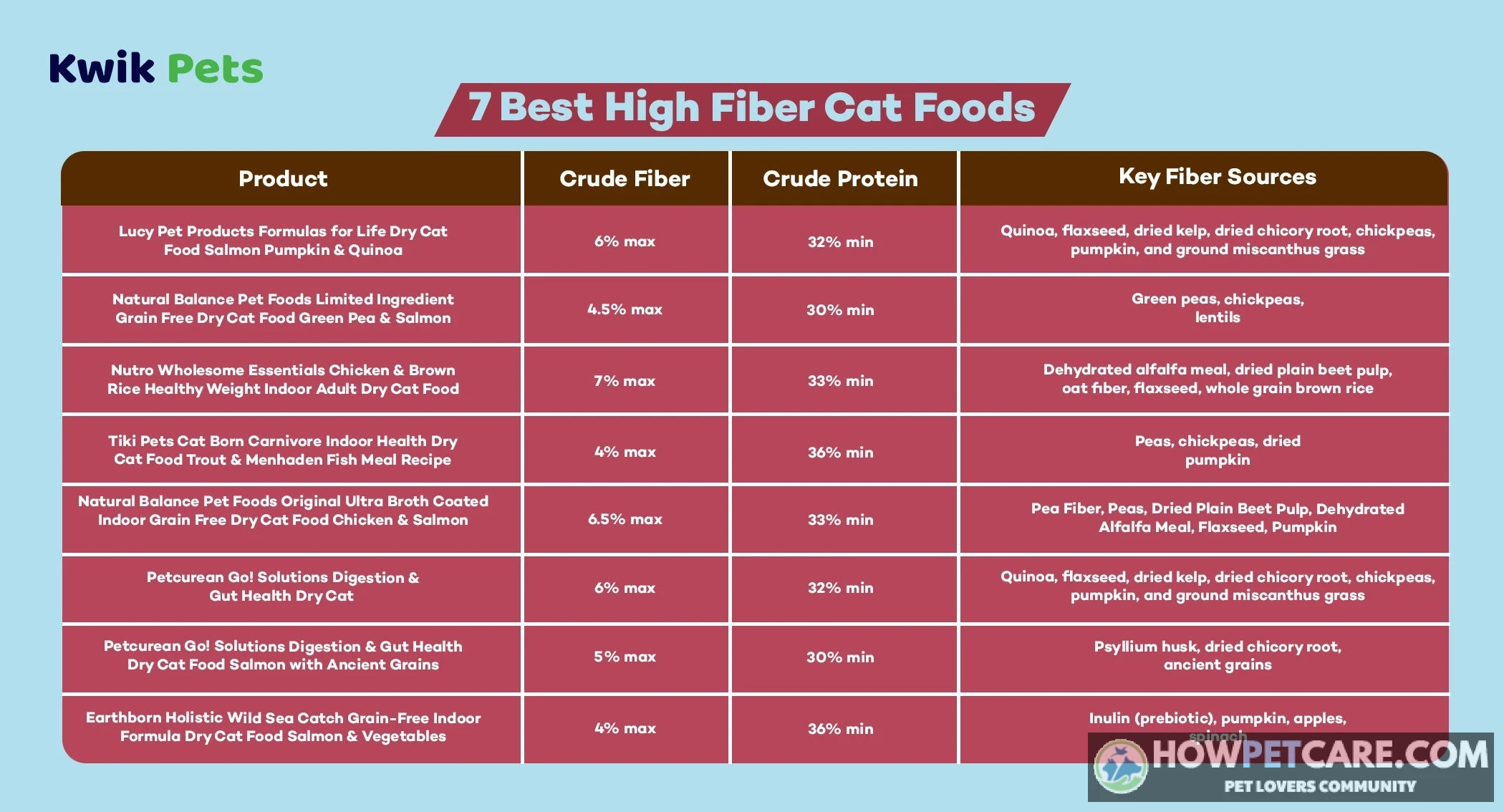

Best high-fiber cat food depends on the job and the verified dry-matter fiber, not the front-of-bag claim:
- Prescription GI/constipation: Purina EN Fiber Balance (~10% DM fiber) or Royal Canin Fiber Response (~8% DM).
- Prescription weight + glucose + GI: Hill’s w/d Multi-Benefit (~10–11% DM, lower calorie).
- OTC hairball/mild constipation: Hill’s Science Diet Hairball Control (~9% DM) or Royal Canin Hairball Care (~8% DM).
- Budget OTC: Iams Indoor Weight & Hairball (~7% DM).
- Always: confirm current guaranteed analysis, moisture, calories, AAFCO status, and vet fit.
For cats with constipation, hairballs, or weight gain, a high‑fiber diet is often one of the first options owners consider. The right food can add bulk to stool, help move hair through the digestive tract, and promote satiety. But a product labeled “high fiber” won’t necessarily offer the same benefits as another. This guide compares prescription and over‑the‑counter (OTC) foods with verified fiber percentages, explains how to convert label values to a dry‑matter basis, and matches fiber types to common needs. It also covers safe use of pumpkin or psyllium supplements, when a diet change may help, and when a veterinary exam is needed—particularly for cats with diabetes, chronic kidney disease, or urinary crystals.
Best high fiber cat food: prescription and over-the-counter picks
Prescription diets for veterinarian‑directed needs
| Food and format | Rx or OTC | Crude fiber (as fed) | Dry‑matter fiber (approx.) | Protein (as fed) | Fat (as fed) | Calories | Est. cost/month | Data note |
|---|---|---|---|---|---|---|---|---|
| Royal Canin Veterinary Gastrointestinal Fiber Response, dry | Rx | ~7% (max) | ~8% | ~30% | ~14% | ~345 kcal/cup | $60–80 | GA values are minimums/maximums; confirm on current label |
| Purina Pro Plan Veterinary Diets EN Gastroenteric Fiber Balance, dry | Rx | ~9% (max) | ~10% | ~30% | ~10% | ~330 kcal/cup | $60–85 | Highest crude fiber of the major Rx GI lines; verify current GA |
| Hill’s Prescription Diet w/d Multi‑Benefit, dry | Rx | ~9–10% (max) | ~10–11% | ~17% | ~9% | ~255 kcal/cup | $70–90 | Lower calorie, fat, and protein — built for weight, glucose, and GI together |
| Hill’s Prescription Diet Gastrointestinal Biome, dry | Rx | Not disclosed | Cannot be calculated | ~32% | ~15% | ~365 kcal/cup | $70–90 | Hill’s publishes “total dietary fiber” rather than crude fiber — it cannot be compared apples‑to‑apples here |
| Hill’s Prescription Diet Gastrointestinal Biome, stew (wet) | Rx | Not disclosed | Cannot be calculated | ~5–6% | ~3% | ~80 kcal/2.9 oz can | $90–130 | Same disclosure gap as the dry version; ask Hill’s or your vet for total dietary fiber |
| Hill’s Science Diet Adult Hairball Control, dry | OTC | ~8% (max) | ~9% | ~31% | ~9% | ~295 kcal/cup | $35–50 | Among the highest crude‑fiber OTC labels |
| Royal Canin Feline Care Nutrition Hairball Care, dry | OTC | ~7.5% (max) | ~8% | ~33% | ~13% | ~350 kcal/cup | $40–55 | Insoluble‑fiber‑focused formula |
| Iams ProActive Health Indoor Weight & Hairball Care, dry | OTC | ~6.5% (max) | ~7% | ~30% | ~11% | ~330 kcal/cup | $25–35 | Budget‑friendly; also lower calorie |

How to read this table: Crude fiber is a guaranteed‑analysis minimum or maximum, not an exact amount, and it doesn’t capture some soluble fiber. Dry‑matter fiber (column 4) is a fairer way to compare foods across formats; see the conversion example below. If a brand doesn’t disclose fiber, as with Biome, contact the manufacturer or ask your vet for total dietary fiber rather than assuming the food is high in fiber.
OTC fiber‑rich cat food for owners who need accessible options
OTC formulas often use insoluble fiber sources such as cellulose, beet pulp, or wheat bran. They may suit cats with mild constipation, frequent hairballs, or weight‑management needs, as long as the food remains complete‑and‑balanced (AAFCO‑approved) and you monitor the cat’s total calorie intake; our guide to food and cats covers portions, safe foods, and labels. For a 10‑lb cat eating roughly 200–250 kcal per day, these options cost $25 to $55 per month, making them more budget‑friendly than prescription diets.
What counts as high fiber—and how to compare label percentages fairly
Read crude fiber and moisture on the guaranteed analysis
The crude fiber value on a guaranteed analysis is a minimum or maximum from a laboratory assay of indigestible plant material. It doesn’t measure soluble fiber (e.g., psyllium, inulin) or the full range of fiber that may affect stool bulk or satiety. And because the value is reported “as fed,” moisture can change how large or small the percentage looks.
Worked wet‑to‑dry‑matter conversion
Canned food is mostly water, so its crude fiber percentage can look low next to kibble—even when it provides more fiber per bite.
Label A — hypothetical wet food
- Crude fiber (as fed): 2.0%
- Moisture: 78%
- Dry‑matter fiber = 2.0 ÷ (100 − 78) × 100 = 2.0 ÷ 22 × 100 ≈ 9.1%
Label B — hypothetical dry food
- Crude fiber (as fed): 6.0%
- Moisture: 10%
- Dry‑matter fiber = 6.0 ÷ (100 − 10) × 100 = 6.0 ÷ 90 × 100 ≈ 6.7%
Result: The wet food labeled as having “only 2% fiber” provides about 36% more fiber on a dry‑matter basis than the kibble advertising 6%.
Reusable formula (copy this):
Dry‑matter fiber % = crude fiber % as fed ÷ (100 − moisture %) × 100
If a label rounds its moisture value, use these quick benchmarks: kibble ≈ 10% moisture, canned/pouched ≈ 75–82%. Guaranteed‑analysis numbers are minimums or maximums, not lab‑exact values, so treat the result as “about,” not precise.

 You might be wonderingAdult cat foodAdult Cat Food Buying Guide: Vet-Backed Picks & Feeding MathRead the answer
Match fiber type and food format to constipation, hairballs, diarrhea, or weight
Fiber sources and the conditions they may suit
| Fiber source | Soluble or insoluble profile | Potential use | Key limitation or caution |
|---|---|---|---|
| Psyllium husk | Soluble (gel‑forming) | Stool bulking, firming, satiety | Requires adequate water; can cause constipation if not enough fluid |
| Beet pulp | Soluble (fermentable) | Constipation relief, prebiotic effect | May lower digestibility of other nutrients if overused |
| Cellulose | Insoluble (bulk‑forming) | Hairball passage, constipation, stool volume | Inert; does not provide calories or nutrients |
| Pumpkin (plain) | Soluble (pectin) | Softening stool, hairball control, mild laxative effect | High water content; excess can dilute calories |

Cats can respond differently to the same food: a formula that firms one cat’s stool may constipate another. A separate cat grass option for hairballs may interest some owners, but it is not a measured substitute for dietary fiber. If your cat is both constipated and overweight, for example, vet‑directed prescription options may address both needs more reliably than combining OTC foods.
Wet versus dry food for hydration and convenience
Wet high‑fiber foods provide moisture, which may help cats that drink little or are prone to urinary issues. Dry high‑fiber foods are more calorie‑dense and can be easier to measure precisely, but the cat still needs to get enough water elsewhere. There’s no robust evidence that wet food relieves constipation faster than dry food; total fiber intake and overall hydration matter most. Consider palatability, calorie density, and your cat’s usual fluid intake when choosing a format.

Add pumpkin or psyllium carefully: dose, transition, and nutrient balance
Start low and confirm a cat‑specific amount
| Cat’s weight | Pumpkin start | Pumpkin typical max | Psyllium start | Notes |
|---|---|---|---|---|
| Under 8 lb (3.6 kg) | 1/2 tsp | 1 tsp/day | A pinch (~1/16 tsp) | Tiny cats escalate fast — stay at start dose |
| 8–12 lb (3.6–5.4 kg) | 1 tsp | 2 tsp/day | 1/8 tsp | Most cats live in this band |
| Over 12 lb (5.4 kg) | 1–2 tsp | 1 tbsp/day | 1/8–1/4 tsp | Larger dose doesn’t mean faster results |

Hard guardrail — nutrient dilution: Keep all supplements, toppers, and treats under 10% of daily calories so they don’t dilute the complete‑and‑balanced base diet or crowd out essentials such as adequate taurine intake for cats. Pumpkin has roughly 5 kcal per tsp, so a 200‑kcal/day cat reaches that ceiling near 4 tsp/day—but effective fiber doses are usually well below it. Psyllium is nearly calorie‑free, but it still displaces real food, so the same cap applies.
Mixing rules: Stir pumpkin or psyllium into wet food or a spoonful of water. Never offer dry psyllium without fluid; it swells in the throat. Keep fresh water available at all times.
A gradual food transition and signs to pause
-
Days 1–2
Mix 25% new food with 75% old food.
-
Days 3–4
Mix 50% new food with 50% old food.
-
Days 5–6
Mix 75% new food with 25% old food.
-
Days 7–8
Feed 100% new food — or hold at 75% new / 25% old through day 10 for sensitive cats.
-
Pause or revert
If vomiting, appetite loss >24 h, loose stool, or straining appears, drop back to the last tolerated ratio for 2–3 days, then advance more slowly. If signs persist, stop and call the vet.
Important safety note: Too much fiber without enough water can cause impaction or worsen constipation. Provide fresh water and keep an eye on stool consistency.
Diabetes, kidney disease, and urinary crystals: check safety before switching
For cats with diabetes, fiber may slow glucose absorption and improve satiety, but the diet’s overall carbohydrate content, calorie density, and feeding schedule matter more. High‑fiber foods may help regulate post‑prandial glucose spikes, but they don’t replace insulin therapy or a veterinarian‑approved diabetic diet. Discuss any change with the prescribing vet.
Cats with chronic kidney disease (CKD) often need controlled protein, phosphorus, and calorie intake to help preserve appetite and muscle mass. Added fiber may support gut health, but some high‑fiber formulas are low in calories and could worsen weight loss. Hydration matters; wet high‑fiber foods can provide extra fluid, but the food must still meet the kidney‑specific nutrient profile. Involve your vet before switching.
Cats with a history of urinary crystals or stones need a diet that supports urinary health (e.g., low phosphorus, adequate moisture). Fiber alone doesn’t affect crystal formation; the S/O Index on prescription foods is designed for that purpose. Adding fiber without veterinary guidance may disrupt the balance needed to prevent crystals.
Use stool changes and warning signs to decide when home adjustments stop
What to monitor at home
- Stool frequency: Note how many times your cat defecates per day.
- Stool consistency: Use the 5‑point fecal score (see checklist).
- Appetite: Record whether it’s normal, reduced, or absent.
- Water intake: Check that your cat is drinking regularly.
- Vomiting: Log any episodes.
Red flags that need veterinary care
- Score 1–2 or 4–5 persisting more than 48 hours → call the vet before adding more fiber.
- Blood in stool, repeated unproductive straining, vomiting, appetite loss, or worsening lethargy → veterinary appointment now.
- No stool for 48+ hours, painful or swollen abdomen, known megacolon or obstipation → fiber is not a home fix; urgent vet care required.
- Straining in the box with little or no urine produced → emergency — this is often a urinary blockage mistaken for constipation, especially in male cats.
Also log daily: Stool frequency, appetite (normal/reduced/none), water intake, and vomiting. If the problem persists, bring the log to the vet; a two‑week record is more useful than memory.

Choose a food and make a safe next‑step plan
Choose based on the diagnosed or suspected issue, whether you can access a prescription, wet‑versus‑dry preference, calorie needs, and verified dry‑matter fiber—not marketing claims. Before comparing products, check the current guaranteed analysis, moisture, calories, complete‑and‑balanced statement, and price. If fiber data are missing, contact the manufacturer. Ask your veterinarian whether symptoms warrant an exam, which fiber source and target are appropriate, and how any other health conditions affect the choice. Transition gradually and track stool and appetite. If the problem persists or new symptoms appear, check back with the vet.
Never replace a veterinary diagnosis with a food change. If your cat shows any red‑flag symptom, seek professional care promptly.
Keep all fiber supplements under 10% of daily calories and never exceed the maximum daily amounts listed above. Excess can dilute essential nutrients and lead to gastrointestinal upset.
[kdlx_checklist type=”note” title=”Home fecal scoring and the stop‑here decision rule”]
Score every stool you scoop during a diet change. Consistency in how you score matters more than which scale you use.
5‑point fecal score:
- ☐ 1 — hard, dry pellets, or no stool produced → too firm
- ☐ 2 — firm, segmented, holds shape → acceptable if passed without straining
- ☐ 3 — moist log, holds shape, leaves slight residue → target
- ☐ 4 — soft, loses shape when scooped → too loose
- ☐ 5 — unformed puddle or liquid → too loose
Decision rule — what the score + symptoms tell you to do:
- ☐ Score 3 and normal appetite, energy, and water intake → continue current plan; recheck weekly
- ☐ Score 1–2 or 4–5 persisting more than 48 hours → call the vet before adding more fiber or supplements
- ☐ Blood in stool, repeated unproductive straining, vomiting, appetite loss, or worsening lethargy → veterinary appointment now
- ☐ No stool for 48+ hours, painful or swollen belly, or known megacolon/obstipation → fiber is not a home fix; vet visit required
- ☐ Straining in the box with little or no urine produced → emergency — this is often a urinary blockage mistaken for constipation, especially in male cats
Also log daily: Stool frequency, appetite (normal/reduced/none), water intake, and vomiting. If the problem persists, bring the log to the vet; a two‑week record is more useful than memory.
[/kdlx_checklist]
Use the comparison table, dry‑matter conversion formula, and condition-to-recommendation guide to find a high‑fiber food that fits your cat’s needs without unnecessary nutrient dilution or added safety risks. Verify fiber percentages on the label, confirm the product’s AAFCO‑complete‑and‑balanced status, and talk with your veterinarian before changing your cat’s diet—especially if your cat has diabetes, chronic kidney disease, or urinary crystals.
FAQ
Can I use human fiber supplements for my cat?
Do not give a human fiber supplement without checking with your veterinarian: ingredients, flavorings, concentration, and fluid requirements can make products unsuitable. Your veterinarian can recommend a cat-appropriate product and starting amount.
Can fiber make a cat’s constipation worse?
It can, particularly if the cat is dehydrated, has an obstruction or severe motility problem, or receives too much fiber without enough fluid. Worsening straining or inability to pass stool needs veterinary assessment, not more supplementation.
How much does high-fiber cat food cost per month?
Monthly cost depends on the product, the cat’s calorie needs, package size, and local pricing; prescription diets may also require veterinary authorization. Compare the cost of the amount your cat actually eats, rather than the price per bag or can.
Can probiotics replace a high-fiber diet?
No. Probiotics and dietary fiber serve different roles, and neither is a universal treatment for constipation, diarrhea, or other digestive problems. Ask your veterinarian whether either is appropriate for your cat’s specific symptoms.