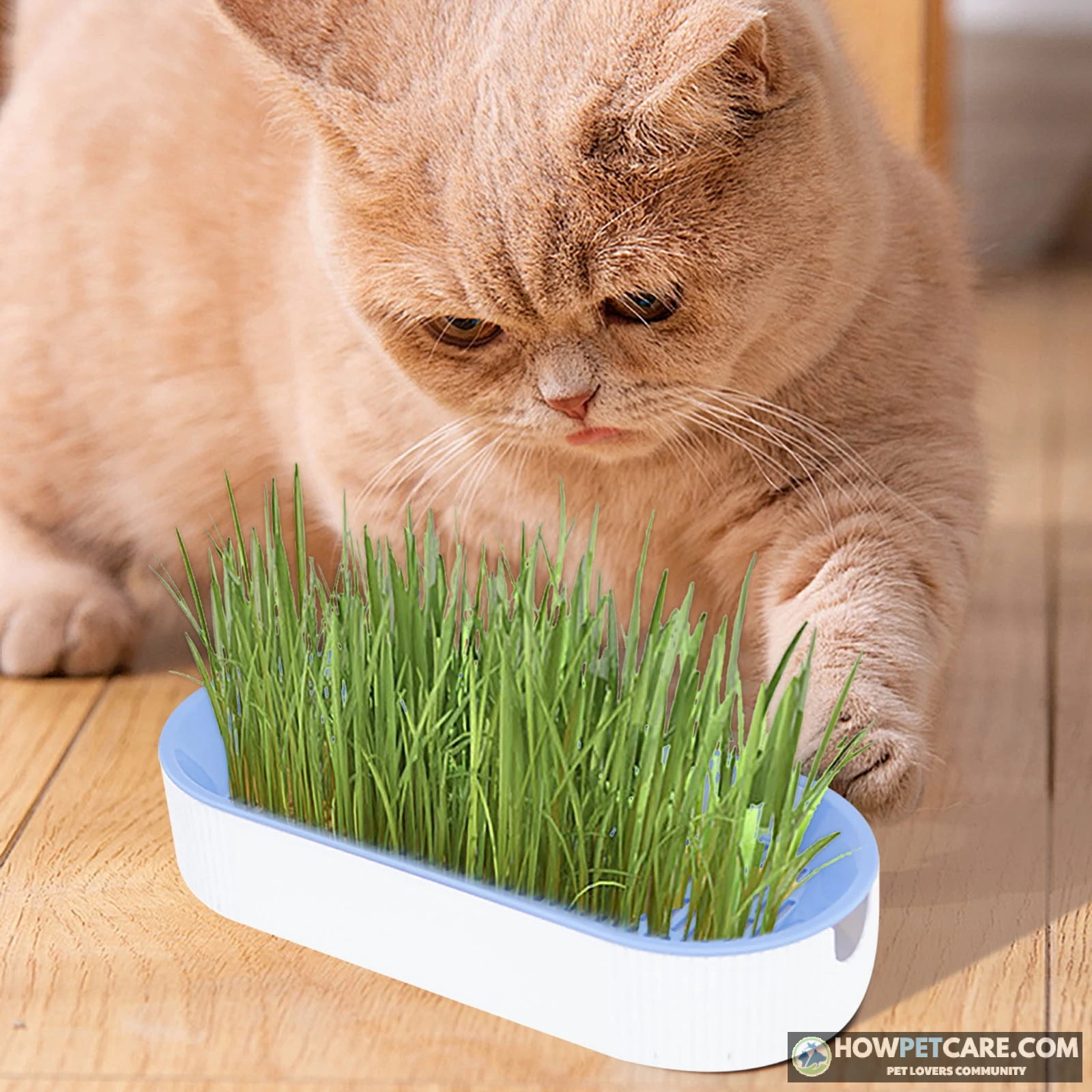

Cat grass is young shoots of wheat, oat, barley, or rye grown for cats to nibble. It is not catnip and not lawn grass. Grow it indoors from untreated seed in clean medium, harvest at 4–6 inches, and offer small weight-based amounts; introduce kittens only after 6 months.
Cat grass is simply young shoots of cereal grains — wheat, oat, barley, or rye — grown specifically for cats to nibble. It is not lawn grass, and it is not catnip: catnip is a mint-family herb that produces a euphoric response in many cats, while cat grass produces no such effect. The two can be used together — many owners offer catnip as a play treat and cat grass as a fiber snack — but they serve different purposes and are not interchangeable. If your indoor cat chews houseplants or begs for greens, a pot of cat grass gives it a safe target while you figure out which seed, how much, and how often. This guide answers all three, plus how to keep the pot mold-free.
What Cat Grass Is — and How It Differs from Lawn Grass and Catnip
Cat grass is young cereal-grain shoots — wheat, oat, barley, rye — grown for grazing. It is a fiber snack, not a lawn. Lawn grass may carry pesticides, parasites, and lawn chemicals, which is why it should never be offered indoors; cat grass is grown in a clean medium without chemicals and is safe for indoor cats when handled that way.
Catnip is a different plant entirely: a mint-family herb that triggers a euphoric response in many cats. Cat grass has no such effect — it provides fiber that supports digestion and helps move swallowed hair through the gut, which may reduce hairball formation. Cat grass also contains vitamins and micronutrients such as folic acid, which supports hemoglobin production for oxygen transport in blood. These are "contains" statements, not proven health benefits — no study in the cited material shows cat grass treats or prevents any condition.
Growing a dedicated pot also redirects a cat away from toxic houseplants. A kitten can be introduced to cat grass once it is at least 6 months old, starting with a gentler variety such as oat.

How to Grow Cat Grass Indoors from Seed, Step by Step
Soak seeds 4–6 hours before sowing. Sow them densely in a shallow tray (about 7.5 inches / 19 cm in diameter is a commonly recommended pot size) and press them lightly into moist medium; covering is optional — some growers press seed in without soil on top, others add about 1/4 inch of soil, with little difference in growth speed.

-
Soak
Soak seeds 4–6 hours in water, then drain.
-
Sow
Fill a shallow tray with moist medium and sow seeds densely; press lightly.
-
Germinate
Keep warm and moist; germination takes 3–7 days.
-
Light and water
Once sprouted, give 4–6 hours of light daily and water lightly each day, keeping soil moist but never waterlogged.
-
Harvest
Let grass reach 4–6 inches (10–15 cm) tall before first grazing — usually 7–14 days after sowing.
Sowing and germination
Sources disagree on pre-soaking: some recommend soaking 4–6 hours to speed germination, while others sow dry seed onto moist medium with similar results. Either works; soaking is a small insurance step for beginners. Germination typically occurs in 3–7 days.
Light, watering, and readiness
Lighting advice also varies: some growers place trays in indirect light 4–6 hours a day from the start, while others keep them dark and warm for the first 2–3 days to sprout, then move them into light. For a north-facing sill or weak winter light, a cheap LED grow light on a 4–6 hour timer is enough to keep grass from stretching and falling over. Water lightly every day; the goal is evenly moist medium, not soggy. If your house is warm and humid, that same moisture can invite mold — see the mold triage section below for signs and fixes. Grass is ready to graze at 4–6 inches (10–15 cm) tall.
Which Seed to Buy: Wheat vs Oat vs Barley vs Rye

The four grains differ in speed, cost, texture, and which cats prefer. Wheat is the all-rounder; oat is the gentlest for kittens, seniors, and sensitive stomachs; barley is firmer for cats that pull and chew hard; rye is the fastest and cheapest but thinnest.
| Variety | Germination (days) | Days to first harvest | Cost per tray | Texture/taste | Best-fit cat profile |
|---|---|---|---|---|---|
| Wheat | 2–3 | 7–10 | $0.35–$0.60 | Medium, slightly sweet | Average adult cat; good all-rounder |
| Oat | 2–4 | 8–12 | $0.40–$0.70 | Soft, mild | Kittens, seniors, sensitive stomachs |
| Barley | 3–4 | 9–13 | $0.45–$0.80 | Firmer, grassy | Cats that pull and chew hard |
| Rye | 2–3 | 6–9 | $0.30–$0.55 | Thin, sharp | Fast growers; cats that prefer tender blades |
Costs assume 2 tablespoons of seed per 4-inch tray and bulk seed, with reusable trays. Seed storage: keep leftovers in an airtight container in a cool, dry place; the cited growing sources do not give a shelf life, though most cereal seed is commonly said to stay viable 1–2 years.
How Much Cat Grass to Feed: Weight-Based Daily Amounts
"In moderation" is not a number. Use this chart as a starting point, scaled to weight and age, then adjust based on your cat’s tolerance. The blade and spoon amounts are practical estimates for beginners, not figures from a feeding study, so treat them as a place to start rather than a prescription.
| Cat weight | Age group | Daily amount | Weekly frequency | Notes |
|---|---|---|---|---|
| 5 lb | Adult | 3–5 blades or 1/4 tsp chopped | 3–4 days/week | Start with 2 blades; increase only if no vomiting |
| 10 lb | Adult | 6–10 blades or 1/2 tsp chopped | 4–5 days/week | Offer after meals, not as a meal replacement |
| 15 lb | Adult | 10–15 blades or 3/4 tsp chopped | 4–5 days/week | Split into two small servings if gulping |
| Any weight | Kitten under 6 months | Do not offer | 0 | Wait until 6 months; use oat first |
| Any weight | Kitten 6–12 months | 2–3 blades or a pinch | 2 days/week | Supervise; stop 48 hours if vomiting |
Ceiling rule: if grass becomes more than a small garnish of the daily diet, pause 3 days and restart at half the amount. Small daily amounts are generally fine for healthy adult cats, but watch for vomiting, diarrhea, or appetite loss and pause if these appear. Is daily grass safe? For most healthy adults, small daily amounts are acceptable, but the chart’s ceiling rule and red-flag criteria below still apply.
This feeding chart is general guidance, not a substitute for veterinary care. If your cat has a chronic condition, is on medication, or is underweight, ask your vet before changing its diet.
Mold Triage: Prevent and Fix White Fuzz in Warm or Humid Rooms

White fuzz often appears by day 3–4 from dense sowing and excess moisture. Prevention: use drainage holes, bottom-water, increase airflow (a small fan across the room, not directly on the tray), and avoid overwatering. In a warm or humid room, check the tray surface daily and water less, not more, if the medium still feels damp.
| Symptom | Likely cause | Salvageable? | Action |
|---|---|---|---|
| White fuzz only on soil surface, day 3–4 | Normal early mycelium from dense sowing | Yes | Increase airflow, reduce watering, scrape top 1/4 inch if loose |
| White fuzz on blades or stems | Too much moisture or poor drainage | Usually no | Bin the tray; wash tray with hot soapy water |
| Green or black spots | Contaminated seed or stagnant water | No | Discard entire tray and medium; do not rinse and reuse |
| Sour smell or slimy soil | Overwatering and low airflow | No | Discard; next tray needs drainage holes and bottom watering |
| Fuzzy growth only at tray edge | Water pooling in saucer | Yes, if blades clean | Empty saucer, move tray, trim affected edge |
Keep-or-toss rule: if mold touches a blade your cat will eat, toss the tray.
Soil-free and hydroponic growing in water or coconut coir works and lowers mold risk, but roots are weaker and pots may need more frequent watering. Coconut coir is a clean alternative to potting soil for apartment growers worried about gnats or mold.
Pot Lifespan and Rotation: Never Run Out
One pot stays palatable 1–3 weeks after planting. Plan on 2–3 weeks of useful life per tray before quality declines. For a single cat, two trays in rotation covers a month; three adds a buffer for mold or over-pulling. Multi-cat homes should scale up: roughly one active tray per cat plus one in reserve.

If a cat pulls the whole plant out roots and all, do not panic — re-sow the tray or offer the next tray in rotation. To reduce pulling, let grass grow to the full 4–6 inch harvest height before offering, and consider a heavier, wider pot.
Kittens, Seniors, and Sensitive Digestion: When Grass Means Stop
Offer cat grass only from 6 months of age; under 6 months, do not offer. Start kittens on oat grass at 6–12 months with 2–3 blades, 2 days a week, supervised, and stop for 48 hours if vomiting occurs. Seniors and sensitive-stomach cats also do best on oat and a slower introduction.
Normal grass-related vomiting: one small vomit of grass and hair within 10–30 minutes after grazing, followed by normal appetite and energy. Occasional grass in stool without straining or lethargy is also normal.
Call the vet if vomiting happens more than twice in 24 hours; if grass vomiting is paired with lethargy, hiding, or refusal to eat for 12+ hours; if you see blood, black/tarry stool, repeated dry retching, or abdominal pain; or if a kitten under 6 months eats grass and then vomits repeatedly. Pause grass for 72 hours after any red flag, then reintroduce at half the previous amount only after your vet agrees.
Cost Reality: DIY Pot vs Store-Bought Tray (Worked Example)
Assumptions for one 10 lb cat eating 4 days/week:
- DIY tray: $1.20 seed + $0.80 coconut coir + 0.50 reusable pot =2.50 first tray; seed and coir for 4 more trays = $8.00 total for 5 trays.
- Store-bought pot: 6.50 each; 5 pots needed =32.50.
- Month total DIY: $8.00 (pot reused) vs store-bought $32.50.
- Break-even: the DIY setup pays for itself after about 1.5 store-bought pots, roughly day 10 of the first month.
- Yield check: one DIY tray lasts 2–3 weeks, so 2 trays cover the month; 3 add a buffer for mold or over-pulling.
Use kits only when you need the tray, light, and instructions in one box; they do not change the seed math. A kit does not change the underlying cost of seed.
On nutrition: cat grass is mostly fiber and water. It contains folic acid and other micronutrients, but the hairball-reduction benefit is not well proven and is largely anecdotal. Treat it as enrichment, not medicine.
Your Next Step: A One-Page Sowing and Feeding Checklist
Shopping list: untreated cereal seed (oat for kittens/sensitive cats, wheat as the default), a shallow tray with drainage holes, coconut coir or potting medium, and an optional cheap LED if your light is weak.
Sowing plan for a mold-free pot: soak 4–6 hours, sow densely, press lightly, keep warm and moist, give 4–6 hours of light once sprouted, water lightly daily, and harvest at 4–6 inches.
Feeding schedule at a glance: 5 lb cat 3–5 blades 3–4 days/week; 10 lb cat 6–10 blades 4–5 days/week; 15 lb cat 10–15 blades 4–5 days/week; kittens 6–12 months 2–3 blades 2 days/week; under 6 months, none.
Decision tree: weak light or humid apartment — use coir, bottom-water, add airflow, and prefer rye for speed. Cat pulls plants — let grass grow taller and use a heavier pot. Sensitive stomach or senior — choose oat and introduce slowly. Multi-cat home — run 3 trays in rotation.

| Variety | Germination (days) | Days to First Harvest | Cost per Tray | Texture / Taste | Best-Fit Cat Profile |
|---|---|---|---|---|---|
| Wheat | 2–3 | 7–10 | 0.35–0.60 | Medium, slightly sweet | Average adult cat; good all-rounder |
| Oat | 2–4 | 8–12 | 0.40–0.70 | Soft, mild | Kittens, seniors, sensitive stomachs |
| Barley | 3–4 | 9–13 | 0.45–0.80 | Firmer, grassy | Cats that pull and chew hard |
| Rye | 2–3 | 6–9 | 0.30–0.55 | Thin, sharp | Fast growers; cats that prefer tender blades |
FAQ
Is cat grass safe for indoor cats?
Yes, when grown from untreated cereal seed in clean medium without pesticides or fertilizers. Avoid lawn grass and unknown outdoor greens.
Does cat grass reduce hairballs?
It may help some cats through added fiber and vomiting of indigestible matter, but the hairball-reduction benefit is not well proven and is largely anecdotal.
Can you grow cat grass in water or coconut coir only?
Yes. Hydroponic or coir-only growing works and reduces mold risk, but roots are weaker and pots may need more frequent watering.
How do you store leftover cat grass seed?
Keep it in an airtight container in a cool, dry place away from humidity; most cereal seed stays viable for one to two years.
Is it safe for a cat to eat grass every day?
Small daily amounts are generally fine for healthy adult cats, but watch for vomiting, diarrhea, or appetite loss and pause if these appear.