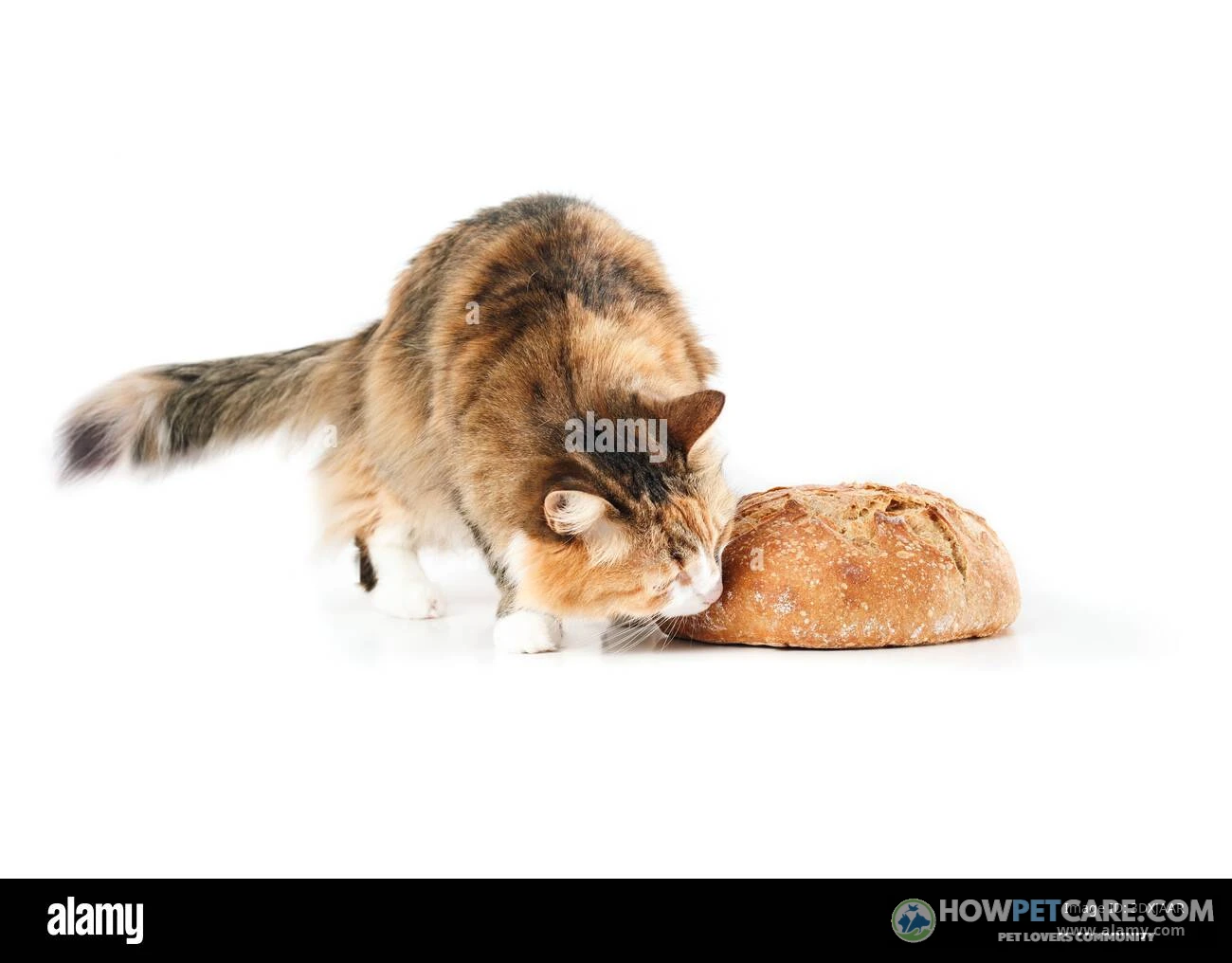

Plain baked bread is SAFE for cats only as a rare, tiny treat — one thumb-sized piece (about a 1 cm cube) no more than once or twice a week. It is not a food; cats need animal protein. Never feed raw dough, garlic or onion bread, sweet breads, or moldy bread.
Can Cats Eat Bread? The Direct Verdict
Plain baked bread isn’t toxic to cats, but it gives them nothing they need. A healthy adult cat can have a tiny piece of plain white or whole-wheat bread as an occasional treat, not as food. Classify every bread item as safe, limited, or unsafe before offering it. Cats are obligate carnivores, so their nutrition should come mainly from animal protein and fat, not carbohydrates.
Verdict: SAFE – but only as a rare, tiny treat. What qualifies: plain baked white or whole-wheat bread, fully cooked, no spreads, no add-ins, no mold. Serving limit: one piece no bigger than the tip of your thumb, about a 1 cm cube and roughly 5-10 calories. Frequency limit: no more than once or twice per week, never daily. Never a meal: bread has zero nutrients your cat needs and must never replace regular cat food. Automatic disqualifiers: raw dough, garlic or onion bread, sweet breads, moldy bread, or anything buttered or salted. If any disqualifier applies, skip the bread and offer a plain piece of cooked chicken instead.
Which Bread Types and Ingredients Are Dangerous for Cats
Dangerous bread problems usually come from add-ins, not from plain flour and yeast alone; for broader guidance on feeding cats a balanced diet, focus on animal protein. Garlic, onion, chives, and leeks are toxic and can cause hemolytic anemia. Raisins, grapes, chocolate, and xylitol are also dangerous inclusions. Even seemingly harmless fruits require safe portions for apples. High sodium, butter, and sugar increase obesity and cardiac risk. Moldy bread can cause tremors or liver damage.

Garlic and onion bread
Even powdered garlic in dough counts. Bread with garlic, onion, chives, or leeks belongs in the unsafe category, regardless of portion size.
Sweet and dessert breads
Banana bread, cinnamon rolls, and similar items are unsafe because of sugar, fat, raisins, nuts, or chocolate. They’re dessert foods, not plain bread.
Moldy or stale bread
Don’t let a cat finish stale or moldy bread. Mycotoxins can cause tremors or liver damage. Discard moldy bread instead.
Bread-Type Comparison: Safe vs Limited vs Unsafe
| Bread type | Verdict | Key concern | Notes |
|---|---|---|---|
| Plain white or wheat bread (baked) | Safe (limited) | Empty calories | Thumb-sized piece, 1-2 times per week max |
| Bread crust | Safe (limited) | Same as base bread | No safer than the slice; same portion rules |
| Bread crumbs | Safe (limited) | Easy to over-sprinkle | A pinch on food occasionally; count the calories |
| Plain breadsticks | Safe (limited) | Added salt on some brands | Check label for salt and seasonings first |
| Gluten-free bread | Check first | Substitute flours and sweeteners | Some recipes use xylitol or excess sugar; read ingredients |
| Banana bread | Unsafe | Sugar, raisins, nuts, fat | Dessert bread, not plain bread |
| Garlic or onion bread | Unsafe | Allium toxicity (hemolytic anemia) | Even powdered garlic in the dough counts |
| Breaded chicken or fried foods | Unsafe | Breading, oil, salt, seasonings | Offer plain cooked chicken instead |
| Buttered bread | Unsafe | Fat, salt | Butter adds calories and can trigger GI upset |
| Raw dough (any type) | Unsafe – emergency | Expands and produces ethanol in stomach | Use the raw dough decision tree immediately |
| Moldy or stale bread | Unsafe | Mycotoxins: tremors, liver damage | Discard; never let the cat finish it |

Bread crust is generally safe in tiny amounts, but it offers no extra nutrition and can be harder to chew. Bread crumbs are also generally safe in small amounts, though they add empty calories. Avoid crumbs from seasoned, garlic, or moldy bread. Breaded foods are a different problem: the breading, oil, salt, and seasonings make them unsafe, so remove breading and serve only plain cooked chicken.
Raw Bread Dough Emergency: What to Do and When
Raw yeast dough is extremely dangerous because it can expand and produce ethanol in the stomach. Signs include bloating, vomiting, ataxia, and depression. Don’t induce vomiting at home on your own; there’s a risk of stomach injury and aspiration. Activated charcoal is not useful for raw dough toxicity because it doesn’t bind ethanol and may increase aspiration risk.
-
Step 1 - Confirm what was eaten
Raw bread dough with yeast? If it was already baked, this tree does not apply; use the portion rules instead.
-
Step 2 - Check the clock
Note the time of ingestion. The safest window for any intervention is roughly the first 1-2 hours, before the dough has expanded significantly.
-
Step 3 - Call first, act second
Call your veterinarian or a pet poison hotline before doing anything at home. ASPCA Animal Poison Control is (888) 426-4435 in the US, and Pet Poison Helpline is 1-800-213-6680.
-
Step 4 - Follow the vomiting rule
Induce vomiting only if the vet or poison control explicitly instructs you and only within their advised window. Do not induce vomiting if the cat is lethargic, wobbling, seizing, bloated, or if more than a short window has passed.
-
Step 5 - Watch for red flags
Distended or hard belly, repeated vomiting, uncoordinated walking, drooling, depression, unusual stillness, or alcohol-smelling breath all require urgent care.
-
Step 6 - Expect veterinary treatment
Typical care includes stomach decompression, IV fluids, temperature control, and monitoring for alcohol toxicosis.
-
Step 7 - Recovery timing
With prompt veterinary care, mild cases often stabilize within 12-24 hours of monitoring; severe cases can need 1-3 days of supportive care. Do not feed or medicate at home until your vet clears the cat.
When to induce vomiting
Induce vomiting only if advised by a vet or poison control, and only within their advised window. The golden window is roughly within one hour of ingestion.
When NOT to induce vomiting
Do not induce vomiting if the cat is lethargic, wobbling, seizing, bloated, or if more than a short window has passed. A weakened cat can inhale vomit, and expanded dough will not come back up easily.
Expected recovery timeline
Recovery typically requires veterinary monitoring and supportive care. Mild cases often stabilize within 12-24 hours; severe cases can need 1-3 days.

| Symptom or situation | Action | Avoid | Vet needed |
|---|---|---|---|
| Raw yeast dough eaten within about 1 hour | Call vet or poison control immediately | Home vomiting unless instructed | Yes |
| Lethargy, ataxia, seizures, bloating, or expanded belly | Transport for emergency care | Inducing vomiting | Yes |
| Already baked bread only | Use portion rules and monitor | Emergency measures | Only if symptoms appear |
| Toxic add-in such as garlic, onion, xylitol, raisins, or chocolate | Call vet or poison control immediately | Waiting to see what happens | Yes |

How Much Bread Can a Cat Eat: Weight- and Calorie-Based Portions
Bread treats should stay under 10% of daily calories. A typical safe serving is one 1/4-inch square piece. One slice of white bread can contain about 20% of a cat’s daily energy need, so a whole slice is far too much. Frequency should be no more than once or twice weekly.

| Cat weight | Max bread portion | Calorie limit | Frequency |
|---|---|---|---|
| 4 kg (about 9 lb) indoor cat | One 1 cm cube, roughly 2-3 g | About 5-8 kcal from bread within ~19 kcal total treats | 1-2 days per week |
| Less active senior at 4 kg | Half a 1 cm cube or skip bread | About 16 kcal total treats | 1-2 days per week |
| Kitten or pregnant or nursing cat | Avoid bread | Not applicable | Not applicable |
| Cat with diabetes, kidney, heart, or allergy issues | Generally avoid | Not applicable | Not applicable |
For an indoor cat, a common estimate is roughly 40-50 calories per kg of body weight per day. Milo, a 4 kg neutered indoor cat, needs about 180-200 kcal daily. If his food provides about 190 kcal per day, 10% is about 19 kcal for all treats combined. One 1 cm cube of plain white bread weighs about 2-3 g; white bread is roughly 265 kcal per 100 g, so one cube is about 5-8 kcal. That uses about one-third of Milo’s treat budget, leaving room for other treats or none that day. Even when the calories fit, bread stays at 1-2 days per week, not every day. If Milo were a less active senior needing closer to 160 kcal daily, his treat budget drops to about 16 kcal, and one bread cube becomes nearly half of it.
Bread Guidance by Life Stage and Health Condition
Kittens should avoid bread and prioritize growth nutrition. Senior cats should be limited because of dental and weight concerns. Pregnant or nursing cats should avoid unnecessary empty calories. Diabetic, renal, cardiac, or allergic cats should generally avoid bread. It also lacks taurine, so review taurine needs in cats. Bread spikes blood glucose, which is risky for diabetic cats. Commercial bread sodium can strain renal and cardiac patients. Preservatives and additives offer no feline benefit. Repeated bread feeding contributes to obesity. For enrichment, cat grass for fiber may be a better option than bread.
Glycemic Response, Sodium, and Preservatives in Bread
Bread is mostly carbohydrate, so it can raise blood glucose quickly. For a diabetic cat, that’s a real concern. Commercial bread also contains sodium, which matters for cats with kidney or heart disease. Preservatives, flavorings, and added fats don’t benefit cats and can add unnecessary load. Repeated bread treats can quietly push a cat toward weight gain, especially an indoor cat with low activity.

Using Bread to Hide Medication vs Purpose-Made Treats
A small piece of plain bread can be used to hide or wrap a pill. Buttered bread is not a good choice because it adds fat and salt. Purpose-made pill pockets are usually more reliable and nutritionally balanced for cats. Bread can crumble, expose the pill, or be rejected, wasting medication. For daily or long-term medication, purpose-made pill pockets or a pill giver keep calories, sodium, and failed doses lower.
| Option | Hides pill well? | Health trade-off | Reliability | Verdict |
|---|---|---|---|---|
| Plain bread ball | Moderately; dry crumb can expose the pill | Adds empty carbs and sodium; some cats refuse bread | Low; bread crumbles and pill falls out | Backup only |
| Buttered bread ball | Better stickiness | Adds fat and salt on top of carbs | Medium, but teaches a high-fat habit | Avoid |
| Commercial pill pocket (cat formula) | Yes; designed to seal around the pill | Nutritionally balanced, about 5-10 kcal each, counts toward treat budget | High; soft texture masks scent and taste | Best default |
| Soft chive- or cheese-flavored treat wrapped around pill | Varies | Flavorings may include onion or garlic powder; check label | Medium | Only if label is allium-free |
| Pill giver or syringe with water chaser | No food needed | Zero extra calories | High once practiced | Best for daily medication |

Bottom line: for a one-off pill, a small plain bread ball is acceptable if your cat reliably swallows it. For daily or long-term medication, purpose-made pill pockets or a pill giver keep calories, sodium, and failed-dose waste to a minimum.
Your Bread Decision Checklist and When to Call the Vet
Run the safe, limited, or unsafe classification before feeding. Apply the portion and frequency limits. Use the raw dough decision tree immediately if needed. Contact a veterinarian for toxic ingredients, large amounts, or symptoms. Call poison control for raw dough, garlic, onion, xylitol, raisins, grapes, chocolate, or mold exposure. Seek care promptly for vomiting, diarrhea, bloating, lethargy, uncoordinated walking, seizures, or breathing changes.
| Bread Type / Product | Verdict | Key Concern / Risk | Serving Limits & Frequency | Additional Notes |
|---|---|---|---|---|
| Raw dough (any type) | Unsafe - emergency | Expands and produces ethanol in stomach (bloating, vomiting, ataxia, depression) | Never feed / Avoid completely (Emergency situation) | Use the raw dough decision tree immediately; call vet or poison control. Do not induce vomiting without vet instruction. Activated charcoal is not useful. |
| Garlic or onion bread | Unsafe | Allium toxicity (hemolytic anemia) | Unsafe regardless of portion size | Even powdered garlic in the dough counts. Includes chives and leeks. Skip and offer plain cooked chicken instead. |
| Moldy or stale bread | Unsafe | Mycotoxins: tremors, liver damage | Never feed / Avoid completely | Discard; never let the cat finish it. |
| Banana bread | Unsafe | Sugar, raisins, nuts, fat | Avoid / None | Dessert bread, not plain bread. |
| Breaded chicken or fried foods | Unsafe | Breading, oil, salt, seasonings (fat, salt, potential garlic/onion) | Avoid breading | Offer plain cooked chicken instead by removing the breading. |
| Buttered bread | Unsafe | Fat, salt; triggers GI upset and adds unnecessary fat and calories | Avoid | Butter adds calories and fat on top of carbs, triggering GI upset. Plain bread is the safer choice. |
| Sweet and dessert breads (e.g., cinnamon rolls) | Unsafe | Sugar, fat, raisins, nuts, or chocolate | Avoid completely | These are dessert foods, not plain bread. |
| Bread and milk | Unsafe / Avoid | Lactose intolerance; diarrhea and stomach upset | Avoid | Best to avoid pairing bread with milk as most adult cats are lactose intolerant. |
| Plain white or wheat bread (baked) | Safe (limited) | Empty calories | Thumb-sized piece (one 1 cm cube, roughly 2-3 g / 5-10 calories), 1-2 times per week max | Fully cooked, no spreads, no add-ins, no mold. Offers no extra nutrition; nutrition should come from animal protein and fat. |
| Bread crust | Safe (limited) | Same as base bread | Same portion rules as plain bread (thumb-sized piece, 1-2 times per week max) | No safer than the slice; offers no extra nutrition and can be harder to chew. Avoid crusts with seeds, garlic, or heavy seasoning. |
| Bread crumbs | Safe (limited) | Easy to over-sprinkle; empty calories | A pinch on food occasionally; count the calories | Adds empty calories. Avoid crumbs from seasoned, garlic, or moldy bread. |
| Plain breadsticks | Safe (limited) | Added salt on some brands | Not in source | Check label for salt and seasonings first. |
| Gluten-free bread | Check first | Substitute flours and sweeteners | Not in source | Some recipes use xylitol or excess sugar; read ingredients. |
FAQ
Can cats eat bread crust?
Yes, bread crust is generally safe in tiny amounts, but it offers no extra nutrition and can be harder to chew. Keep portions small and avoid crusts with seeds, garlic, or heavy seasoning.
Can cats eat bread and butter?
Butter adds unnecessary fat and calories and may cause digestive upset. A tiny buttered crumb is unlikely to harm a healthy cat, but plain bread is the safer choice.
Can cats eat bread and milk?
Most adult cats are lactose intolerant, so milk can cause diarrhea and stomach upset. It is best to avoid pairing bread with milk.
Can cats eat breaded chicken?
The breading itself is not toxic, but fried or seasoned coatings add fat, salt, and sometimes garlic or onion. Remove the breading and serve only plain cooked chicken.
Can cats eat bread crumbs?
Small amounts of plain bread crumbs are generally safe, though they add empty calories. Avoid crumbs from seasoned, garlic, or moldy bread.