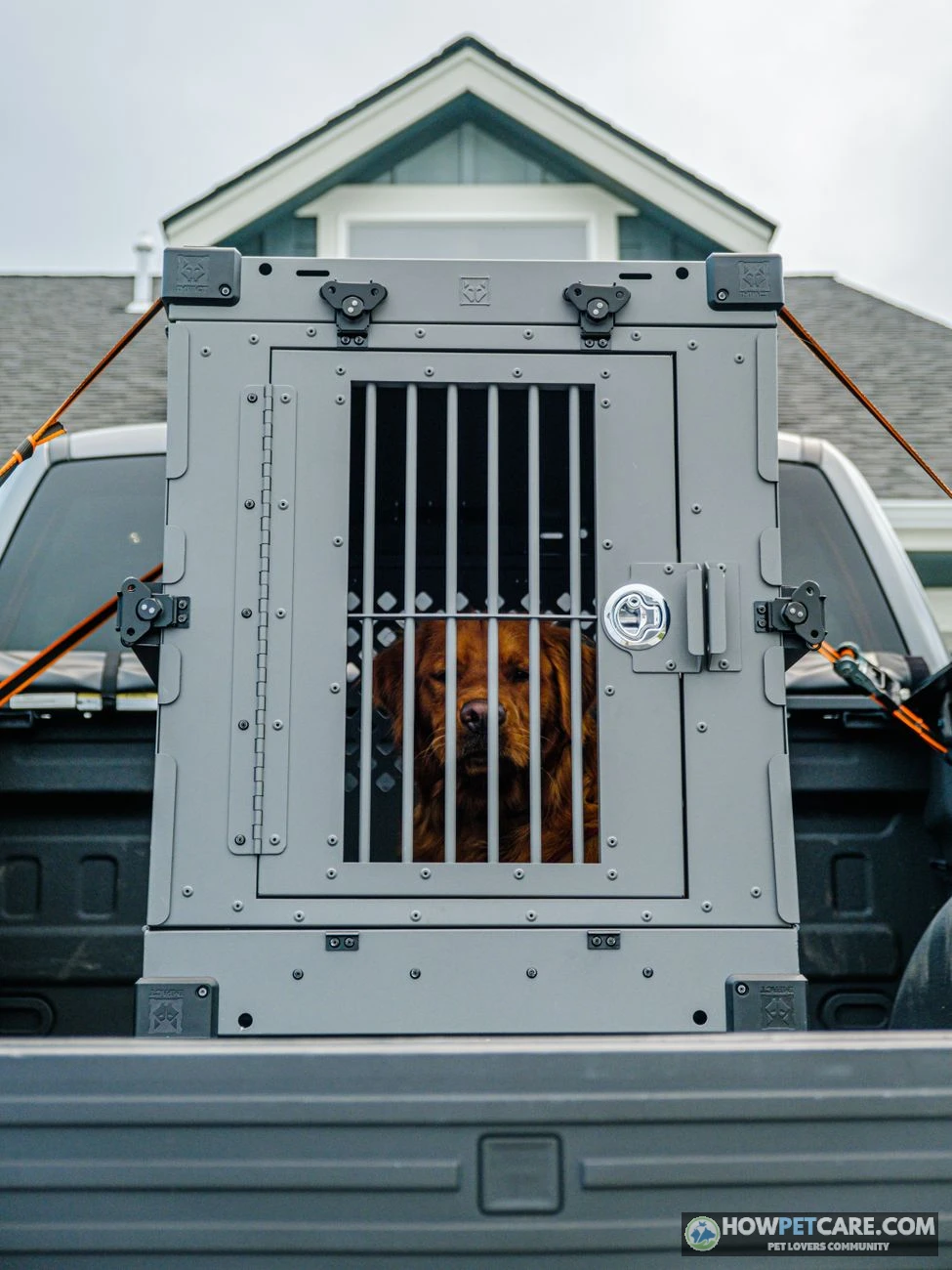

Never put a dog in a sealed sedan trunk. In an SUV or hatchback’s open cargo area, secure a properly sized, crash-tested crate to the vehicle’s factory tie-down anchors exactly as the crate maker instructs, keep it ventilated and cool, and protect the dog from loose objects.
Never put a dog in the sealed trunk of a sedan. If you’re looking for how to secure a dog in the trunk of an SUV or hatchback, the distinction is important: the open cargo area can be suitable if it shares cabin air and has a properly sized, crash-tested pet travel crate secured according to both the crate and vehicle manufacturers’ instructions. Protect the dog from heat and loose objects, too.
A cargo barrier can keep a dog from reaching the driver, but it won’t hold the dog in place during a crash. A harness may be an option only if its manufacturer permits the specific vehicle location and attachment. Here’s how to choose a setup, anchor a crate, check airflow and prepare for an emergency.
Trunk vs. Cargo Area: What’s Safe and What’s Never Okay for Your Dog
Sealed sedan trunk: why the answer is always no
A closed sedan trunk isn’t a passenger compartment. It can become dangerously hot, has no dependable supply of conditioned cabin air and can expose a dog to exhaust or injury. You also can’t monitor the dog while it’s inside.
In a sedan, use an appropriate restraint in the passenger cabin instead. One possible alternative is a back-seat dog car harness installed with the seat belt as directed by its manufacturer.
Open SUV cargo area: when it works
An SUV or hatchback cargo area can work if it’s open to the passenger cabin, receives enough conditioned air and has a compatible, securely installed restraint. Existing guidance describes both a dog guard and a crate in the cargo area of a five-door car as possible approaches, though they provide different kinds of protection.
Before loading your dog, ask three questions: Does this space share cabin air? Is the dog restrained? Is the restraint installed using approved vehicle attachment points? If any answer is no, change the setup before driving. Remember that sharing cabin air alone doesn’t guarantee the crate will stay cool enough.

Crate, Cargo Barrier or Harness Tether: Choosing the Safest Restraint for an SUV Cargo Area
Crate: strongest containment, needs anchoring
A properly sized crate with independently verified crash-test results is a practical first choice for containing a medium or large dog in a cargo area. It must also be installed as it was designed and tested to be used. Even a strong shell can’t do its job reliably if the whole crate moves freely around the vehicle.
Look for a model that fits both your dog and your car, has accessible ventilation and a secure door, and comes with a clear vehicle-installation method. If the crate maker specifies an anchor kit or orientation, follow those instructions rather than improvising.

A dog that’s anxious about a crate may need gradual, positive practice at home before traveling in it. Don’t assume that a larger crate, an open cargo area or a barrier alone will solve dog anxiety in the car.
Barrier: separation, not restraint
A cargo barrier or dog guard separates the cargo area from the passenger cabin. It can help prevent a dog from distracting the driver, but the dog can still move around the cargo floor and strike the barrier or vehicle in a collision. A barrier isn’t a substitute for an individually secured crate or an approved restraint.
A dog car hammock isn’t a crash restraint either. It protects upholstery and may help contain dirt, but it doesn’t secure a dog or crate.
Harness tether: where it fits and where it doesn’t
A crash-tested dog car harness can be useful in a seating position for which it was designed. Cargo floors often lack a compatible seat belt or approved harness attachment point, though. A cargo hook isn’t automatically suitable just because a dog seat belt clip fits it.
Use a harness in the cargo area only if the harness maker and vehicle maker permit that location and attachment. Attach the tether to the harness, never to a collar. A zipline harness or long tether may allow movement, but it can also let a dog strike the vehicle interior or become tangled. Unless the complete arrangement is explicitly approved, use a compatible back-seat installation or a secured crate instead.

Crate Materials Compared: Aluminum vs. Roto-Molded vs. Wire vs. Dog Guards
Material is a starting point, not a crash rating. Construction, door hardware, anchoring and the actual test result matter more than the material name alone.
| Restraint type | Crash-safety implications | Ventilation | Weight and portability | Tie-down compatibility | Best for | Main drawback |
|---|---|---|---|---|---|---|
| Wire crate | Panels or latches may deform or fail in a collision; ordinary folding crates should not be assumed crashworthy | Generally open on multiple sides | Often light and foldable | A strap around a wire panel does not establish a crash-secure installation | Home use; vehicle use only when the specific model and installation are approved | An everyday crate may offer little crash protection |
| Aluminum crate | Strength depends on the frame, joints, door and tested design | Varies with the openings | Often bulky; weight varies | Some designs have designated attachment points | Owners seeking a ventilated crate with a verified vehicle installation | Aluminum alone does not prove crash performance |
| Roto-molded plastic crate | A rigid shell may provide containment, but performance varies by model and test | Depends on the size and location of vents | Can be heavy and bulky | Use designated points and the specified tie-down method | Dogs and vehicles that fit a verified shell-style crate | Openings can be obstructed; some models are difficult to lift |
| Dog guard or cargo barrier | Separates the cabin but does not restrain the dog within the cargo area | Generally allows cabin air through | Fit and removal vary by vehicle | Mounts to the vehicle rather than securing the dog | Extra separation when used with a compatible restraint | The dog can still be thrown against the barrier or floor |

Choose the specific crate and installation first, then check its ventilation in your vehicle. Don’t assume a roto-molded shell is always stronger than aluminum or that an expensive crate has passed an independent test.
Sizing a Crate for Car Travel (and Fitting It to Your Cargo Area)
Measuring your dog
Measure your dog from the nose to the base of the tail and from the floor to the top of the head while standing. Check sitting height, too, especially if the ears extend above the head. Compare those measurements with the crate maker’s internal dimensions and sizing instructions, rather than relying on the exterior size or a breed label.
Your dog should be able to stand naturally, turn around and lie down without being compressed against the walls. Avoid choosing a much larger crate solely to add unused space, though: extra room can allow more movement during a sudden stop. If the manufacturer’s travel-fit instructions differ from a general sizing rule, ask the manufacturer how to choose a safe size for your dog.

Measuring your cargo area
With the rear seats locked in their intended position, measure cargo depth, usable height and the narrowest width between the wheel wells. Measure the hatch opening, too. A crate that fits on the floor may not fit through the opening.
Leave room for the specified straps and ventilation openings, and make sure the door can be opened safely. Remove a parcel shelf or cargo cover if it obstructs airflow or installation; never place the crate on the cover. Check rear visibility and the vehicle’s cargo and payload limits. Also make sure you can load the crate safely without dropping it.

If the crate only fits by pressing against the tailgate or blocking its vents, look for another approved size, model or vehicle location. Practice entering and resting in the crate at home before the first drive.
How to Secure a Dog Crate in the Trunk or Cargo Area with Ratchet Straps: Step by Step
The following walkthrough covers the checks involved in a strap-based installation. It’s not a universal tie-down pattern: use ratchet straps only if the crate manufacturer approves them for that model and identifies the routing and attachment points. The vehicle’s cargo anchors must be suitable for that use, too. If either maker’s instructions prohibit the setup or don’t provide enough information, ask them before driving.
What you need before you start
Gather the crate’s installation instructions, the vehicle owner’s manual and the manufacturer-specified anchor kit or straps. If ratchet straps are approved, use undamaged straps with a legible working load limit and fittings that properly engage the specified anchors. The required rating depends on the full setup; a generic strap rating can’t establish crash safety or make an unrated vehicle anchor suitable.
A thin non-slip mat may help prevent ordinary movement if the instructions allow it, but it isn’t an anchor. Use edge protection only where it’s compatible with the approved routing. Don’t substitute bungee cords, rope, an improvised seat-belt arrangement or straps with damaged stitching.
Finding the tie-down anchor points on a typical SUV
Look for recessed loops or D-rings in the cargo floor, often near its corners; some vehicles also have side-mounted points. Consult the manual under cargo tie-downs or lashing points to identify them and check their limits. A shopping-bag hook, plastic trim piece, cargo-cover mount or exposed seat rail isn’t a substitute.

A strap’s printed load limit is not a crash certification for the crate, anchor or vehicle floor. If you cannot identify an approved installation, choose a restraint and vehicle position that the manufacturers support.
Strap routing and the push test
- Clear and prepare the floor. Remove loose cargo and any obstructing cover. Put the rear seats in the position required by the vehicle and crate instructions, and confirm they’re locked.
- Identify the approved anchors. Match each proposed attachment to the owner’s manual. Confirm that the hooks or fittings seat fully and can’t slip off when tensioned.
- Position the crate. Place it in the orientation specified by the crate maker. If permitted, position it toward the locked rear seatback rather than immediately against the tailgate, leaving clearance for vents, straps and access. Don’t force it against the seatback if that conflicts with the installation instructions.
- Route the straps exactly as specified. Attach them to the designated structural points or around the areas the crate maker identifies. Keep webbing flat and clear of the door, latch, sharp edges and essential vents. Some approved systems use straps on opposing sides; don’t invent an X pattern or wrap straps around handles, wire panels or hinges.
- Tension and check. Ratchet each strap to the manufacturer’s specified tension or snugness. Remove slack without crushing or bending the crate. Push and pull firmly in every direction: the crate shouldn’t slide or tip under hand pressure. A push test catches obvious looseness; it doesn’t prove the installation will withstand a crash. If the crate flexes, the anchors move or you can’t remove slack without deformation, stop and consult the manufacturers.
- Secure the loose ends. Tuck strap tails away from the dog, the door and moving vehicle parts. Confirm the door opens as intended and the ratchets can’t release accidentally.

Picture the installation from above: the crate sits on the cargo floor, with its approved attachments connected to the vehicle anchors identified in the manuals. From the side, it’s stable on the floor, not balanced on a cargo cover. At each anchor, the fitting sits fully in the loop rather than catching on its edge. The exact strap path must come from the equipment instructions.
Recheck routine
On a first trip with a newly installed crate, stop in a safe place after about 10 minutes. Check for slack, movement, damage and obstructed vents. Recheck whenever the crate is removed or repositioned, and before later drives. Ten minutes is a practical inspection interval, not proof that the system will remain secure for the rest of a trip.
What Happens to a Dog in the Cargo Area in a Rear-End Collision
Crumple-zone risk and crate placement
Vehicles are designed to deform in certain areas to manage crash energy. Because the rear cargo area is close to the back of the vehicle, a severe rear impact can intrude into the space occupied by a crate. The space affected depends on the vehicle, impact and circumstances; no universal clearance guarantees protection.
Where the instructions permit, placing the crate toward the locked rear seatback can leave more space between it and the tailgate than placing it at the very back. That doesn’t remove rear-impact risk. Keep heavy luggage and unsecured objects away from the crate, and secure them separately so they can’t move into it.

Crate orientation and door position
A rear-facing door can make loading easy, but a damaged or blocked hatch may prevent access after a collision. A side-facing door may offer another access route in some vehicles, but only if it can actually open and the crate is approved in that orientation. Neither orientation is universally safest in every crash.
Follow the crate maker’s tested orientation and anchoring instructions. Look for a securely latching door and sound construction, but don’t treat a “crush-resistant” material claim as proof that a crate can protect its occupant against intrusion from every rear-end collision.
Crash-Tested Dog Restraints: Which Products Have Verified Center for Pet Safety Results
How to verify a CPS certification
The Center for Pet Safety, or CPS, is an independent organization that publishes pet restraint testing and certification information. Certification applies to a particular product and test program; it isn’t a promise of survival or proof that every size, vehicle position and installation has been tested.
Before buying or installing a restraint, consult CPS’s published product listings and test information. Match the exact model, size and version. Check whether the listing says certified or merely reports that a product was tested, and read the applicable installation requirements. Then compare those requirements with the manufacturer’s current instructions.
“Crash-tested” by itself doesn’t tell you whether a product passed, what failed, who conducted the test or whether your installation matches the test. Ask for the test method and result rather than relying on a label.
Certified crates and harnesses worth knowing
Gunner’s G1 kennel line and Sleepypod’s Clickit harness line are examples to investigate in CPS’s published testing and certification materials. They illustrate different types of restraint, not a ranking or endorsement. Verify the exact model, size, current certification status and approved installation before purchase: a result for one version doesn’t automatically apply to another, and a harness result doesn’t establish that it can be tethered to an SUV cargo-floor hook.

If a suitable verified crate won’t fit or can’t be installed as directed, a compatible restraint in an approved rear-seat position is a better next step than improvising a cargo-area attachment.
Ventilation and Heat: Airflow Checks and Temperature Limits for Cargo Areas
Quick airflow check before you drive
Airflow and sunlight in cargo areas can differ from conditions in the front seats. A closed parcel shelf, luggage against a crate or vents facing a vehicle wall can make conditions inside the crate harder to judge from the driver’s seat.
Before your dog enters, run the climate system and check airflow at the crate openings and inside the crate, without blocking the vents yourself. Remove an obstructing cargo cover and reposition luggage. Place a small thermometer at crate height where the dog can’t chew it; if possible, use a remote display visible to an adult in the cabin. Check the reading during a short initial drive and whenever conditions change.

A comfortable dashboard setting doesn’t measure the air around your dog. There’s no universal airflow test or temperature difference that applies to every SUV, crate and route.
Temperature and time benchmarks
Never leave a dog unattended in a parked vehicle. Heat can build quickly, and a running air conditioner can fail or be switched off. Neither a cracked window nor a shade is a dependable safeguard.
For a practical setup check, inspect the crate-area thermometer before departure and again after approximately 10 minutes of the initial drive. This is an inspection schedule, not a safe exposure limit. No single crate temperature or number of minutes guarantees safety for all dogs: humidity, sun, age, health, body size and breed all matter. If the space feels hot or your dog shows distress, stop safely and act immediately rather than waiting for the next scheduled check.
Heavy or persistent panting, thick drool, weakness, vomiting or collapse can signal heat illness. Move your dog to a cooler place, begin cooling with cool—not icy—water and contact a veterinarian or emergency veterinary clinic immediately. A dog that appears to have recovered still needs veterinary advice.
A fan can supplement airflow but does not replace effective vehicle climate control or make a parked car safe. Check that cords, blades and mounting hardware are inaccessible to the dog.
Cooling add-ons for cargo areas without rear vents
Pre-cool the vehicle, direct available vents toward the rear where possible and use shades that don’t obstruct the driver or the crate’s ventilation. A securely mounted fan may help move conditioned air, but verify conditions at crate level rather than assuming it solves the problem. If adequate conditions can’t be maintained, use a different approved location or postpone the trip.

Cold weather needs attention, too. Check for uncomfortable drafts and temperatures at crate level, and don’t assume the rear of the vehicle warms as quickly as the driver’s area.
Securing Two or More Large Dogs in One Cargo Area Without Tangles or Collisions
Two crates vs. one divided crate vs. barrier
Plan around the vehicle’s space and load limits, not just whether both dogs fit through the hatch. Each dog needs a properly sized compartment, and every installed crate needs an approved attachment method. Two large crates may leave too little room for safe anchoring or ventilation.
| Setup | Best for | Collision and tangling risk | Cargo footprint | Anchoring approach |
|---|---|---|---|---|
| Two separate crates | Dogs needing individual space, when the vehicle has enough room | No shared tether; inadequately secured crates can strike each other | Often wide, especially for large dogs | Secure each crate to approved vehicle anchors using its specified installation; confirm that anchors can accommodate the combined setup |
| One purpose-built divided crate | Dogs that fit separate compartments in an approved divided design | Divider must stay secured; both dogs depend on the same shell and installation | One larger footprint | Anchor the complete unit as its maker specifies; do not add an unapproved divider to a single-dog crate |
| Barrier plus harnesses | Only where each harness maker and the vehicle maker approve the exact positions and attachments | Dogs may collide or tethers may cross; the barrier does not restrain them | May use less floor space than crates | Use separate approved restraint systems; if the configuration is not explicitly supported, use another arrangement |

For side-by-side crates, check that each door opens, vents remain clear and neither crate bears on the other’s straps. Don’t assume padding between crates prevents impact or makes an unsupported installation safe. Secure the crates to the vehicle as directed, not merely to each other. Avoid stacking unless the crate and vehicle manufacturers explicitly approve the complete stacked arrangement.
Keeping tethers from tangling
Don’t use two long leads, a shared zipline or a collar attachment in the cargo area. Separate attachment points alone don’t guarantee that dogs can’t tangle or collide. Don’t shorten a tether beyond its manufacturer’s instructions: changing its length can alter how the restraint works.
If you can’t establish an approved, non-tangling configuration for both dogs, use separate secured crates if they fit, an approved rear-seat restraint for one dog, or another vehicle. Check the combined weight of dogs, crates, equipment and passengers against the vehicle’s payload limits.
Is It Illegal to Transport a Dog in the Cargo Area? State-by-State Restraint Laws
A dog riding in an SUV cargo area isn’t necessarily subject to the same rules as an animal in an open pickup bed. Laws differ by state, and a rule about driving with a dog on your lap isn’t the same as a requirement to anchor every cargo-area crate. Animal-cruelty and distracted-driving laws may also apply, depending on the circumstances.
The following are examples of state provisions to check, not a complete 50-state inventory. Statutory wording, exceptions, enforcement and penalties can change, so consult the official state code and local rules for your trip. This is general information, not legal advice.
| State | Law or statute citation | What it requires | Penalty | Notes |
|---|---|---|---|---|
| Hawaii | Hawaii Revised Statutes § 291-11.5 | Restricts holding an animal in the driver’s lap or allowing an animal in the driver’s immediate area in a way that interferes with control | Verify the current statute and applicable penalty | A driver-area rule; do not treat it as a universal cargo-crate specification |
| New Jersey | New Jersey Statutes § 4:22-18 | Prohibits transporting an animal in a cruel or inhumane manner | Verify the current statute and applicable penalty | Whether a particular setup is inhumane depends on the circumstances; the statute does not prescribe one universal crate |
| Rhode Island | Rhode Island General Laws § 31-22-22 | Addresses transporting an animal outside the passenger compartment, including restraint requirements and exceptions | Verify the current statute and applicable penalty | Check the statutory definitions and exceptions before assuming it applies to an enclosed SUV cargo area |
Distracted-driving provisions can also matter if an animal interferes with safe control of the vehicle. For searches using “boot” outside the United States, check the rules of the country and jurisdiction where you drive; US state statutes don’t govern those trips.
Before Every Drive: Post-Crash Preparedness and a Cargo Area Safety Checklist
Emergency label template
Attach a waterproof label to a visible exterior surface of the crate without covering vents, installation points or the latch. If another side is visible from inside the vehicle, add a second copy there. Keep contact and medical information current.
LIVE ANIMAL INSIDE
Dog's name and description: __________________
Owner and phone: _____________________________
Emergency contact and phone: __________________
Veterinarian and phone: _______________________
Medical needs or medication: __________________
May bite when frightened or injured: __________

Responders: The dog is in a secured crate.
Approach carefully and keep the dog contained
away from traffic when safe to do so.
After a crash, first protect people and move away from traffic if it’s safe. Call emergency services when needed and tell responders that a dog is secured in the cargo area. Don’t enter a dangerous roadway or force a damaged hatch. An injured or frightened dog may bite or escape, so ask responders for help accessing the crate and have a leash ready before opening it when conditions permit. Seek veterinary assessment even if your dog appears uninjured.
Pre-trip checklist
- Confirm the dog is in an open, climate-controlled passenger or cargo area, never a sealed trunk.
- Check that the crate fits the dog and vehicle, and that the door and ventilation openings are clear.
- Verify the specific restraint’s test or certification listing and follow its approved installation instructions.
- Inspect anchors, straps and fittings; perform the push test and secure loose strap ends.
- Remove or separately secure heavy cargo, and check rear-seat locks and vehicle payload.
- Check airflow and crate-level temperature; plan to stop immediately if the dog shows distress.
- Confirm applicable laws and keep emergency contact and veterinary information visible.
- If the crate can’t be anchored as instructed, don’t improvise: use another approved restraint and seating position or a vehicle that accommodates the setup.
1Why is placing a dog inside a closed sedan trunk considered extremely hazardous?
Closed sedan trunks are not passenger compartments, exposing pets to dangerous heat, potential exhaust fumes, and an inability for the driver to monitor them.
2What is the main safety limitation of using a cargo barrier or dog guard by itself in an SUV?
Barriers act as physical dividers to prevent driver distraction, but they do not secure the pet against impact forces inside the cargo space.
3Under what specific condition is it acceptable to anchor a dog harness tether in an SUV cargo area?
Cargo floors often lack compatible seat belt buckles or rated harness attachment points, requiring explicit dual-manufacturer approval.
4When measuring a dog to select a properly sized travel crate, which principle should be followed?
A travel crate must fit the dog's actual height and length while avoiding extra space that would allow violent sliding during sudden stops.
5When measuring an SUV cargo area to determine if a travel crate will fit, which often-overlooked dimension must be checked?
A crate that fits comfortably on the cargo floor may still fail to pass through a smaller or sloped tailgate opening.
6Where should ratchet straps be attached when securing a travel crate in an SUV?
Only structural cargo anchors specified in the vehicle's manual provide the intended load capacity for tie-downs.
7Why is placing a travel crate directly against the tailgate less ideal than positioning it towards the locked rear seatback?
Vehicles feature rear crumple zones that deform upon severe impact, making space near the tailgate more vulnerable to deformation.
8When reviewing a pet restraint product labeled as 'crash-tested,' what step should a consumer take to verify its safety?
Independent verification confirms whether a specific product model and size passed standard crash testing and outlines required installation methods.
9How should a driver properly check airflow and temperature conditions at the crate's location in an SUV?
Cargo space conditions often differ from front seats due to sun exposure, distance from vents, and potential blockages from luggage.
10What is the recommended approach for transporting two large dogs in a single SUV cargo area?
Each dog requires individual containment and independently secured anchoring to prevent collisions and tangles.
| Restraint type | Crash-safety implications | Ventilation | Weight and portability | Tie-down compatibility | Best for | Main drawback |
|---|---|---|---|---|---|---|
| Wire crate | Panels or latches may deform or fail in a collision; ordinary folding crates should not be assumed crashworthy | Generally open on multiple sides | Often light and foldable | A strap around a wire panel does not establish a crash-secure installation | Home use; vehicle use only when the specific model and installation are approved | An everyday crate may offer little crash protection |
| Aluminum crate | Strength depends on the frame, joints, door, and tested design | Varies with the openings | Often bulky; weight varies | Some designs have designated attachment points | Owners seeking a ventilated crate with a verified vehicle installation | Aluminum alone does not prove crash performance |
| Roto-molded plastic crate | A rigid shell may provide containment, but performance varies by model and test | Depends on the size and location of vents | Can be heavy and bulky | Use designated points and the specified tie-down method | Dogs and vehicles that fit a verified shell-style crate | Openings can be obstructed; some models are difficult to lift |
| Dog guard or cargo barrier | Separates the cabin but does not restrain the dog within the cargo area | Generally allows cabin air through | Fit and removal vary by vehicle | Mounts to the vehicle rather than securing the dog | Extra separation when used with a compatible restraint | The dog can still be thrown against the barrier or floor |
FAQ
Can a dog ride in the trunk of a sedan?
No. A sealed sedan trunk has no airflow, can overheat quickly and offers no crash protection, so dogs should ride in the cabin with a crash-tested harness or a secured crate.
Should a crate in the cargo area face forward, backward or sideways?
It depends on the vehicle and the crate. Most guidance places the crate flush against the seatback with the door facing the rear or side so the dog can be reached, but always follow the crate maker’s anchoring instructions.
Is a dog car hammock safe for the cargo area?
A hammock protects seats from hair and dirt but doesn’t restrain the dog in a crash. Use it together with a crate or a crash-tested harness, not instead of one.
How often should I stop when a dog rides in the cargo area?
A common guideline is every 2 to 3 hours for water, a bathroom break and a check of the crate straps and temperature. Stop more often in hot weather or with puppies and older dogs.
Can I use a regular seat belt or bungee cord to hold a crate in place?
No. Bungee cords stretch and can snap, and a standard seat belt isn’t designed for crate loads. Use ratchet straps or an anchor kit rated for the crate’s weight and attached to the vehicle’s tie-down points.