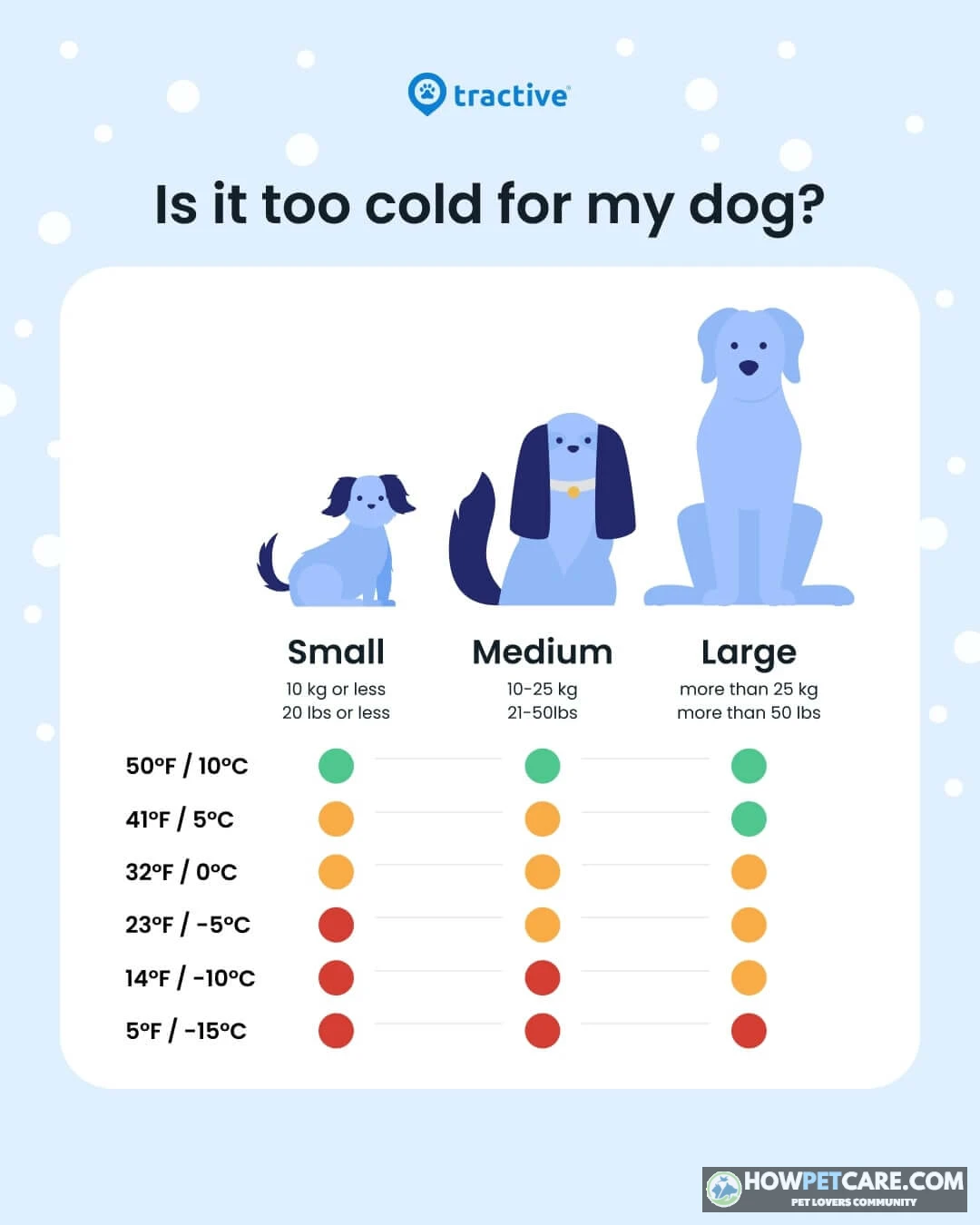

Below 45°F (7°C), small, thin-coated, young, senior, or ill dogs may already be uncomfortable. Below 32°F (0°C), the risk of frostbite and hypothermia rises for vulnerable dogs. Below 20°F (-7°C), limit nearly every dog to brief, supervised potty breaks.
Below 45°F (7°C), some dogs are already uncomfortable. At 32°F (0°C) and below, vulnerable dogs need short, supervised outings. Below 20°F (-7°C), every dog faces greater risk, so save outdoor time for essential potty breaks. These are screening guidelines, not universal cutoffs.
Before clipping on the leash, check the wind chill, your dog’s size, coat, age, and health, and whether their fur might get wet. A quick potty trip is different from a 30-minute walk. Head inside right away if your dog shivers, slows down, lifts a paw, or tucks their tail. Cold stress can start even above these temperatures.
These thresholds follow the 45°F, 32°F, and 20°F framework used in veterinary cold-weather guidance. Above 45°F, most healthy dogs can take their usual walks. Between 45°F and 32°F, take extra care with small, thin-coated, young, elderly, or ill dogs. Below 32°F, the risk of frostbite and hypothermia rises. Below 20°F, keep outings to brief potty breaks for nearly every dog.
You can make the call at the door. Check your weather app for the wind chill or feels-like temperature, then compare it with your dog’s profile in the chart. If your dog is small, short-haired, a puppy, a senior, underweight, or ill, use the cold-sensitive column. Wet or windy weather, or a dog who will be standing still, calls for moving down one risk band. If you’re unsure, shorten the outing or stay in and play.
Below 20°F (-7°C), treat every dog as high-risk. For most dogs, limit time outside to essential potty breaks under direct supervision; only a healthy, cold-acclimated adult might manage a brief supervised outing. Go inside at the first sign of shivering, paw-lifting, or slowing down.
Dog cold temperature chart: Risk by size, coat and age

Use the chart as a screening tool, not a guarantee. Find the temperature band, then your dog’s size column, and apply any modifier that fits. Look beyond weight alone: a lean, 55-pound Greyhound may respond more like a small dog, while a healthy husky-mix puppy still counts as higher risk until fully grown. These ranges are for supervised outings, not guarantees. Move down one full band if your dog’s fur is wet, the wind is strong, or your dog is inactive.
| Temperature band | Small dogs (under 20 lb) | Medium dogs (20-60 lb) | Large dogs (over 60 lb) | Thin-coat modifier | Puppy, senior, sick or underweight modifier |
|---|---|---|---|---|---|
| Above 45°F (7°C) | Safe for normal walks | Safe for normal walks | Safe for normal walks | No change | No change for healthy seniors; watch stiff, arthritic dogs |
| 40-45°F (4-7°C) | May be chilly on long walks — add a coat if shivering | Generally fine | Generally fine | Treat as one band lower | Treat as one band lower; keep walks shorter |
| 32-40°F (0-4°C) | Short supervised walks only; coat recommended | Normal walks OK for healthy adults | Normal walks OK | Short outings only, coat strongly advised | Brief potty trips only; limit to 10-15 min |
| 20-32°F (-7-0°C) | Brief potty trips only | Short supervised walks | Short-to-moderate supervised walks | Minimal exposure; consider indoor potty options | Potty trips of a few minutes only |
| 10-20°F (-12 to -7°C) | Risk of hypothermia and frostbite on all dogs — potty trips only | Potty trips only | Very short supervised outings | Avoid extended time outside entirely | Stay inside except for minutes-long potty breaks |
| Below 10°F (-12°C) | Dangerous for all dogs; limit to essential potty breaks with supervision | Same | Same | Same | Same |
How breed cold tolerance and double-coated breeds affect risk
Cold-tolerant breeds tend to have thick double coats and larger bodies. Examples include Siberian Huskies, Alaskan Malamutes, Samoyeds, Newfoundlands, and Saint Bernards. Chihuahuas, Greyhounds, French Bulldogs, Basenjis, and Xoloitzcuintlis are examples of cold-sensitive breeds. These are breed averages, not guarantees. A fit, acclimated dog may handle cold better than its breed’s reputation suggests; an unhealthy or underweight dog from a cold-hardy breed can still be at serious risk.
| Breed examples | Typical coat and size | Relative cold sensitivity | Important individual exceptions |
|---|---|---|---|
| Siberian Husky, Alaskan Malamute, Samoyed, Newfoundland, Saint Bernard | Thick double coat, medium to large | Low sensitivity; generally cold-tolerant | Health, age, weight, and acclimation still override breed averages |
| Chihuahua, Greyhound, French Bulldog, Basenji, Xoloitzcuintli | Thin coat, small to medium | High sensitivity; often needs a coat | Individual conditioning can vary; never assume immunity based on breed |

Breed generalizations are hedged for a reason. Individual health, conditioning, and acclimation override breed averages, so treat your actual dog’s behavior as the final authority.
Why puppies and senior dogs need extra protection
Puppies, senior dogs, underweight dogs, and dogs with illness or mobility limits may have a harder time regulating body temperature than healthy adults. For these dogs, read the chart as if the temperature were one band colder. Don’t leave puppies outside to build tolerance. Keep their exposure brief and supervised, then dry and warm them promptly.

How long can dogs stay outside at 40°F, 32°F, 20°F and 10°F?
No veterinary body sets exact minute limits for every temperature and dog profile. The table separates conservative planning estimates from genuine evidence gaps. All times assume a dry dog, no extreme wind, and an owner watching for cold stress. Head in at the first sign of trouble, even if the suggested time hasn’t passed.
| Temperature | Healthy, acclimated adult (medium/large, normal coat) | Cold-sensitive dog (small, thin-coated, puppy, senior, ill) | Supported limit or evidence gap | Conditions and stop signs |
|---|---|---|---|---|
| 40°F (4°C) | 30-60+ min walk is typically fine | 15-30 min with a coat | Estimates only; no formal universal limit | Rain or wet snow halves the time; stop at sustained shivering |
| 32°F (0°C) | 15-30 min supervised walk | 5-15 min, coat on | Estimates only | Paw lifting or refusing to walk means head home now |
| 30°F (-1°C) | 10-20 min | 5-10 min; many vets advise indoor alternatives for tiny or thin-coated dogs | Estimates only | For a prolonged walk with a small, short-haired, young, old, or unwell dog, 30°F is often too cold |
| 20°F (-7°C) | 10-15 min max, brisk and supervised | Potty trip only — under 5 min | Estimates only; frostbite risk begins on exposed ears, tail, paws | Any slowing, whining, or tucked tail means go inside |
| 10°F (-12°C) and below | Potty break only — minutes, not a walk | Minutes only; consider indoor potty pads | Evidence gap: no safe extended-exposure figure exists at this range for any dog | Treat shivering that does not stop indoors within about 10 min as a vet call |
These are upper planning bounds, not safety guarantees. A healthy medium or large adult with a normal coat may manage a brief, supervised outing at 30°F. Cut the time in half in rain or wet snow.
Wind chill, wet fur and cold-water exposure
Use your local weather service’s calculated wind chill as a conservative screening aid, not as an exact measure of your dog’s skin temperature.
For example, if the air temperature is 35°F (2°C) and the wind is 15 mph, the National Weather Service wind chill formula puts the temperature at roughly 25°F (-4°C). Check the wind chill reported by your weather app rather than guessing.
There is no validated formula that says wet fur equals a specific temperature drop, so don’t apply a made-up deduction. Instead, move down one risk band on the chart if your dog is damp, standing still, or in wet snow — the same caution used for dogs in the snow. Treat a wet dog at a 25°F wind chill like a dry dog near 10 to 20°F.

Avoid cold-water swimming when you can’t establish safe conditions. A wet dog that shivers, seems weak, or responds slowly needs prompt warming and veterinary advice.
For your decision, use the wind chill or feels-like figure from your weather service, not just the thermometer reading. Wind strips heat from a dog’s coat much faster than still air.
Signs of hypothermia and frostbite in dogs: What to do
Early signs of cold stress include shivering, anxiety, lifting paws, slowing down, reluctance to walk, and a tucked tail. More urgent signs include weakness, confusion, collapse, slow or shallow breathing, and unresponsiveness. Shivering can stop as hypothermia worsens, so a cold dog who stops shivering isn’t necessarily getting better.
Look for pale, gray, or bluish skin, coldness, swelling, and pain as possible signs of frostbite, especially on the ears, tail, and paws. The damage may not be obvious at first and can appear later.
Hypothermia is an abnormally low body temperature. No single outdoor temperature predicts when it will happen. Exposure time, wind, wetness, and the dog’s individual vulnerability all play a role.
First aid while contacting a veterinarian
-
Move indoors immediately
Take the dog to a warm, dry room away from drafts and cold floors.
-
Strip wet gear and dry gently
Towel-dry the coat and remove wet harnesses, coats, and booties. Do not rub vigorously.
-
Wrap in dry blankets
Use blankets warmed in the dryer if possible. Cover the body and leave the nose and mouth free.
-
Add wrapped warmth
Place a warm water bottle or a heating pad on low, always wrapped in a towel, against the torso. Never use direct skin contact, hot water, or a hair dryer on hot.
-
Check awareness
Offer room-temperature water only if the dog is fully alert and able to swallow. Never force food or drink into a drowsy dog.
-
Call your veterinarian
Call while rewarming. Do not wait to see if the condition passes.
Call an emergency veterinarian immediately if your dog collapses, can’t stand, seems confused or unresponsive, breathes slowly or shallowly, or has pale, gray, or bluish skin on the ears, tail, or paws. If your dog is still cold but stops shivering, treat that as a sign hypothermia may be worsening—not improving.
Never rub suspected frostbitten tissue, apply hot water or direct heat to numb skin, or leave your dog to sleep it off.
If a cold dog stops shivering while still feeling cold to the touch, hypothermia may be progressing. Call a veterinarian immediately rather than waiting to see if the dog recovers on its own.
When cold stress becomes an emergency
Collapse, altered awareness, breathing problems, or inability to stand call for emergency veterinary care; arrange transport as you call. Frostbite also needs professional evaluation, since tissue damage can progress after the dog is warmed.
When is it too cold for dogs outside overnight, in a car or in a garage?
Have your dog sleep indoors during cold weather, especially if they’re a puppy, senior, short-haired, or have a health condition. A doghouse alone doesn’t establish a universally safe minimum overnight temperature.
An unheated garage or parked car can become dangerously cold. Don’t leave your dog unattended in either place; outdoor temperature alone can’t tell you how long a blanket will keep them safe.
For nighttime potty trips, use the same assessment of your dog’s profile and wind chill that you would for a daytime walk. Stay close and keep the trip brief when conditions are risky.
If outdoor shelter is temporarily unavoidable, provide a dry, insulated, wind-blocked shelter and unfrozen water. These steps can reduce risk, but they don’t replace supervision or guarantee safety. Check local animal welfare rules before leaving a dog outside overnight.
Protect dogs’ paws and bodies before and after a winter walk
Does your dog need a coat or booties?
A well-fitting dog winter jacket or sweater can help small, short-haired, lean, senior, or otherwise vulnerable dogs. Protective gear reduces exposure; it doesn’t make a dangerously cold outing safe.
Introduce booties or a coat indoors, a little at a time, with short sessions and rewards. Before going outside, check that the gear fits, allows your dog to move, and doesn’t rub their skin.

Let your dog wear a coat or booties indoors for short periods with treats and praise before the first winter walk. A panicked dog pulling at new gear may distract you from early signs of cold stress.
Post-walk paw care for salt and ice
Protect your dog’s paws on ice and treated surfaces, where road salt on dog paws becomes a concern. After the walk, rinse or wipe the paws and between the toes, dry them thoroughly, and check for cracks, ice, and irritation. Contact a veterinarian or animal poison service if your dog ingests ice melt or develops symptoms.

1According to veterinary screening guidance, at what temperature threshold does the risk of hypothermia and frostbite begin to rise significantly for vulnerable dogs?
Below freezing, body heat drops faster and delicate exposed tissues become susceptible to frostbite and hypothermia.
2How should a dog owner adjust risk assessment on the cold safety chart if a dog has wet fur, is walking in wet snow, or is standing still?
Moisture and inactivity significantly accelerate body heat loss, shifting the dog into a colder risk category.
3Why might an unhealthy or underweight dog from a cold-tolerant breed (such as a Siberian Husky) still face serious risk in freezing weather?
Underlying health issues and low body fat impair thermoregulation regardless of typical breed reputation.
4What critical physiological sign indicates that a cold dog's hypothermia may be worsening rather than improving?
As body temperature drops dangerously low, the body's involuntary shivering reflex fails.
5When providing first aid for a dog suspected of having frostbite on its ears or paws, which action must be strictly avoided?
Mechanical friction or rapid direct heat causes severe tissue damage to frozen, numb skin cells.
6How should a dog's profile be evaluated on the temperature chart if the dog is a puppy or an elderly senior?
Young puppies and senior dogs have less effective thermoregulation, requiring the stricter safety guidelines of a colder risk band.
7What is the recommended paw care routine after walking a dog on surfaces treated with winter road salt or ice melt?
Thorough cleaning removes toxic de-icing agents and drying prevents moisture-induced skin cracking or freezing.
8Which set of behaviors represents early stop signs indicating a walk should end right away?
These behavioral changes are the initial signs that a dog is experiencing discomfort from cold stress.
9What does the guidance state regarding leaving dogs unattended in unheated garages or parked cars during cold weather?
Enclosed unheated spaces rapidly lose ambient heat, creating severe hypothermia hazards for unattended animals.
10When assessing whether conditions are safe for a winter walk, which temperature reading should owners rely on?
Wind strips heat from a dog's coat quickly, making wind chill a essential screening metric.
Your cold-weather dog walk checklist
Run through this checklist each time you head out.
Step 1 — Check the number. Open your weather app and read the wind chill or feels-like figure, not just the air temperature.
Step 2 — Adjust for conditions. If it’s raining, snowing, or the ground is wet, move down one risk band on the chart. In windy, exposed areas, use the wind chill figure as your temperature. If your dog will be standing still, move down one band.
Step 3 — Match your dog. For a small, thin-coated, lean, young, senior, sick, or underweight dog, use the cold-sensitive column. For a healthy, conditioned adult with a double coat, use the standard column. A hardy breed isn’t immune to cold.
Step 4 — Choose your outing. Go for a normal walk within the suggested time range, watching for stop signs. Or shorten it to a brisk loop or potty trip, adding a coat if needed. If conditions are dangerous, stay in; indoor play or potty pads are safer options.
One rule overrides the rest: shivering, paw-lifting, slowing down, or a tucked tail means turn around and head home.
Before you leave, put on protective gear if appropriate. Watch for cold stress during the outing. Once you’re back, dry your dog and check their paws.
If your dog spends a lot of time active outdoors, ask your veterinarian about winter calorie needs rather than increasing food automatically. Most indoor dogs don’t need extra food just because it’s winter.
| Temperature Range | Healthy Adult Dog Walk Duration | Cold-Sensitive Dog Walk Duration | Evidence Level | Key Conditions and Stop Signs |
|---|---|---|---|---|
| 40°F (4°C) | 30-60+ min | 15-30 min (with a coat) | Estimates only; no formal universal limit | Rain or wet snow halves duration; stop at sustained shivering |
| 32°F (0°C) | 15-30 min (supervised) | 5-15 min (with a coat) | Estimates only; no formal universal limit | Paw lifting or refusing to walk means head home immediately |
| 30°F (-1°C) | 10-20 min | 5-10 min (indoor alternatives advised for tiny or thin-coated dogs) | Estimates only; no formal universal limit | Prolonged walks are often too cold for small, short-haired, young, old, or unwell dogs |
| 20°F (-7°C) | 10-15 min max (brisk and supervised) | Potty trip only (under 5 min) | Estimates only; frostbite risk begins on exposed ears, tail, and paws | Any slowing down, whining, or tucked tail means go inside |
| 10°F (-12°C) and below | Potty break only (minutes only, no full walk) | Potty break only (minutes only; consider indoor potty pads) | Evidence gap: no safe extended-exposure figure exists at this range for any dog | Treat shivering that does not stop indoors within ~10 min as a vet call |
FAQ
How cold is too cold for a dog inside the house?
There is no single safe indoor temperature for every dog. Provide a warm, dry sleeping area away from drafts, and ask a veterinarian about heating needs if your dog is small, short-haired, very young, elderly or ill.
Can dogs tolerate cold better than humans?
Some thick-coated, cold-acclimated dogs tolerate cold better than a lightly dressed person, but small or short-haired dogs may get cold quickly. A person’s comfort is not a reliable substitute for checking the dog’s behavior and conditions.
Can a dog get frostbite above freezing?
Frostbite involves tissue freezing and is primarily a risk in freezing conditions. Wetness and wind increase heat loss, so do not use the air temperature alone to judge whether a dog is safe.
Is it safe to walk a dog in 20-degree weather?
At 20°F (-7°C), a healthy, acclimated adult dog might manage a brisk supervised outing of about 10-15 minutes, but small, thin-coated, young, senior, or ill dogs should go out only for a potty trip under five minutes. Head inside at the first sign of shivering, paw-lifting, or slowing down.