
A protected territory franchise grants the buyer a defined geographic area — such as ZIP codes, a radius, or a household count — in which the franchisor contractually agrees not to place another same-brand outlet. Protection covers only what the agreement lists; reserved carve-outs like e-commerce and national accounts still apply.
A protected territory is a defined geographic area in which the franchisor promises, in the franchise agreement, not to place another outlet of the same brand. The promise covers only what the contract lists — every carve-out defines where the promise ends.
If you are weighing a protected territory franchise offer and can’t tell what that promise is actually worth, this guide is built for exactly that moment. By the end you will be able to classify the territory in front of you, find its boundaries and exceptions, run a nine-step review against Item 12 of the Franchise Disclosure Document (FDD), test whether the territory holds enough pet-owning households to break even, and know your options if the franchisor later competes inside it.
Start with what protection is not. A protected territory is not a guaranteed customer base, a guaranteed revenue figure, or immunity from every channel the brand can use to reach buyers. It is a contractual restraint on the franchisor, limited to the wording it agreed to. The label on the brochure matters far less than the sentence in the agreement — which is why two pet franchises can both advertise "protected territories" while granting very different rights.
The term has no single legal meaning either. Franchisors use "protected," "exclusive," "designated," and "primary" loosely across the industry, so treat every label as a marketing word until you have read the clause that defines it. What is standardized is disclosure: Item 12 of the FDD must describe the territory and its conditions, which makes territory rights a checkable item rather than a verbal promise.
The workflow below follows the order a careful buyer actually uses: compare territory types, understand how boundaries are measured, inventory the carve-outs, check the digital channels, verify everything in the FDD, test the economics, and only then think about remedies and negotiation.
This is general education for prospective franchisees, not legal advice, and it isn’t guidance for an active territory dispute. Territory rights live in a specific contract governed by specific state law. Have a franchise attorney review your FDD and franchise agreement before you sign or pay anything.
Exclusive vs. Protected vs. Non-Exclusive vs. Area-Development Territories
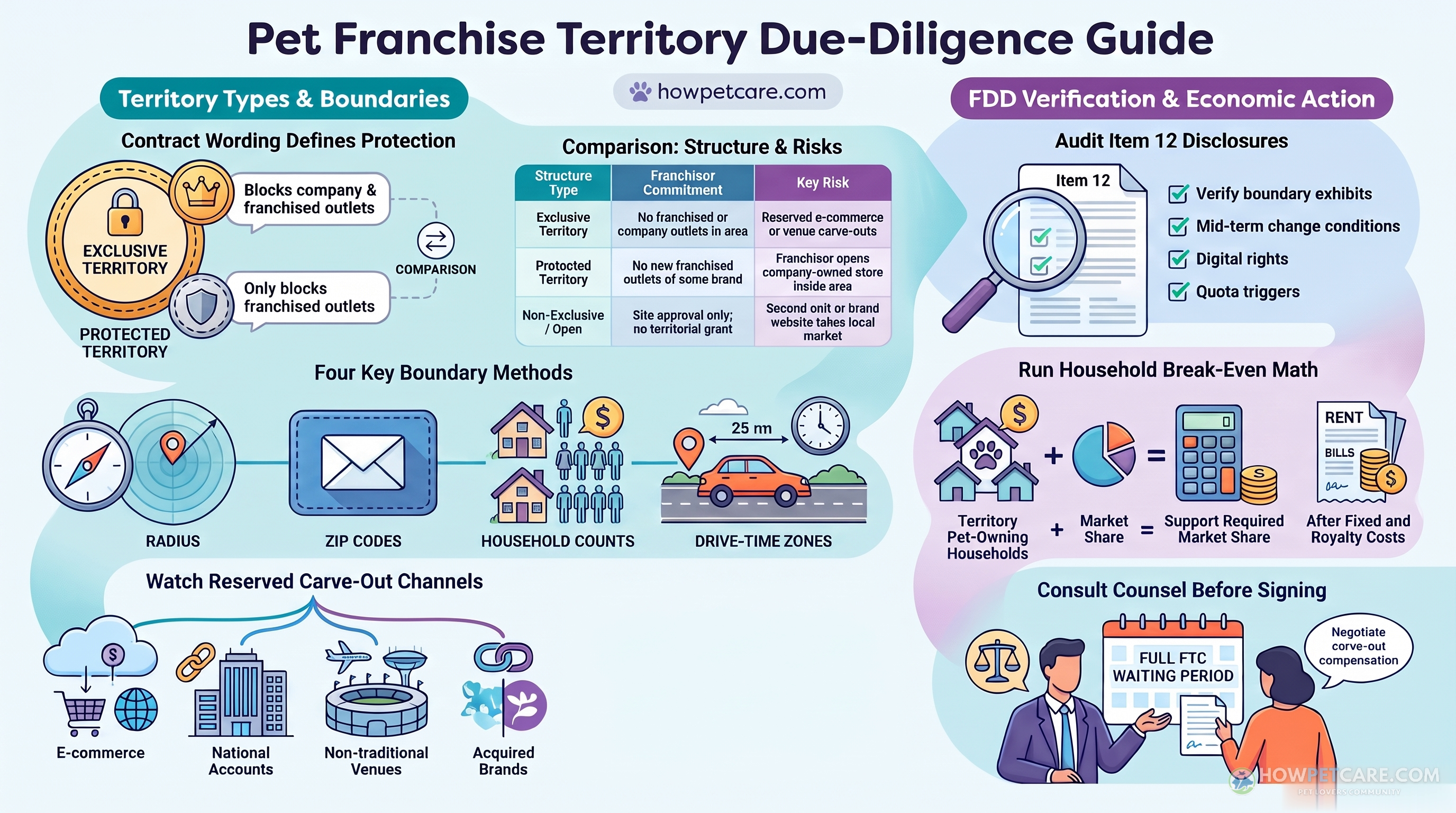
Four territory structures show up repeatedly in pet franchising, and the differences are practical, not academic. A protected territory is the narrower promise: the franchisor typically agrees not to license another franchisee of the same brand inside a defined area, while keeping other rights for itself. An exclusive territory is usually written as a broader commitment against both franchised and franchisor-owned units of the brand in the area — but it still travels with a list of reserved channels. Non-exclusive (sometimes called "open" or "site approval only") means no territorial promise at all. Area development grants rights to open several units across a region on a schedule, and protection often depends on hitting that schedule.
Because the words are used inconsistently in sales conversations, classify the offer by the contract text, not the pitch.
| Territory type | What the franchisor promises | What the franchisor can still do | Main risk to the buyer | What to verify in the FDD and agreement |
|---|---|---|---|---|
| Exclusive | No franchisor-owned or franchised units of the brand in the defined area | Usually reserved: e-commerce, national accounts, non-traditional venues, other brands, acquisitions | "Exclusive" language attached to a carve-out list that guts the promise | Whether reserved channels are itemized, and whether any of them pay you compensation |
| Protected | No new franchised outlets of the same brand in the defined area | Often everything above, plus franchisor-owned units if the wording only covers "franchised" outlets | A company-owned location or another channel placed inside your area | Whether the clause says "franchised" or "any" units, and the full carve-out list |
| Non-exclusive / open | Nothing — site approval only | Place other franchisees, company stores, or channels anywhere, including next door | Another unit opens across the street and the brand website takes your customers | Whether Item 12 explicitly states that no territory is granted |
| Area development | Rights to open multiple units in a region on a set schedule | Reduce or revoke territory if you miss the development schedule; often reserves the channels above | Losing part or all of the territory — and fees already paid — over a missed deadline | The schedule, the default and cure terms, and whether protection survives a partial default |
How to use the table: ask the franchisor which row your agreement matches, then confirm the answer in Item 12 and in the territory section of the agreement. If the sales conversation says "exclusive" but the contract wording matches the protected or non-exclusive row, the contract row wins.
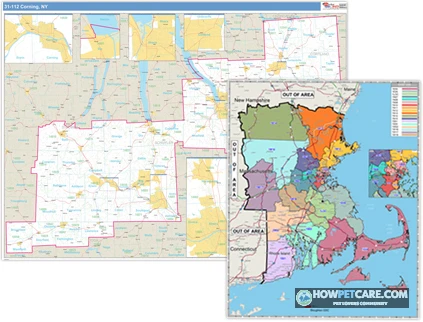
Exclusive vs. protected: where the wording diverges
The divergence usually sits in one phrase. "The franchisor will not license another franchisee to operate within the Territory" leaves the franchisor free to open a company-owned unit there. "The franchisor will not establish or license any outlet of the brand within the Territory" closes that door. Read for who is restrained (franchisor only, or franchisor and other franchisees) and for what is restrained (franchised outlets, all outlets, or all channels).
Non-exclusive and "first-come" territories
In a non-exclusive arrangement, the only practical protection is the site-approval process and whatever market knowledge you have. That isn’t automatically a bad deal — it can be cheaper and more flexible — but it should be priced and evaluated as an open market. If Item 12 says no territory is granted, plan your marketing and unit economics as if a second operator could appear in your best ZIP code next quarter.
Area-development agreements and the schedule trap
Area development adds a second contract layer: the development schedule. Protection here is often conditional, and missing a milestone can trigger a reduction in territory rather than a simple warning. If this structure is on the table, read the default and cure provisions as carefully as the grant itself, and treat every date in the schedule as a term you must be able to hit with your own capital and staffing.
How Franchise Territory Boundaries Are Defined and Measured
A territory is only as good as its definition. The common methods are:
- ZIP or postal codes. Easy to administer, easy to understand, and vulnerable to boundary shifts and postal-route changes over a long term.
- Radius from a location. A circle of a set distance around the site. Typical protection radii in franchise agreements cluster in the 5-to-10-mile range, though the figure varies by system and by market density.
- Household or population counts. A defined number of households rather than a drawn shape. Standard territory sizes for home-service concepts commonly fall in the 50,000-to-100,000-household range, again varying by brand and service model.
- Drive-time zones. Isochrone-based boundaries measured in minutes of driving, often used for destination businesses where customers will travel 20 to 30 minutes to reach the location.
- County, city, or polygon maps. Political lines or custom polygons attached to the agreement as an exhibit.
Each method behaves differently in practice. A radius circle ignores rivers, highways, and density, so a 10-mile radius in a suburban market and a 10-mile radius in a dense urban market can contain wildly different customer counts. ZIP lists are precise but brittle. Household counts can be frozen at a census date, meaning the number is fixed even as the area grows — good for you if the market booms, bad if a new subdivision lands just outside the polygon.
Radius, ZIP code, household count and drive-time: pros and cons
The test is not which method is "best" — it is whether the method produces a market you can serve and whether the exhibit matches the area you will actually drive. Radius boundaries are simple but can hand you a circle with a freeway through the middle. ZIP boundaries are clean but can split a natural trade area down the middle of a street. Household-count boundaries scale with your economics, which helps with budgeting, but they tell you nothing about where those households are. Drive-time boundaries match real customer behavior for destination services like boarding or daycare, but they change with traffic patterns and road construction.
Mobile vs. location-based pet franchises: why the boundary logic differs
Mobile pet services — mobile grooming vans, pet waste removal routes, in-home training — are route businesses. Their constraint is windshield time, so territories are usually drawn in households, ZIP clusters, or drive-time rings that keep a day’s stops tight. A radius drawn around a storefront that does not exist makes little sense for a van.
Boarding, daycare, and brick-and-mortar grooming or retail are destination businesses. Their constraint is how far a customer will drive, so protection is usually tied to a radius or drive-time zone around the physical site. A dog training franchise can fall into either bucket depending on whether it operates from a facility or in clients’ homes.
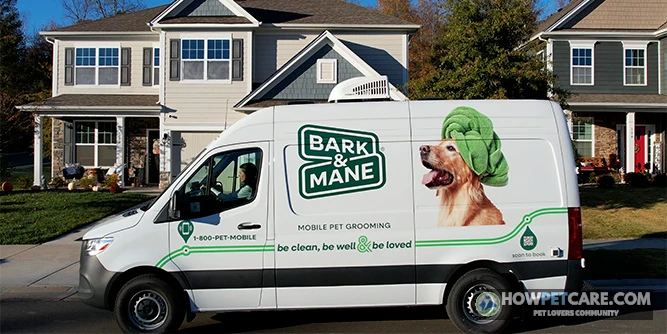
Ask the franchisor to explain the logic behind its boundary method and to show how a unit in your proposed territory would actually route or fill. If the explanation doesn’t match the map, write that down.
Ask for the territory definition as a document attached to the franchise agreement — a ZIP list, a polygon map, or a household schedule. A verbal description of the area, or a circle drawn on a marketing brochure, is not a territory right.
What a Franchisor Can Still Do Inside Your Protected Territory
This is where most first-time buyers get surprised. Franchisors routinely reserve channels, and those reservations are disclosed rather than hidden — typically in Item 12 and in the territory section of the agreement. Common reserved rights include online and e-commerce sales, national and regional accounts, non-traditional venues such as airports, stadiums, campuses, hospitals, and retail host locations, franchisor-owned outlets, sales under other brands the franchisor owns or later acquires, wholesale distribution to third-party retailers, and acquisitions of competing businesses.
| Carve-out | How it typically appears in the agreement | Compensation to franchisee (confirm in writing) | Question to ask or negotiate |
|---|---|---|---|
| E-commerce and brand website | "Franchisor reserves the right to sell through any channel of distribution now existing or later developed" | Often none; some systems credit or share | Are orders shipped into my territory credited to me, and at what percentage? |
| National and regional accounts | Franchisor contracts directly with the account and allocates work | Sometimes a fee or revenue share; frequently nothing | Do I get a first right to service locations inside my territory, and at what rate? |
| Non-traditional venues | Airports, universities, stadiums, hospitals, military bases, big-box host locations | Usually none | Which venue types are listed, and can the list be narrowed? |
| Franchisor-owned units | Company store opened inside the area | None | Does the promise cover "any" outlet or only "franchised" outlets? |
| Other and acquired brands | Franchisor may operate or license other trademarks, or acquire a chain operating nearby | Usually none | Does protection follow the brand name only, or the service category? |
| Wholesale / third-party retail | Product sold through retailers inside the territory | Usually none | Are products I am required to stock sold at retail against my service pricing? |
| Territory reduction | Right to redraw or shrink the area if thresholds are not met | Not applicable | What triggers a redraw, and is there notice and a cure period? |
Territory encroachment is the practical consequence. It happens when the franchisor or another franchisee takes customers or sales inside your area, whether or not a specific clause permits it. The contract determines which of those channels are legitimate and which are breaches.

Annotated sample territory clause and red flags
Below is an illustrative paraphrase of the kind of clause you may encounter. It is not quoted from any real agreement; it exists to show you where the load-bearing language sits.
Section X. Territory. Franchisor grants Franchisee a protected territory consisting of the geographic area described in Exhibit A (the "Territory"). During the term of this Agreement, Franchisor will not establish or license another party to establish a franchised outlet under the Brand with a physical location within the Territory.
Notwithstanding the foregoing, Franchisor reserves the right to: (a) sell products and services through any channel of distribution now existing or later developed, including internet and mobile sales; (b) service national or regional accounts pursuant to agreements between Franchisor and the account holder; (c) operate or license outlets at non-traditional venues, including airports, universities, military installations, and retail host locations; (d) sell products under other trademarks it owns or later acquires; and (e) acquire, or be acquired by, businesses that operate within the Territory.
Four phrases do most of the work. "Another party" can leave the franchisor free to open a company-owned unit, since the franchisor is not another party. "Franchised outlet" narrows the promise to franchisee-operated locations. "Notwithstanding the foregoing" signals that everything after it is an exception to the promise you just read. "Any channel now existing or later developed" is the broadest possible reservation of online and future-channel rights, and it is the phrase that most often collides with modern digital marketing.
Notice also what the sample does not contain: no definition of digital-channel rights, no order-crediting mechanism, and no performance clause. What a clause omits matters as much as what it reserves.

As a working rule in franchise due diligence: the grant paragraph tells you what you were promised, and the carve-out paragraph tells you what you actually got. Read the exceptions twice.
Who gets paid when a national account lands in your territory?
Sometimes the franchisee gets a share; sometimes the franchisee gets a phone call telling them the account has been awarded. Some systems pay a commission or revenue share when carve-out sales are fulfilled inside a franchisee’s area, and others pay nothing at all. Either outcome can be legitimate, but only one of them is in writing. Ask the question in an email and keep the reply: does the agreement provide compensation for e-commerce orders, national accounts, or wholesale sales fulfilled inside my territory, and what is the formula? If the answer is "we handle that case by case," treat the compensation as zero until the contract says otherwise.
Digital Channels That Cross Your Territory Line
A territory drawn on a map doesn’t stop an advertisement, a search result, or a delivery order from crossing it. Older agreements were drafted before most of these channels existed, which is why the digital carve-outs deserve their own scrutiny.
Geotargeted ads and shared marketing funds
Brand advertising is usually controlled at the corporate level. The questions that matter: Who controls the brand’s ad account, who sets geographic targeting, and can a neighboring franchisee’s paid campaign appear in your ZIP codes? If your ad-fund contribution is pooled nationally, ask how spending is allocated and whether any of it drives traffic toward a unit inside your territory. Get answers in writing and compare them with what current franchisees actually observe.
Local Service Ads, brand websites and delivery apps
Local Service Ads are tied to a business listing and a defined service area, so overlapping service areas between two units of the same brand create a genuine conflict — and the answer usually depends on who owns the listing. Brand websites and third-party delivery or ordering apps raise a parallel question: when a customer inside your territory places an order, which unit fulfills it, and does the sale credit you? Some agreements address order routing; many do not.
Ask directly whether the agreement defines the franchisor’s online rights or simply reserves "any channel now or later developed." Then ask three operational questions: how leads generated in my territory are routed, whether ad-fund spending is tracked by area, and how cross-territory complaints are handled and by whom. Existing franchisees listed in the FDD are the best source for what happens in practice rather than on paper.
A 2026-drafted agreement can still reserve every digital channel in a single sentence. Freshness of the contract is not evidence that the digital carve-outs were thought through. Read the words.
Step-by-Step: Verifying Your Territory in FDD Item 12
Item 12 is where the territory description is legally required to appear, and it is the anchor for this review. Work through the sequence below with the FDD and the franchise agreement open side by side.

-
Classify the grant
Does Item 12 say you receive an exclusive territory, a protected territory, or no territory at all? Write down the exact wording.
-
Locate the boundary definition
Identify whether the territory is defined by map, ZIP list, households, radius, or drive-time — and confirm the exhibit is attached to the agreement.
-
Check for change rights
Can the franchisor alter, redraw, or reduce the territory during the term? Find the conditions and any notice requirement.
-
Find the performance trigger
Is there a sales quota or development milestone tied to keeping protection, and what exactly happens if you miss it?
-
Inventory reserved rights
List every carve-out: e-commerce, national accounts, non-traditional venues, company-owned units, other brands, acquisitions.
-
Trace renewal and transfer
What happens to the territory at renewal, when you sell the business, or if you relocate the unit? Check Item 17 alongside the agreement.
-
Cross-check the system data
Review Item 20 for closures, transfers, and unit counts by state, and Item 3 for any territory-related litigation.
-
Compare document against agreement
Read the territory section of the franchise agreement line by line against Item 12 and flag every mismatch for your attorney.
-
Interview franchisees
Call current and former franchisees listed in the FDD and ask specifically about encroachment, online orders, and quota pressure.
Items outside Item 12 that confirm or contradict it
Item 12 rarely tells the whole story on its own. Items 5 and 6 give you the franchise fee, royalty fees, and ad-fund contribution that determine your break-even. Item 7 shows the initial investment. Item 11 covers site selection and advertising, which is often where digital marketing obligations hide. Item 17 governs renewal, termination, and dispute resolution. Item 19, when present, contains financial performance representations — and when absent, tells you the franchisor has chosen not to publish them. Item 20 shows outlet counts, transfers, and closures. Item 3 lists litigation. A territory that looks generous in Item 12 can look very different once Item 20 shows a cluster of nearby closures or Item 3 shows a dispute over territorial rights.
10 questions to answer against your actual FDD before signing
Every answer below should be traceable to specific contract text. If you can only answer from what a salesperson told you, mark it red.
- ☐ 1. Does Item 12 state you receive an exclusive or protected territory — or that no territory is granted?
- ☐ 2. Is the territory defined by map, ZIP list, or household count, and is that definition attached as an exhibit to the agreement?
- ☐ 3. Does the exhibit cover the neighborhoods or service area where you will actually find customers?
- ☐ 4. Can the franchisor change your boundaries or reduce protection mid-term, and under what conditions?
- ☐ 5. Is there a sales quota or performance requirement tied to keeping the territory, and what happens if you miss it once?
- ☐ 6. Does the agreement’s carve-out list match Item 12’s description of reserved rights, word for word?
- ☐ 7. Does the contract say who is credited for online orders, app orders, and leads generated inside your territory?
- ☐ 8. If a carve-out sale is fulfilled in your territory, does the agreement provide a commission or revenue share — in writing?
- ☐ 9. What happens to the territory at renewal, on transfer, or if you relocate?
- ☐ 10. Do Items 3, 17, and 20 contradict the Item 12 story through litigation, a harsh dispute clause, or a pattern of closures?

Every "no," "unclear," or "they said it verbally" answer is either a negotiation point or a reason to pause. Bring the full flagged list to your franchise attorney review.
Is Your Territory Big Enough to Be Profitable? A Worked Sizing Example
The method is straightforward: estimate the households in the territory, multiply by the share that own the relevant pet, multiply by the share that buy your service, multiply by annual spend per customer, and compare the result against your break-even. Inputs come from public and disclosure sources — U.S. Census household counts, pet-ownership rates from industry surveys such as the APPA National Pet Owners Survey or AVMA data, and spend and capture assumptions from Item 19 or from franchisee interviews.
Every number below is hypothetical and illustrative only. Replace each input with data you verify yourself.
| Input or step | Formula or source | Illustrative value | What to check against real data |
|---|---|---|---|
| Households in territory | U.S. Census block-group counts inside the map exhibit | 60,000 | Recount from the actual exhibit, not the brochure |
| Dog-owning households | Households × ownership rate | 60,000 × 50% = 30,000 | Use local or segment-adjusted survey figures |
| Households buying professional grooming | Dog households × service adoption | 30,000 × 30% = 9,000 | Confirm adoption with franchisees in similar markets |
| Annual spend per customer | Average ticket × visits per year | 70 × 7 =490 | Item 19 if published; interviews if not |
| Addressable annual spend | Buyers × annual spend | 9,000 × 490 =4,410,000 | Sanity-check against local competitor count |
| Year-one revenue at assumed share | Addressable spend × capture rate | 4,410,000 × 5% =220,500 | Test at 3% and 7% for range |
| Fixed annual costs | Van or build-out, insurance, wages, software | $150,000 | Item 7 plus local wage data |
| Royalty and ad fund | Percent of revenue | 8% + 2% = 10% | Items 5 and 6 |
| Break-even revenue | Fixed costs ÷ contribution margin | 150,000 ÷ 0.80 =187,500 | Recalculate with your real margin |
| Break-even customers | Break-even revenue ÷ annual spend | $187,500 ÷ $490 ≈ 383 | Compare with the 9,000-household market |
Read the result honestly. The break-even point requires roughly 383 active customers — about 4.3% of the potential market — against a year-one plan that assumes 5%. That works, but the cushion is thin: a slow first year, a new competitor, or a fixed cost overrun pushes the business under water. If break-even demanded 8% share in a market with a dozen established groomers, the honest options are to negotiate a larger territory, choose a different market, or walk away.
A location-based example behaves differently because the revenue ceiling is capped by capacity rather than by drive time. Suppose a boarding and daycare facility in a territory of 80,000 households offers 60 kennels and 40 daycare slots. Revenue is limited by filling those slots at local day rates, so the sizing question becomes whether the drive-time ring contains enough boarding and daycare households to keep occupancy high — not whether the whole polygon is large. For destination businesses, the drive-time boundary and the capacity plan must be tested together.

If the franchisor publishes no Item 19 financial performance representation, your revenue and capture assumptions rest entirely on your own research and franchisee interviews. Weight those conversations more heavily, and ask what occupancy, ticket, and repeat-rate numbers franchisees actually see.
Remember that the franchise fee and initial investment are sunk costs. They don’t appear in the break-even math above, but they raise the revenue you must earn before the business returns anything to you. Any sizing model that ignores them flatters the opportunity.
Quotas, Encroachment and Disputes: Can You Lose Protection, and What Can You Do?
Protection is not permanent, and the mechanism that erodes it is usually a number. Performance quotas and development schedules can convert an exclusive territory into a non-exclusive one, or reduce it outright, if the franchisee misses a target. Termination for breach and non-renewal at the end of the term are the other two exits.
How quotas and development schedules erode protection
Read the clause for three things: the threshold, the cure period, and the remedy. A quota set slightly above what a well-run unit achieves becomes a scheduled downgrade. A short cure period with no notice requirement leaves little room to respond. A remedy that says the franchisor "may, in its discretion, reduce the Territory" is broader than one that requires a documented failure and written notice. Ask whether the franchisor can reduce rather than terminate protection, and whether a first miss triggers anything at all.
From demand letter to mediation or arbitration
The path from a territory problem to a remedy is procedural, and the agreement controls it. A practical order of events:
- Document the encroachment. Dates, locations, advertisements, screenshots, order confirmations, and any lost-sale evidence. Vague complaints are easy to dismiss.
- Re-read the notice and cure provisions. Most agreements require written notice and a defined cure window before formal claims.
- Send written notice or a demand letter, ideally drafted by counsel, citing the specific clause and the specific conduct.
- Use any internal escalation the agreement provides, such as a franchise advisory council review or a meeting with the franchisor’s compliance team.
- Move to mediation if the agreement requires it as a pre-condition — many do.
- Proceed to arbitration or litigation as the agreement directs.
Item 17 tells you what that last step looks like: venue, governing law, jury waiver, arbitration rules, and whether class actions are barred. Those terms determine cost and leverage long before any dispute exists, so read them while you still have negotiating room. Available remedies can include an injunction, damages, or an adjusted royalty or territory, depending on the contract and the facts. Outcomes are fact-specific, which is another reason to have counsel assess any actual claim rather than relying on general descriptions.
1Examine the following contract wording: "The franchisor will not license another franchisee to operate within the Territory." What specific operational risk does this exact sentence leave open for the prospective buyer?
The phrasing restricts licensing to 'another franchisee' but places no contractual restraint on the franchisor itself establishing a corporate outlet.
2Which of the following channels are routinely reserved as corporate carve-outs by franchisors within a franchisee's defined geographic area?
Franchisors frequently reserve online distribution channels to capture digital market share regardless of physical territory boundaries.
3Why do mobile pet franchises (such as mobile grooming vans) typically measure territories using windshield time, household counts, or ZIP clusters rather than a radius drawn around a physical location?
Route-based services rely on minimizing travel time between stops, making household density and drive-time rings more meaningful than a circle around a non-existent storefront.
4A prospective franchisee calculates fixed annual operating costs of 150,000 and combined royalty plus ad-fund fees of 10% (yielding an 80% contribution margin). If the average annual spend per customer is 490, approximately how many active customers are needed annually to reach break-even?
Dividing fixed costs (150,000) by the contribution margin (0.80) yields a break-even revenue of 187,500. Dividing 187,500 by the annual spend per customer (490) results in approximately 382.65, or 383 customers.
5When negotiating a franchise agreement prior to signing, which of the following territory terms are realistically negotiable when backed by documented business evidence?
Franchisors are often willing to share online revenue to align local fulfillment incentives without deleting their corporate online carve-out.
6How do performance quotas or development schedules typically affect territory protection if a franchisee misses a target milestone?
Franchisors include quota and milestone provisions to ensure market penetration, reserving rights to shrink boundaries or revoke exclusivity upon a missed target.
What is realistically negotiable before you sign
Negotiability varies by franchisor and by how much of the market is already sold, so ask directly which terms the franchisor has changed for other franchisees. The items most commonly adjusted:
- Carve-out compensation. A revenue share on national accounts and e-commerce orders fulfilled in your territory is often easier to obtain than deleting the carve-out.
- Boundary size and shape. Adding ZIP codes or households to reach your break-even threshold is a concrete ask, especially in unsold markets.
- Right of first refusal on adjacent territory. Locks in your expansion path before a neighbor takes it.
- Quota level and cure period. Lower the threshold and lengthen the cure window; ask whether reduction replaces revocation.
- First right to service local accounts inside your territory when the franchisor keeps the national contract.
- Defining online rights rather than accepting "any channel now or later developed," with order crediting for sales shipped into your area.
- Company-owned units. If the clause covers only franchised outlets, ask for it to cover franchisor-owned locations too.
Frame every request around a documented business reason — the household math, the break-even calculation, the competitor count — rather than a preference. Specific, evidenced asks get answered; abstract ones get declined.

Your Pre-Signing Territory Action Plan
You now have everything needed to evaluate a specific pet-franchise offer. Work the sequence in order, and do not let a step slide because the sales process is moving quickly.
- Classify the territory type using the comparison table, based on contract wording rather than the pitch.
- Obtain the boundary exhibit — the map, ZIP list, or household schedule attached to the agreement.
- Run the nine-step Item 12 review and the ten-question checklist, writing down every unclear answer.
- List every carve-out with its compensation answer in writing, and note which ones have no compensation mechanism.
- Test the economics with your own household, pet-ownership, spend, and break-even inputs.
- Call current and former franchisees listed in the FDD, plus check franchisee-reported satisfaction sources such as Franchise Business Review, understanding that such surveys reflect respondent opinion rather than audited performance.
- Book a franchise attorney review of the FDD, the franchise agreement, the territory exhibit, and any state addenda before signing or paying.
A simple decision guide helps at the end. Proceed when the territory is clearly defined in an attached exhibit, the carve-outs are itemized with a written compensation answer, the household math clears break-even with real headroom, and Item 20 shows a stable system. Negotiate when the grant is sound but the carve-outs, quota, or boundary size are unfavorable — and put every request in writing. Walk away when Item 12 grants no territory while the sales pitch promises exclusivity, when there is no boundary exhibit, or when the break-even math requires a market share the local competition makes implausible.
Request the full package in writing: the current FDD, the complete franchise agreement with all exhibits, the territory map or ZIP list, the operations manual table of contents, the franchisee list, and any state-specific addenda. The FTC Franchise Rule sets a waiting period between receiving the disclosure document and signing or paying, and that window exists precisely so you can do this work — use all of it. If you are comparing multiple pet franchise opportunities, run the same checklist against each one so the comparison is like for like across grooming, boarding, training, and mobile service models.

This article is general education about how territory rights are structured and disclosed. It’s not legal advice and can’t substitute for a review of your specific documents. Confirm every term — territory, carve-outs, quotas, renewal, and dispute resolution — with a franchise attorney licensed in your state before you sign.
FAQ
Do pet franchises offer protected territories?
Many do, but it varies by brand and by the specific agreement. Some pet franchises grant a protected or exclusive territory, others grant a site-based radius, and some offer none, so check Item 12 and the franchise agreement for the offer you are considering.
Does a protected territory guarantee I will make a profit?
No. It limits certain competition from the franchisor and other franchisees, but it does not guarantee demand, sales, or profit. The territory still has to contain enough customers to cover your fees and costs.
Can a franchisor change my territory after I sign?
Only if the agreement allows it. Item 12 must disclose whether the franchisor can alter the territory or the protection, and under what conditions, so look for any unilateral right to change it.
Does territory protection continue when I renew or sell the franchise?
Not automatically. Renewal terms may offer a different territory or revised agreement, and transfers may require franchisor approval, so check Item 17 and the agreement for how the territory is treated at renewal and transfer.
Do I need a lawyer to review the territory terms?
A franchise attorney is strongly advised before signing. The territory clause interacts with the termination, renewal, and dispute-resolution provisions, and an attorney can spot conflicts that a first-time buyer is likely to miss.
Is the territory fee separate from the franchise fee?
It depends on the franchisor. Some include territory in the initial franchise fee, while others charge extra for larger or additional territories, so confirm in Items 5 and 7 of the FDD.