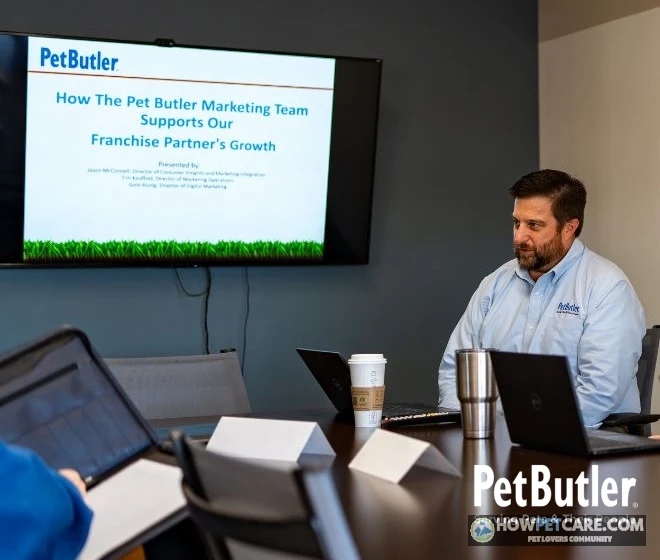

A franchise discovery day is a scheduled visit — in person or virtual — where a qualified candidate meets the franchisor’s leadership, tours operations, and both sides evaluate fit before any agreement is signed. The event is typically educational, and an invitation doesn’t guarantee an offer.
A franchise discovery day is a scheduled visit — or virtual session — run by a franchisor where a qualified candidate meets leadership, tours operations, and both sides evaluate each other before any franchise agreement is signed. The event is usually educational, not a closing pitch, and an invitation doesn’t guarantee an offer.
What a Franchise Discovery Day Is (and What It Isn’t)
In short, a franchise discovery day is a structured event that pulls a prospective franchisee into the franchisor’s world. You see the brand, meet the team, tour operations, hear the financials, and ask questions. The franchisor, in turn, gauges whether you have the temperament and capability to run the business.
The mutual-evaluation frame is real, but it’s asymmetric. The franchisor controls the agenda, the questions, and the pace. You control your attention and preparation. That’s why the best discovery days feel less like sales meetings and more like due-diligence fieldwork.
The term "discovery day" isn’t used consistently. Some brands call it a "meet-the-team day," others a "confirmation day," and still others reserve "validation day" for later-stage checks. Ask the franchisor exactly what the event includes before you prep around the wrong label.
A discovery day isn’t the same as a validation day. Discovery day usually centers on the franchisor presenting culture, support, model, and operations. Validation is your own checking process — franchisee calls, financial review, and so on. A "meet-the-team day" may be a lighter version, and a "confirmation day" can overlap with validation.
Attendance varies. A discovery day may include you, franchisor leadership, and sometimes current franchisees. Some events involve only executives and trainers. Pet-focused discovery days often bring in grooming, boarding, daycare, and retail operators.
Where Discovery Day Falls in the Franchise Buying Process
Discovery day typically follows the initial inquiry, intro call, application, and financial qualification. It often comes after the FDD is delivered, though practices differ. The FTC Franchise Rule requires the franchisor to provide the franchise disclosure document at least 14 calendar days before you sign a binding agreement or pay any money — a clock that matters if someone asks for a deposit at the event.
A common sequence runs: inquiry → intro call → application & financial qualification → FDD delivery → discovery day → franchisee validation calls → agreement review → signing. Some brands schedule discovery day before the FDD, others after. Either way, request the FDD early. Whatever the exact order, discovery day usually sits between FDD delivery and franchisee validation — the stage where you do your own checking, not theirs.
Three practical questions come up constantly at this stage. Who pays for travel? Practices vary — some franchisors reimburse part or all, others don’t, so ask before you book and get the answer in writing. Should you sign or pay a deposit on the day? Generally no — the 14-day FDD rule, the need for attorney review, and the leverage you lose all argue against it. What happens after? Franchisor approval, validation calls, agreement review, and signing — each covered in detail below.
To land an invitation, be qualified on liquid capital and net worth, complete the application, respond promptly to follow-ups, and ask your development contact what triggers an invite. Remember, an invitation signals interest — it doesn’t mean the opportunity has been vetted for you.
A Sample Discovery Day Agenda, Hour by Hour, With What to Watch For
No two agendas are identical. The table below is an illustrative composite drawn from commonly described formats. Ask your development contact for the actual agenda in writing about a week before you attend.
| Time block (illustrative) | What typically happens | What to listen and watch for | Question or note to capture |
|---|---|---|---|
| 8:00-8:30 Arrival and introductions | Coffee, name tags, small talk with development team | Who greets you, just sales staff or operations leaders too? How do staff treat each other? | Note names and roles. You will reference them in follow ups. |
| 8:30-9:15 Brand story and founder presentation | History, mission, growth narrative, culture pitch | Is the story about franchisee success or franchisor growth? Are claims verifiable in the FDD? | Write down every number quoted. Cross check against Items 7, 19, 20 later. |
| 9:15-11:00 Department sessions | Short briefings from ops, marketing, real estate, training, tech | Do presenters answer specifics or deflect? Does training length match Item 11? Does marketing describe lead flow or just brand awareness? | Ask each presenter: What is the most common complaint franchisees have about your department? |
| 11:00-12:00 Facility or flagship tour | Walkthrough of a model or operating location | Cleanliness, equipment condition, staff engagement. For pet concepts: smell, noise level, animal stress signals, staff to animal ratio on the floor | Count animals visible versus staff present. Ask: Is this location franchised or company owned? |
| 12:00-1:00 Working lunch | Informal meal with team and sometimes franchisees | The least guarded block. People relax. Listen for off script comments about support and culture. | Ask a junior staffer how long they have been there and what they would change. |
| 1:00-2:00 Franchisee panel or meet and greet | Current owners answer questions | Are these hand picked top performers? Do they hesitate before answering? Can you get their contact info? | Ask: Knowing what you know now, would you sign again? Write down who says yes fast versus slow. |
| 2:00-3:00 Financial and investment overview | Investment range, revenue potential, financing options | Do quoted numbers match Item 19 exactly? Is revenue being presented where you need profit? | Flag any figure not in the FDD. Ask where it appears in writing. |
| 3:00-4:00 One on one Q and A | Private meeting with development lead | This is where you ask hard questions without an audience. | Use your prepared list. Ask about closures, litigation, and whether answers can be confirmed in writing. |
| 4:00-4:30 Wrap up and next steps | Timeline, deposit pitch sometimes, thank yous | Any urgency language, territory will not last, decision by Friday, is a signal not a favor. | Ask for the stated timeline and deposit terms in writing. Commit to nothing. |

Illustrative agenda with candidate side annotations
For each block, listen for consistency, ask follow-ups, and jot down names, numbers, and commitments.
Virtual versus in person discovery days: trade offs and how to adapt
Virtual days save travel cost and speed scheduling, but they limit site inspection and unscripted observation of staff and animals. If you’re attending virtually, ask for a live video walkthrough via phone, request unscripted franchisee calls, or schedule an unannounced visit to an operating location afterward. Duration varies by brand, so confirm start and end times in advance.
Travel, Cost, Dress Code, and What to Bring: Logistics Most Guides Skip
Who covers travel and lodging? Practices vary. Some franchisors reimburse part or all; others don’t. Ask your development contact before you book and get the answer in writing. A simple script: "Before I book flights, can you confirm what the franchisor covers and what I should plan to cover?" — it’s a normal question experienced franchisors expect.
Dress code: business casual is the safe default, plus closed-toe, comfortable shoes if a facility tour is on the agenda. For pet concepts, avoid clothing you can’t get dirty or that isn’t safe around animals, and ask whether the tour includes kennel or play areas.
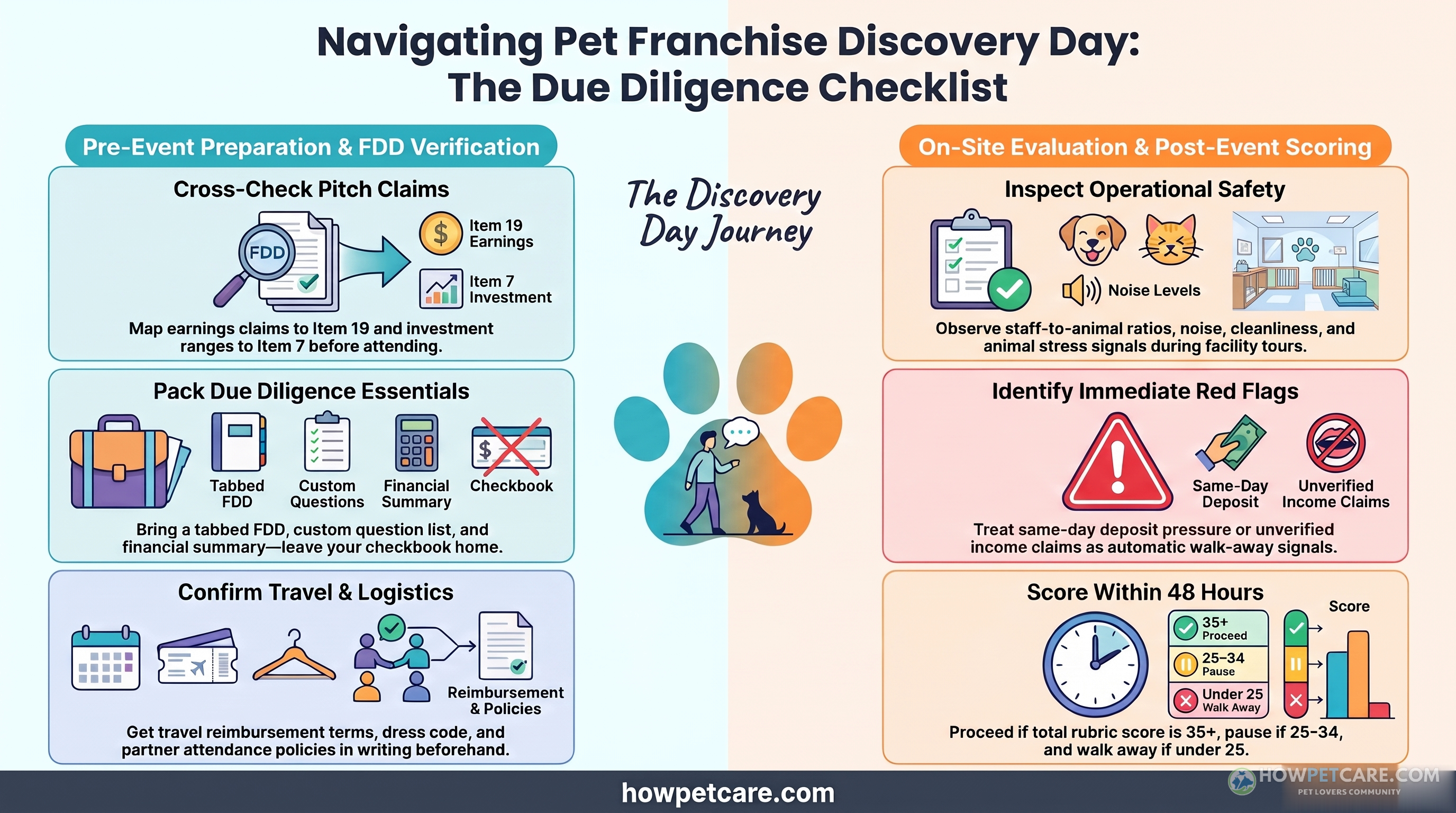
What to bring: a printed FDD with tabs and highlights, your question list, a notebook, a one-page personal financial summary, ID, and a charged phone plus charger. Leave the checkbook at home.
Spouse or partner attendance: bring the person who shares the financial risk or will help run the business. Ask the franchisor in advance whether partners are welcome — policies vary.
Candidate etiquette: limit yourself to one drink at dinner, keep your phone off during presentations, don’t oversell your experience, don’t dominate Q&A, and don’t bad-mouth other franchise brands. Also, don’t be so passive that you skip the hard questions.
Before You Go: An FDD and Item 19 Verification Checklist
Review the FDD before the event. Map every pitch-deck claim to the corresponding FDD item: earnings claims → Item 19, total investment → Item 7, franchise fee → Item 5, royalty and ad-fund fees → Item 6, territory rights → Item 12, outlet counts and closures → Item 20, litigation → Item 3, franchisor financials → Item 21, renewal and termination terms → Item 17.
For Item 19, check which locations are in the sample, what share of the system they represent, whether the figures show revenue or profit, the time period covered, whether company-owned units are included, and what’s excluded. If a presenter cites numbers that aren’t in Item 19, treat those claims as unsupported unless the franchisor can point to them in the FDD.
Item 20 and franchisee validation: examine units opened, transferred, terminated, and closed over the past three years, then use the franchisee contact list to call owners — including those who recently left.
Pet-business numbers to verify: revenue per service line (grooming, boarding, daycare, retail), staffing ratios and labor-cost assumptions, capacity and utilization, build-out costs for kennels and play areas, and insurance and licensing costs.
It’s wise to have a franchise attorney and an accountant review the FDD before or shortly after the event.
Pitch claim to FDD item: what to cross check
| What you hear in the pitch | FDD item to check | What to verify | Red flag if you see this |
|---|---|---|---|
| Revenue or profit claims | Item 19 | Sample size, time period, company owned units, revenue versus profit | Claims not in Item 19 |
| Total initial investment | Item 7 | Breakdown, fees, build out | Range does not match presentation |
| Franchise fee | Item 5 | Exact amount, due at signing | Fee missing or vague |
| Royalty and ad fund | Item 6 | Current rates | Typical rates quoted |
| Territory rights | Item 12 | Exclusive territory, encroachment rules | Vague boundaries |
| Closures and litigation | Item 20 and Item 3 | Unit history, legal history | Hidden patterns |
Questions to Ask at Discovery Day, and How to Tell a Good Answer from an Evasive One
Organize your questions by theme: unit economics, support and training, territory, franchisee satisfaction, franchisor financial health, exit options. For each theme, prepare two or three questions, note why you’re asking, and define what a good answer looks like versus an evasive one.
For instance, when you ask about average time to breakeven, a good answer cites FDD data or franchisee ranges; an evasive answer just says "it depends" with no reference.
Territory rights: ask how territories are defined, whether online or mobile sales encroach, and what happens if another franchisee — or the franchisor — opens nearby.
The pet-industry question bank below covers animal welfare, facility cleanliness, staffing, and safety. For each question, note why it matters and what a good versus evasive answer looks like.
| Category | Question to ask | Why it matters | A good answer | An evasive answer |
|---|---|---|---|---|
| Animal welfare | What certifications or training do staff complete before handling animals? | Untrained handlers are a top injury and liability risk in pet services. | Names a specific program, hours required, and written protocol you can see. | We hire people who love animals. |
| Animal welfare | How do you assess dogs for daycare entry, and how many get turned away? | A brand that accepts every dog accepts bite risk. | Describes temperament evaluation, cites rough rejection rate, explains what happens to failed dogs. | We have never had a problem. |
| Incidents | Walk me through what happens when a dog is bitten or injured here. | Incident handling reveals whether safety is a system or a hope. | Written log, owner notification, vet protocol, incident review. | Vague reassurance, deflection. |
| Safety | What vaccination and health records do you require before a dog joins group play? | Weak vaccine checks invite disease outbreaks that become your reviews and your liability. | Named vaccine list, verification process, and what happens when records lapse. | We trust owners to keep shots current. |
| Facility | What are sanitation and ventilation standards, and how are they audited? | Smell and disease control drive reviews, churn, staff retention. | Named disinfectants, cleaning schedule, air exchange or odor control, audit frequency. | Our franchisees keep things clean with no standard. |
| Staffing | What staff to animal ratio do you require, and what has groomer turnover been like? | Labor is biggest cost; groomer churn kills grooming revenue. | States ratio, admits turnover is a challenge with recruiting plan. | No stated ratio; it depends on the day. |
| Staffing | What is average tenure of a groomer in your system? | Groomers are poached constantly; tenure under two years signals staffing model problem. | Gives number and explains retention tools. | Does not track it. |
| Local demand | What market data did you use to approve this territory? | You are paying for territory rights. | Shares demographic criteria. | We picked your territory, trust us. |
| On tour | Observe, do not ask. Smell, noise, animal stress signals, staff interactions. | You see what operation actually looks like when supervised. | Clean floors, calm animals, staff narrating confidently. | Overcrowded play area, staff hovering, barking distressed. |
Score the Day: A Buyer Side Rubric, Red Flags, and Walk Away Signals
Score each criterion within hours of leaving, while memory is fresh — before any follow-up calls or enthusiastic emails from the franchisor. Weight the criteria that matter most to you, but treat any single red flag as a veto, regardless of the total.
Criteria to score: transparency on numbers, consistency between pitch and FDD, quality of franchisee access, depth of training and support, territory protection, franchisor financial strength, operational standards, and personal fit. For pet concepts, add animal-welfare standards, facility safety, staffing model, and local-demand evidence.
Red flags: pressure to commit or pay a deposit on the spot, refusal to put answers in writing, income claims absent from Item 19, franchisee contacts limited to a hand-picked few, vague answers on closures and litigation, and dismissing animal-safety questions.
Walk-away signals differ from reasons to pause and dig deeper. A pause might look like sending written follow-up questions and making a few extra franchisee calls.
Scoring rubric table:
| Criterion | Score 1 concerning | Score 3 acceptable | Score 5 strong | Your score and notes |
|---|---|---|---|---|
| Transparency on numbers | Dodge, deflect, or cite figures not in Item 19 | Answer most questions, some deferred to we will follow up | Numbers match the FDD and they volunteer caveats | |
| Pitch versus FDD consistency | Live claims contradict Items 7, 19, or 20 | Minor gaps, plausibly explained | No gap between what you heard and what is written | |
| Franchisee access | Only hand picked panelists, no contact info shared | Panel plus a contact list on request | Full Item 20 list offered; you are encouraged to call anyone, including departed owners | |
| Training and support depth | Ongoing support with no specifics | Named programs, unclear capacity | Detailed curriculum, named support staff, franchisees confirm responsiveness | |
| Territory protection | Vague boundaries, online mobile sales unrestricted | Defined territory, some encroachment risk | Exclusive defined territory in writing, clear conflict rules | |
| Franchisor financial strength | Item 21 shows losses or thin capitalization | Stable but modest | Profitable, system growing without heavy closure rates | |
| Animal welfare and facility standards | No written protocols; tour shows stress or sanitation issues | Standards exist, enforcement unclear | Documented handling, incident, and sanitation protocols; facility matches them | |
| Staffing model | No ratios; turnover dismissed | Ratios stated, turnover acknowledged | Ratios enforced; retention plan for groomers exists | |
| Local demand evidence | We picked your territory, trust us | Some demographic data shared | Territory analysis shared, and your own calls to local groomers and vets confirm demand | |
| Personal fit | Culture felt scripted or dismissive | Professional but no connection | You would take a call from these people on a bad day | |
| Red flag veto check | Deposit pressure today, refusal to put answers in writing, or dismissed safety questions equals stop, regardless of total |
Interpretation: 35 + with no vetoes → proceed to validation calls. 25-34 → pause; send written follow-ups and make three extra franchisee calls. Under 25, or any veto → walk away.

Deposits, Signing Pressure, and What Happens After Discovery Day
Should you sign or put down a deposit at the event?
Should you sign or pay a deposit at discovery day? The safe answer is no. Cite the 14-day FDD rule, the need for attorney review, and the leverage you lose by committing before validation.
Deposits: some franchisors ask for a deposit to hold a territory or advance to the next step. Terms vary, so ask whether it’s refundable, under what conditions, within what time window, whether it’s credited toward the franchise fee, and get the terms in writing. A fully refundable deposit credited to the fee, with written terms, can be reasonable. Anything non-refundable before attorney review is not.

How approval and decision timelines usually work
After the event, the franchisor runs an internal review and decides whether to approve you as a candidate. Decision timelines vary by franchisor, so ask for the stated timeline and what happens if you need more time. An unusually short deadline is a signal to examine closely.
In the first 48 hours: complete your scorecard, email written follow-up questions to your development contact, thank the hosts, and request any promised documents. How quickly and completely they respond is data point #11.
From discovery day to signing: the sequence
The post-event sequence: franchisor internal review and candidate approval, franchisee validation calls, attorney and accountant review, financing and lender conversations, territory confirmation, receipt of the franchise agreement, negotiation of any negotiable terms, and signing. Skipping validation or counsel review to speed things up costs you your only leverage.
Franchise-agreement items to review with counsel: term and renewal, franchise fee and royalty fees, transfer and exit rights, territory language, personal guarantee, and non-compete provisions.
Your Discovery Day Action Plan: Before, During, and After
Before: confirm format, agenda, cost coverage, and attendees in writing. Read the FDD, complete the verification checklist, schedule attorney and accountant time, and prepare your questions.
During: take notes, request franchisee contacts, observe operations and animals, limit yourself to one drink, keep your phone away, and avoid commitments.
After: score the day, make franchisee and local-market validation calls, review the franchise agreement with counsel, and decide with your partner against your pre-set criteria.

Decision rule: set your own walk-away criteria before you attend so enthusiasm on the day doesn’t override them.
Use the rubric total and any red flags to decide on a go, pause, or no-go outcome.
FAQ
How do I get invited to a franchise discovery day?
Invitations usually follow an intro call, a completed application, and confirmation that you meet the franchisor’s financial requirements. Ask your development contact which criteria trigger an invitation and how soon after qualification they schedule one.
Is a franchise discovery day a good sign?
An invitation means the franchisor sees you as a qualified candidate. It does not show the business model performs well, so you still need to check the FDD, talk to current franchisees, and score the opportunity yourself.
Are virtual discovery days as effective as in-person ones?
Virtual days save travel time and cost, but they limit your ability to inspect a location and watch staff and animals without a script. If your day is virtual, ask for a live walkthrough of an operating site, unscripted franchisee calls, and an optional in-person visit before you commit.
What is the difference between a discovery day and a validation day?
Brands use the terms differently, but discovery day usually centers on the franchisor presenting the brand, team, and model. Validation is the candidate’s own checking, such as franchisee calls and FDD review. Ask each franchisor exactly what its event includes.
Can I bring a lawyer to a franchise discovery day?
Most candidates have a franchise attorney review the FDD and franchise agreement separately, not attend the event. If you want your attorney or an advisor present, ask the franchisor ahead of time whether that is allowed.