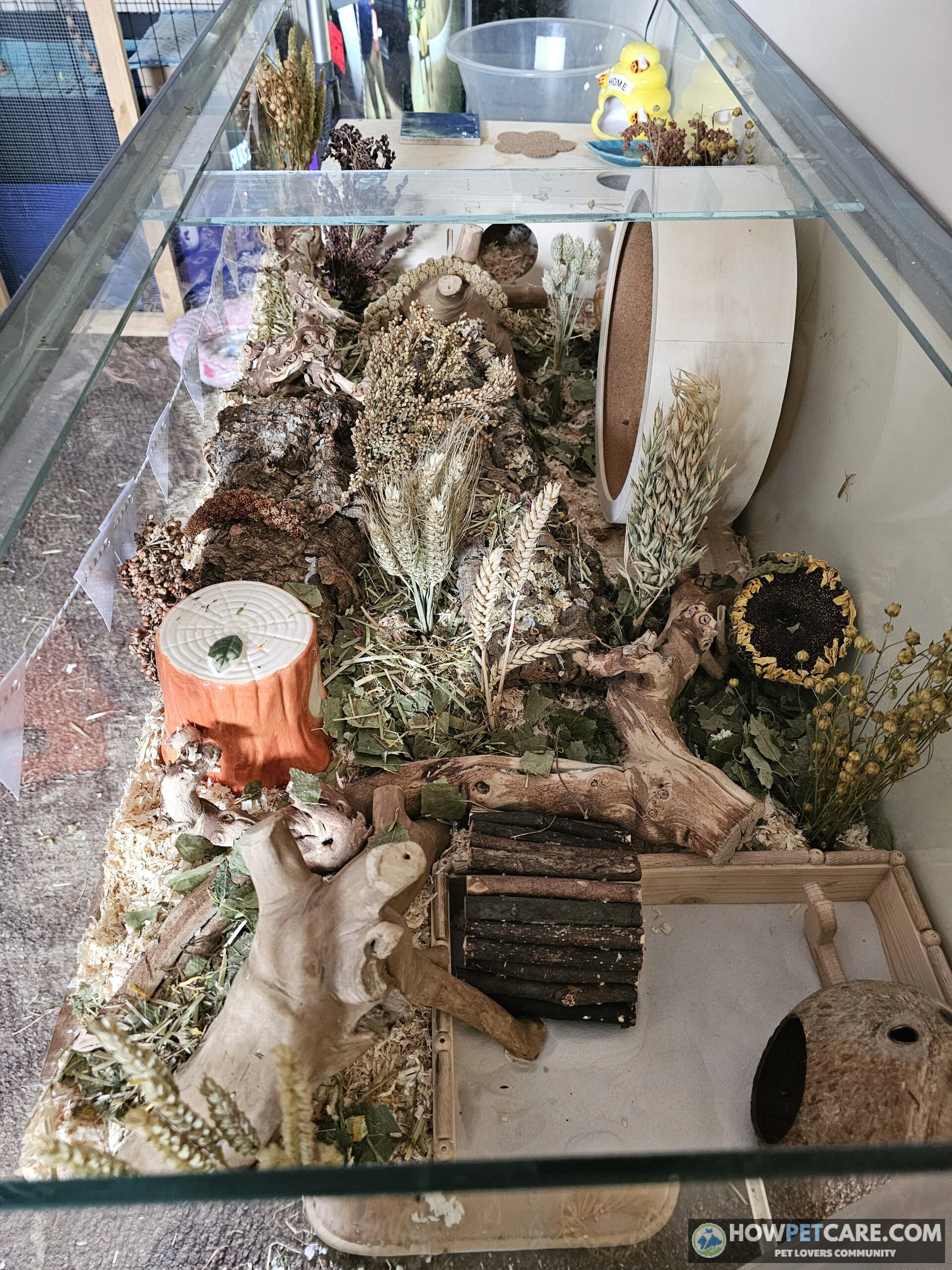

The best hamster cages provide one continuous floor area, deep bedding capacity, secure ventilation, and species-safe bar spacing. Choose at least 775 square inches for Syrians and 620 to 775 square inches for dwarf hamsters, then ensure the enclosure can hold adequate substrate and a properly sized wheel.
Choosing safe, appropriately sized hamster cages requires cutting through decades of misleading pet-store packaging. Most cages on mainstream retail shelves fail to provide the continuous floor space, substrate depth, and airflow needed for basic rodent welfare. A humane habitat must function as a deep-substrate burrowing system, not a plastic novelty toy.
Getting the setup right comes down to matching species-specific physical needs with practical maintenance routines. Syrian hamsters and dwarf hamsters have distinct spatial minimums, bar spacing limits, and running wheel requirements. This guide covers current veterinary size baselines, breaks down major commercial and custom enclosure styles, examines the real first-year cost of ownership, and provides a clear decision matrix for building an enriching home for your pet.
Minimum Hamster Cage Size Requirements and Usable Floor Space
Modern veterinary medicine and animal welfare groups—including the British Hamster Association and the TVT (Veterinary Association for Animal Protection in Germany)—reject the outdated commercial standard of 450 square inches of floor space. Under current welfare benchmarks, all hamster species require a minimum of 775 to 1,000 square inches of unbroken, continuous floor space. For active Syrian hamsters, particularly females, 1,000 to 1,200+ square inches serves as the practical baseline to prevent stress-induced stereotypic behaviors.
A hamster’s spatial needs can only be fulfilled by a single, continuous level. Connecting three small cages of 200 square inches each with plastic external tubes does not equal a 600-square-inch enclosure. Hamsters are terrestrial ground-dwellers and extensive burrowers; segmented modular cages interrupt natural foraging ranges and eliminate their ability to dig contiguous, stable underground tunnel systems.

How to Calculate True Continuous Floor Space
Commercial manufacturers frequently print exterior packaging dimensions that measure the widest plastic lip, protruding handles, or wire roof overhangs. Those numbers do not reflect the actual living space available inside. To establish true continuous floor space, calculate the interior dimensions right at the substrate level:
- Measure the Interior Floor Bed: Run a tape measure along the inside base of the cage pan, recording length and width strictly where the bedding rests.
- Account for Base Tapers: Plastic injection-molded cage trays almost universally taper inward from top to bottom so factories can stack them. A tray measuring 32 inches by 18 inches at the upper rim may measure only 28 inches by 14 inches across the bottom.
- Exclude Ramps, Lofts, and Shelves: Elevated plastic platforms and wire lofts do not count toward baseline square footage. They offer surface area for a food bowl or water bottle, but they cannot hold burrows and can introduce dangerous fall hazards.
- Multiply Base Length by Base Width: An interior floor measuring 38 inches long by 20 inches wide yields 760 square inches of true usable floor space.
Worked Example: Usable Floor Space Calculation for a Syrian Hamster
The Scenario
You are evaluating a commercial cage labeled as "32.5 in x 19 in x 17.5 in" for a female Syrian hamster, which requires a minimum of 775 to 1,000 square inches of unbroken floor space.
Step 1: Strip Exterior Add-Ons
- Exterior advertised footprint: 32.5 in x 19 in = 617.5 sq in (already below the 775 sq in welfare baseline).
- Exterior accessories: The model features two external plastic tube rings and a clip-on loft platform measuring 10 in x 8 in (80 sq in).
- Rule: Detached tubes and elevated wire or plastic platforms do not count toward continuous floor space because hamsters cannot burrow across them or exhibit natural terrestrial foraging.
Step 2: Measure Interior Base Dimensions (Accounting for Taper)
Most molded plastic bases taper inward toward the bottom to allow manufacturer nesting during shipping:
- Top of base rim: 31.0 in length x 17.5 in width
- Bottom of base (where bedding meets floor): 28.5 in length x 15.0 in width
- True Usable Continuous Floor Space: 28.5 in x 15.0 in = 427.5 sq in
Step 3: Vertical Wheel Clearance Check
A full-grown Syrian requires an upright 11- to 12-inch running wheel to prevent spinal curvature (lordosis), plus at least 10 inches of bedding depth.
- Total vertical height needed: 10 in (bedding) + 12 in (wheel diameter) + 2 in (wheel stand clearance) = 24 in minimum internal height.
- Cage internal height: 16.5 in usable height.
Verdict
- Calculated Floor Space: 427.5 sq in vs. 775 sq in minimum requirement (Fails by 347.5 sq in).
- Wheel & Bedding Fit: Installing a safe 12-inch wheel leaves only 4.5 inches of bedding depth, failing the 10-inch burrowing standard.
- Actionable Selection: Reject this unit. Select an enclosure measuring at least a 40 in x 20 in base with 20 to 24 inches of internal height (e.g., a 75-gallon aquarium, Bucatstate 2.0 Large, or Niteangel Bigger World Large).
Syrian Hamster vs. Dwarf Hamster Size Baselines
Syrian hamsters (Mesocricetus auratus) are solitary, territorial giants compared to dwarf species. An adult Syrian reaches 6 to 8 inches in length and weighs between 120 and 220 grams. Because of their body mass, Syrians require larger hideouts, wider entrance tunnels, and big wheels that take up substantial cage volume. Female Syrians also go into estrus every four days, creating intense territorial frustration if confined to an enclosure under 1,000 square inches.
Dwarf hamsters—comprising Campbell’s Russian (Phodopus campbelli), Winter White (Phodopus sungorus), and Roborovski (Phodopus roborovskii)—average 2 to 4 inches in length. Their bodies are small, but their energy and natural roaming ranges are immense. In the wild, a Roborovski hamster can travel several miles in a single night across sand dunes and semi-arid terrain. While a dwarf hamster can start in 620 to 775 square inches of continuous floor space, expanding toward 1,000 square inches produces noticeable drops in territorial stress, cage-biting, and corner-digging.

Hamster Enclosure Styles Compared: Wire, Glass Terrarium, Acrylic, and DIY Bins
Small-pet owners in the US market generally choose among four structural habitat formats: traditional wire cages, glass terrariums, acrylic enclosures, and DIY storage bin builds. Each design presents specific trade-offs between airflow velocity, bedding retention, structural chew-resistance, and overall purchase price.
Wire Cages vs. Acrylic Enclosures
Wire-frame enclosures mounted on plastic base trays offer superior passive airflow. Natural cross-ventilation constantly evacuates metabolic heat and respiratory moisture, preventing dampness. Wire habitats also permit easy exterior mounting of water bottle brackets and running wheels.
However, standard wire cages severely limit bedding depth. Most feature shallow plastic pans measuring only 5 to 6 inches deep. Because a hamster needs 8 to 12 inches of substrate to build stable burrows, wire cage owners must install acrylic or cardboard bedding guards around the perimeter to keep bedding from spilling through the bars. Wire rungs also expose stressed animals to chronic bar-chewing injuries if the cage is too cramped.
Acrylic enclosures (such as those engineered by Niteangel or Bucatstate) provide smooth viewing panels with pre-drilled cross-ventilation holes. These enclosures feature solid lower walls that retain 10 to 14 inches of substrate without spillage. Their flat, non-porous walls eliminate bar-chewing entirely, preventing tooth fractures. The main trade-offs are scratch vulnerability during cleaning, less airflow compared to open wire, and a higher retail purchase price.

Glass Terrariums and Converted Aquariums
Standard glass aquariums (40-gallon breeder tanks or 75-gallon tanks) and front-opening reptile terrariums make popular homes for small rodents. Glass is chew-proof, non-porous, unaffected by urine acid, and clear for easy observation.
Because tanks feature solid walls, they can hold 12 to 16 inches of packed bedding. This allows the hamster to dig underground tunnels right against the glass. The main challenge is air exchange. Airflow only moves across the top plane, so a glass tank must use an open, heavy-gauge wire mesh lid. Solid glass lids or plastic hood covers must never be used on a rodent enclosure, as they trap ammonia gas and humidity inside.

The Safety Risks of Cheap Hamster Cages with Tubes
Mass-market starter cages built with external plastic crawl tubes (such as the Tiny Tales or Kaytee CritterTrail lines) are widespread in big-box retail. Animal welfare professionals advise against these systems for several clear reasons:
- Respiratory Stagnation: Narrow plastic tubes (typically 2 to 2.25 inches in diameter) have minimal airflow slits. When hamsters urinate, sleep, or store fresh greens inside these tubes, high concentrations of ammonia build up in the enclosed tube loop, causing severe respiratory inflammation.
- Physical Entrapment and Cheek Impact: Adult Syrian hamsters often measure 2.5 to 3 inches wide across the torso when their cheek pouches are packed with food. An adult Syrian attempting to navigate a narrow tube with filled pouches can wedge tightly inside, risk tearing the internal pouch membrane, or suffer fatal suffocation.
- Sanitary Failure: Disassembling dozens of tube connectors during weekly cleanings is labor-intensive. Pet owners frequently skip cleaning soiled tube runs, leading to dried urine scale and fungal growth.
Do not use commercial modular cages with connected external tubing as a primary habitat. Tubes provide zero burrowing value, cause fatal cheek pouch impactions in Syrian hamsters, and concentrate respiratory toxins within unventilated bends.

Commercial Hamster Enclosure Specifications and Brand Comparison
To help you evaluate commercial hamster cages against current welfare baselines, the table below compares key technical specifications, usable footprints, and verified 2026 retail price brackets across major brands in the United States.
| Model / Brand | Enclosure Style | Usable Floor Space (sq in) | Bar Spacing / Mesh Gauge | Recommended Species | Estimated Price Range (2026) |
|---|---|---|---|---|---|
| Savic Plaza 120 | Wire frame with deep plastic base | 890 | 3/8-inch (9.5 mm) | Syrian, Dwarf, Chinese | $150 – $190 |
| Niteangel Bigger World (Large) | Wood-composite frame with acrylic panels | 930 | Solid walls / Top wire mesh | Syrian, Dwarf | $190 – $240 |
| Prevue 528 Universal | Wire upper with 6-inch plastic tub pan | 620 | 3/8-inch (9.5 mm) | Dwarf only (Entry-level) | $90 – $120 |
| Bucatstate Metal 2.0 (Large) | Acrylic front/sides with metal top mesh | 810 | Solid walls / Top wire mesh | Syrian, Dwarf | $160 – $210 |
| 75-Gallon Rimmed Tank (Aqueon) | Glass aquarium | 864 | Requires separate screen lid | Syrian, Dwarf | $130 – $230 |
| Ferplast Karat 100 | Glass bottom tank with wire top tier | 780 | 3/8-inch (9.5 mm) | Syrian, Dwarf | $280 – $370 |
| Full Cheeks Easy Clean | Plastic pan with wire top and tubes | 380 | 1/2-inch (12.7 mm) | Below welfare minimums | $50 – $75 |

ASCII Scale: Visualizing Usable Floor Space Across Common Habitats
Veterinary baselines require a continuous, unbroken floor plane. Elevated lofts and tube attachments do not add to this baseline footprint.
Pet Store Modular Cage (e.g., Tiny Tales / CritterTrail) [180 sq in]
[====] (Cruelty threshold; fails all species)

Outdated Commercial Baseline [450 sq in]
[==========] (Fails modern welfare baselines)

Prevue 528 Wire Enclosure [620 sq in]
[==============]
* Minimum entry point for dwarf hamsters only

Modern Welfare Minimum (Dwarf & Syrian) [775 sq in]
[==================]
* Recommended baseline: Savic Plaza 120 / 50-Gal Converted Bin

Syrian Optimal Floor Baseline [1,000 sq in]
[=======================]
* Bucatstate 2.0 / 75-Gallon Breeder Tank (approx. 48 in x 18 in)

Veterinary Gold Standard [1,200+ sq in]
[============================]
* Niteangel Bigger World XL / Converted Furniture / Custom Enclosures
Scale: 1 bracket marker "=" equals approximately 40 square inches of unbroken floor area.
| Model / Brand | Enclosure Style | Usable Floor Space (sq in) | Bar Spacing / Mesh Gauge | Recommended Species | Estimated Price Range (2026) |
|---|---|---|---|---|---|
| Niteangel Bigger World (Large) | Wood-composite frame with acrylic panels | 930 | Solid walls / Top wire mesh | Syrian, Dwarf | $190 – $240 |
| Savic Plaza 120 | Wire frame with deep plastic base | 890 | 3/8-inch (9.5 mm) | Syrian, Dwarf, Chinese | $150 – $190 |
| 75-Gallon Rimmed Tank (Aqueon) | Glass aquarium | 864 | Requires separate screen lid | Syrian, Dwarf | $130 – $230 |
| Bucatstate Metal 2.0 (Large) | Acrylic front/sides with metal top mesh | 810 | Solid walls / Top wire mesh | Syrian, Dwarf | $160 – $210 |
| Ferplast Karat 100 | Glass bottom tank with wire top tier | 780 | 3/8-inch (9.5 mm) | Syrian, Dwarf | $280 – $370 |
| Prevue 528 Universal | Wire upper with 6-inch plastic tub pan | 620 | 3/8-inch (9.5 mm) | Dwarf only (Entry-level) | $90 – $120 |
| Full Cheeks Easy Clean | Plastic pan with wire top and tubes | 380 | 1/2-inch (12.7 mm) | Below welfare minimums | $50 – $75 |
Species-Specific Safety Criteria: Bar Spacing, Bedding Depth, and Wheel Clearance
A cage’s interior volume is safe only if its physical components prevent traumatic injury, accidental escape, and long-term skeletal damage.
Safe Bar Spacing Tolerances by Species
A hamster’s skeleton is remarkably flexible. Its skull is the only rigid physical constraint: if the skull slips through a gap, the rest of the body follows. Wire cages must strictly adhere to these spacing limits:
- Dwarf Hamsters (Roborovski, Winter White, Campbell’s): Require bar spacing between 1/4-inch (6.35 mm) and 5/16-inch (8 mm). Placing a juvenile dwarf hamster into a cage with 1/2-inch bar spacing will result in complete enclosure escape or catastrophic head entrapment.
- Syrian Hamsters: Require bar spacing between 3/8-inch (9.5 mm) and 1/2-inch (12.7 mm). Never house an adult or juvenile Syrian in a cage with bar spacing exceeding 1/2-inch. Gaps wider than 12.7 mm allow them to wedge their snout through, leading to broken facial bones or fatal hanging.
Substrate Depth for Natural Burrowing Space
In natural arid and grassland habitats, hamsters build complex underground networks with separate food pantries, sleeping chambers, and latrines. These burrows insulate them from surface temperature spikes and predators. When kept on shallow 1- to 2-inch bedding, their biological burrowing drive is blocked, triggering chronic stress.
- Dwarf Hamsters: Require an absolute minimum of 6 to 8 inches of tightly packed, paper-based or aspen substrate.
- Syrian Hamsters: Demand an absolute minimum of 10 to 12+ inches of packed substrate. Female Syrians show measurable behavioral stabilization only when substrate depths approach or exceed 12 inches.
To hold functional burrows, bedding must support weight without collapsing. Blend soft, unbleached paper fibers with sterile aspen wood shavings and orchard grass hay to create an interlocking substrate matrix that keeps tunnels intact.

Vertical Clearance for Exercise Wheels
A properly sized wheel is a core physical health requirement. Running on an undersized wheel forces the hamster to run with its spine curved backward in hyperlordosis, leading to slipped discs, osteophyte formation, and permanent mobility loss.
Syrian hamsters require an 11- to 12-inch diameter upright wheel; dwarf hamsters need an 8- to 10-inch diameter wheel. These running wheels feature wide mounting bases that add 2 to 3 inches of height. Consequently, an enclosure housing a Syrian hamster requires 22 to 24 inches of total internal vertical height to accommodate 10 inches of bedding alongside a 12-inch wheel on its stand.

Species-Specific Pre-Purchase Safety Checklist
Before buying or building an enclosure, verify these hard physical dimensions against your pet’s needs:
Syrian Hamsters (Mesocricetus auratus)
- ☐ Unbroken Floor Space: Minimum 775 sq in; 1,000+ sq in strongly recommended (especially for high-stress female Syrians).
- ☐ Bar Spacing (if wire cage): Strictly between 3/8-inch and 1/2-inch (maximum 12.7 mm). Never exceed 1/2-inch to avoid head entrapment.
- ☐ Bedding Depth Capacity: Solid-walled base must hold at least 10 to 12 inches of packed paper bedding without spilling through vents.
- ☐ Exercise Wheel Height Clearance: Vertical clearance of at least 14 inches above the base floor to accommodate an 11- to 12-inch upright wheel on a stable stand.
- ☐ Door & Tube Apertures: All entrance holes, internal arches, and tunnel diameters must be at least 2.75 inches (7 cm) wide so a Syrian with fully pouched cheeks cannot impact or tear cheek pouches.
Dwarf Species (Campbell’s, Winter White, Roborovski)
- ☐ Unbroken Floor Space: Minimum 620 to 775 sq in.
- ☐ Bar Spacing (if wire cage): Maximum 1/4-inch to 5/16-inch (6.35 mm to 8 mm). A 1/2-inch bar gap allows juvenile Roborovskis and dwarf hamsters to escape completely.
- ☐ Bedding Depth Capacity: Solid-walled base must hold at least 6 to 8 inches of substrate.
- ☐ Exercise Wheel Height Clearance: Minimum 10 to 12 inches vertical clearance to house an 8- to 10-inch wheel.
- ☐ Surface Traction: Glass and acrylic ramps must be textured or cork-lined; dwarf hamsters have fur-covered footpads and slide on smooth, steep inclines.
Ventilation, Humidity, and the Behavioral Risks of Substandard Habitats
A hamster’s respiratory anatomy is delicate. Poor airflow and cramped quarters lead directly to chronic respiratory illness, behavioral distress, and physical injury.
Microclimate Control: Ammonia, Airflow, and Humidity
Hamster urine contains high levels of urea, which environmental bacteria break down into gaseous ammonia (NH3). In poorly ventilated cages, ammonia builds up at the substrate surface. Inhaling airborne ammonia at levels as low as 20 parts per million (ppm) damages the protective cilia lining the respiratory tract, paving the way for Mycoplasma pulmonis and opportunistic bacterial pneumonia.
Wire cages offer exceptional passive airflow, which prevents ammonia from pooling. However, wire walls leave the animal open to seasonal room drafts. Glass terrariums and acrylic habitats protect hamsters from drafts, but they need an open mesh roof across the entire top surface to maintain continuous convection airflow. Keep ambient relative humidity inside the enclosure between 40% and 60%. Levels over 65% encourage mold in food hoards, while levels below 30% cause dry skin and eye irritation.
Glass terrariums also present thermal risks: placing a tank in direct sunlight creates a greenhouse effect that can drive internal temperatures above 85°F (29°C), causing fatal heat stroke. The optimal ambient room temperature for both Syrian and dwarf hamsters is 65°F to 75°F (18°C to 24°C).

| Enclosure Material | Airflow / Ventilation Quality | Max Bedding Depth Capacity | Ammonia Accumulation Risk | Spot-Clean Frequency |
|---|---|---|---|---|
| Wire Frame / Plastic Base | Exceptional (360° cross-flow) | Low (5–6 in unless modified) | Very Low (rapid gas exchange) | Every 2–3 days |
| Glass Terrarium / Tank | Moderate (top-down convection) | Exceptional (12–18 in) | Moderate (if lid mesh is obstructed) | Every 1–2 days |
| Solid Acrylic Habitat | Good (routed multi-vent ports) | High (10–14 in) | Low to Moderate | Every 2 days |
| DIY Plastic Storage Bin | Moderate (requires top & side mesh) | High (8–12 in) | High (if only top lid is vented) | Every 1–2 days |
Stereotypic Behaviors and Cage-Induced Pathologies
When hamsters are confined to habitats that block natural behaviors, they develop stereotypies—repetitive, purposeless habits caused by chronic stress. Common cage-induced problems include:
- Bar-Chewing (Stereotypic Gnawing): Confinement stress causes hamsters to relentlessly gnaw on cage wires. This can fracture incisor teeth, cause malocclusions (where teeth fail to meet and overgrow into the palate), and lead to facial dermatitis from friction against the bars.
- Bar-Scaling and Monkey-Barring: Hamsters climb wire walls and hang from the roof mesh out of an urge to escape. Hamsters have poor depth perception and lack prehensile climbing paws; falls from the cage roof onto hard decor frequently cause internal bleeding and fractured limbs.
- Repetitive Pacing and Corner-Digging: Frantic, non-stop digging against solid plastic corners indicates confinement-related distress.
- Wet Tail (Proliferative Ileitis): In Syrian hamsters, stress-induced immunosuppression allows Lawsonia intracellularis bacteria to proliferate rapidly, causing acute, life-threatening diarrhea that can be fatal within 48 to 72 hours.
Total Cost of Ownership: Ready-Made Enclosures vs. DIY Bin Cages
First-time pet owners often underestimate the long-term cost of setting up a humane habitat. Beyond the upfront purchase price, outfitting an enclosure with safe substrate and accessories requires an ongoing financial commitment. The table below outlines the true first-year cost of ownership across four standard habitat styles in the United States.
First-Year Cost of Ownership: Ready-Made Habitats vs. DIY Bin Enclosures
| Expense Category | Wire Cage (800+ sq in) | Glass Tank (75-Gallon) | Acrylic Enclosure | DIY 50-Gal Bin Cage |
|---|---|---|---|---|
| Base Enclosure Purchase | $130 – $180 | $120 – $220 (sale vs regular) | $170 – $260 | $30 – $45 (heavy-duty tote) |
| Mesh / Secure Lid Hardware | $0 (included) | $35 – $50 (metal screen lid + clips) | $0 (built-in acrylic/mesh) | $15 – $25 (1/4" hardware cloth, bolts, zip ties) |
| Wheel Appropriate to Scale | $25 – $35 (11"–12") | $25 – $35 (free-standing 12") | $25 – $35 (acrylic stand wheel) | $20 – $30 (silent wheel) |
| Initial Deep Bedding Fill (10"–12") | $40 – $55 | $55 – $75 | $50 – $70 | $35 – $50 |
| Annual Bedding Upkeep (Spot Clean + Partial) | $120 – $160 | $150 – $190 | $140 – $180 | $110 – $140 |
| Chew-Proof Water & Food Hardware | $15 – $20 (wire-hang bottle + bowl) | $20 – $28 (industrial velcro bottle / freestanding) | $20 – $25 (freestanding wooden/acrylic stand) | $15 – $22 (bolt-through or freestanding) |
| Bedding Guard Modifications | $15 – $25 (cardboard/acrylic inserts) | $0 (solid walls) | $0 (solid walls) | $0 (solid walls) |
| Estimated Year-One Total | $345 – $475 | $405 – $598 | $405 – $570 | $225 – $332 |
Initial Setup Expenses: Commercial vs. DIY Bin
A DIY bin cage—built from a 50-gallon clear plastic storage container like a Sterilite 200-quart latching tote—is the most affordable way to hit minimum floor space requirements. The tote itself costs $30 to $45 at home improvement stores. Modifying it requires cutting out sections of the lid and side panels, then attaching 1/4-inch galvanized hardware cloth using zip ties or machine bolts ($15 to $25 in hardware).
Commercial acrylic habitats and 75-gallon rimmed tanks cost significantly more upfront, running between $120 and $260. However, they provide better durability, optical clarity, and chew resistance. Plastic bin walls remain vulnerable to chewing if a Syrian finds an interior plastic seam or ventilation hole.

Year-One Recurring Substrate and Supply Costs
Bedding is the largest ongoing cost for any hamster habitat. Filling an 800- to 1,000-square-inch enclosure with 10 to 12 inches of compressed paper bedding requires three to four 60-liter bags for the initial setup ($40 to $75).
Deep-substrate habitats require complete cleanings far less frequently than shallow pet store cages. Because of the sheer volume of bedding, waste remains localized. Annual bedding costs average between $110 and $190 using partial spot-cleaning routines, avoiding the waste of weekly full dumps. Quality ceramic bowls, chew-proof water bottles, natural wood hideouts, and boredom-breaking chews add another $50 to $80 during year one.

Sanitation and Odor-Control Protocols Tailored by Enclosure Type
One persistent myth in small-pet care is that hamster cages need a full, scrub-down cleaning every week. Stripping all bedding removes the hamster’s scent map, which relies on pheromones left by territorial scent glands. Dumping the whole cage causes acute disorientation, drives up stress levels, and triggers frantic scent-marking that makes the cage smell worse within 48 hours.
Never replace more than 30% of a hamster’s clean bedding in a single cleaning session unless the habitat has suffered an infectious parasite outbreak or toxic water bottle flood. Retaining familiar bedding scent markers stabilizes your hamster’s nervous system and prevents chronic territorial stress.
Low-Stress Enclosure Sanitation Cadence
-
Daily Protocol (All Enclosures — 3 Minutes)
Identify the enclosure’s designated corner toilet area or sand bath. Scoop urine-soaked clumps using a fine reptile sand scoop. Wipe running surfaces with a damp, fragrance-free cloth if soiled. Refill the water bottle with fresh water and remove leftover fresh vegetables older than 4 hours.
-
Weekly Protocol (High-Contact Zones — 10 Minutes)
Sift the sand bath through a fine wire strainer to remove debris while salvaging clean sand. Inspect burrows near the main sleeping chamber to remove damp, cached perishable foods. Wipe down interior glass or acrylic surface splashes using a 50/50 mix of distilled white vinegar and warm water.
-
Monthly Partial Rotation (Never Complete Strip-Down — 20 Minutes)
Transfer the hamster to a secure holding box with several handfuls of its current clean bedding. Discard only the top 20% to 30% of soiled bedding, leaving the deep lower burrow foundations intact. Add fresh bedding and blend it gently with the remaining substrate to preserve familiar scents.
Daily Spot-Cleaning vs. Partial Bedding Rotations
Providing 8 to 12 inches of substrate allows the enclosure to function as an odor-absorbing bio-filter. Hamsters naturally choose one or two discrete toilet areas—typically their sand bath or a specific deep corner. Daily spot-cleaning of these waste zones prevents ammonia from spreading through the rest of the substrate, keeping the main bedding pack fresh for 6 to 12 weeks at a time.
Material-Specific Decontamination Methods
Different cage materials require specific cleaning techniques to avoid surface damage and respiratory irritation:

- Acrylic Panels: Acrylic scratches easily. Never wipe acrylic with abrasive pads or rough paper towels; use only microfiber cloths. Avoid rubbing alcohol or ammonia-based window sprays, which cause permanent acrylic hazing and emit hazardous vapors. Use a diluted 50/50 distilled white vinegar and warm water solution to dissolve mineral water scale and urine salts.
- Glass Terrariums: Glass is chemically non-reactive and can handle deeper sanitation. Use vinegar solutions to dissolve stubborn urine scale along corner silicone seams. Ensure the glass interior is dry before adding new bedding to prevent moisture from becoming trapped in base corners.
- Wire Cages with Plastic Pans: Detach the wire upper assembly and wash the plastic base tray using warm water and unscented dish soap. Wipe the wire rungs with a vinegar-soaked cloth to remove dried urine spray, and dry the metal thoroughly to prevent weld rust.
- DIY Plastic Bins: Inspect interior corners, ventilation mesh edges, and zip-tie anchor points for gnawing damage during monthly rotations. Replace chewed plastic zip ties with stainless steel machine bolts and washers to prevent structural failures.
How to Choose the Right Hamster Cage: A Pre-Purchase Decision Matrix
Selecting the right enclosure comes down to matching your budget, available room space, and pet species with a habitat that meets modern welfare standards.

Step 1: Filter by Species Needs
- Female Syrian Hamster: Needs an enclosure providing 1,000 to 1,200+ square inches of unbroken floor space and at least 22 to 24 inches of vertical height. Look for a 75-gallon aquarium, a Bucatstate 2.0 Large, or a Niteangel Bigger World XL.
- Male Syrian Hamster: Needs a minimum of 775 to 1,000 square inches of continuous floor space and at least 20 to 22 inches of vertical clearance. The Savic Plaza 120 or a custom glass terrarium are reliable choices.
- Dwarf Hamsters (Roborovski, Campbell’s, Winter White): Need a minimum of 620 to 775 square inches of continuous floor space. Prioritize narrow bar spacing (1/4-inch to 5/16-inch maximum) or solid-walled acrylic or glass habitats to prevent escapes.
Step 2: Match to Owner Budget
- Budget Under $100: Choose a DIY 50-Gallon Bin Cage. Purchase a 200-quart clear tote ($35 to $45), 1/4-inch hardware cloth ($15), and bolts or zip ties ($5 to $10). This build provides over 750 square inches of floor space at a fraction of commercial costs.
- Budget $100 to $200: Choose a Savic Plaza 120 or a 75-Gallon Rimmed Tank (often discounted to ~$130 during seasonal aquarium sales). These options offer solid durability and generous floor space.
- Budget $200 to $350+: Choose a furniture-grade Niteangel Bigger World or Bucatstate Acrylic Habitat. These models feature high aesthetic appeal, smooth acrylic viewing, and deep base retention without the need for DIY modifications.
Step 3: Enclosure Hardware Inspection Checklist
- Mesh Wire Welds: Confirm that all wire joins are smooth and free of sharp, protruding solder burrs that could lacerate eyes or cheek pouches.
- Lid Latches: Ensure glass tank screen lids have heavy-duty metal locking clips. Hamsters are skilled climbers that can lift unsecured mesh lids using their heads.
- Door Access Dimensions: Choose cages with large front-opening doors rather than tiny top hatches. Approaching a hamster from directly overhead triggers its instinctual aerial-predator escape response, increasing fear and defensive biting.
- Corner Profiles: Confirm that interior corners are smooth, rounded, or flush-fitted so chewing-prone hamsters cannot catch their incisors on an edge.
Safe Household Placement Criteria
Once you select an enclosure, its physical location in your home directly impacts your hamster’s health:
- Shield from Direct Sunlight: Never position glass tanks or acrylic cages directly across from south- or west-facing windows. Solar radiation quickly turns enclosed habitats into lethal heat traps.
- Maintain Distance from HVAC Registers: Keep cages away from direct air conditioning vents, forced-air heating ducts, and exterior doors to prevent drafts and sudden temperature swings.
- Elevate Above Floor Level: Place the habitat on a sturdy table, credenza, or aquarium stand rated for the enclosure’s filled weight (a 75-gallon tank packed with substrate and sand weighs over 100 pounds). Elevating the enclosure protects it from floor drafts, footstep vibrations, and curious household pets.
- Avoid Ultrasonic Noise Sources: Hamsters communicate and hear well into ultrasonic acoustic frequencies. Position the cage away from television setups, computer towers, routers, and high-frequency appliances to ensure a quiet, low-stress environment.

Investing in a spacious, deep-bedding enclosure transforms daily pet care. Meeting modern floor space baselines, providing clean ventilation, and supporting natural burrowing eliminates the underlying frustration behind bar-chewing and cage aggression, creating a stable, healthy environment for your hamster.
FAQ
Can two hamsters share one large hamster cage?
No. Syrian and Chinese hamsters are strictly solitary and will fight to the death over territory regardless of cage size. While some dwarf species naturally live in social groups in the wild, pairs in captivity frequently turn aggressive, so housing hamsters individually is the safest practice.
How do I calculate usable floor space in a plastic storage bin cage?
Measure the inside dimensions of the bin at the bottom floor, not the top rim, because plastic storage totes taper inward toward the base. Multiply the interior length by the interior width in inches to determine true usable square inches.
Do glass terrariums require seasonal temperature or humidity adjustments?
Yes. Glass acts as an insulator that traps heat in direct sunlight and conducts cold in unheated rooms during winter. Maintain indoor room temperatures between 65°F and 75°F (18°C–24°C), position terrariums away from exterior windows, and ensure a full mesh top prevents moisture accumulation.
How often should I replace water bottles and food dishes in a hamster enclosure?
Water bottles and ceramic dishes should be washed and refilled daily to prevent bacterial biofilms from forming. Inspect plastic bottle spouts and rubber gaskets monthly for leaks or gnaw marks, replacing worn components immediately.